
RADIO CONTROL ELECTRICS
Bob Kopski
25 West End Drive, Lansdale PA 19446
This month's topics include a meet announcement, a new catalog, observations at the '98 LVRCS meet, servo current drain and related consequences, and my own ESC design progress.
Devil Mountain All Electric RC Fun Fly
The Concord Model Engineers, in conjunction with Sailplane and Electric Modeler, present the Third Annual Devil Mountain All Electric RC Fun Fly on Sunday, October 4. The meet will be held on the Bay Area Radio Control Society field in Richmond, CA.
Described as "a totally informal event," the meet includes a raffle and several "fun" events, including AULD, some unusual and creative pylon races where the models are not really fast, and a pilots' choice award.
- Contact: Chuck Hill, 1382 Deerfield Court, Concord, CA 94521; Tel.: (925) 685-1546
- Or: Greg Gallegos at (925) 684-9268
New Creations RC catalog
New Creations RC has released the latest version of its Electric catalog—issue 29. NCRC head modeler is Kirk Massey, who ranks with the most gentlemanly and knowledgeable E-fliers I've met. Kirk and his staff "are dedicated to meeting the special needs of the Electric modeler," as stated in the catalog. I can tell you firsthand that they do this very well.
- Call: (409) 856-4630
- Write: Box 496, Willis, TX 77378 for a catalog
'98 LVRCS E-Meet (June 13–14) observations
The '98 LVRCS E-Meet was held the weekend of June 13–14 near Easton, PA. I always look forward to attending this affair. CD Mike Stewart and wife Patty did a super job running the meet despite adverse weather that threatened the entire weekend.
Saturday morning brought major rainfall, which later lightened and then stopped so that those who stuck it out got some great flying in for the remainder of the two days. This meet always brings out plenty of interesting things.
One LVRCS flightline photo presents the "old" and the "new" of it. My 11-year-old all-balsa profile Ampeater bipe simply could not keep up with Chris True's modified Kyosho T-33. Chris replaced the stock power system with an Astro turbo .05, a Wemotek fan, on 10 × 1,250 SCRs; and at 44 ounces it moves! I think the entire crowd was quite impressed with its commanding (though comfortable) performance. While Chris likes 'em extra hot, he does note that the stock T-33 with supplied power system also flies well.
I may be biased, but I got the impression that as much comment as the T-33 got, so also did the Ampeater—but for entirely different reasons. I first showed this airplane in the February 1988 column. This all-balsa craft was built on a whim and no plans, and it flew great right from the start. But it drew rather limited flightline interest at the time and has been languishing in my hangar mostly unused over the years. I recently refitted a new six-cell geared power system and chose to flight-test a home-brew ESC design. I took it to LVRCS—again, on a whim—expecting little flightline interest.
What a difference a decade makes! Maybe it's because "profile" has gained commercial acceptance in the intervening years, but the crowd loved it! I got several inquiries for plans (I have none) or a construction article. I do admit, it looks "charming" in the air—at a distance, of course.
Speed 400 designs and the New Creations Blue Foamie
Speed 400 airplanes were quite popular at the meet. Tom Hunt of ModelAir-Tech probably had the most Speed 400 craft on the flightline; he has the shop, hence he designs and sells plans for them.
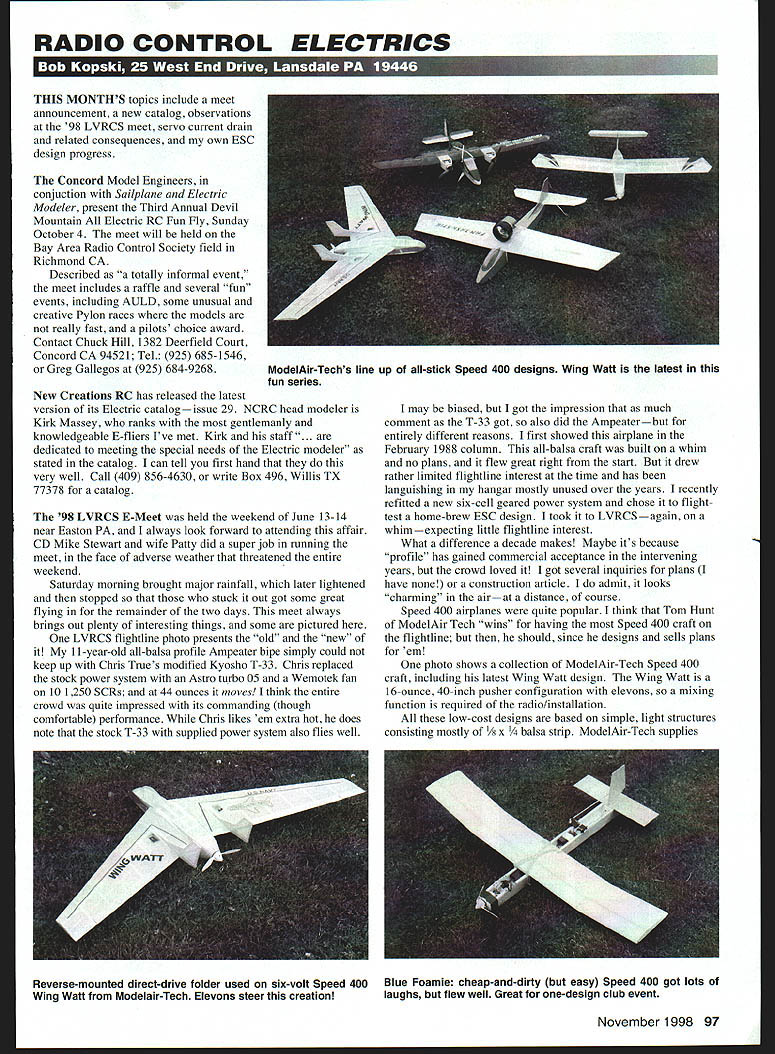
One photo shows a collection of ModelAir-Tech Speed 400 craft, including his latest Wing Watt design. The Wing Watt is a 16-ounce, 40-inch pusher configuration with elevons, so a mixing function is required on the radio/installation. All these low-cost designs are based on simple, light structures consisting mostly of 1/8 × 1/4 balsa strip. ModelAir-Tech supplies plans.
New Creations' Blue Foamie ($15 400-size kit) drew a lot of chuckles and some real appreciation. Pat Mattes, 9732 Lafayette Center Rd., Yoder, IN 46798-9723, brought one; Dereck Woodward flew it. I've just opted for the two-for-$29 e-wing ($9 inc. postage) deal. The 36-inch wing features a true Clark Y section; the airplane can be mostly assembled with tape. As the name suggests, the craft is made mostly of blue foam with some wood spar and aft surfaces.
BEC/ESC issues and servo current drain
As expected, the burgeoning interest in Speed 400-size airplanes has produced a corresponding increase in appropriately sized speed controls, receivers, servos, etc., and also some special problems peculiar to the pursuit. Because of the small sizes and low weights involved, BEC-equipped ESCs are commonplace in Speed 400 craft. These ESCs are built with surface-mount technology (SMT) and most are quite tiny. Being so small and using such components, these ESCs are not capable of much heat dissipation—as more and more modelers are finding out. And it's not running the motor that's the problem!
The BEC device—usually a low-drop three-terminal regulator IC—must dissipate heat associated with powering the airborne radio; the servos represent the largest load. (See the March '98 column for reference.) Depending on the system makeup, the associated heat can be considerable, and many regulator ICs have internal shutdown protection if they get too hot. And that, folks, shuts down the radio.
The main culprits are the servos—the number and the kind. FMA S80s and S90s are popular servos with the Speed 400 crowd, and what I'm hearing is that the same-size but more powerful S90 is often too much load for some tiny BEC-equipped ESCs. It seems that S80s, with their lower current drain, are preferred in this application. I decided to look into this matter in greater detail.
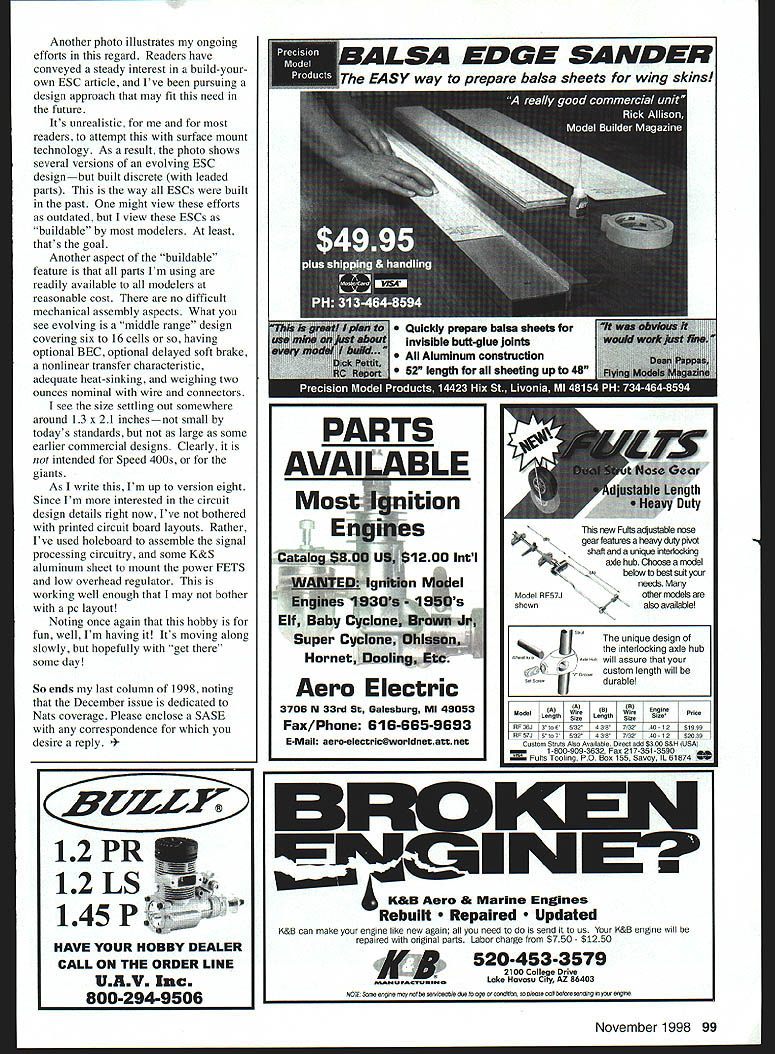
One photo shows a test setup that makes use of my Servo Cycler (September 1998 MA) and an additional homemade test accessory called an RC System Analyzer. The latter device measures average servo current, peak servo current, and minimum system voltage when servos are moved.
The Cycler does the moving; it provides the stepped or swept drive signal for the servo under test. Parameter readout is on a DVM as shown. The other "black box" seen in the photo is a convenience-packaged 4.8 volt Ni-Cd "bench battery" used as a receiver pack.
I chose to evaluate five relatively small servos that I had on hand, and the results are shown below. The "average" servo current is read while the Cycler is smoothly, slowly slewing the servo back and forth over its range. The short-duration "peak" current is captured when the Cycler is set to rapidly step the servo back and forth. This momentary peak occurs when the servo either starts moving or changes direction.
- Airtronics 94501 — Average current: 93 mA; Peak: 850 mA
- Hitec HS80 — Average current: 80 mA; Peak: 960 mA
- FMA S80 — Average current: 150 mA; Peak: 860 mA
- FMA S90 — Average current: 130 mA; Peak: 1,280 mA
- Futaba S133 — Average current: 160 mA; Peak: 710 mA
The photo was taken with an S90 in place, and the DVM reading is almost 1.3 amps peak—the highest of the bunch. At the same time, as seen above, the S90 is not much different from the others with regard to average current drain as tested.
For a flight with a lot of servos, stabs, tops, and reverses, the combined running average current and the frequent high current peaks add up to considerable total average current (and corresponding higher power dissipation) in the BEC IC, which can shut down to protect itself. And it's all the greater a problem the more servos you have, of course.
Let's not try to shrink BEC/ESC size down to the point of uselessness. Considering that the BEC function eliminates a receiver battery, surely there is some reasonable size and weight tradeoff that will still render a net gain in weight reduction with adequate performance and reliability in a reasonably small package. I do think it may be time to make some of today's tinier ESCs larger to better handle the dissipation; either that, or go back to using a receiver pack.
My ESC design progress
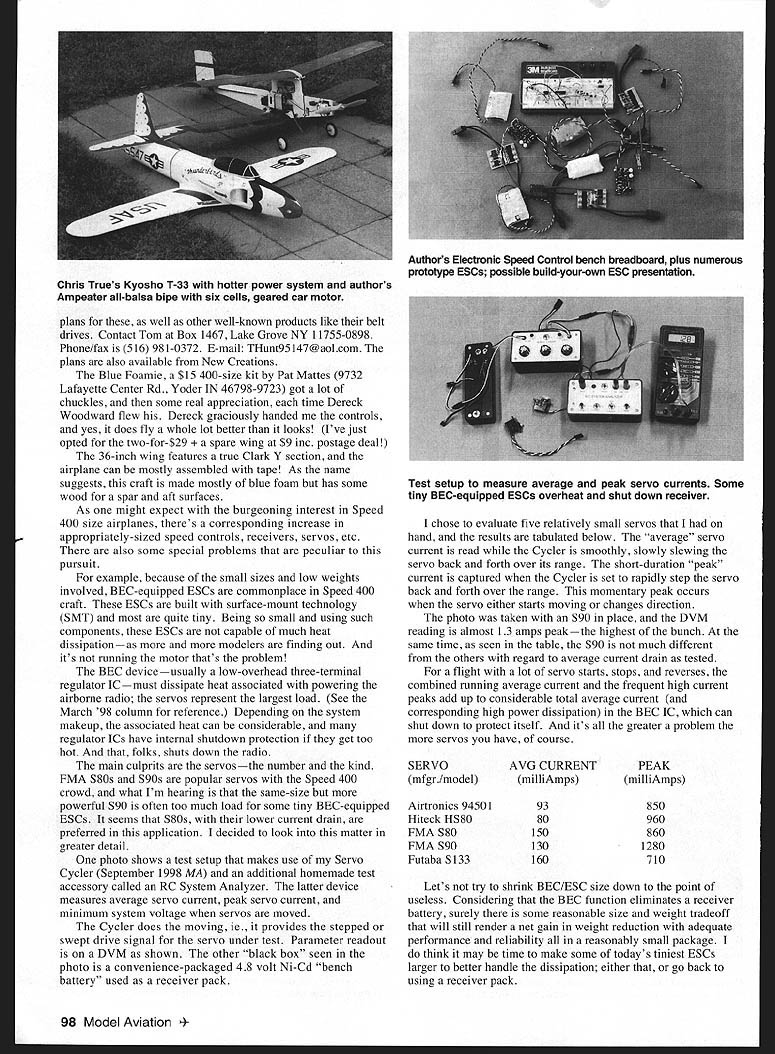
Another photo illustrates my ongoing efforts in this regard. Readers have conveyed a steady interest in a build-your-own ESC article, and I've been pursuing a design approach that may fit this need in the future.
It's unrealistic for me and for most readers to attempt this with surface-mount technology. As a result, the photo shows several versions of an evolving ESC design built with discrete (leaded) parts. This is the way all ESCs were built in the past. One might view these efforts as outdated, but I view these ESCs as "buildable" by most modelers. At least, that's the goal.
Another aspect of the "buildable" feature is that all parts I'm using are readily available to most modelers at reasonable cost. There are no difficult mechanical assembly aspects. What you see evolving is a "middle range" design covering six to 16 cells or so, having optional BEC, optional delayed soft brake, a nonlinear transfer characteristic, adequate heat-sinking, and weighing two ounces nominal with wire and connectors.
I see the size settling out somewhere around 1.3 × 2.1 inches—not small by today's standards, but not as large as some earlier commercial designs. Clearly, it is not intended for Speed 400s, or for the giants.
As I write this, I'm up to version eight. Since I'm more interested in the circuit design details right now, I've not bothered with printed circuit board layouts. Rather, I've used holeboard to assemble the signal processing circuitry, and some K&S aluminum sheet to mount the power FETs and low-drop regulator. This is working well enough that I may not bother with a PC layout.
Noting once again that this hobby is for fun—well, I'm having it! It's moving along slowly, but hopefully I'll "get there" someday.
So ends my last column of 1998, noting that the December issue is dedicated to Nats coverage. Please enclose a SASE with any correspondence for which you desire a reply.
Transcribed from original scans by AI. Minor OCR errors may remain.

