
Radio Control: Electrics
Bob Kopski, 25 West End Dr., Lansdale PA 19446
This month's column offers some special battery, charging, and discharging stories.
It seems that every couple of years I manage to run my auto battery down while charging my motor packs. This happened again a few weeks ago, but it was not exactly a surprise this time. My car had warned me a few times with some sluggish starting sounds, which I ignored.
This was the original battery in my '96 Plymouth Voyager minivan, and the fact that the battery lasted more than two years, given the way I use it, is something new. Previous OEM batteries failed after just a few months of deep-cycle use—the kind of use a battery is likely to have with lots of motor-pack charging. I do not know if the car maker has upgraded the battery specification or not. My experience is as follows.
I had a replacement Interstate-brand battery installed within a day. I always choose this brand because they are serviceable; I can actually check the fluid and adjust as needed. Many auto batteries, like my original, are sealed or maintenance-free. My previous experience with these is that they cannot tolerate deep-cycle applications.
Alternator behavior and en-route charging
Whether my OEM battery was better than previous ones or not, there are two things quite different about the charging system in this car compared with all others I've experienced. Perhaps they account for the improved battery service life; I know for sure that these behaviors account for motor-pack charging difficulties on the road.
In earlier columns I described routing wiring from the vehicle battery in front through the minivan to my "hangar area" in the back. This installation allows me to charge en route to the field, and this technique has been working well for nearly 20 years. But now there's a change.
I've used an ammeter on my car alternator output for nearly two decades. This allows me to see what's happening with this function any time the engine is running. Normally the alternator supplies substantial charge current to the car battery right after starting, as might be expected. After a few minutes of driving, this charge current drops to near zero, after having replenished the battery from the starting discharge. However, if I'm charging packs while the engine is running, the ammeter indicates alternator current going to the chargers.
It's normal for the ammeter to show rather high and sustained charge current during the trip home from a flying session, because the car battery is now comparatively well-discharged. In fact, since my trip to the field is only about five miles, the car battery is usually not recharged by the time I return home. I then hook up a standard auto battery charger for a while to bring the battery all the way up. I've learned to judge the time needed by the ammeter indication during the trip home. One to two hours usually does it.
Because I normally pay so much attention to the ammeter, I've also been noticing periodic short-duration high-magnitude discharge currents indicated on the meter. These strong needle swings are blink-of-the-eye quick — I'm guessing at magnitudes greater than 50 amps.
It appears that the auto charging/charging-control system hits the car battery with these periodic "burst" discharges whenever the car is running. This reminds me of the "burp" charge technique sometimes used in Ni-Cd chargers, but I don't know if it's the same thing.
I've also noticed that the car voltage varies quite a bit during normal driving — predominantly with speed. I can tell because I have a voltmeter installed right alongside the ammeter. All prior auto experience was that the car system voltage was "rock steady" by comparison to the half-volt-or-so motion I see during normal driving now.
Charger compatibility: what this means for motor-pack chargers
So what does all this mean? Some motor-pack chargers tolerate the above behavior and some do not. Those that do, continue on steadily charging my packs — alternator current spikes and system voltage motion notwithstanding.
For example, my Astro 110D Peak Charger simply shrugs off this behavior and continues delivering the chosen output current as though it were being powered by a solid supply—when it isn't. The 110D has great "line regulation," a term used to describe a supply that delivers constant output despite varying input.
On the other hand, my SR Smart Charger/Cycler cannot tolerate the described behavior. This charger is not regulated, and in fact the output current moves in accordance with the input voltage; if the input voltage drops, the output current drops. When this happens, the motor pack terminal voltage drops a little, causing the charger to "think" that the pack has peaked. This, in turn, causes the charger to shut down. There can be a whole lotta false peaking going on during just a short trip to the field!
Since en route charging is fundamentally important to me, I've given up on these chargers and am now using two 110Ds simultaneously; and I'll probably add a third. The SRs work fine when the engine's not running, or in the shop, but that's not what I need.
Note that this was never a problem with my previous vehicles. The SRs and my '96 Plymouth Voyager simply don't mix. I do not know if there are any other newer cars with similar electrical system behavior, but I'd guess other late-model Chrysler products might be candidates.
Sanyo 1,700 SCRC cells: false peaking after rest
Sanyo 1,700 SCRC cells are very popular in motor packs, being the same nominal size and weight as historic 1,200s and 1,400s. I have many in use, as do most modelers on my flightline.
However, a very disturbing characteristic has been manifesting itself with 1,700s after some use. In particular, packs of these cells display an increasing tendency to "false peak" the more they are used. (This has nothing to do with the story above.)
This misbehavior is typically seen in the first charge of the day following some period of no use—even as little as overnight. Typically an "older" pack may false-peak several times in the first few minutes of charge, and then act normally within that flying session.
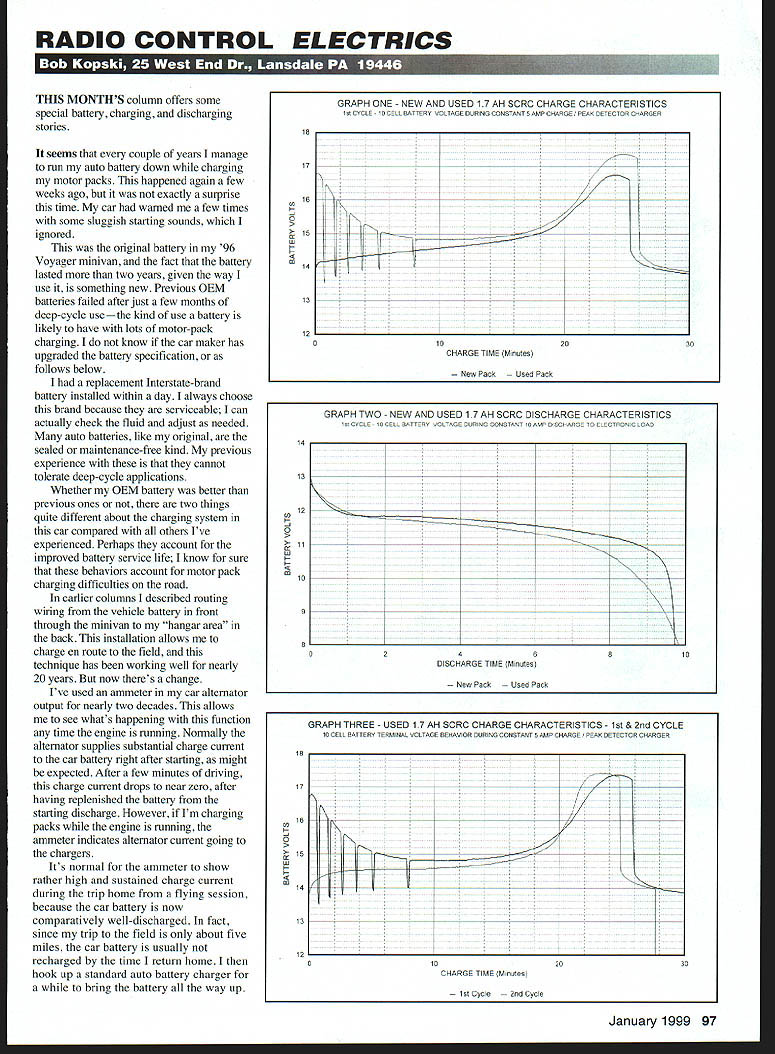
I decided to study this more carefully, and the accompanying graphs show what I've been able to quantify so far.
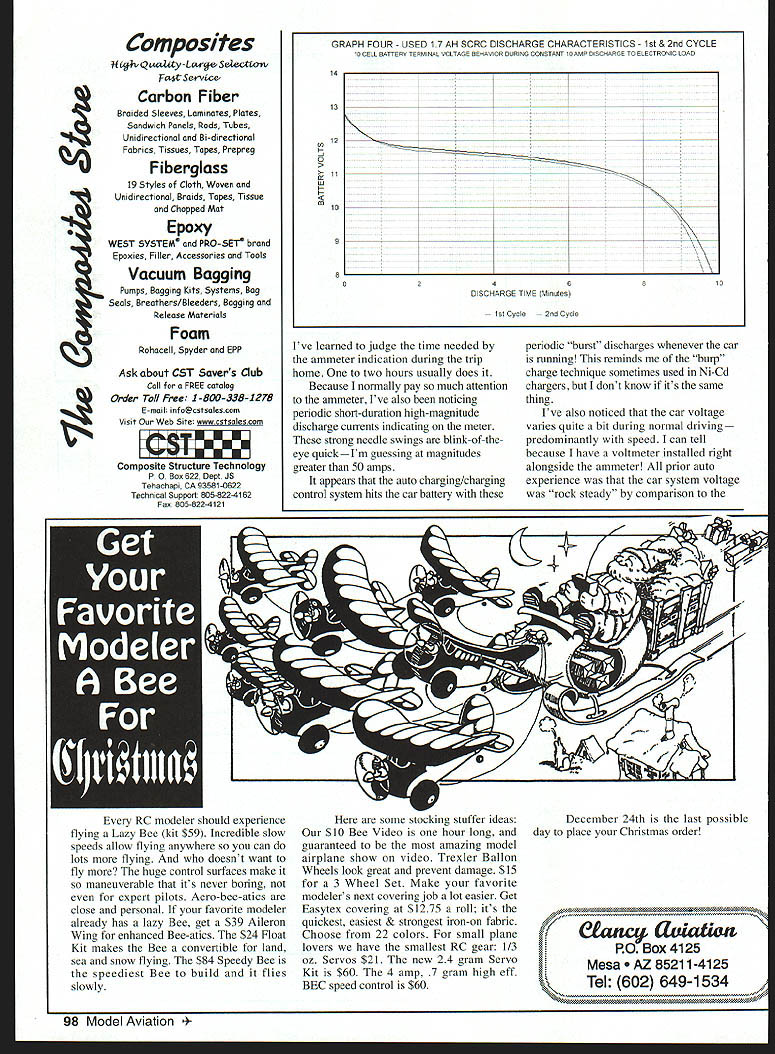
The graphs compare two 10-cell 1,700 SCRC packs under charge and discharge conditions on the bench. One pack has about 10 flights on it; the other, nearly 200. Neither pack had seen service for a few days, and they were "dead" prior to this testing. The battery terminal voltage data was automatically recorded with a computer-controlled data acquisition system. The numerical data (400 points for each individual curve) was then imported into a spreadsheet program for graphing.
Referring to Graph One, it's clear that the used pack is displaying strange behavior right at the start of charge. This pack initially displays rather high terminal voltage that begins to decline immediately. The sharp spikes are the result of the Astro 110D Peak Charger stopping charge when it sensed the declining terminal voltage — just like when a pack is truly peaked. This battery clearly displays this strange behavior for nearly six minutes of charge.
The charger shut down six times during this period. Each time I quickly reset it to "keep it going." Finally the battery terminal voltage settled into a normal-looking pattern with time.
Obvious in Graph One is that the new pack behaved "normally" throughout the charge period — no false peaks here. Both packs finally peaked in customary fashion at around 25–26 minutes, and the charger shut down as it should.
Graph Two compares the discharge curves for both packs following these "first charges." Clearly, the new pack looks "new" — it holds a higher terminal voltage longer. By comparison, the well-used pack looks "limp" beginning around seven minutes. In flight, the used pack will yield diminishing flight performance faster than the new pack, but it's still quite useful for sport flying.
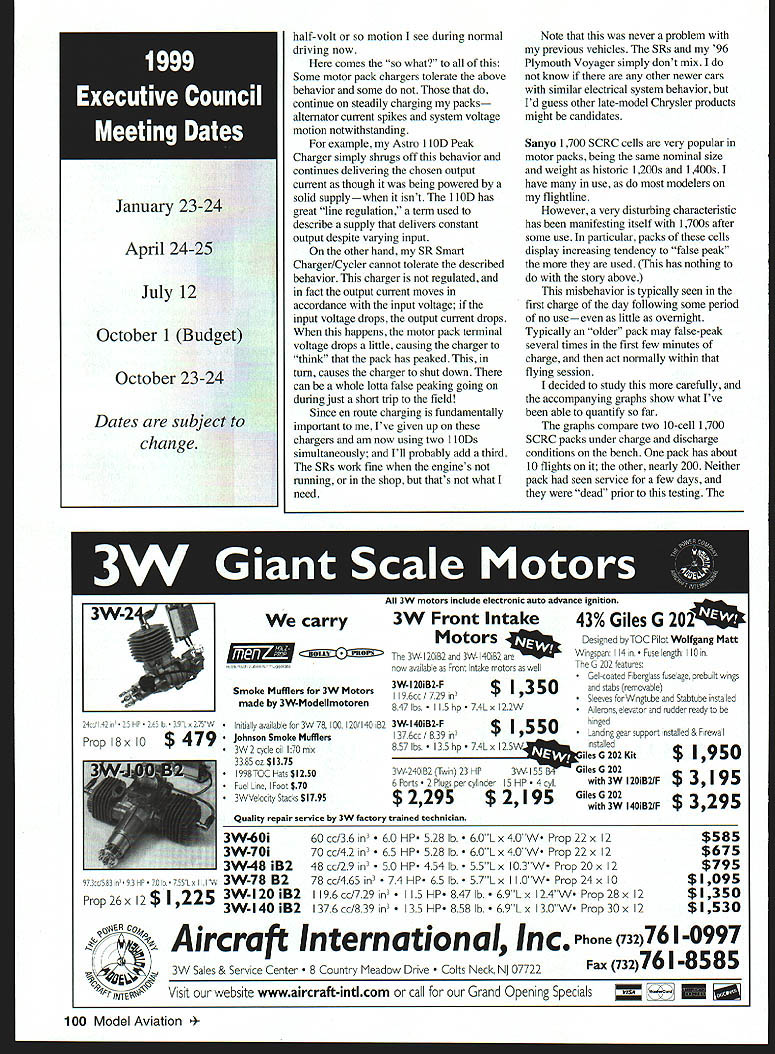
Graph Three combines the first and second charge-of-the-day data for the used pack. The "spikey" curve is simply a repeat from Graph One. The smooth curve is for the same pack on its second charge of the test session. While these curves may look like they are for different packs, they aren't! What a difference one "bench flight" makes!
Clearly, sitting on the shelf for a day or more creates a wild monster, and one flight tames it. I think the suggestion here is to never stop flying!
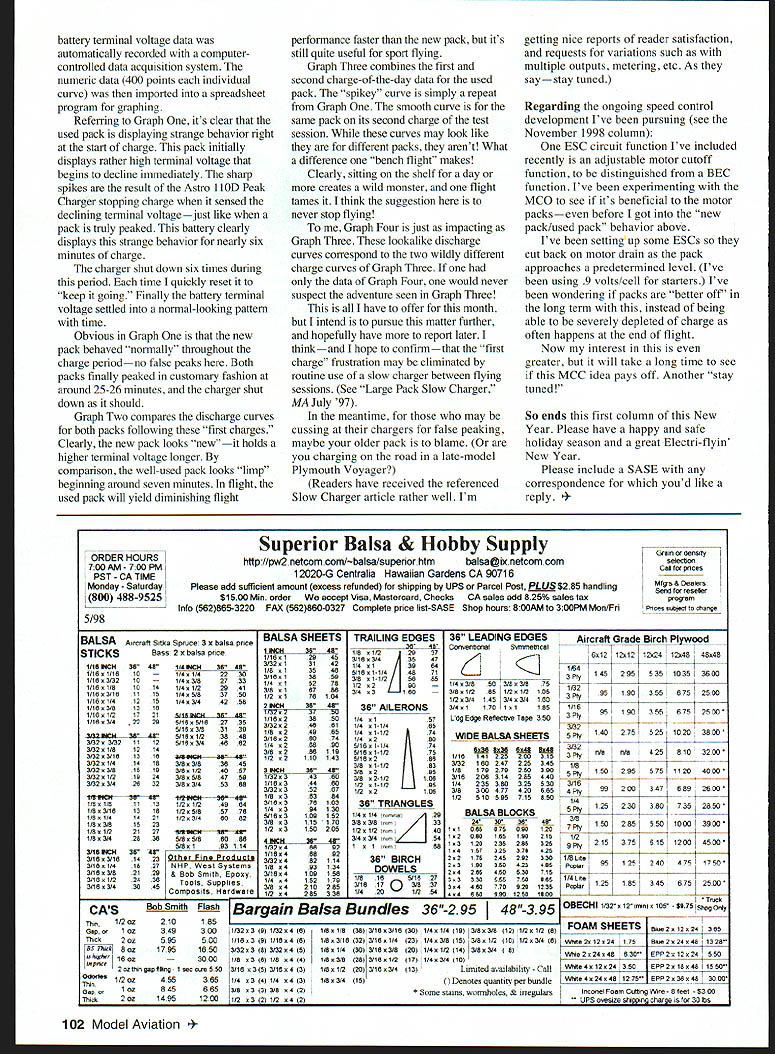
To me, Graph Four is just as impacting as Graph Three. These lookalike discharge curves correspond to the two wildly different charge curves of Graph Three. If one had only the data of Graph Four, one would never suspect the adventure seen in Graph Three!
This is all I have to offer for this month, but I intend to pursue this matter further, and hopefully have more to report later. I think — and I hope to confirm — that the "first charge" frustration may be eliminated by routine use of a slow charger between flying sessions. (See "Large Pack Slow Charger," MA July '97).
In the meantime, for those who may be cussing at their chargers for false peaking, maybe your older pack is to blame. (Or are you charging on the road in a late-model Plymouth Voyager?)
(Readers have received the referenced Slow Charger article rather well. I'm getting nice reports of reader satisfaction, and requests for variations such as with multiple outputs, metering, etc. As they say — stay tuned.)
Motor cutoff (MCO) experiments and ongoing development
Regarding the ongoing speed-control development I've been pursuing (see the November 1998 column):
One ESC circuit function I've included recently is an adjustable motor cutoff (MCO) function, to be distinguished from a BEC function. I've been experimenting with the MCO to see if it's beneficial to the motor packs — even before I got into the "new pack/used pack" behavior above.
I've been sorting a few more ESCs so they cut back on motor drain as the pack approaches a predetermined level. (I've been using 0.9 volts per cell for starters.) I've been wondering if packs are "better off" in the long term with this, instead of being allowed to be severely depleted of charge as often happens at the end of flight.
Now my interest in this is even greater, but it will take a long time to see if this MCO idea pays off. Another "stay tuned!"
So ends this first column of this New Year. Please have a happy and safe holiday season and a great Electri-flyin' New Year.
Please include a SASE with any correspondence for which you'd like a reply.
Transcribed from original scans by AI. Minor OCR errors may remain.

