
Radio Control: Electrics
Bob Kopski 25 West End Dr., Lansdale, PA 19446
Late News
The Silent Electric Flyers of San Diego announces the Second Annual "Mid‑Winter Electrics," February 12–14. Contact Charlie White, 4420 Ladera St., San Diego, CA 92107; Tel.: (619) 223‑8903; E‑mail: charliew@adnc.com for more information.
Reader mail
Each issue of Model Aviation is followed by a flurry of reader letters that lasts about two weeks. Mail brings reader reaction to recent columns and sometimes to long‑past material. Letters typically:
- Ask questions.
- Offer suggestions.
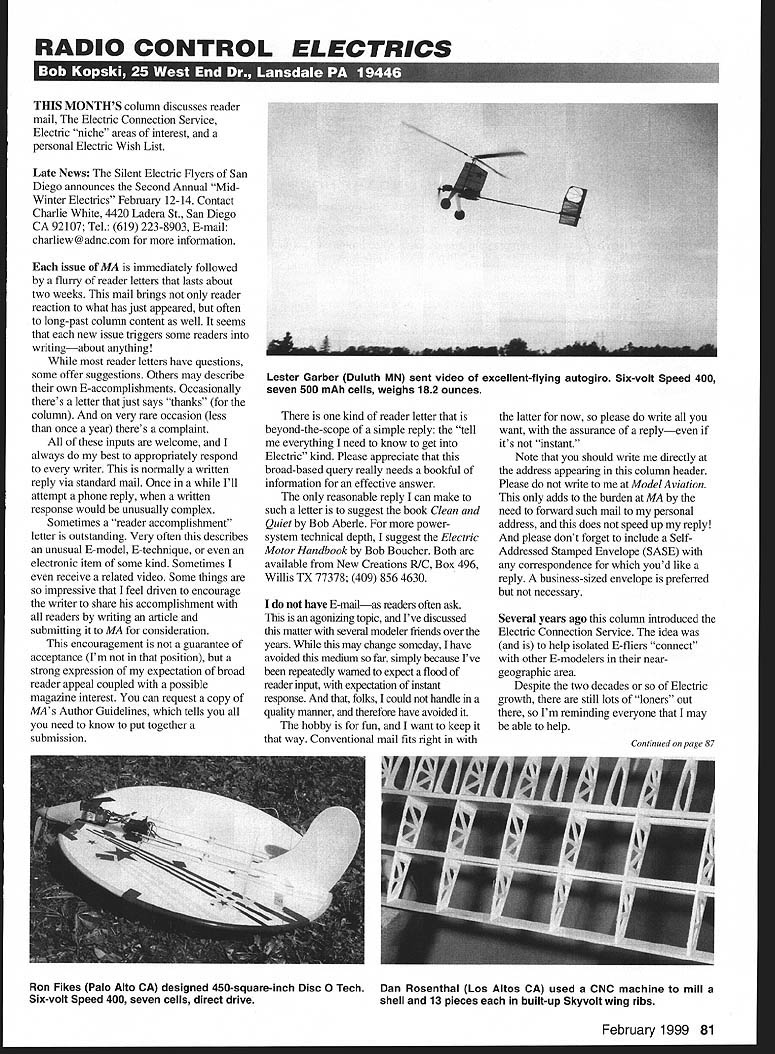
- Describe personal electric accomplishments (sometimes with video).
- Occasionally simply say “thanks.”
- Rarely (less than once a year) offer a complaint.
I respond to every writer, normally with a written reply via standard mail. On rare occasions I’ll use the phone if a written response would be unusually complex.
If a reader submission describes an unusual model, technique, or electronic item that seems broadly interesting, I often encourage the writer to submit an article to Model Aviation. That encouragement is not a guarantee of acceptance; it’s simply an expression that the material might appeal to a wider audience. Model Aviation’s Author Guidelines describe how to prepare a submission.
Please note:
- I do not use E‑mail for reader correspondence. I avoid instant electronic response because it creates an expectation of immediate replies and would flood my ability to give quality answers.
- Conventional mail works best for me. Write directly to the address in this column header (not to Model Aviation), and include a Self‑Addressed Stamped Envelope (SASE) if you’d like a reply. A business‑size envelope is preferred.
Electric Connection Service
Several years ago this column introduced the Electric Connection Service to help isolated electric fliers connect with other electric modelers in their area. Despite decades of electric growth there are still many “loners.” If you’d like to be listed, I will publish your name and address (and phone, if you wish) in a future column indicating you’re looking to meet other local electric fliers. Expect a delay of several months between your request and publication—if you have the interest, time, and patience, the service is yours for the asking.
What to include when you write:
- Your name and mailing address.
- Phone number (optional).
- A SASE if you want a reply.
Resources
For power‑system technical depth I recommend:
- Clean & Quiet by Bob Aberle.
- Electric Motor Handbook by Bob Boucher.
Both are available from New Creations R/C, Box 496, Willis, TX 77378. Tel.: 409‑856‑4630.
Electric niches and diversity
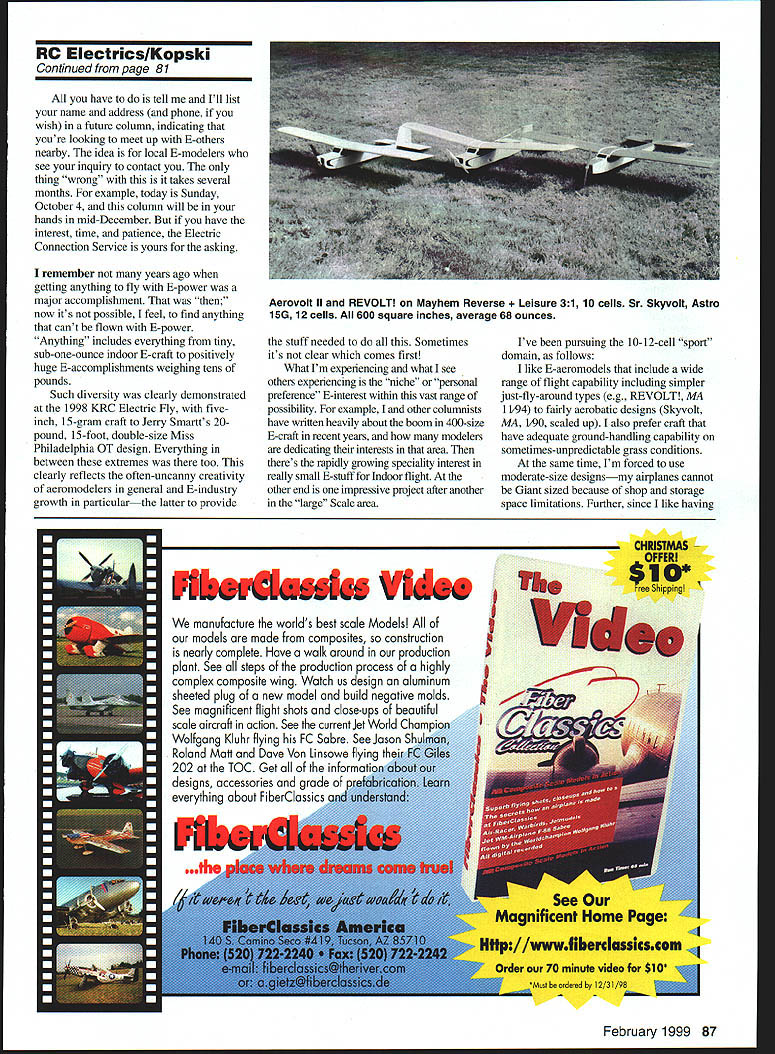
Electric flight now covers everything from tiny sub‑one‑ounce indoor craft to large, multi‑pound scale ships. For example, the 1998 KRC Electric Fly featured five‑inch, 15‑gram craft alongside Jerry Smartt’s 20‑pound, 15‑foot double‑size Miss Philadelphia OT design. This range reflects both modeler creativity and industry growth.
Modelers tend to specialize or develop “niche” interests within this diversity. Popular niches include:
- .400‑size electrics (recent boom).
- Very small indoor electrics.
- Large scale electrics.
My niche: 10–12‑cell sport domain
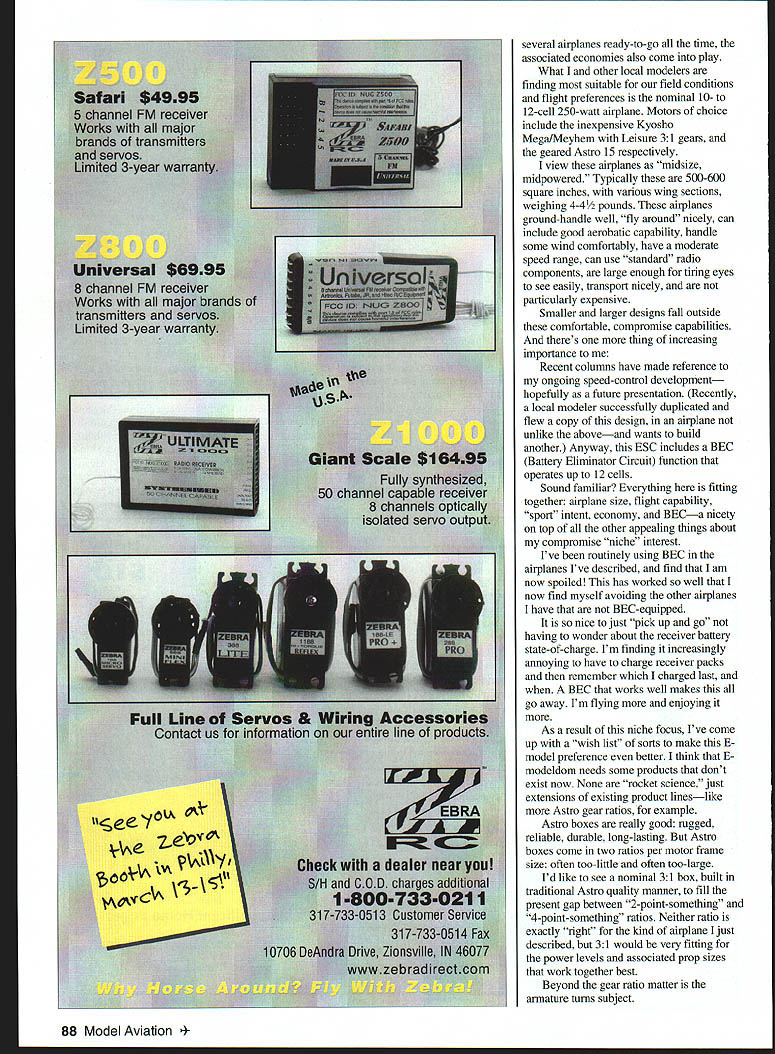
My preference is a compromise “sport” niche: 10–12 cell, roughly 250‑watt airplanes. Constraints and goals that shape this choice:
- Shop and storage space limit me from building giant airplanes.
- I like having several airplanes ready to fly; economy matters.
- Field conditions (sometimes unpredictable grass) require reasonable ground handling.
Typical characteristics of the airplanes I prefer:
- Midsize, midpowered: about 500–600 in² wing area.
- Weight around 4½ pounds.
- Adequate ground handling on grass.
- Wide flight capability: stable “fly‑around” behavior to fair aerobatic ability.
- Moderate speed range and wind handling.
- Use of standard radio components.
- Easy to see in the air and transport.
- Reasonable cost.
Motors and gearboxes I use or recommend for this niche:
- Kyosho Mega / Meyhem motors with Leisure 3:1 gears (inexpensive).
- Geared Astro 15.
Speed control / BEC
I’ve been developing a speed control (ESC) that includes a BEC (Battery Eliminator Circuit) function operable up to 12 cells. A local modeler has successfully duplicated and flown a copy and plans another build.
I routinely use BEC on the airplanes described and find the convenience transformative: no separate receiver packs to charge or track, and truly “pick up and go” operation. I now avoid flying airplanes that are not BEC‑equipped.
Wish list (products I’d like to see)
I believe the hobby needs some modest product extensions—nothing rocket‑science, just additional options:
- Astro gearboxes in a nominal 3:1 ratio built to Astro’s traditional quality. Current Astro gearboxes typically come in two ratios per motor frame size that are often either slightly too low or too high; a 3:1 would better match the props and power levels for the airplanes I prefer.
- Beyond gear ratios, better options or guidance regarding armature‑turns would also be useful.
(End of column.)
Transcribed from original scans by AI. Minor OCR errors may remain.

