
RADIO CONTROL ELECTRICS
Bob Kopski 25 West End Dr., Lansdale, PA 19446
New E-products from KRC '98
A recent show revealed several interesting new electric products.
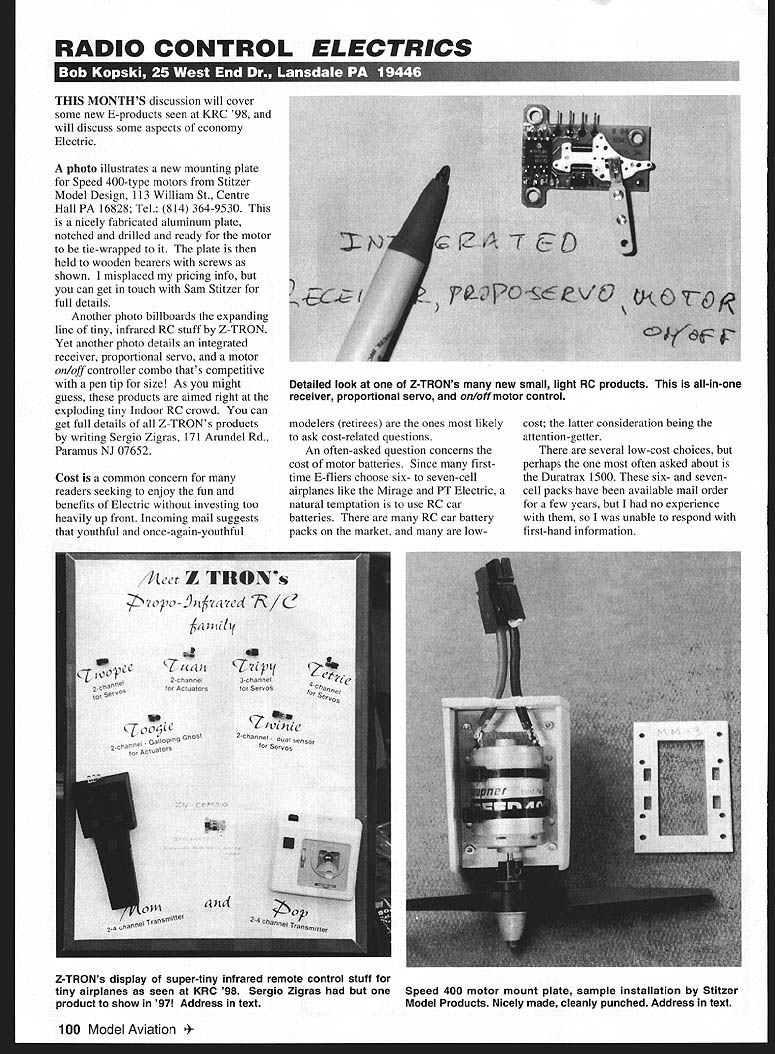
- Stitzer Model Design has a new mounting plate for Speed 400–type motors. It is a nicely fabricated aluminum plate, notched and drilled and ready for the motor to be tie-wrapped to it. The plate is held to wooden bearers with screws as shown. Contact: Stitzer Model Design, 113 William St., Centre Hall, PA 16828; Tel.: (814) 364-9530.
- Z-TRON is expanding its line of tiny infrared RC gear aimed at the indoor RC crowd. They showed an integrated receiver, proportional servo, and motor on/off controller combo the size of a pen tip. For details contact Sergio Zigras, 171 Arundel Rd., Paramus, NJ 07652.
Cost and economy Electric
Cost is a common concern, especially among younger hobbyists and retirees returning to the hobby. One frequently asked question concerns the cost and suitability of motor batteries. Many first-time E-fliers choose six- to seven-cell airplanes (like the Mirage and PT Electric) and are tempted to use low-cost RC car battery packs.
A commonly asked-about economy pack is the Duratrax 1500 (six- and seven-cell packs). I had not used them previously, so I purchased two six-cell packs to evaluate.
Duratrax 1500 battery test
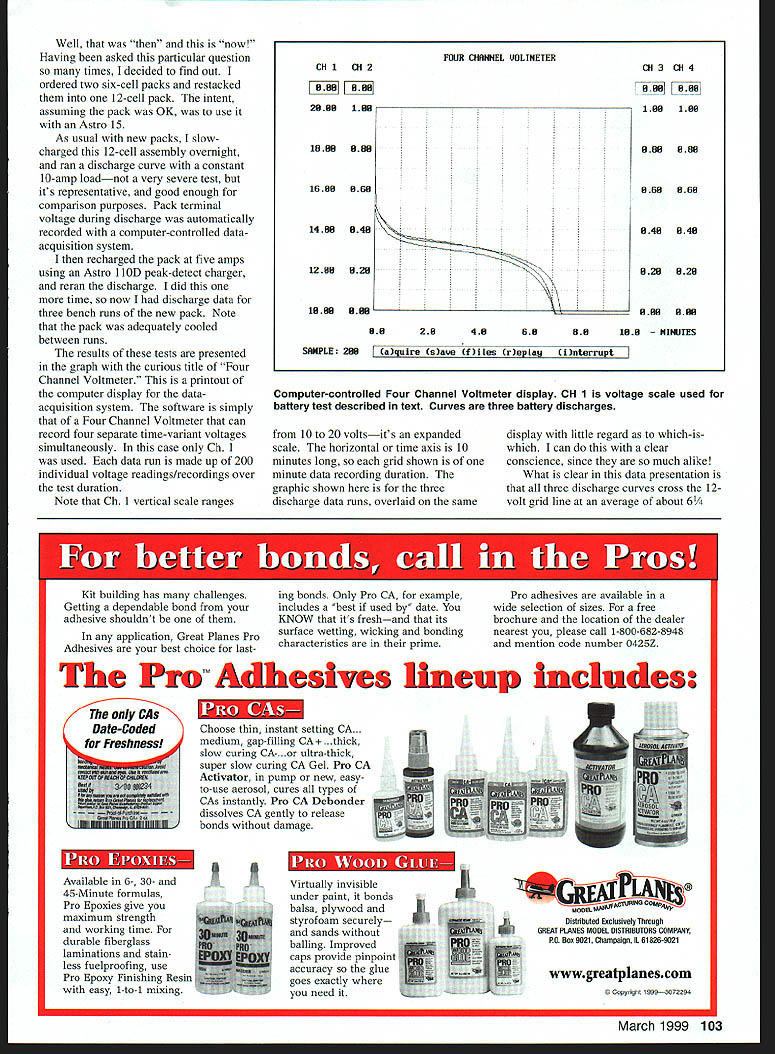
I restacked the two six-cell packs into a single 12-cell assembly intending to use it with an Astro 15. The new pack was slow-charged overnight. I ran discharge tests at a constant 10-amp load — not very severe, but representative and suitable for comparison.
- Pack terminal voltage during discharge was recorded by a computer-controlled data-acquisition system.
- After each discharge I recharged the pack at five amps using an Astro 11i peak-detect charger, then repeated the discharge. I completed three discharge runs, allowing the pack to cool between runs.
- The data-acquisition software (a four-channel voltmeter) recorded 200 individual voltage readings over each test run. The three discharge curves were very similar and crossed the 12-volt level at an average of about six minutes.
Applying a cutoff criterion of "one volt per cell," these runs show the pack under test has a capacity of slightly more than 1,000 mAh — well below the labeled 1,500 mAh. This was at a relatively light 10-amp load (about half the typical value for the airplanes/power systems mentioned). I also checked individual cell voltages during discharge; all cells behaved uniformly, so this is not attributable to a bad cell.
Interpretation and recommendation on the packs
Would an airplane powered by this pack fly? Yes — but it would not fly long compared with higher-performance batteries. These economy cells, at about 1,000 mAh, weigh about the same as 1.7 Ah or 2.0 Ah cells and occupy similar space. If you truly want only 1,000 mAh capacity, you can get smaller, lighter "real" 1,000 mAh cells.
In short: the cost savings here are offset by excessive size and weight.
Caveats:
- This test was based on a small sample (two six-cell packs); it might not represent the entire product line.
- I reported the results to the supplier but received no response.
- I’m not planning further follow-up on low-cost packs; I prefer to buy known, reliable products.
Battery favorites on my flightline remain B&T and SR cells and packs.
Economy motors versus high-quality motors
A reader reported similar flight performance using a Goldfire "can" motor and an Astro 05 cobalt motor on the same six-cell battery and prop. At the low power levels he used, the two motors performed comparably.
However, at higher power levels the performances diverge. The Astro, with a superior brush/commutator interface, ball bearings, larger-diameter shaft, cobalt magnets, and serviceable brushes, will outperform and outlast economy "can" motors — especially under sustained higher-power use.
That said, economy "can" motors are reasonable when flight demands and performance expectations are modest. Many fliers, including myself, use economy motors for many applications, but higher-quality motors are preferable for higher performance and longevity.
Car motors
Car motors generate reader interest for economy builds, but be cautious:
- Direct-drive application: generally not suitable. Car motors are typically wound for high RPM, which forces use of small props to keep current reasonable. Small props usually cannot produce needed thrust or efficiency. Car motors also often lack a good brush/commutator interface and use non-serviceable bearings, so they wear out quickly.
- Geared car motors: can be viable. Their high-RPM characteristics make them useful in geared installations. Operating over six to ten cells while holding current in the ~20-amp area can yield good flight performance at reasonable cost, provided you match motor, gear drive, prop, and battery.
Examples of proven combinations:
- Magnetic Mayhem Reverse (~$19) with a 3:1 drive turning an 11x7 prop on 10 cells.
- Same motor with a 3.8:1 drive to turn a 13x7 prop on 10 cells.
These setups are suitable for airplanes up to about 3½–4 pounds. Remember these are economy motors and will wear out sooner than high-quality products.
Chargers
When cutting costs, do not skimp on chargers. Economy six- to seven-cell chargers are often a poor long-term investment and may end up as trash. If you must economize, consider starting with an economy motor but invest in a good charger from the outset.
Recommendation:
- Astro 110D peak-detect charger — reasonably priced, charges up to 18 cells, and provides reliable peak-detecting operation. I use two of these routinely.
Coupling a quality charger with a reliable battery pack is the best and most economical approach over time for E-aeromodeling.
Closing
That’s another column. Come on, E–Springfield? Please enclose a SASE with any correspondence for which you'd like a reply.
Transcribed from original scans by AI. Minor OCR errors may remain.

