
RADIO CONTROL ELECTRICS
Bob Kopski 25 West End Dr., Lansdale PA 19446
Web resources
- ezonemag.com — A popular online magazine dedicated to electric aeromodeling. Ed Bourke produces a free monthly "issue" with E-related articles, archives of past issues, links to other electric-modeling resources, and occasional advertising or product specials.
- Pat's Custom Models — www.thuntek.net/pcmodels. Pat Tritle offers plans, custom building services, and items covering a wide range of aeromodeling interests (Free Flight, rubber, Giant Scale, etc.). One photo shows two available WWII designs equipped with Magnetic Mayhem power systems on 10 cells.
- Mail: Pat's Custom Models, 10313 Snowheights Blvd NE, Albuquerque NM 87112-3054
- Tel: (505) 296-4511
- Email: pcmodels@thuntek.net
- To obtain catalog info, send SASE to the above address.
Small-model products
Two recent products focused on small-end modeling:
- Texas Tips video (Robins View Productions)
- Producer: Bob Hunt (contest fliers will recognize him)
- Shows Randy Randolph’s shop and small-model building techniques
- Price: $13.95; Priority Mail: $3
- Mail: Robins View Productions, Box 68, Stockertown PA 18083
- Tel: (610) 746-0106
- Don Ross — Flying Models: Rubber, CO2, Electric & Micro Radio Control
- Author: Don Ross, 38 Churchill Rd, Cresskill NJ 07626
- Tel: (201) 568-5272
- 15 chapters, 240 pages, strong coverage for small models
- Price: $19.95 plus shipping
- (Don also has a book entitled Rubber Powered Model Airplanes worth picking up.)
Small servos and BEC concerns
Small airplanes and Speed 400–class equipment remain popular. A trend toward physically smaller speed controls raises concerns about heat dissipation, especially for the BEC portion of ESCs. As unit size decreases, operating temperature tends to increase. Many BEC regulator ICs include automatic thermal shutdown; if the BEC overheats and the regulator shuts down, you can lose radio control.
Key points affecting BEC heat dissipation:
- Servo load current is the dominant source of BEC power dissipation.
- Number of servos, mechanical load (including linkage quality), and the fraction of time servos are moving during flight all affect heat.
- A referenced table (November 1998 column) listed peak and average servo currents measured with a home-built RC System Analyzer; results were displayed on a DVM.
Two popular small servos are the FMA S80 and S90:
- Physically identical and share mounting requirements.
- S90 has higher speed and torque but draws more current.
- Higher current demand makes S90s harder on small BEC-equipped ESCs.
Servo testing with the PCS64i
New test equipment: Velleman PCS64i PC oscilloscope.
Test setup:
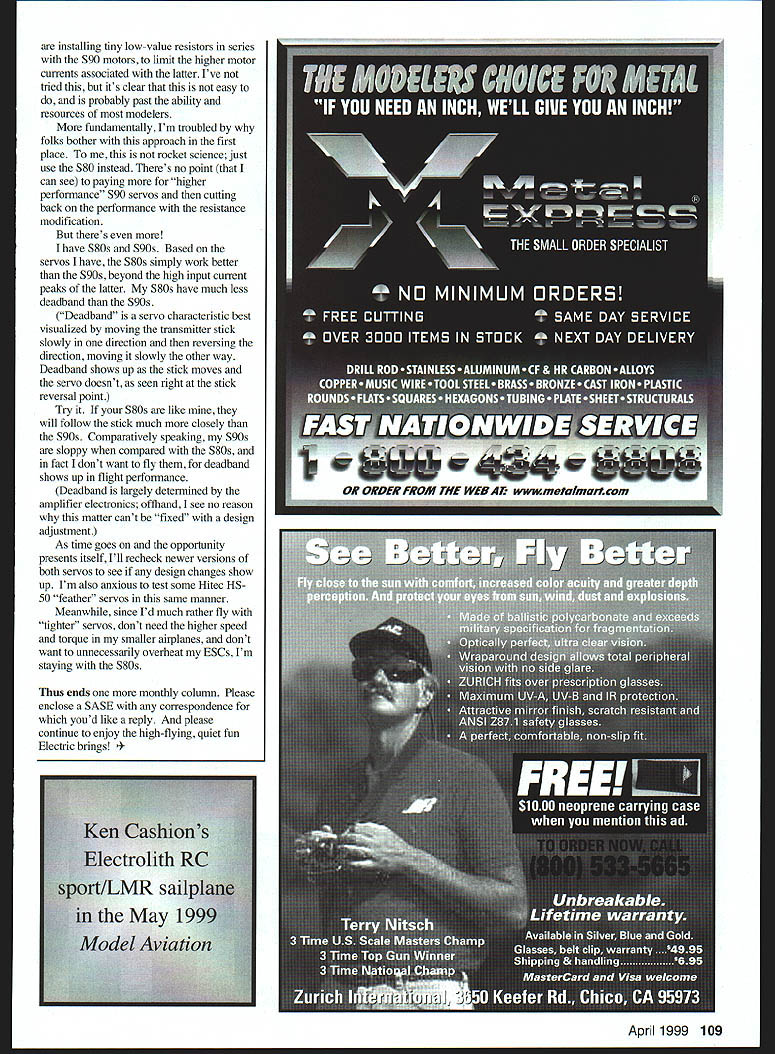
- Servo Cycler configured for "bang-bang" operation (~2 seconds per cycle), sweep width ~±45°.
- PCS64i observed servo input current via a precision 0.1 ohm sampling resistor in the negative battery lead.
- Power: 4.8 V Ni-Cd battery for cycler and servos.
- Data: PCS64i captured current waveforms for one back-and-forth cycle; numeric data saved and imported to a spreadsheet for graphic presentation.
The captured current waveforms represent rapid transmitter stick movement limit-to-limit and holding each limit about one second. Each current burst begins with the stick command and lasts a short time compared with the one-second rest at each limit.
S80 vs S90 test results
S80:
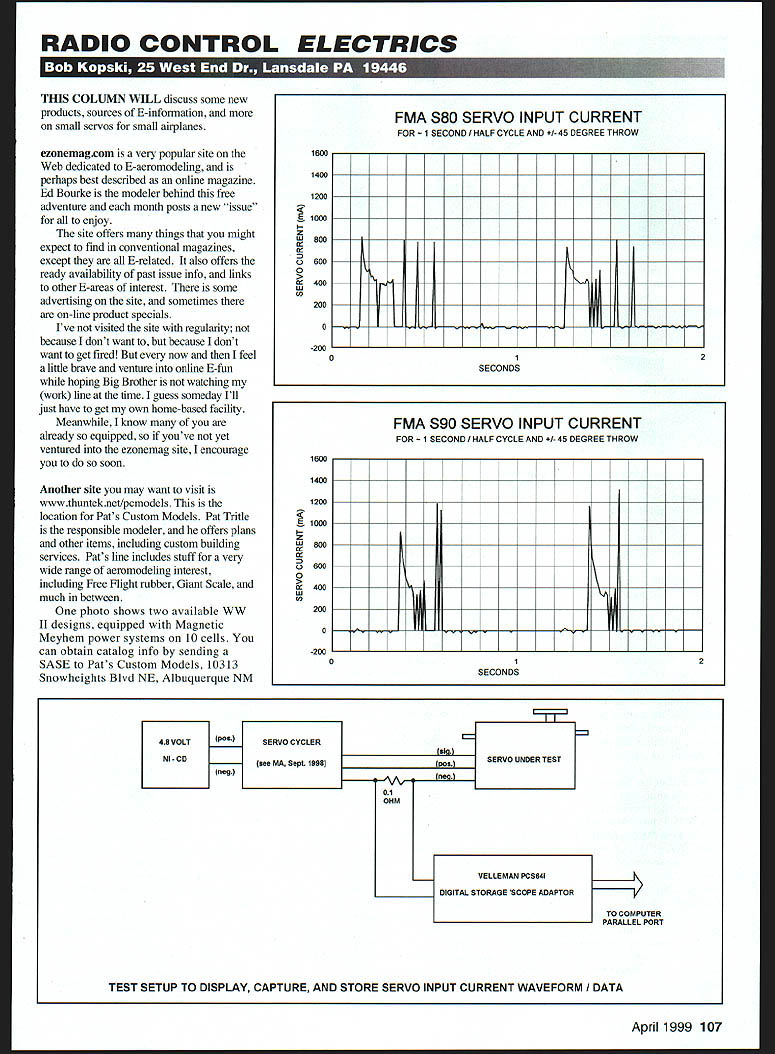
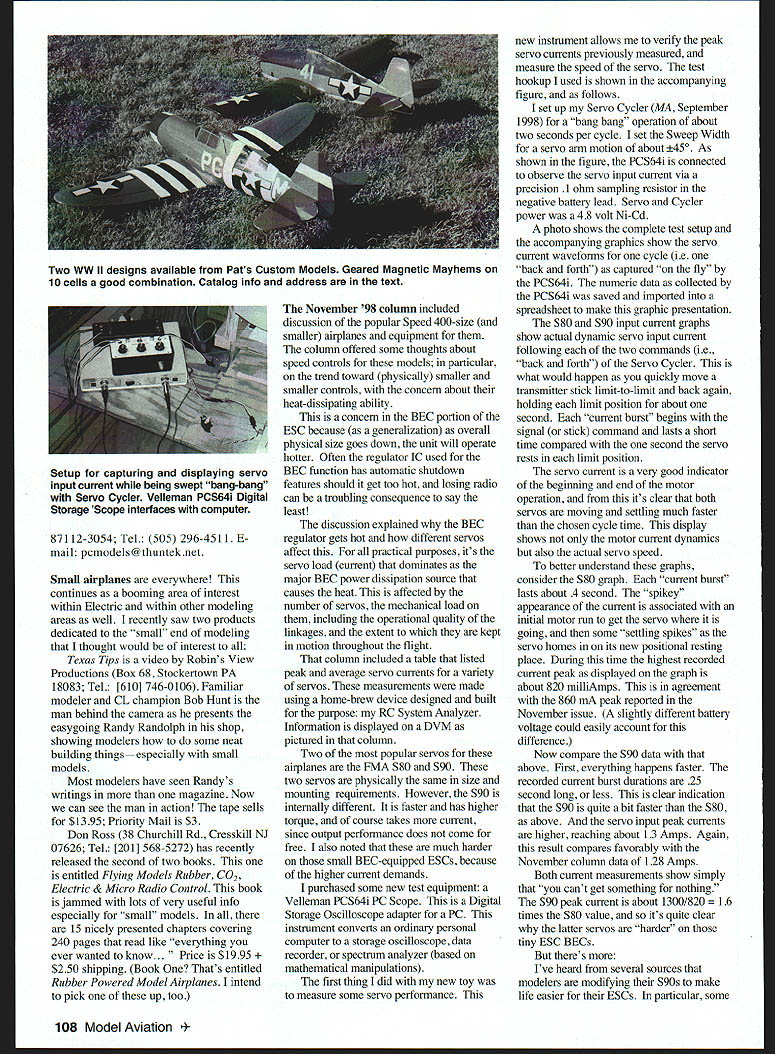
- Each current burst ≈ 0.4 second.
- Initial spike for motor start, then settling spikes as the servo homes in.
- Highest recorded peak ≈ 820 mA (consistent with ~860 mA measured previously; small battery voltage differences can account for variance).
S90:
- Current burst durations ≈ 0.25 second or less (clearly faster than the S80).
- Peak input currents ≈ 1.3 A (consistent with ~1.28 A from earlier tests).
Comparison:
- S90 peak current ≈ 1.6 times the S80 peak (1300 mA / 820 mA).
- Higher current means greater stress on small ESC BECs.
Modifications and practical advice:
- Some modelers install small series resistors in S90 motor leads to limit peak current. This is difficult to do and likely beyond many modelers’ resources.
- Simpler and more sensible: use the S80 if the extra speed/torque of the S90 isn’t required. There’s little point paying more for higher performance and then reducing it with a resistor.
- In my experience, S80s also have much less deadband than S90s. Deadband is observed when slowly reversing the transmitter stick and noting a region where the servo does not respond immediately at the reversal point.
- My S80s follow the stick more closely; my S90s are comparatively sloppy. Deadband affects in-flight performance.
- Deadband is largely determined by amplifier electronics and could be addressed in design changes.
Planned testing: recheck newer versions of both servos for design changes and test Hitec HS-50 “feather” servos in the same manner.
Conclusion
I prefer to fly with tighter servos that do not overheat ESCs. For my smaller airplanes I do not need the extra speed and torque of the S90, and I’m staying with the S80s.
Please enclose a SASE with any correspondence for which you'd like a reply. Enjoy the high-flying, quiet fun electric power brings!
Transcribed from original scans by AI. Minor OCR errors may remain.

