
RADIO CONTROL ELECTRICS
Bob Kopski, 25 West End Dr., Lansdale PA 19446
QUICKIE MEET ANNOUNCEMENTS
- The Old Time Eagles MAC hosts, and FM magazine sponsors, the Third Eagles All Electric Fly-In, May 15 (rain date May 16) in Hope, NJ. All FF and RC electrics welcome. CD: Joe Beshar, 198 Merritt Dr., Oradell, NJ 07649; Tel.: (201) 261-1281. I heard last year’s meet was terrific!
- The E-Power Spring Sizzle is scheduled for May 30 from 10 a.m. to dark. Location: 600 Gude Drive East, Rockville, MD. For info contact Dereck Woodward, 11159 Captains Walk Court, N. Potomac, MD 20878; Tel.: (301) 309-0140. Email: weekendpilot@juno.com.
INTRODUCTION
This column and the next few are especially for RC modelers with some wet-power flight experience who are considering, or just beginning, E-power aeromodeling. These columns will look briefly at some E-history, discuss some basic electric operating principles, include some perspective on contemporary electric, and offer some insight and some “how to” suggestions for your initial electric success and continuing enjoyment.
Forget what the nay-sayers have said, open your mind, and read on.
A SHORT HISTORY OF ELECTRIC AEROMODELING
Electric aeromodeling in the U.S. is somewhere around a quarter century old. One measure of this begins with the appearance of the earliest E-power products in the early ’70s. Of course, there were modelers pursuing electric prior to this time, but that’s when a few products became available, so that modelers at large could more easily participate—even if with considerable difficulty.
The earliest products were minimal performers to say the least, and modelers who wanted to fly electric had to be especially dedicated and inventive to be successful. There was relatively little information available, and the sparse interest made it nearly impossible to get assistance from another. If one was actually flying electric successfully, it’s because that person really wanted to fly electric! It is fair to say that electric had a very slow and difficult start for these reasons. On the other hand, so did some other aeromodeling specialties—like in the earliest days of RC.
I was one of the relatively few hobbyists in the early ’70s who “really wanted to fly electric.” Once I caught on to its existence, I quickly developed a burning interest. I had been flying glow-power RC since 1955, but this new challenge really turned me on.
Early products notwithstanding, doing it myself, from scratch, was my desire—and a fun-filled challenge. Fun, after all, is what the hobby is for. I remember rewinding toy motors, making gear drives, and playing with wimpy Ni-Cds of the day—all with much enthusiasm! I was trying to learn firsthand how much power it took to make something fly, and how to build such a power system. The whole process was slow-going, but it was great fun for me!
I was not alone in this root interest; there were several like-minded modelers around the country. This basic driving interest still exists within the growing E-community, but now it includes many E-modelers and suppliers pushing the powerful state of the art in many fast-moving, high-flying, exciting directions—rather than just a few individuals struggling to get off the ground.
AN EARLY EMPIRICISM
As time went along, I did enjoy small successes one after another. I actually experienced the transitions from “powered sink” to level flight to climbing flight—all with home-made E-stuff. What a thrill! I used those early struggles and simple successes to describe the power needed to fly a model with simple arithmetic.
Basically, I constructed a simple empiricism. This relationship was developed while flying several simple E-models with a variety of power systems over the course of a year or two.
Power = wt x Wing Loading
Where:
- Power = watts input to motor
- Weight = finished model pounds
- Wing Loading = oz/sq ft planform
This equation has held up very well. I acknowledge units may not make perfect sense, but the arithmetic does work and it became the basis for E-designs for years. In effect, I knew the needed power level to attain climbing flight. Once I got past that point in my E-model career, everything designed thereafter flew very satisfactorily (published equation was in R/C Electric series Part 8, April 1984).
Please don’t get uptight about arithmetic or techno-terms like watts. The technical complexity of the thrust presentation here is intended to provide easy insight and understanding. I feel the technical terms invoked will easily become second nature as part of routine flightline language.
THE EVOLUTION OF ELECTRIC KNOWLEDGE
As time went on, more and more E-stuff was published, more and better E-products appeared, and more modelers gradually became interested in E-power. Some began to use the equation or variations with success; and as part of this, the word “power” became very useful and important. “Power” remains in the E-aeromodeler’s vocabulary today, even though my early equation is now of little use.
In some ways, “power” (watts) is now used much like “displacement” is with wet engines. And that early equation has given way to contemporary ways of describing power—the kind and the kind of flying expected of it.
There is also a new “electric model” in the form of sophisticated commercial software programs. This software is a very exciting and fun extension within electric, but it is really a nicety and not a necessity. So no, you don’t need a computer to fly electric! Far more important to early E-success and continuing enjoyment of electric is just some good information, coupled with a little insight and understanding.
There is plenty of knowledge within modeldom regarding wet engine displacement or “size” and models and their flight characteristics. There are several reasons for this wealth of knowledge, primarily because of its long history and present widespread use; “everybody’s doing it!”
So “cubic inches” is very familiar language in the hobby shop and on the wet power flightline. And if it’s not “cubic inches,” then it’s probably just the product name of some engine, since “everybody” knows what that means. Props and fuels often get mentioned too.
ELECTRIC FLIGHTLINE LANGUAGE
Were you to walk an electric flightline, you'd hear words like “watts” and “cells.” You may also hear motor product names like “Turbo 10” and “Astro 40,” and you might hear words like “three-to-one” (referring to gear ratio). You will also hear “props” and “amps” discussed. A sentence or two combining two or more of these words or expressions can describe the power system makeup in one’s E-model. One E-modeler can tell another everything he needs to know about a power system in this manner.
Now and then you may hear about a wet model’s weight. But on the electric flightline, you'll likely hear more about weight, because weight is comparatively more important in electric. So while each flightline has its own language, they are not really so different; it’s just that electric’s is not yet as familiar (widespread) as wet power’s. But electric’s is not more difficult.
BASIC MAKEUP OF AN ELECTRIC POWER SYSTEM
The basic makeup of any electric power system is a battery and a motor/propeller combination. This is not unlike a wet fuel tank and engine/prop combination. Electric power systems include associated or supporting items such as a switch, speed control, fuse, wiring, connectors, etc. These are much like fuel line, fuel filler fitting, and a carburetor with linkage to a servo.
Another very rough comparison may be drawn between two-strokes and four-strokes with electric’s direct-drive and gear-drive respectively.
One area where the power plants differ is with the muffler: electrics don't need them! Another divergent area may be with power system weight; relatively speaking, a typical electric installation is heavier than a comparable wet installation—that’s why I made the point about overall model weight.
Both power systems fly aeromodels by virtue of the propeller's moving air; simple as that. And large props or props turning faster move more air per unit time than small props or props turning slower. The former requires more displacement and/or rpm, or more watts, than the latter.
The widespread familiarity and long history of wet power makes it appear easy to match up a suitable engine, prop, fuel, and airplane; “everybody” just knows what to do, as if this knowledge was innate! Electric is not at this level yet, but it’s getting there. E-modelers have evolved some rules of thumb that virtually assure fully satisfactory E-flight, no matter the airplane.
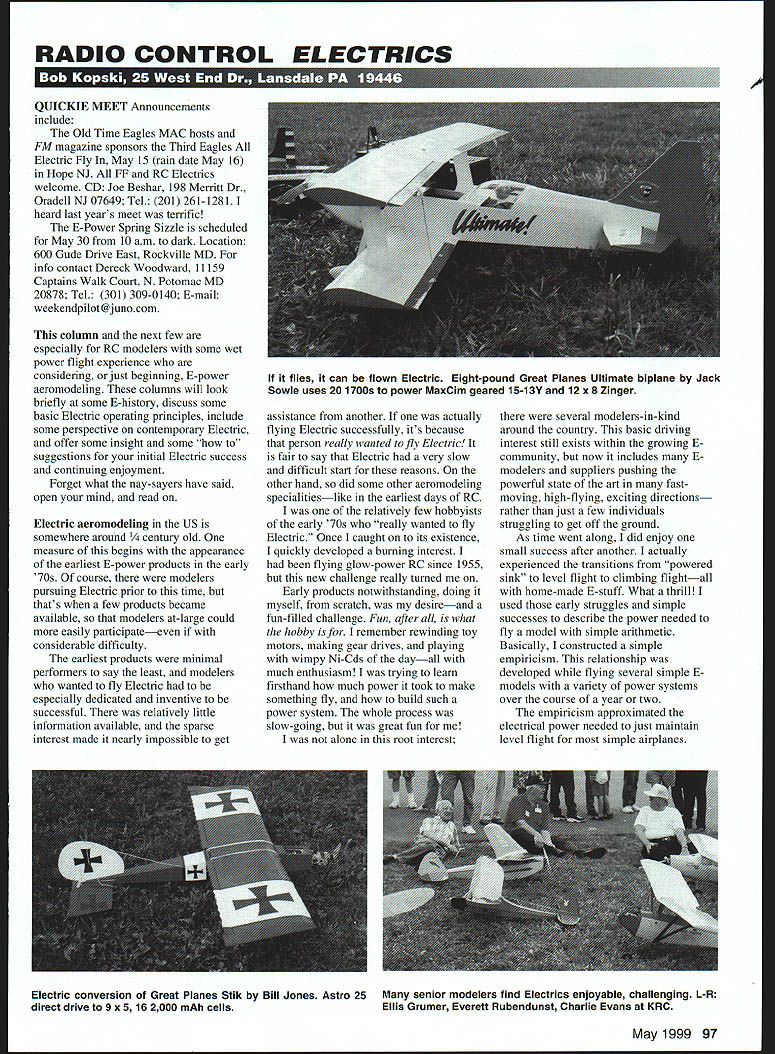
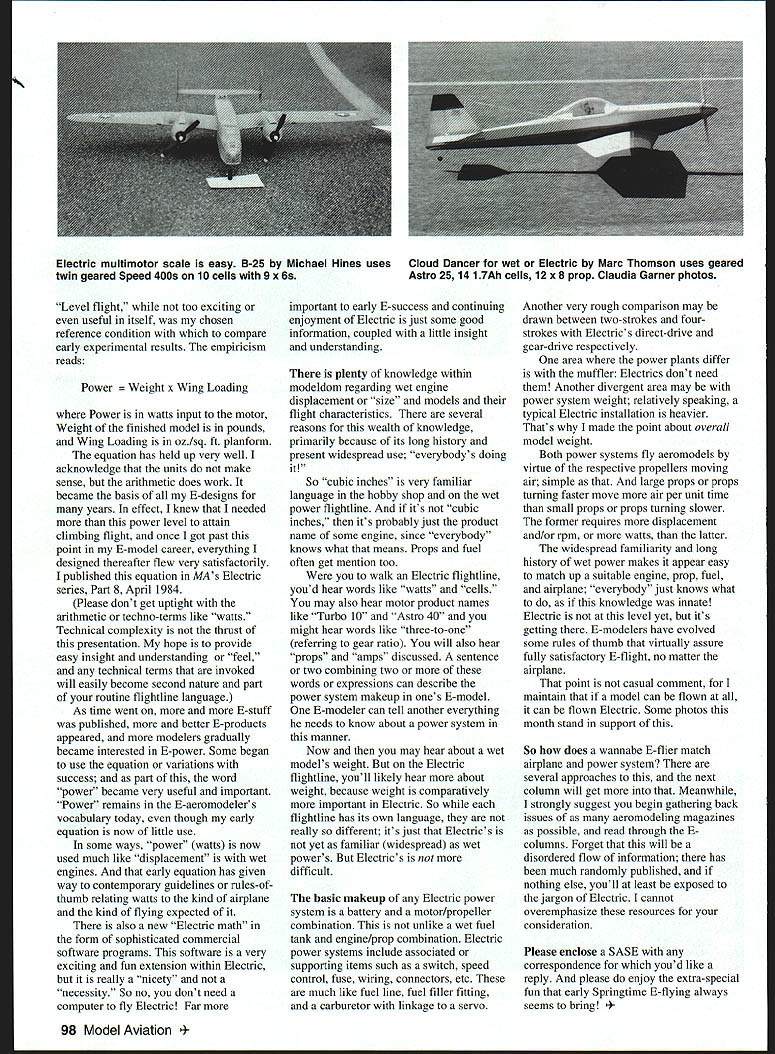
That point is not casual comment, for I maintain that if a model can be flown at all, it can be flown electric. Some photos this month stand in support of this.
MATCHING AIRPLANE AND POWER SYSTEM
So how does a wannabe E-flier match airplane and power system? There are several approaches to this, and the next column will get more into that. Meanwhile, I strongly suggest you begin gathering back issues of as many aeromodeling magazines as possible, and read through the E columns. Forget that this will be a disordered flow of information; there has been much randomly published, and if nothing else, you'll at least be exposed to the jargon of electric. I cannot overemphasize these resources for your consideration.
Please enclose a SASE with any correspondence for which you'd like a reply. And please do enjoy the extra-special fun that early springtime E-flying always seems to bring!
Transcribed from original scans by AI. Minor OCR errors may remain.

