
Radio Control: Electrics
By Bob Kopski
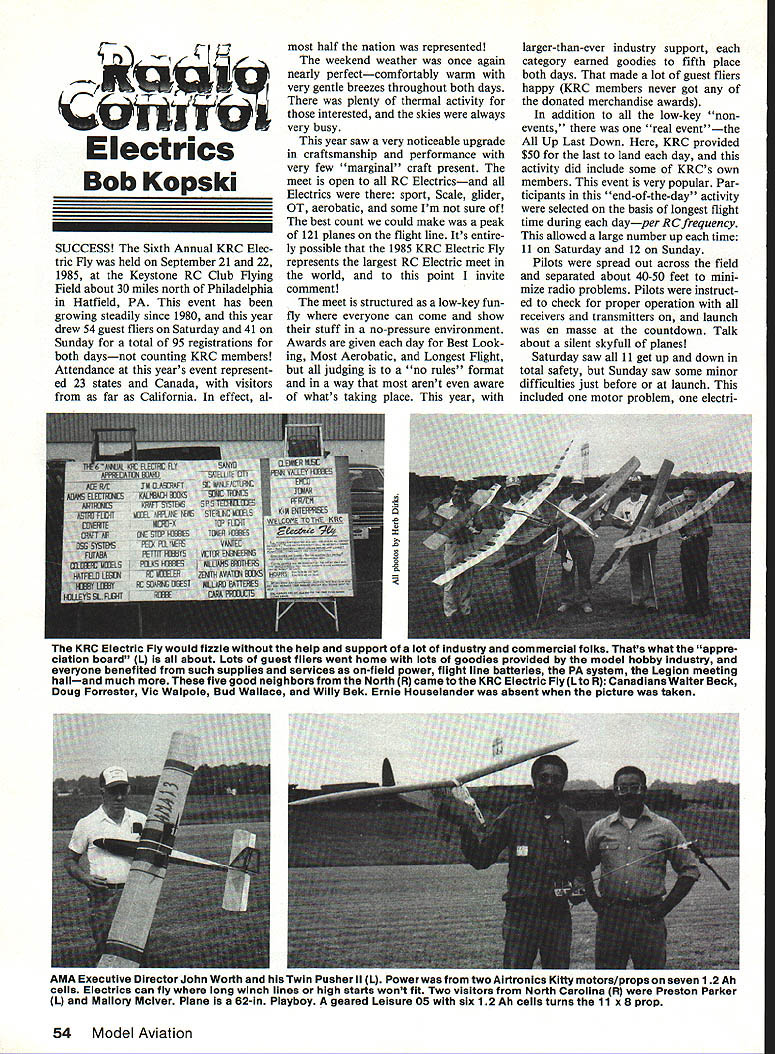
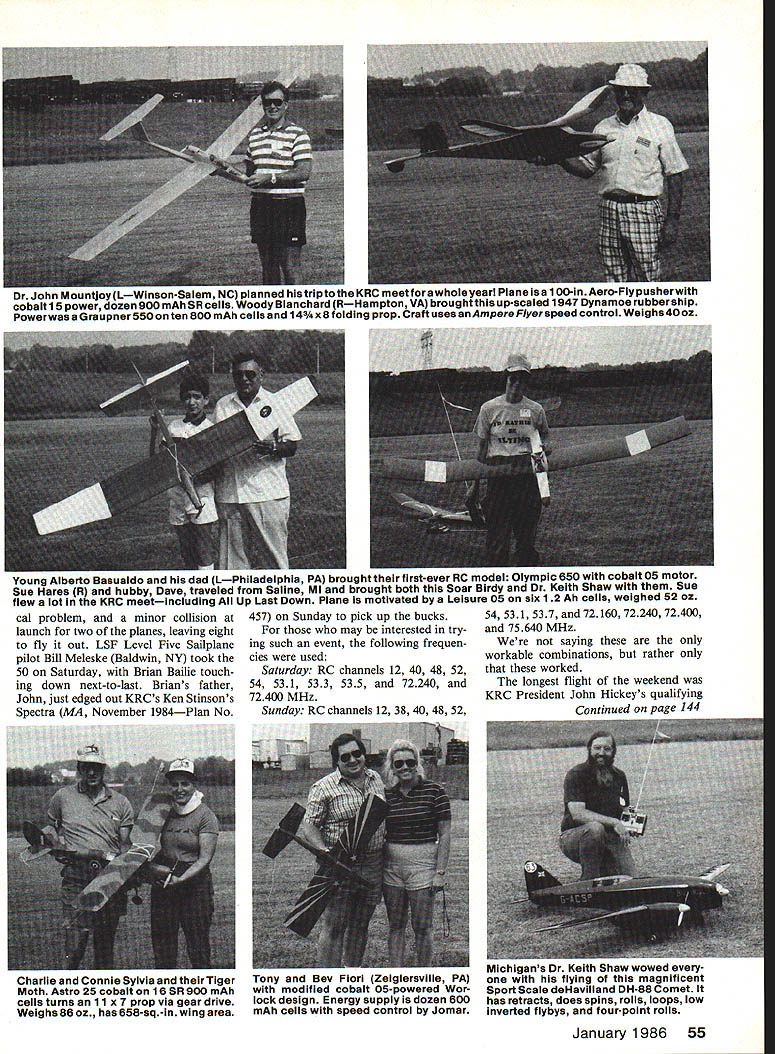
SUCCESS! The Sixth Annual KRC Electric Fly was held on September 21 and 22, 1985, at the Keystone RC Club flying field about 30 miles north of Philadelphia in Hatfield, PA. This event has been growing steadily since 1980, and this year drew 54 guest fliers on Saturday and 41 on Sunday for a total of 95 registrations for both days—not counting KRC members. Attendance represented 23 states and Canada, with visitors from as far as California. In effect, almost half the nation was represented!
The weekend weather was nearly perfect—comfortably warm with very gentle breezes throughout both days. There was plenty of thermal activity for those interested, and the skies were always very busy.
This year saw a noticeable upgrade in craftsmanship and performance, with very few marginal craft present. The meet is open to all RC electrics—and all electrics were there: sport, scale, glider, OT, aerobatic, and some I'm not sure of. The best count we could make was a peak of 121 planes on the flight line. It's entirely possible that the 1985 KRC Electric Fly represents the largest RC electric meet in the world.
The meet is structured as a low-key fun-fly where everyone can come and show their stuff in a no-pressure environment. Awards are given each day for Best Looking, Most Aerobatic, and Longest Flight, but all judging follows a "no rules" format and is done in a way that most participants aren't even aware of what's taking place. This year, with larger-than-ever industry support, each category earned goodies to fifth place both days. That made a lot of guest fliers happy (KRC members never got any of the donated merchandise awards).
All-Up Last-Down
In addition to all the low-key non-events, there was one "real event"—the All-Up Last-Down. KRC provided $50 for the last to land each day, and this activity did include some of KRC's own members. This event is very popular. Participants in this end-of-the-day activity were selected on the basis of longest flight time during each day—per RC frequency. This allowed a large number up each time: 11 on Saturday and 12 on Sunday.
Pilots were spread out across the field and separated about 40–50 feet to minimize radio problems. Pilots were instructed to check for proper operation with all receivers and transmitters on, and launch was en masse at the countdown. Talk about a silent sky full of planes!
Saturday saw all 11 aircraft launch and land safely. Sunday saw some minor difficulties just before launch, including a motor problem and a minor collision at launch for two of the planes, leaving eight to fly it out.
Frequencies used
For those interested in trying such an event, the following frequencies were used:
- Saturday: RC channels 12, 40, 48, 52, 54, 53.1, 53.3, 53.5, and 72.240, 72.400 MHz
- Sunday: RC channels 12, 38, 40, 48, 52, 54, 53.1, 53.3, 53.7, and 72.160, 72.240, 72.400, and 75.640 MHz
We're not saying these are the only workable combinations, only that these worked.
Highlights
The longest flight of the weekend was KRC President John Hickey's qualifying flight on Sunday. John flew his Spectra for 48:50 and also set a new internal KRC flight-time record.
While there was a lot of duration flying all weekend, the real show-stopper was the personality, planes, and piloting of Keith Shaw (Ann Arbor, MI). Keith was here last year and went home with many awards, including a couple dozen 1.2-Ah Sanyo cells. This year, Keith brought them back—wrapped in a 7½-pound package shaped exactly like an 88-inch de Havilland Comet DH-88!
Twin Keller 25/12s turning Rev-Up 9×7 props pulled this three-quarter-scale masterpiece (1985 Toledo Best MonoKote winner) through Hatfield skies to the silent, captivated stare of the hundreds who crowded the field throughout the weekend. Each flight of this retract-equipped electric was a smoothly flowing symphony of graceful, end-to-end maneuvers, conducted by maestro Shaw. Keith owned the air, it seemed, as other planes and performers relinquished it for his solo performances.
But the DH-88 was not his only presentation. Keith also returned with his very popular Spitfire and Columbia aerobatic, a new, cute little "PT 24" (converted RN Models rubber scale), plus a new, screaming, 66-inch flying Win Banshee—"evil, wicked, mean, and nasty"—a shimmering, swift slicing edge in the air. Keith, et al., is a show in himself—a once-a-year phenomenon here.
Mishaps
As with any meet this size, there were several mishaps. Most seemed relatively minor—except one (mine). This had to be the most spectacular midair ever at Electric Flys combined. As I saw it, Ted Davey's (DSG Systems) Le Crate viciously assaulted my Cobalt 40-powered Excalibur head-on, shearing off the latter's wings and allowing the fuselage to projectile into a flatbed truck laden with structural steel beams. Score: steel 1, Excalibur 0. Eighty-one ounces of rubble.
The Le Crate returned to earth in a more feathery and graceful fashion—quite repairable but destined to be replaced with a new one; it was Ted's show plane for the kit he manufactures. What I remember most was the explosive sound as the planes collided—very noticeable in the silence of the day. The "blast" sent friend Heinz's dog running for cover into his camper—hundreds of feet from the aerial carnage!
Equipment and radio notes
The characteristic quiet of this meet permitted another sound to be routinely noticed—the rather frequently interrupted whir of motors, gears, and props as radio glitches manifested themselves as momentary "power outages." There's no question in my mind that the only kind of speed control to use is one that's optically coupled; beyond that, good equipment installation practice and adequate spark suppression at the motor brushes are absolute musts. More on this in a later column.
Guests and attendees
The Electric Fly usually attracts lots of interesting and interested participants and spectators alike. This year's was no exception, with such notables in attendance as AMA Executive Director John Worth, retired AMA Technical Director Frank Ething, PAA Master, District III Associate VP Eva Biddle accompanied by husband Ralph (SAM 76), Joe Beshara (FAI Electric Technical Committee), Dwight Holley (1982 World Soaring Champ), Joe Utsai (JOMAR), Les Adams (Adams Electronics), Jim Zarembski (RCM "Silent Power" columnist—watch for a line of kits by Jim), and my "boss", MA Associate Editor Ross Rudd (my spelling and grammar deficiencies are really his!). This un-ordered list is incomplete but representative of the appeal and reach of the KRC Electric Fly.
Social events and raffle
This year saw the continuation of two Electric Fly institutions: the Saturday Social and the Electric Fly Raffle. The Saturday Social and the Electric Fly Raffle are hosted each year by the KRC ladies at the Hatfield Legion Hall—KRC's regular meeting spot. Everyone is invited to attend, spending Saturday evening socializing, snacking, and sharing in the door prizes. This year's raffle offered nearly $1,500 worth of top-notch model merchandise. The long list was headed by two radio systems and two large Astro flight-control systems with Adams controllers. Need I say—some people were very happy?
Clinic and the future
Missing this year—another Electric Fly institution: the Electric Fly Clinic. This, in my view, represents a backward step. The Clinic was established several years ago when it was obvious that many folks needed basic electric help. In earlier years, many modelers came with problem planes and systems, and most were put into operation by the very capable Heinz Koerner who ran the clinic.
But last year "something funny" happened—there were practically no takers at the clinic. Electrics had suddenly "grown up." Very nearly everyone had everything up and running well. Result: the Clinic was discontinued this year. It served its purpose; its time is past. What better testimony to the present advanced electric state?
Next year? It's too early to know for sure, but there's been some discussion about adjusting the format of the meet to keep pace with the progress of electric modeling. With steadily increasing electric participation and proficiency each year brings, I can see the possibility of some specialized events catering to those desiring to flex their electric muscles. Thus, next year may see the word "contest" associated with some events. But I can never see the word "fun-fly" disassociated with the basic KRC Electric Fly—I believe there will always be plenty of the low-key atmosphere for which the meet is famous.
Acknowledgments
Accolades to the KRC members who ran the show—the biggest and best Electric Fly ever: KRC Field Officer Ed Schmitt and KRC Secretary Ken Stinson. These two gentlemen teamed up and took on the monumental task of organizing this year's meet—a near year-long job (as they now realize!). They were supported and assisted by nearly every KRC member—two-thirds of whom don't fly electric—and without whose accommodation and assistance there would be no Electric Fly.
On behalf of the Officers and Membership of the Keystone RC Club, a hearty and sincere "Thank You" to those in the model hobby industry who provided huge amounts of support to our electric cause. And to those who traveled so far with friends and families to join us, a hearty and sincere Thank You, too—for you are the Electric Fly!
Contact
Please direct any comment or question (with SASE, please) to the author:
Bob Kopski 25 West End Dr. Lansdale, PA 19446
Many, many happy quiet landings be yours.
Transcribed from original scans by AI. Minor OCR errors may remain.

