
RADIO CONTROL ELECTRICS
Bob Kopski 25 West End Dr., Lansdale, PA 19446
This column, last month's, and the next few are especially for RC modelers with some wet-power flight experience who are considering, or just beginning, Electric (E-) power aeromodeling.
Last month's column presented some history of Electric flight and described early challenges and difficulties. It also compared wet power and Electric, and argued that while wet power is more widespread and familiar, contemporary Electric is very capable and easy to apply to almost any RC aeromodel. This is because of technology advances, a multitude of good products on the market, and rapidly increasing Electric participation and knowledge. Upcoming columns will show how to get into Electric successfully and assure continuing enjoyment.
Who Electric is for
Electric is not for everyone—just as wet power, rubber, CO2, or hand-launch are not for everyone. Electric is one wonderful way to power an aeromodel, and if it appeals to you there is virtually nothing you can't fly with it.
It is important to set expectations. Prospective Electric fliers must understand their interests and goals before starting an E-project. I often get inquiries from modelers who want some cheap E-stuff just to try Electric without a big money or time risk. If performance expectations are high, that approach will likely lead to disappointment and the inevitable conclusion: "Electrics don't fly well!"
For example, a highly experienced modeler who has flown wet sport aerobatics for a while may find himself bored with an economy Electric like a Mirage or Spectra because they don't fly like his high-powered sport aerobatic model. He may conclude that "Electric doesn't fly" because his meaning of "fly" is what he's used to, even though the Electric is flying exactly as designed.
This is analogous to a "wrong pilot/wrong airplane" condition. It's the inverse of a beginning pilot with a way-overkill first airplane. Neither pilot will fly well or enjoy it, albeit for different reasons. This scenario has happened to many over the years, and those often-vocal folks have not done E-power (or themselves) any favors. Be reasonably discerning and clear about your E-goals: anything reasonable can be achieved—or exceeded—with the right equipment.
Motor nomenclature and comparisons
Many modelers familiar with wet power frequently ask, "What motor is like a .40?" AstroFlight, the granddaddy Electric manufacturer, attempted to answer by designating motors 05, 25, etc. This approach has been marginally workable over the years but still causes confusion.
My assessment is that the smaller motor range (035, 05) is dramatically more capable than correspondingly named wet engines. I believe this is less true at the other end (25s, 40s, 60s). This is a somewhat subjective position; no true easy-to-understand Electric-to-wet comparison is really possible because many variables are involved. Still, the Astro nomenclature is a workable starting point and is better than nothing.
Other manufacturers use less-meaningful names such as Turbo 10, Goldfire, Speed 400, and the like. Those product names give no clue about motor use, and they can confuse potential E-modelers. Once you see the motor in use, however, it’s easy to apply products to appropriate aircraft.
Consider how wet-engine advertisements always list displacement. Everyone would benefit if Electric motors had a similar, easy-to-understand specification.
How to choose a motor, airplane, and power system
There are several ways to select a motor/airplane/flight capability. Using combinations of approaches is encouraged.
Recommended steps and resources:
- Collect Electric-related columns and back issues of aeromodeling magazines. These archives are a huge wealth of Electric knowledge.
- Study E-model photos and construction articles that include power system details. These are excellent examples of airplane/power system combinations.
- Use published lists of "what works" from columnists; they provide many helpful airplane/power system examples (you may need to dig through archives).
- Once you find a model similar in kind, size, weight, and flight characteristics to what you want, use the published power system as a guideline and adapt from there.
- Check with an experienced E-modeler for a sanity check. If local help isn't available, ask me or another columnist—many will respond with advice or alternatives.
- Consult reference books such as Clean and Quiet by Bob Aberle and Electric Motor Handbook by Bob Boucher (AstroFlight).
- Visit ezonemag.com for additional information.
- Check with motor manufacturers, especially those with extensive product lines (for example, Aveox).
- Attend E-meets. E-modelers are usually friendly and eager to share what they know.
- If you're brave, try a "brute force" approach: modern batteries, motors, and other E-products are so capable that even imperfect installations often fly OK.
Conversions and examples:
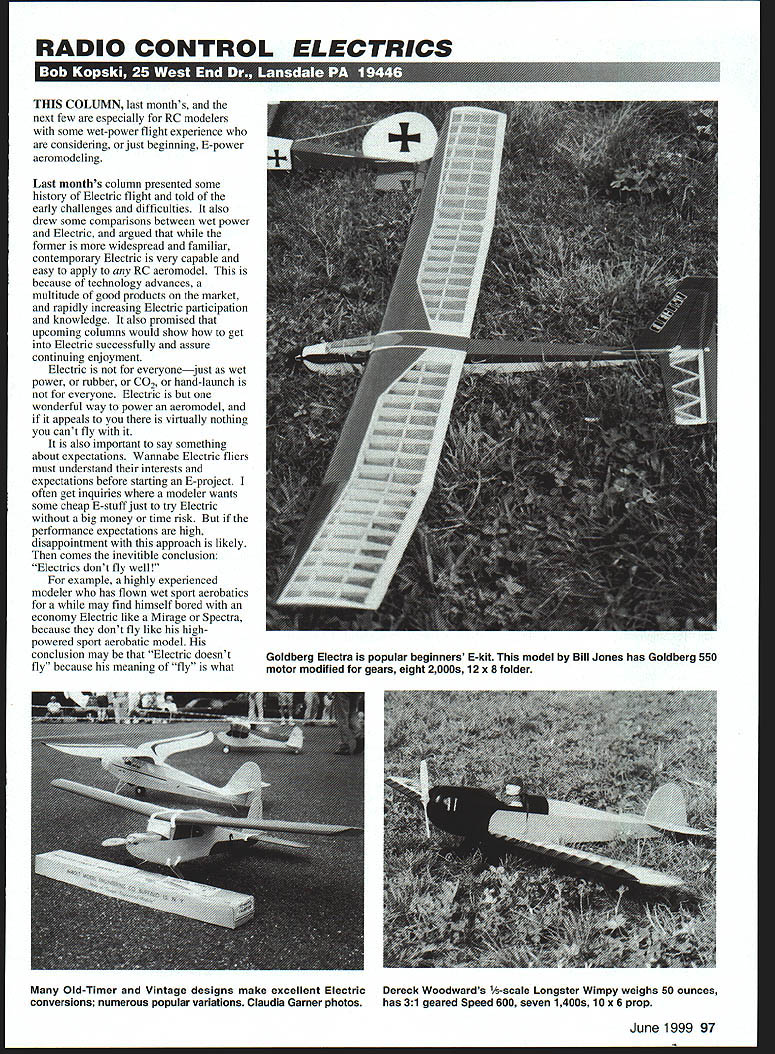
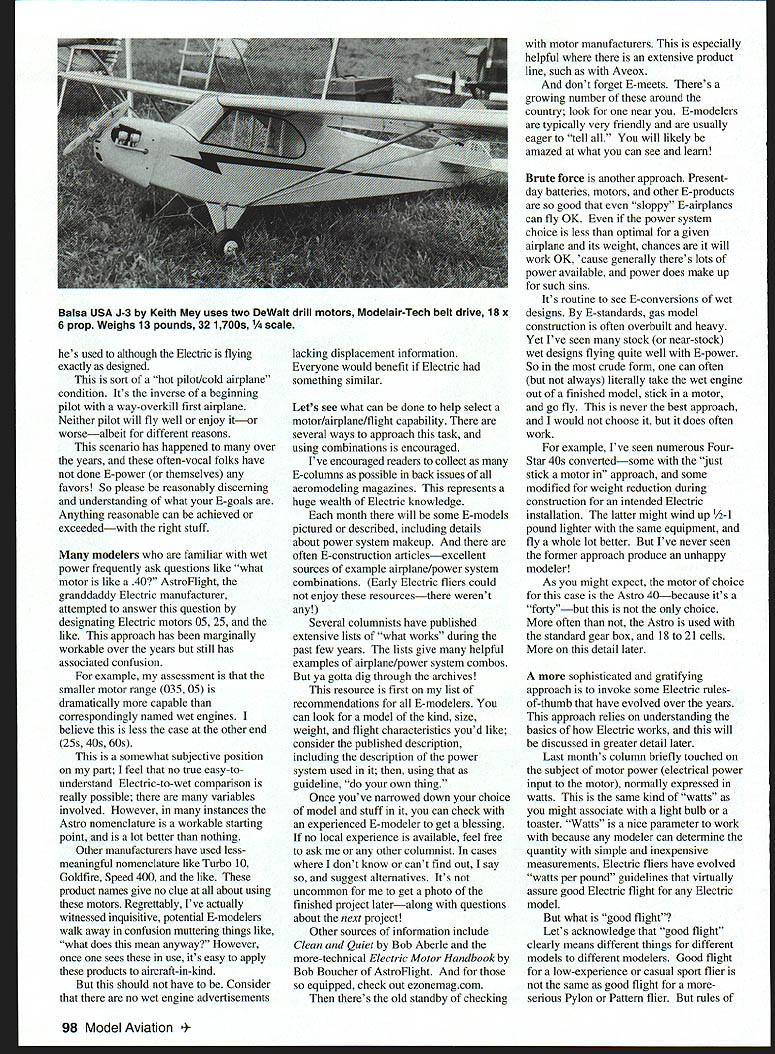
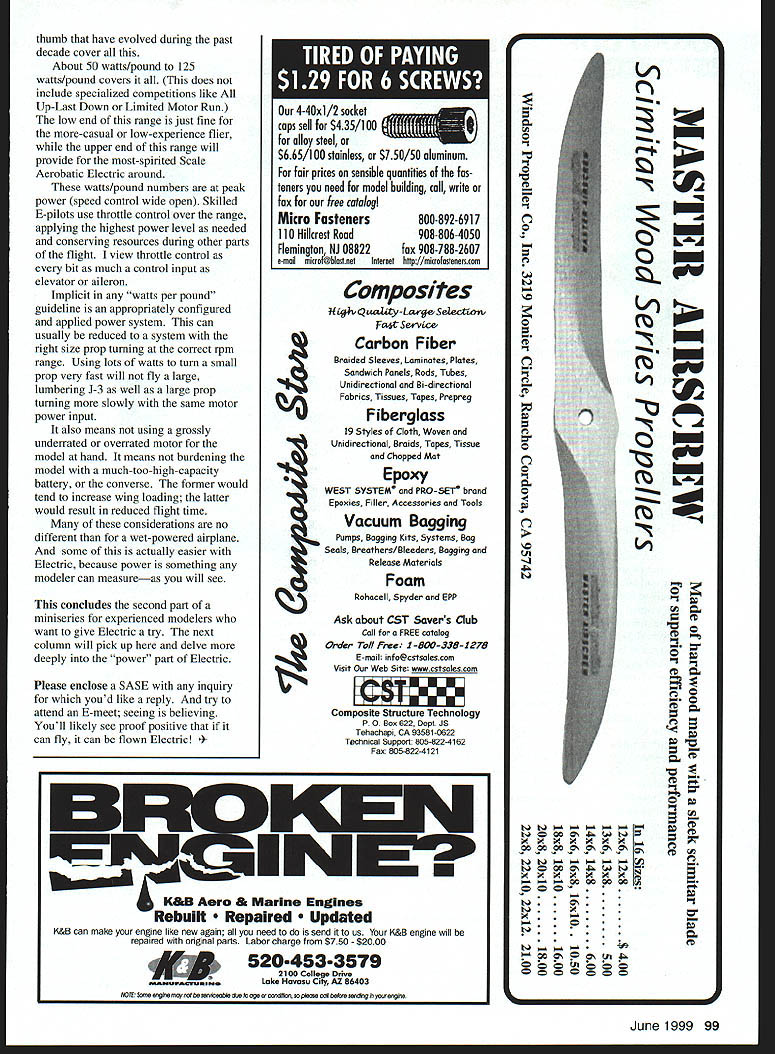
- It's routine to see E-conversions of wet designs. Gas-model construction is often overbuilt and heavy by E-standards, yet many stock (or near-stock) wet designs fly quite well with Electric power.
- Some builders literally remove the wet engine, insert a motor, and fly. This crude approach can work, though it's not optimal.
- Conversions of the Four-Star .40 are common. Some builders simply swap in a motor; others reduce weight during construction and end up 1/2–1 pound lighter and much better flying.
- A common motor choice for such conversions is the Astro 40 (used with the standard gearbox and 18–21 NiCd cells), but it is not the only option.
A more sophisticated approach is to apply Electric rules-of-thumb that evolved over the years. That relies on understanding how Electric power and propeller choices interact to produce good flight.
Watts-per-pound rule of thumb
Motor power (electrical power input to the motor) is normally expressed in watts—the same unit used for light bulbs or toasters. Because any modeler can measure watts with inexpensive gear, Electric fliers have evolved "watts per pound" guidelines that virtually assure good Electric flight.
What is "good flight"? It varies by model and pilot. Good flight for a casual sport flier is not the same as for a serious pylon or pattern competitor. The rules of thumb developed over the past decade cover this range.
- About 50 watts per pound to 125 watts per pound covers most needs (this excludes specialized competition classes such as All-Up-Last-Down or Limited Motor Run).
- The low end (≈50 W/lb) is fine for casual or low-experience fliers.
- The high end (≈125 W/lb) will support spirited aerobatic flight and scale aerobatic performance.
These watts-per-pound figures refer to peak power (speed control wide open). Skilled E-pilots use throttle control over the flight to apply high power when needed and conserve resources otherwise—throttle control is as important an input as elevator or aileron.
Implicit in any watts-per-pound guideline is an appropriately configured and applied power system:
- Use a propeller of the right size turning in the correct rpm range. Lots of watts turning a small prop very fast will not fly a large, lumbering model as well as a larger prop turning more slowly with the same motor power input.
- Avoid grossly underrating or overrating a motor for the model at hand.
- Avoid burdening the model with a much-too-high-capacity battery (which can increase weight and wing loading) or a battery that’s too small (which reduces flight time).
Many of these considerations are similar to those for wet-powered airplanes. Some aspects are easier with Electric because power is measurable.
Final notes
This concludes the second part of a miniseries for experienced modelers who want to give Electric a try. The next column will delve more deeply into the "power" part of Electric.
Please enclose a SASE with any inquiry for which you'd like a reply. Try to attend an E-meet—seeing is believing. You'll likely see proof positive that if it can fly, it can be flown Electric.
Transcribed from original scans by AI. Minor OCR errors may remain.

