
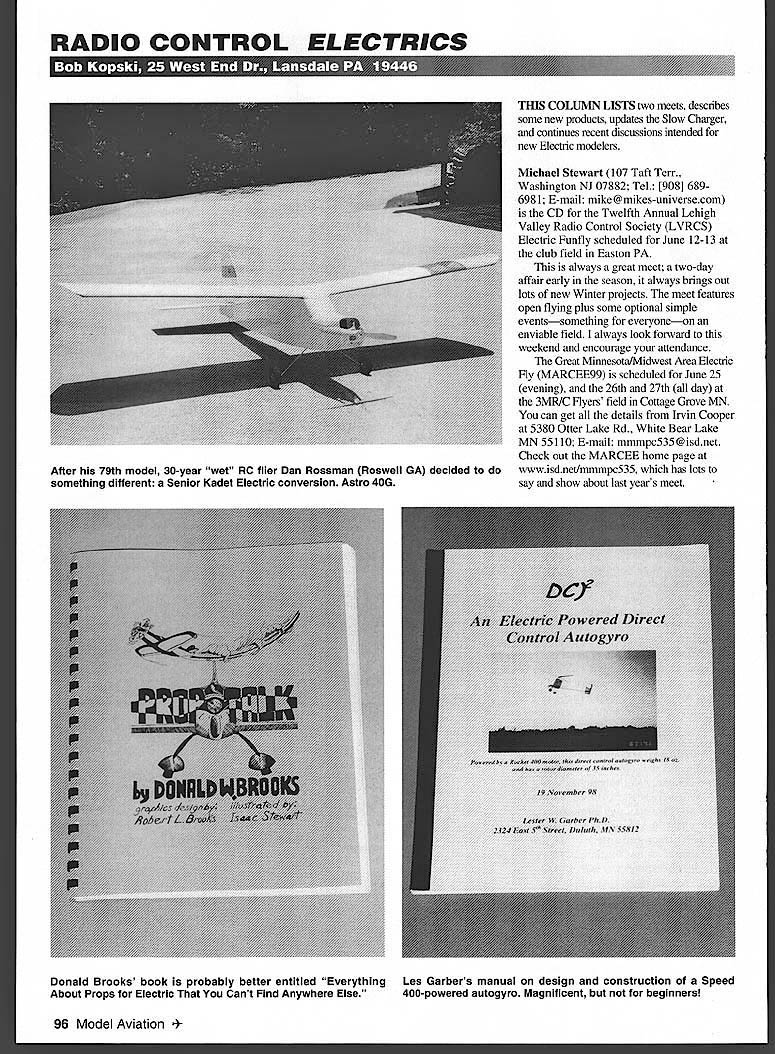
RADIO CONTROL ELECTRICS
Bob Kopski, 25 West End Dr., Lansdale PA 19446
This column lists two meets, describes some new products, updates the Slow Charger, and continues recent discussions intended for new electric modelers.
Meets
- Twelfth Annual Lehigh Valley Radio Control Society (LVRCS) Electric Funfly
Date: June 12–13 Location: Club field, Easton, PA Contest Director: Michael Stewart Contact: Michael Stewart, 107 Taft Terr., Washington, NJ 07882; Tel.: (908) 689-6981; E-mail: mike@mikes-universe.com
- Great Minnesota / Midwest Area Electric Fly (MARCEE99)
Dates: June 25 (evening), June 26–27 (all day) Location: 3MR/CFlyers' field, Cottage Grove, MN Contact: Irvin Cooper, 5380 Otter Lake Rd., White Bear Lake, MN 55110; E-mail: mmmpc535@isd.net Web: www.isd.net/mmmpc535 (has reports and photos from last year's meet)
I encourage you to attend these meets — they are great places to see a lot of new winter projects and to get inspired. The LVRCS Funfly is a two-day early-season event with open flying and optional simple events for many skill levels.
New publications and products
- Les Garber — Autogyro booklet
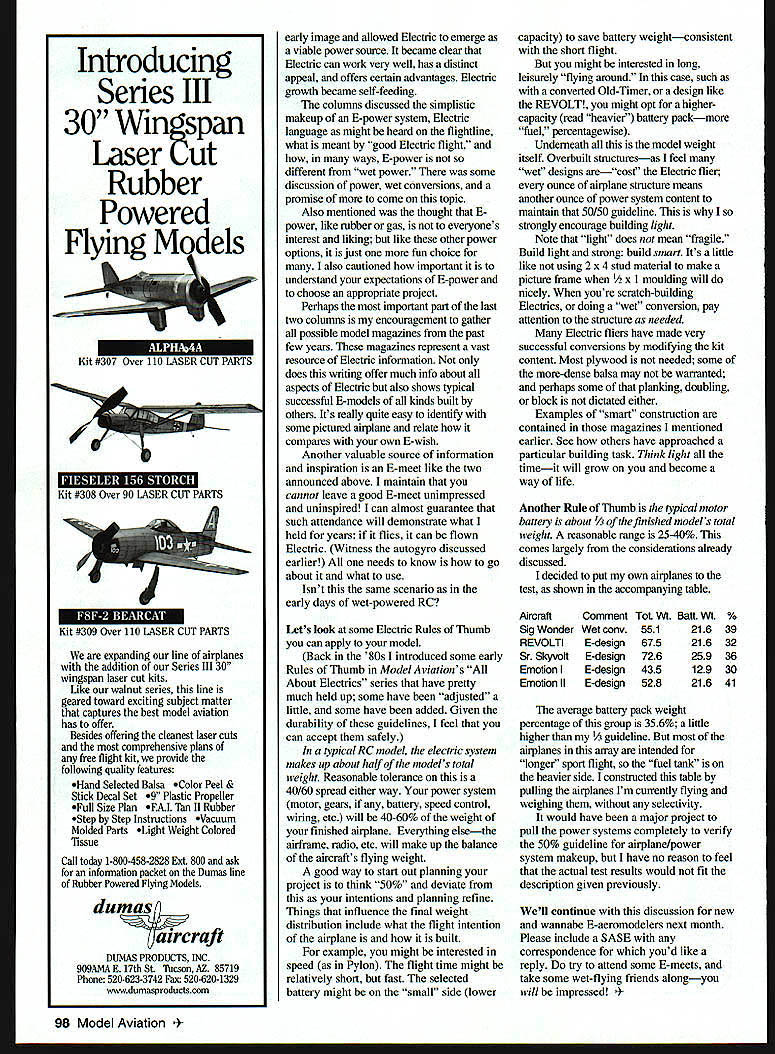
Les Garber has produced a 35-page booklet detailing his 400-powered autogyro (photo appeared in the February '99 column). It describes how it was done and how you can duplicate it. This is not for beginning modelers. Price: $15 plus $5 S&H. Contact: Les Garber, 2324 East 5th St., Duluth, MN 55812; Tel.: (218) 728-6827; E-mail: lgarber@d.umn.edu
- Donald Brooks — Small Prop book ("Prop Talk")
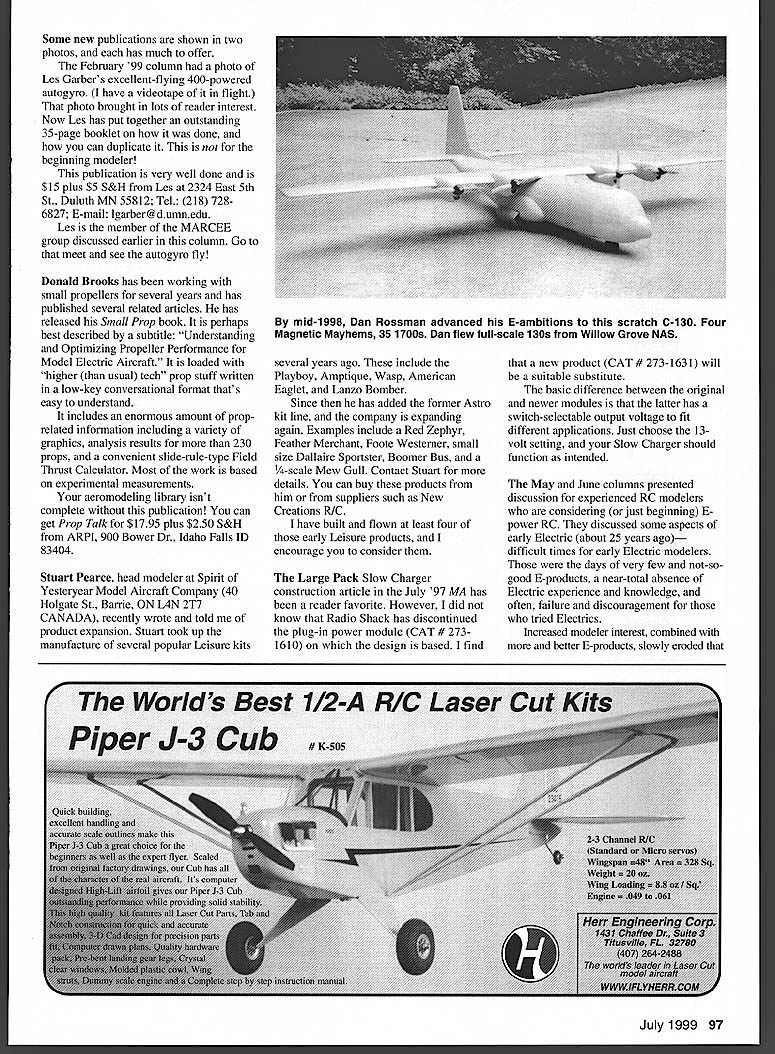
Title/Subtitle: Understanding and Optimizing Propeller Performance for Model Electric Aircraft. Contains in-depth prop info, graphics, analysis results for more than 230 props, and a slide-rule–type Field Thrust Calculator. Based largely on experimental measurements. Price: $17.95 plus $2.50 S&H. Order from: ARPI, 900 Bower Dr., Idaho Falls, ID 83404
- Spirit of Yesteryear Model Aircraft Company (Stuart Pearce) — product expansion
Stuart Pearce (head modeler) has expanded the product line and now manufactures several Leisure kits and the former Astro kit line. Examples of kits available: Playboy, Amptique, Wasp, American Eaglet, Lanzo Bomber, Red Zephyr, Feather Merchant, Foote Westerner, small-size Dallaire Sportster, Boomer Bus, and a 1/4-scale Mew Gull. Contact: Spirit of Yesteryear Model Aircraft Co., 40 Holgate St., Barrie, ON L4N 2T7, CANADA. Products are also available from suppliers such as New Creations R/C.
I have built and flown several of the early Leisure products and recommend considering them.
Slow Charger update
The Large Pack Slow Charger construction article (Model Aviation, July 1997) has been popular. Radio Shack has discontinued the original plug-in power module (CAT #273-1610) used in that design. A suitable substitute is the newer module (CAT #273-1631).
The newer module differs in having a switch-selectable output voltage. Set it to the 13-volt position and the Slow Charger should function as intended.
Electric modeling: background and advice
The May and June columns discussed aspects of early electric RC (about 25 years ago), when products and knowledge were scarce and many early attempts met with failure. Since then, increased interest and much better products have allowed electric power to emerge as a viable, appealing option with distinct advantages. Electric growth has become self-sustaining.
Past columns covered the basic makeup of an electric power system, flightline electric language, what constitutes a good electric flight, similarities to "wet" (internal combustion) power, and thoughts on power and wet conversions. I emphasized that electric power is one option among others (rubber, gas) and that it may not suit everyone. It is important to set realistic expectations and choose an appropriate project.
Two valuable resources for prospective electric modelers:
- Back issues of model magazines from recent years — they contain a vast amount of electric information and show many successful electric models that can inspire and guide your choices.
- Electric meets — attending one will expose you to many flying examples and demonstrate that, in many cases, if it flies on IC power it can be flown electric.
Rules of Thumb for electric models
- The electric system (motor, ESC, battery, wiring, etc.) typically makes up about half of the model's total flying weight. A reasonable tolerance is a 40/60 spread either way. Think "50%" when starting project planning and adjust as needed.
- Flight intent and construction influence weight distribution. For example:
- Speed-oriented models (short flights) may use smaller, lighter battery packs.
- Duration-oriented models (longer, leisurely flights or Old-Timer conversions) will use higher-capacity, heavier battery packs.
- Build light, not fragile. Overbuilt structures common in many IC designs add unnecessary weight for electric applications. When scratch-building or converting a kit, consider reducing plywood, heavy balsa, unnecessary planking or doublers, and unnecessary block. Review examples in magazines to learn smart construction techniques.
- Typical motor battery weight is about one-third of the finished model's total weight. A reasonable range is 25–40%.
Motor / battery weight examples
I weighed a sample of airplanes I'm currently flying (no selectivity) to check battery weight percentage:
- Sig Wonder — Wet conversion — Total Wt.: 55.1 oz — Batt. Wt.: 21.6 oz — 39%
- REVOLT — E-design — Total Wt.: 67.5 oz — Batt. Wt.: 21.6 oz — 32%
- Senior Swallow — E-design — Total Wt.: 72.6 oz — Batt. Wt.: 25.9 oz — 36%
- Emotion I — E-design — Total Wt.: 43.5 oz — Batt. Wt.: 23.2 oz — 54%
- Emotion II — E-design — Total Wt.: 52.8 oz — Batt. Wt.: 21.6 oz — 41%
The average battery pack weight percentage for this group is 35.6%, slightly higher than the guideline, which reflects that many of these airplanes are intended for longer sport flights and therefore carry heavier "fuel" packs.
We'll continue this discussion for new and wannabe electric aeromodellers next month. Please include a SASE with any correspondence for which you'd like a reply. Do try to attend some electric meets, and take some wet-flying friends along — you will be impressed!
Transcribed from original scans by AI. Minor OCR errors may remain.

