

RADIO CONTROL ELECTRICS
Bob Kopski, 25 West End Dr., Lansdale, PA 19446
THIS COLUMN discusses two E-meets, a good parts source with examples, a current project, and continues with the ongoing discussion of beginning Electrics for already‑modelers.
E‑meets and announcements
- The Keystone R/C Club (KRC) has announced the cancellation of the 1999 KRC Electric Fly. There are several reasons for this year's action, and as of this writing no club position has been established regarding future years. I know this affects many readers, and I will update the subject in future columns. In the meantime, you can access KRC's web page (www.krc.org) for more information as it is posted.
- Ken Cashion (157 Tennyson Cove, Picayune, MS 39466; Tel.: (601) 798‑5807; E‑mail: kcashion@datasync.com) announces the Eleventh Annual Gulf States Electric Fly‑In, October 16‑17 in Slidell, LA (near New Orleans). This is a meet combining open fun‑flying along with five AMA rule‑book events, plus NEAC Sport Sailplane, AULD, and 1/2A Sailplane. Ken refers to the meet as a "southern KRC."
Parts source and useful tools
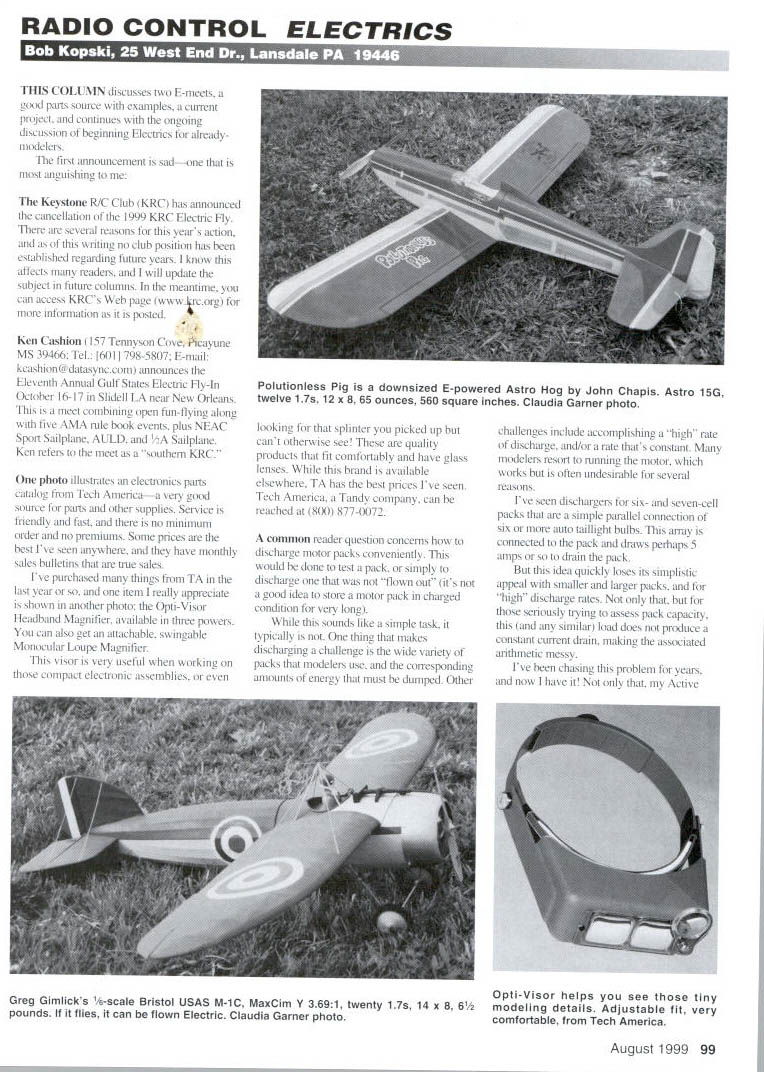
One photo in the original column illustrates an electronics parts catalog from Tech America — a very good source for parts and other supplies. Service is friendly and fast, there is no minimum order and no premiums. Some prices are the best I've seen anywhere, and they have monthly sales bulletins that are true sales. I've purchased many items from Tech America in the last year, and one item I really appreciate is the Opti‑Visor headband magnifier, available in three powers. You can also get an attachable, swingable monocular loupe magnifier.
- The Opti‑Visor is very useful when working on compact electronic assemblies or for close inspection tasks. These are quality products that fit comfortably and have glass lenses. While this brand is available elsewhere, Tech America often has the best prices.
- Tech America (a Tandy company) can be reached at (800) 877‑0072.
Discharging motor packs
A common reader question concerns how to discharge motor packs conveniently. This is done to test a pack or simply to discharge one that was not "flown out" (it's not a good idea to store a motor pack in a charged condition for very long).
While this sounds simple, it typically is not. Discharging is complicated by the wide variety of packs modelers use and the corresponding amounts of energy that must be dissipated. Other challenges include accomplishing a "high" rate of discharge and/or a rate that's constant. Many modelers resort to running the motor, which works but is often undesirable for several reasons.
I've seen dischargers for six‑ and seven‑cell packs that are a simple parallel connection of six or more auto taillight bulbs. This array is connected to the pack and draws perhaps 5 amps or so to drain the pack. But this idea quickly loses its appeal with smaller and larger packs, and for high discharge rates. Not only that, but for those seriously trying to assess pack capacity, this (and any similar) load does not produce a constant current drain, making the associated arithmetic messy.
I've been chasing this problem for years, and now I have it: an Active Load. My Active Load is relatively simple, can be easily duplicated, is capable of dissipating 600 watts, can be made larger or smaller, has a fully adjustable load current (0–25 amps), maintains set current constant, will easily handle 40 cells, uses readily available parts, and requires no fragile light bulbs, resistor assemblies, or running motors.
A pleasant discovery is the Radio Shack 22‑118A PC‑serial multimeter. This is a winner instrument and can be tied to a PC serial port to acquire, display, and store voltage and other data using DOS/Windows software that comes with it. Thus you can monitor, record and plot charge/discharge curves and, using the Active Load, have a true graphic picture of battery performance. Of course there are many other things a multimeter can do — including just being a simple, no‑PC multimeter.
I'll have much to share on Active Load/PC/DMM instruments later, but meantime if you're in the market for a DMM consider this item.
Mini‑series for beginning E‑modelers
The last three columns and the next few will form a mini‑series for wannabe beginning E‑modelers. If you already have RC flight experience, these discussions — from E‑modeling history through some present‑day B‑power perspectives, the importance of understanding what you want to fly, wet‑design conversions, Rules of Thumb and encouragement — will be useful.
Gather E‑stuff; you could collect recent aeromodeling magazines. AMA's other E‑columns routinely offer photos and discussions about B‑models and the associated power installations. This useful guideline information allows any reader to pursue a similar aircraft, already knowing how to power it.
From January 1994 through December 1998, Model Aviation's (MA) "RC Electrics" column pictured and described 101 E‑models of all kinds. There were many more photos of other E‑related items; nevertheless, the pictured E‑models are most useful to many who may be struggling with what to build and how to power it.
Combine these photos/descriptions with the many columns and E‑construction articles appearing over these years in the popular aeromodeling publications and you have an unbeatable wealth of directly useful information. I believe you should be able to find worthwhile reference for any E‑project you can dream up.
Another excellent source of inspiration can be found in various hobby catalogs, such as those from New Creations and Hobby Lobby. These and some others offer extensive E‑model and E‑equipment descriptions that are often very helpful.
Since this is the season, don't forget the "up close and personal" approach (an E‑meet like the two listed above); you can learn a lot. For example, some estimates at last year's KRC meet put the number of E‑models on the flightline at more than 500. But even at smaller gatherings you'll find lots of inspiring models with very friendly and conversational modelers attached to them.
There is simply no way any wannabe E‑modeler cannot be inspired at any meet I've seen. Typically, there is so much variety and creativity to be seen that it challenges written description.
Wet‑power conversion example — Ron Farkas and the Dazzler
The April '99 column described online magazine ezonemag and encouraged visitors to the ezonemag.com site. The March issue included a detailed description of a wet‑power conversion that I'd like to expand upon.
Ron Farkas, a regular at KRC and no stranger to successful E‑conversions (see this column, Feb. '92 re: his four Star 40 conversion), describes his recent conversion of the Great Planes Dazzler (designed for .30 to .40 glow engines). Ron details his installation of a geared Astro "15" on 14 cells and the resulting performance.
A review: previous columns described some guidelines for E‑powered designs and offered the "watts per pound" concept: most E‑models can be flown with 50–125 watts per pound of motor input power. I also offered that half the final weight of most Electrics is in the power system, and that the typical motor battery accounts for about one‑third of a finished model's weight. Let's see if Ron's Dazzler obeys these Electric Rules of Thumb.
- Ron says his airplane weighs just about 80 ounces.
- He checked actual weights and found that the geared "15", 14 cells, a typical speed control, wiring, motor mount, etc., weighs 38–39 ounces. So much for the "50%" Rule of Thumb!
- Of this equipment, the battery is about 27 ounces, and 27/80 = 34%. So much for the "one‑third" Rule of Thumb!
- It is typical for sport fliers to run motors at 20–25 amps maximum, and Ron describes his motor current as being 24 amps with the Rev‑Up 11x8 he's using. If we assume an average cell voltage of 1.1 volts per cell during discharge, then the motor input power is 1.1 × 14 × 24 = 370 watts.
- The airplane weighs 80 ounces (5 lb), so the watts per pound is 370/5 = 74 W/lb. This fits well within the 50–125 W/lb guideline.
This example shows how E‑modelers can assure good flight performance, whether with wet conversions or scratch E‑designs. It is important to watch model structural weight, because associated power system weight for the same nominal performance goes up proportionally. You must think of every ounce saved or gained as really being two ounces to assure best flight performance.
Some weight past this guideline is not the end of the world; it simply reduces flight performance and/or flight time. Contemporary electric power systems are quite capable and often have some power to spare. The tradeoff is not "no flight" but reduced performance/time compared to an ideal build.
While the ezonemag article was timely and highly representative, this kind of information is found throughout recent model magazines' construction articles and columns.
It's exactly in this same manner that early wet‑powered RC grew, despite some contemporary feeling that "everybody just automatically knows what to do" in that area. For those confused by how a "15" can fly a model designed for a .30 to .40, remember that electric motor nomenclature leaves something to be desired — think "watts," not "cubic inches."
Please include a SASE with any correspondence for which you'd like a reply. Have a good E‑flyin' summer, with some E‑meet attendance included!
Transcribed from original scans by AI. Minor OCR errors may remain.

