
Radio Control: Electrics
Bob Kopski, 25 West End Dr., Lansdale PA 19446
This column offers information on mini/lite/slow RC electric flying and continues the discussion for experienced modelers who are wannabe or beginning E-fliers.
There is a growing interest in small, low-power, and/or slow electric RC.
Micro RC categories
John Worth of Cloud Nine (Cloud Nine Micro RC Newsletter, April 1999) describes three categories of micro RC related largely to weight:
- Indoor Only: about 1 ounce; typically suited to very small indoor sites.
- Indoor/Outdoor: about 2–3 ounces; may be flown either indoors or outdoors in calm conditions.
- Outdoor Only: about 4 ounces and up; larger, heavier, quicker airplanes that can handle some breeze and need more room.
Wing area and model speed are closely coupled considerations. Most indoor facilities are small, so slow-moving models are easier to pilot indoors. Larger, heavier, quicker airplanes need more room and are generally outdoor designs. These one- to four-ounce models are true RC models and may be electric or CO2 powered — this is what is meant by micro RC. There are many products available to fly and enjoy these tiny models.
If interested, write to John Worth at 4326 Andes Dr., Fairfax VA 22030; Tel.: (703) 273-0607 (10 a.m.–2 p.m. weekdays). You can subscribe to Cloud Nine and buy the tiny RC gear there.
I also encourage you to read the six-times-a-year "Electric Flight" column by Dick Miller in Flying Models. Dick devotes each column to small RC. (The six in-between columns are written by Don Belfort and cover electric flight in general.)
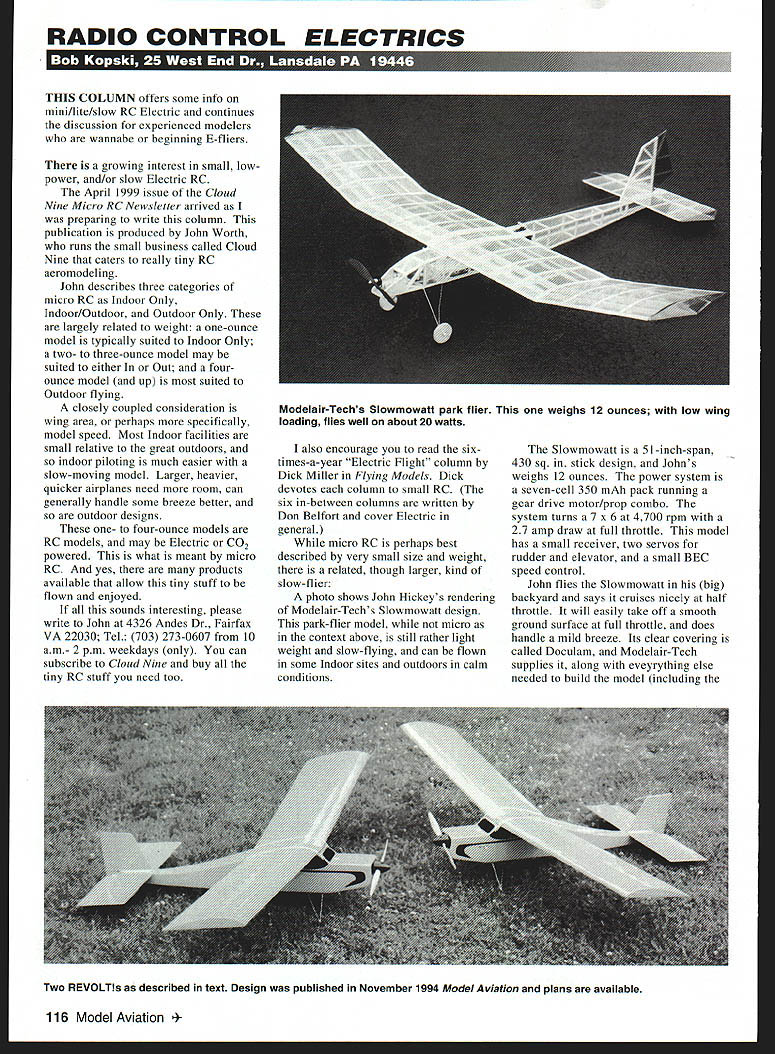
Slow-flier example: Slowmowatt
Modelair-Tech's Slowmowatt is a park-flier model that, while not micro in the 1–4 ounce sense, is still light and slow-flying. It can be flown in some indoor sites and outdoors in calm conditions.
Specifications and features (John Hickey's example):
- Span: 51 inches
- Wing area: 430 sq. in.
- Weight: 12 ounces (John's example)
- Power: seven-cell 350 mAh pack driving a gear-drive motor/prop combo
- Performance: turns a 7 x 6 prop at about 4,700 rpm with a 2.7 amp draw at full throttle
- Equipment: small receiver, two servos (rudder and elevator), small BEC speed control
- Covering: Doculam (available from Modelair-Tech)
Modelair-Tech supplies the kit (including the geared motor) for $41.95; you still need the RC system, batteries, speed control, adhesives, etc.
Growing appeal of electric flight
Electric micro/lite/slow RC is very appealing. Twenty years ago there was very little that could be flown electric; now virtually any model that will fly can be converted to or built for electric power.
Recent columns have emphasized the value of magazine electric columns and feature articles, books, and online resources (for example, ezonemag.com). Another recommended resource is S&E Modeler magazine, a slick bimonthly edited by Wil Byers. Subscription info (U.S.): (509) 627-0456; cost $24 in the U.S. It is also available at hobby shops.
REVOLT! — a versatile designed-for-electric aircraft
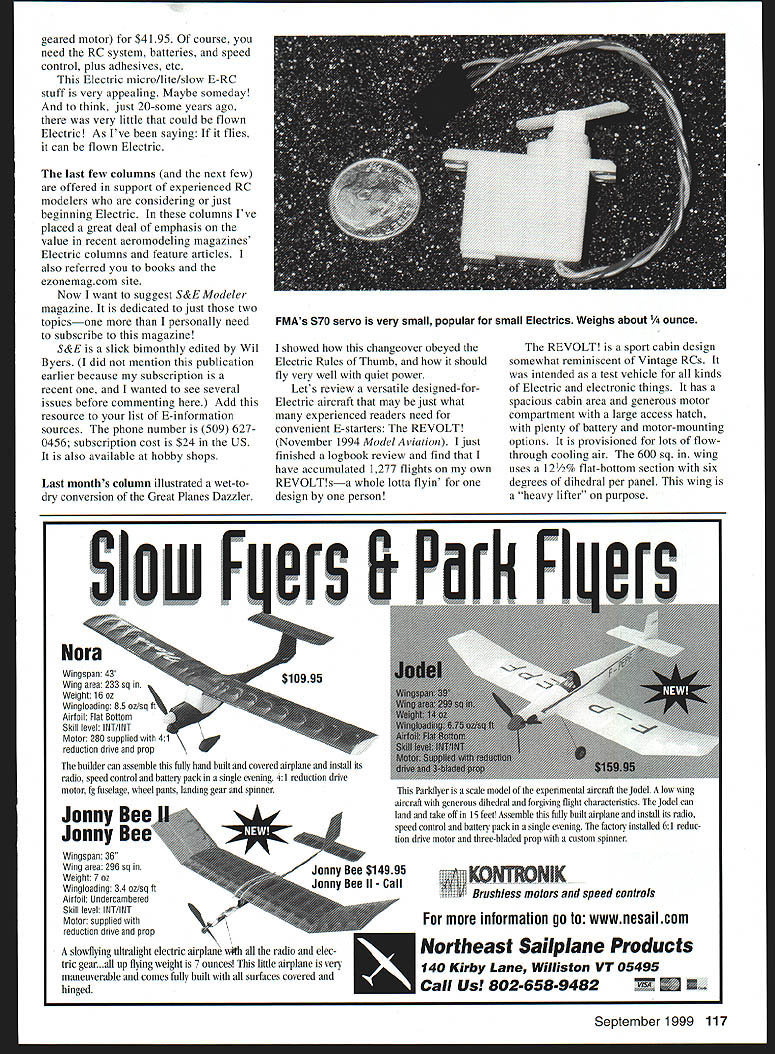
The REVOLT! (November 1994 Model Aviation) is a sport cabin design reminiscent of vintage RCs. It was intended as a test vehicle for many electric and electronic developments. It has a roomy cabin and a generous motor compartment with a large access hatch, plenty of battery and motor-mounting options, and provision for ample flow-through cooling air. The 600 sq. in. wing uses a 12½% flat-bottom section with six degrees of dihedral per panel. This wing is a "heavy lifter" by design.
Key points:
- Recommended control: RME (rudder, motor, elevator); ailerons are not recommended.
- Uses: testbed for speed controls, airborne telemetry, glitch counters; also an excellent "flyin' around" sport airplane.
- Trainer capability: with the proper setup it becomes a hands-off, slow-flyer suitable as a basic trainer.
- Other uses: payload (small cameras), glider tow-and-release.
- Further REVOLT! discussion: see RC Electrics columns 9/93, 10/93, 1/94, 3/94, 9/94, 2/95, and 5/95. Article reprints available from AMA HQ.
I have logged 1,277 flights on my own REVOLTs, flown with everything from a direct-drive .05 can on seven cells to a geared .40 cobalt on 21 cells. Popular and practical power ranges include geared .05 cobalts on seven cells through geared 25s on 14 cells.
Rules of thumb and sample power-system calculations
General rules of thumb:
- The power system weight in a typical electric installation is often about half the total weight (reasonable limits roughly 40/60 to 60/40).
- Motor power input of about 50 watts per pound generally flies most models well. High-lift-wing designs (like REVOLT!) can fly on less power, but the rule provides a good baseline.
Example 1 — Geared .05 on seven cells:
- Airframe weight (with radio, without power system): ~30 oz.
- Power system weight (geared .05 cobalt, seven-cell 1.7 Ah pack, speed control, wiring, prop): ~24 oz.
- Total = 54 oz (3.375 lb, roughly 3.4 lb).
- For 50 watts per pound: 50 x 3.375 = 169–170 W required.
- Using 1.1 V per cell under load: 7 cells x 1.1 = 7.7 V.
- Motor current at full throttle: 170 W / 7.7 V ≈ 22 A.
This is a reasonable current for sport flying. With an 11 x 7 prop, REVOLT! flies very nicely and takes off smartly from a smooth surface. Wing loading: 54 oz / (600 in² ÷ 144) = 54 / 4.1667 ≈ 13 oz/sq. ft. — a floater.
Example 2 — Geared 25 on 14 cells:
- Power system weight: ~43 oz.
- Total weight: 30 + 43 = 73 oz (4.5625 lb).
- For 50 W/lb: 50 x 4.5625 = ~228 W.
- Voltage: 14 cells x 1.1 V = 15.4 V.
- Motor current: 228 W / 15.4 V ≈ 14.8 A.
This yields relatively low current and long flight times. If propped up to 22 A for comparison: power = 22 A x 15.4 V ≈ 339 W, giving about 74–75 W/lb. Wing loading: 73 oz / (600 in² ÷ 144) ≈ 17.5 oz/sq. ft. — still quite reasonable. This configuration provides enthusiastic climb and near-instantaneous ground launches.
Other systems that work well include a 10-cell-powered Magnetic Mayhem reversed geared 3:1 to an 11 x 7.
The designed-for-electric REVOLT!, and many other models, are adaptable to a wide range of electric power systems. The Rules of Thumb are guidelines to help assure success; once you have a good initial experience, confidence quickly leads to more electric projects and experimentation.
I hope these columns broaden your electric view and lessen any apprehension about trying electric power. More information and answers to system-choice questions will follow.
Please enclose a SASE with any correspondence for which you would like a reply.
Transcribed from original scans by AI. Minor OCR errors may remain.

