
RADIO CONTROL ELECTRICS
Ron Scharck, 7319 Olivetas Ave., La Jolla CA 92037
Electric Nats — Overview
The National Electric Aircraft Council (NEAC) hosted the Electric Nats August 1–4, with support, equipment, and facilities provided by the AMA. This team effort made the Electric events at the Nats possible and very successful.
This year's E‑Nats included four official AMA rule‑book events and six unofficial events:
- Official: Class A Sailplane (LMR), Class B Sailplane (LMR), Class A Old‑Timer (LMR), Class B Old‑Timer (LMR).
- Unofficial: four 1/2A (Speed 400) events — 1/2A Sailplane (LMR), 1/2A Texaco Old‑Timer, 1/2A Fun Scale, 1/2A Pylon — and two Sport events: Sport Sailplane and Sport Scale.
The expanded six‑round format for the Class A and B Sailplane events reduced luck and rewarded consistency.
Class A Sailplane
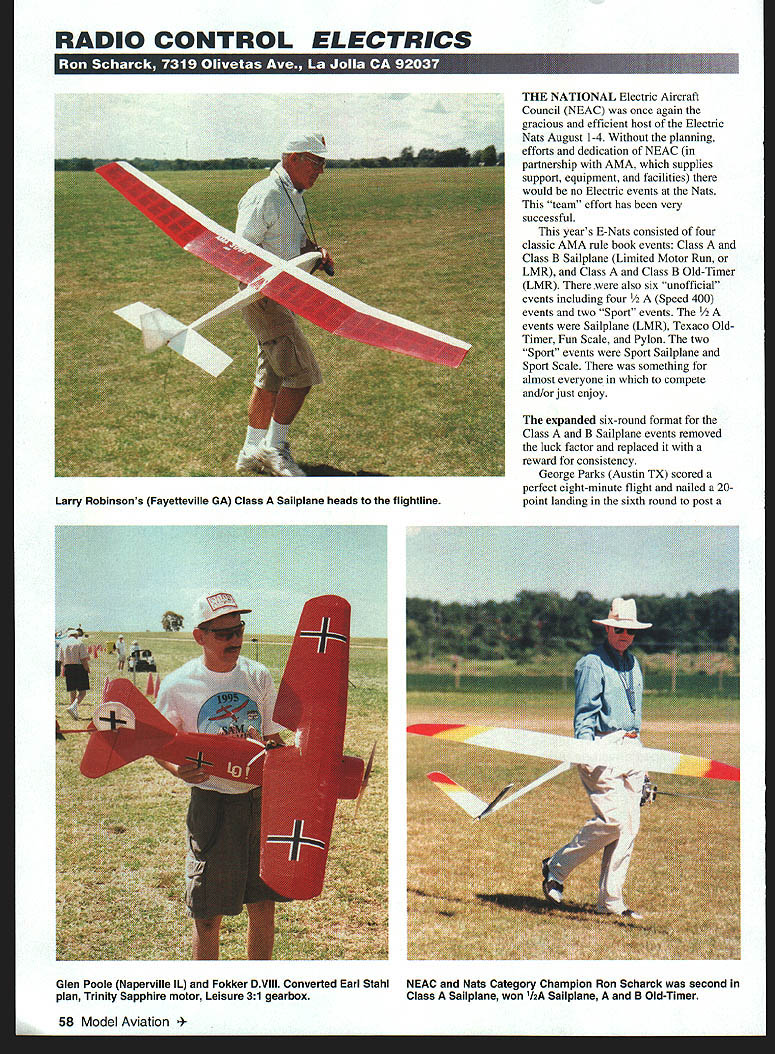
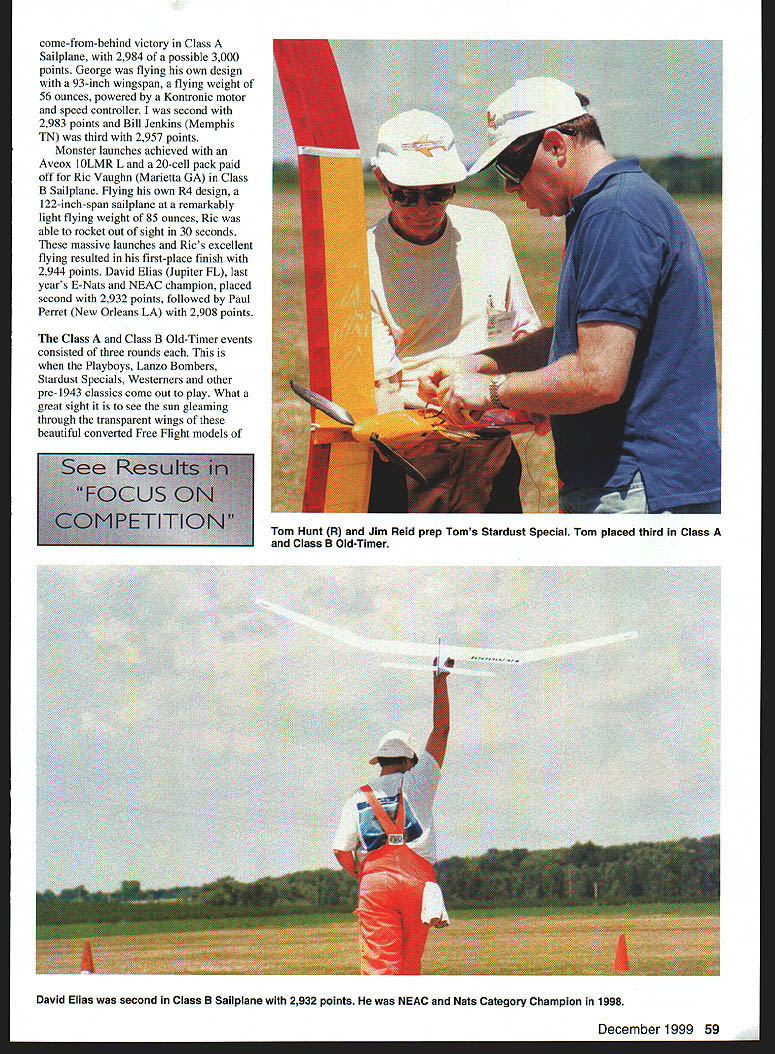
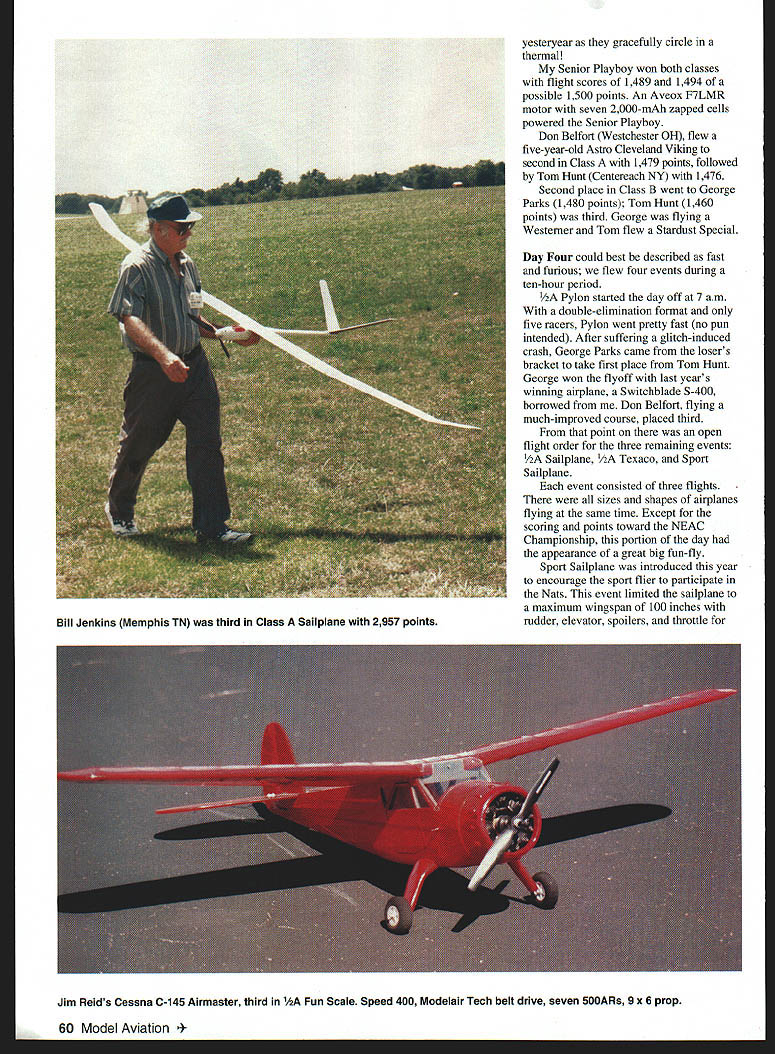
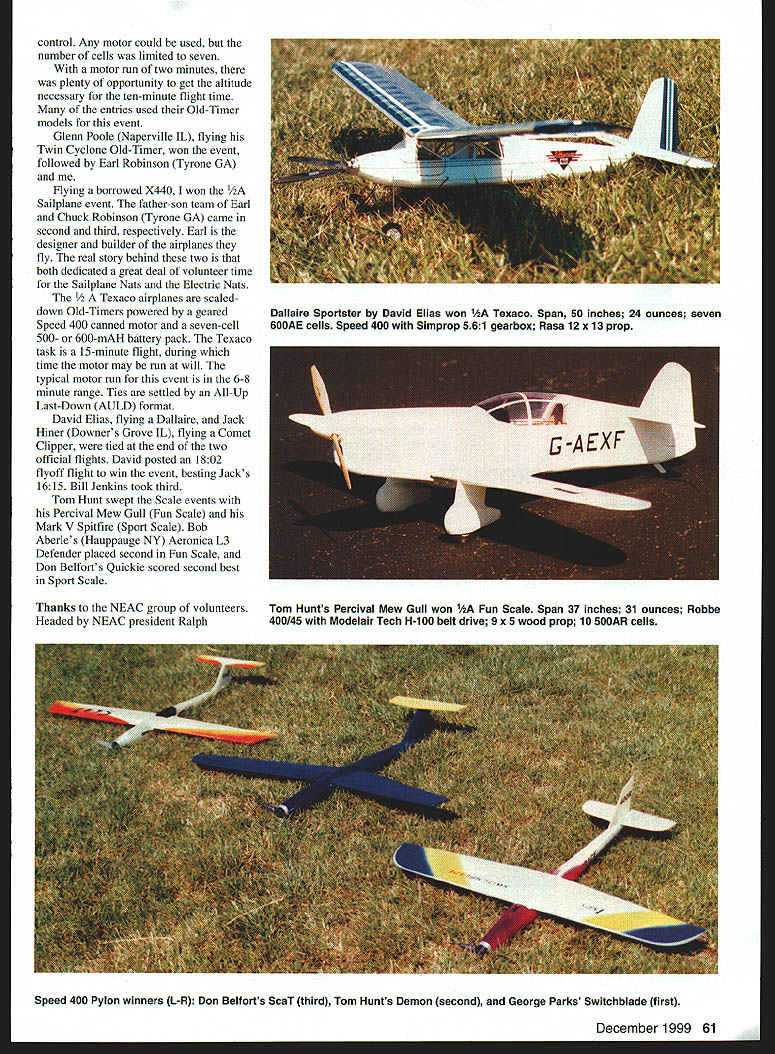
George Parks (Austin, TX) posted a come‑from‑behind victory with 2,984 of a possible 3,000 points. He flew his own design (93‑inch wingspan, 56‑ounce flying weight) powered by a Kontronic motor and speed controller. Bill Jenkins (Memphis, TN) was second with 2,983 points; third place scored 2,957 points.
Class B Sailplane
Monster launches paid off in Class B. Ric Vaughn (Marietta, GA) flew his R4 design (122‑inch span, 85‑ounce flying weight) using an Aveox 10 LMR motor and a 20‑cell pack to achieve 30‑second launches and a first‑place total of 2,944 points. David Elias (Jupiter, FL), last year’s E‑Nats and NEAC champion, placed second with 2,932 points; Paul Perret (New Orleans, LA) was third with 2,908 points.
Old‑Timer (Class A & B)
The Class A and B Old‑Timer events were three‑round contests featuring Playboys, Lanzo Bombers, Stardust Specials, Westerners, and other pre‑1943 classics — beautiful converted Free Flight models.
- The author’s Senior Playboy won both classes with flight scores of 1,489 and 1,494 (possible 1,500). It was powered by an Aveox F7 LMR motor and seven 2,000‑mAh cells.
- Class A: 2nd — Don Belfort (Westchester, OH) flying an Astro Cleveland Viking (1,479); 3rd — Tom Hunt (Centereach, NY) (1,476).
- Class B: 2nd — George Parks (1,480); 3rd — Tom Hunt (1,460). George flew a Westerner; Tom flew a Stardust Special.
Day Four — 1/2A and Sport Events
Day Four was fast and furious: four events over a ten‑hour period.
1/2A Pylon
- Started at 7 a.m. with a double‑elimination format and five racers.
- After a glitch‑induced crash, George Parks came through the losers bracket to win the flyoff, flying last year’s winning Switchblade S‑400 borrowed from the author. Don Belfort placed third.
Remaining 1/2A and Sport Events
The remaining events (1/2A Sailplane, 1/2A Texaco, Sport Sailplane) ran with open flight order. Each event consisted of three flights; many sizes and shapes flew simultaneously, making this portion of the day feel like a large fun‑fly aside from championship scoring.
Sport Sailplane was introduced to encourage sport fliers to participate. Rules included:
- Maximum wingspan: 100 inches.
- Control: rudder, elevator, spoilers, and throttle allowed.
- Motor: any motor allowed, but number of cells limited to seven.
- Motor run: typically two minutes to obtain altitude for a 10‑minute flight.
Glenn Poole (Naperville, IL), flying a Twin Cyclone Old‑Timer, won the Sport Sailplane event. Earl Robinson (Tyrone, GA) was second; the author placed third.
1/2A Sailplane
The author won flying a borrowed X440. Earl and Chuck Robinson (Tyrone, GA) placed second and third, respectively. The Robinsons contributed significant volunteer time to the Sailplane Nats and the Electric Nats.
1/2A Texaco
1/2A Texaco models are scaled‑down Old‑Timers powered by a geared Speed 400 and a seven‑cell 500–600 mAh pack. The task is a 15‑minute flight during which the motor may be run at will; typical motor run is 6–8 minutes. Ties are settled by an All‑Up Last‑Down (AULD) flyoff.
- David Elias (flying a Dallaire) and Jack Hiner (Downers Grove, IL, flying a Comet Clipper) were tied after the official flights. In the flyoff, David posted an 18:02 to Jack’s 16:15 and won the event. Bill Jenkins took third.
Scale Events
Tom Hunt swept the Scale events:
- Fun Scale: 1st — Tom Hunt (Percival Mew Gull); 2nd — Bob Aberle (Hauppauge, NY) (Aeronca L3 Defender).
- Sport Scale: 1st — Tom Hunt (Mark V Spitfire); 2nd — Don Belfort (Quickie).
Attendance, Promotion, and the Future
At first glance, this year’s turnout of 25 registrants was disappointing compared to 36 in 1997 and 42 in 1998. Two primary reasons are evident:
- Promotion — The increases in 1997–1998 were largely due to the promotion efforts of Doug Ward (NEAC president and E‑Nats CD). This year’s drop reflects a lack of comparable promotion.
- Competition format — The E‑Nats has moved from a fun‑fly feel toward a more serious contest. Most electric fliers are sport fliers who prefer fun‑fly formats; the Nats is AMA’s national contest and will naturally be more competitive.
The good news: the core group of contest pilots is growing and competition is improving. To build attendance and capability, NEAC should:
- Aggressively market the E‑Nats.
- Promote AMA rule‑book events at the local level in concert with clubs, giving more pilots an entry point into electric competition.
- Consider making the four official AMA rule‑book events five‑round contests to enhance the E‑Nats’ credibility as a national class contest.
- Continue to include NEAC "unofficial" events to offer varied flying experiences with modest expense.
By promoting local competition and nurturing competitive pilots, NEAC can strengthen future E‑Nats participation and equipment levels.
Acknowledgments
Thanks to the NEAC volunteers, headed by NEAC president Ralph Weaver, for a great job. Editor’s note: special thanks to Ron Farkas for valuable photographic assistance.
Transcribed from original scans by AI. Minor OCR errors may remain.

