
Radio Control: Electrics
Bob Kopski
Introduction
Before we get into some electric technical goodies, let's look at a few photos and reports I've received in recent weeks. Each is significant in its own special way.
Solar-powered glider (Brian Bailie)
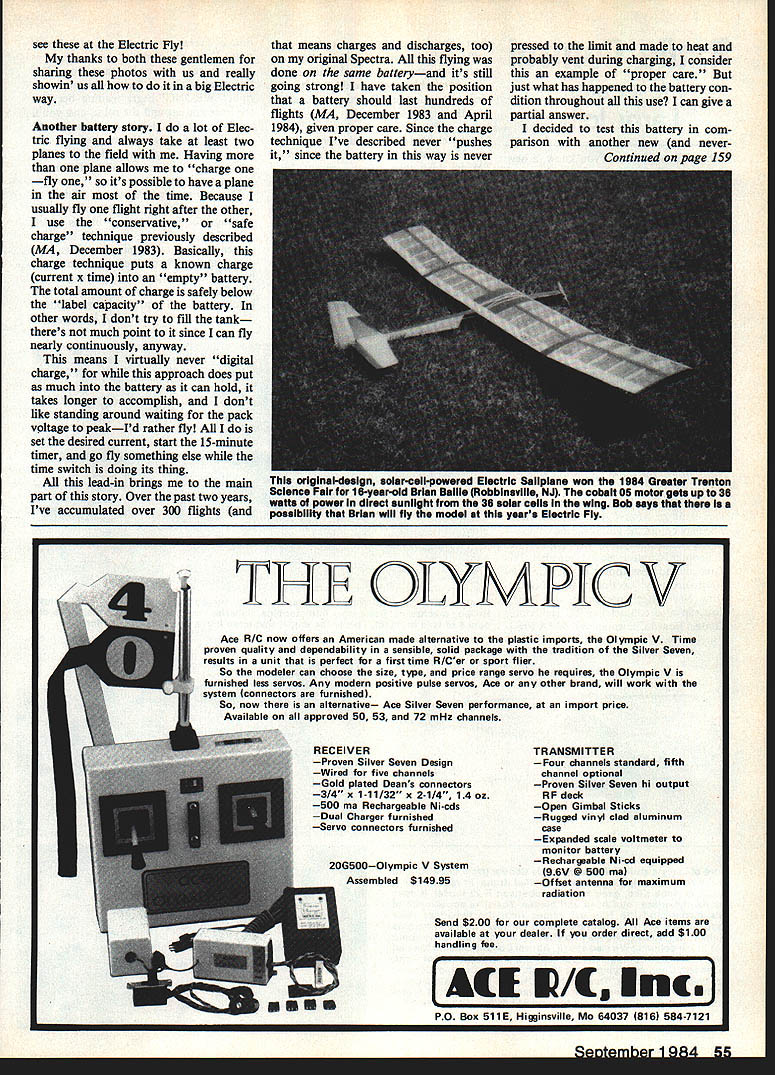
First, from Brian Bailie (Robbinsville, NJ), is an original glider design with a big difference—it's solar-powered. While we've heard of solar-powered accomplishments before, those usually have high-tech, big-dollar backing. Brian is a 16‑year‑old high school student, and the plane won first place in the Greater Trenton Science Fair. What I'm wondering is what the plane is going to get him in the "All Up, Last Down" event at the 1984 Electric Fly!
Details:
- Wing: 17% computer-designed airfoil
- Weight: 59 oz.
- Wing loading: 7.5 oz./sq. ft.
- Motor: Astro 05 Cobalt
- Power source: 36 solar cells on the wing
- Solar cells develop about 36 watts in direct sunlight
Using my "Rule of Thumb One" (MA, April 1984): Watts = Weight (lbs.) × Wing Loading (oz./sq. ft.)
Calculation:
- Weight in lbs = 59 / 16 = 3.6875 lb
- Watts = 3.6875 × 7.5 ≈ 28 W
Since 36 W > 28 W, it should fly—and Brian says it does. Part of the 59 oz. is an on‑board battery pack (likely a temporary backup). Flight without the backup battery should improve performance. Brian didn't give the plane a name. Congratulations, Brian—looking forward to seeing it fly.
Dr. John Mountjoy's fleet
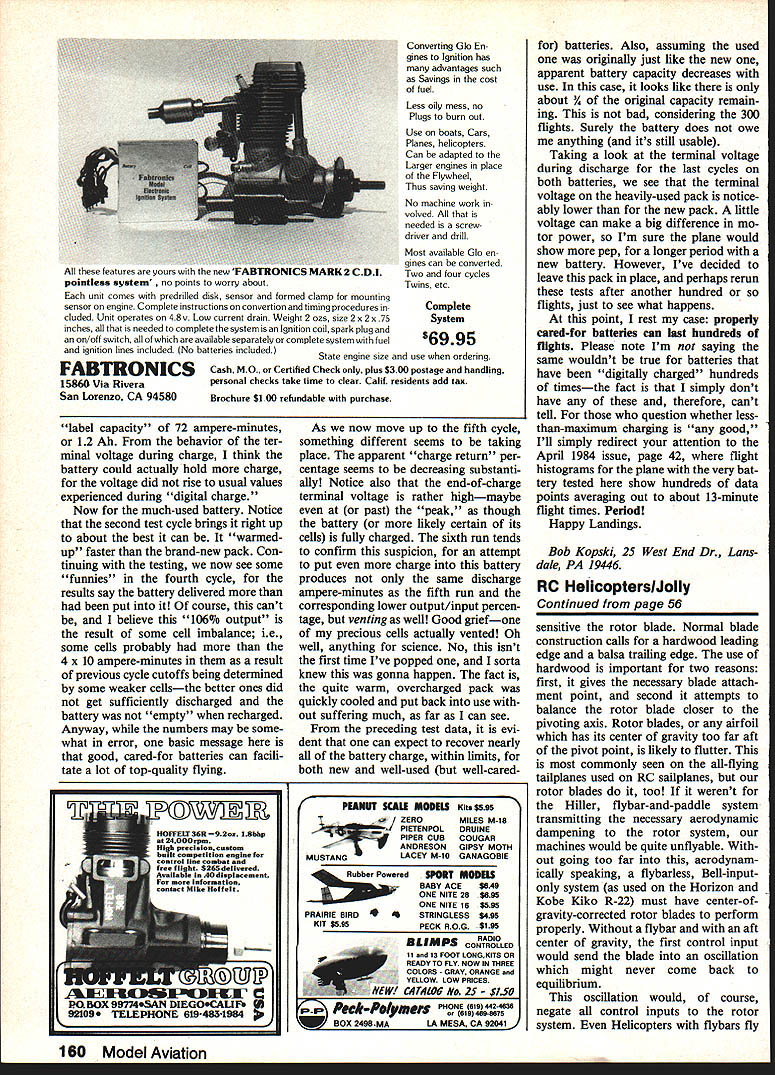
Next, from Dr. John Mountjoy (Winston‑Salem, NC), we have an impressive fleet of Electrics—all built over the past year and a half. The doctor reports these all fly beautifully. Take heart if you're still on your first electric!
Fleet highlights:
- Wasp: seven cells, Cobalt 05, 7×4 prop (impressive acrobatic craft; reportedly to be kitted by Leisure)
- Glider (Electricus): Cobalt 05, 7×4 prop, seven 800 mAh cells
- Playboy: six 1.2 Ah cells powering a Leisure 2.5:1 gear system
- Another model: Leisure 3.6:1 gear turning a Robbe prop
- Flying Quaker: Jomar SC‑1 speed control, seven cells
- Train‑Air 20: Cobalt 15 with a Jomar SC‑1 between the motor and 12 cells
The doctor didn't provide weights, but all except the Playboy are covered with Micafilin—a very light covering—so Dr. John clearly watches electric weight carefully.
Charging technique and field practice
When electric flying, always take at least two planes to the field. Having two planes allows one to charge while the other is flying, enabling nearly continuous flying.
My conservative, safe charge technique (described previously in MA, December 1983):
- Use a known charge current and time so that charge current × time = amount put into an empty battery, kept safely below the labeled capacity.
- Don't try to "fill the tank" completely; there's little point since you can fly nearly continuously.
- Avoid frequent use of digital charge modes for field use; they tend to put in as much charge as the battery can hold but take longer.
- Practical approach: set the desired current, start a 15‑minute timer, go fly, and let the charger do its thing.
This approach keeps the battery from being stressed or heated and promotes long life.
Battery comparison test — purpose and assumptions
Over the past two years I've accumulated over 300 flights on one original Spectra flying pack, and it's still going strong. I hold that a battery should last hundreds of flights with proper care (MA, December 1983; April 1984). Since adopting the conservative charge technique, the pack has never been pushed to its limits.
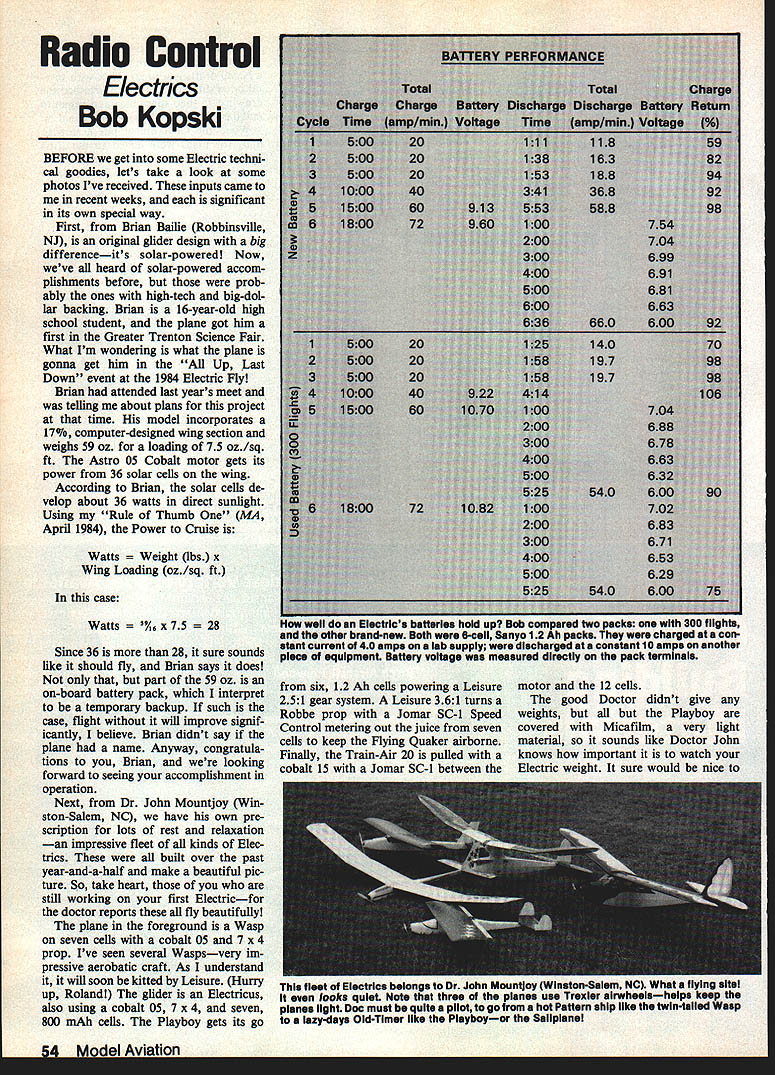
To get a partial answer about battery condition over many flights, I tested the heavily used pack against a brand‑new pack. Assumptions and context:
- Both packs: six‑cell Sanyo 1.2 Ah packs (1.2 Ah = 72 ampere‑minutes)
- The used pack had about 300 flights; I have no break‑in data from when it was new, so I assume the used pack, when new, was like the new pack used in the test. This allows an estimate of degradation.
- Objective: determine how much the used pack has degraded from use and whether properly cared‑for batteries can still perform well.
Test procedure
- Six charge/discharge cycles were performed on each pack.
- Charging:
- Constant current: 4.0 A (regulated lab supply)
- Charge time varied across cycles (from relatively short to a time equal to label capacity)
- Discharging:
- Constant discharge current: 10.0 A (electronically regulated load)
- Discharge cutoff: 1.0 V per cell = 6.0 V total for six‑cell packs
- Battery voltage was measured directly at the pack terminals during discharge.
- No attempt was made to identify which individual cells caused terminal voltage drops; cell imbalance was noted as a likely factor in the used pack.
Test results and analysis
- New pack behavior:
- The familiar "first flight's not so good" phenomenon appeared: initial cycles deliver less, then improve over the first few charges (a "warm‑up" effect).
- After the initial cycles, the apparent charge returned approached the charge input, even up to a sixth cycle where input equaled the labeled capacity (72 ampere‑minutes). Terminal voltage behavior suggested the battery might hold more than the label suggests.
- Used pack behavior:
- The used pack warmed up faster—reaching near-best performance by the second cycle.
- In one cycle the used pack appeared to deliver more ampere‑minutes than were put in (e.g., 106% output). This is impossible and likely due to cell imbalance: weaker cells determined prior cutoffs, leaving stronger cells less discharged and thus partially charged when recharged.
- By the fifth cycle, apparent charge return percentage decreased substantially. End‑of‑charge terminal voltage was rather high—suggesting certain cells were fully charged or even past peak.
- On the sixth run, attempting to put even more charge into the used pack produced the same discharge ampere‑minutes as the fifth run, a lower output/input percentage, and venting of a cell. One cell vented (overpressure) during this overcharge attempt. The pack was warm and overcharged, then cooled and returned to use without obvious lasting damage.
- Overall capacity:
- Assuming the used pack started out like the new one, apparent capacity on the used pack decreased to about 3/4 of the original after ~300 flights. This is not bad considering usage; the pack remains usable.
- Terminal voltage under load:
- The heavily used pack showed noticeably lower terminal voltage during discharge than the new pack. Lower voltage reduces motor power and flight performance.
- Practical takeaway:
- Properly cared‑for batteries can recover nearly all charge within limits and can handle hundreds of flights.
- Cell imbalance can produce misleading apparent results; individual cell behavior matters.
- Overcharging can cause venting—so conservative charge limits are wise in field practice.
Conclusions
- Good, carefully managed charging practice promotes long battery life. The conservative, timed charge method prevents stressing cells and appears to allow many hundreds of flights from a pack.
- A used pack may retain significant useful capacity (in this case roughly 75%) after 300 flights but will show reduced terminal voltage and thus somewhat reduced performance.
- For those asking whether less‑than‑maximum charging is acceptable: see MA, April 1984, page 42, where flight histograms for the plane using the tested battery show hundreds of data points averaging about 13‑minute flight times. The practical flight record supports conservative charging.
Happy landings.
Bob Kopski 25 West End Dr., Lansdale, PA 19446
Transcribed from original scans by AI. Minor OCR errors may remain.

