
RADIO CONTROL ELECTRICS
Bob Kopski, 25 West End Dr., Lansdale PA 19446
Electric Connection Service (ECS) requests
- Fred Marion (511 Liberty St., Lawton MI 49065; Tel.: (616) 624-1195) wrote to describe a small electric club based in Kalamazoo, Michigan, called ERM (Electric Powered Radio Control Model Airplane Club). The club has five members and publishes a sizable monthly newsletter that includes selected extracts (published with permission) from Model Airplane News, Sailplane & Electric Modeler, and Flying Models. Newsletter distribution is 15 — three times larger than the club. Contact Fred for more info or a sample newsletter (tell him Bob sent you).
- Craig Mitchell (8383 Twin Lakes Dr. S., Mobile AL 36695; Tel.: (251) 633-6875) is seeking other electric aeromodelers in his area. Craig has approximately 10 airplanes but needs help with flying. E-fliers in the Mobile area can help Craig by getting in touch with him. The ECS is an exclusive service of this column and is available to anyone seeking electric fliers nearby. If you are an individual or an E-club looking to connect with others, send a request and your info will be published in an upcoming column.
Electric Free Flight — a Fubar FFE
Paul, a full-scale pilot and routine spectator at a local E-flying site, often drifts into stories of his youth flying 1/2A Fubar Free Flight Gas (FFG) models — a 1950s FFG contest design. He told how he'd lose one and then get in his Cessna to go find it. He wanted to build another Fubar but wasn't able to for various reasons, and I decided to surprise him with a completed reproduction.
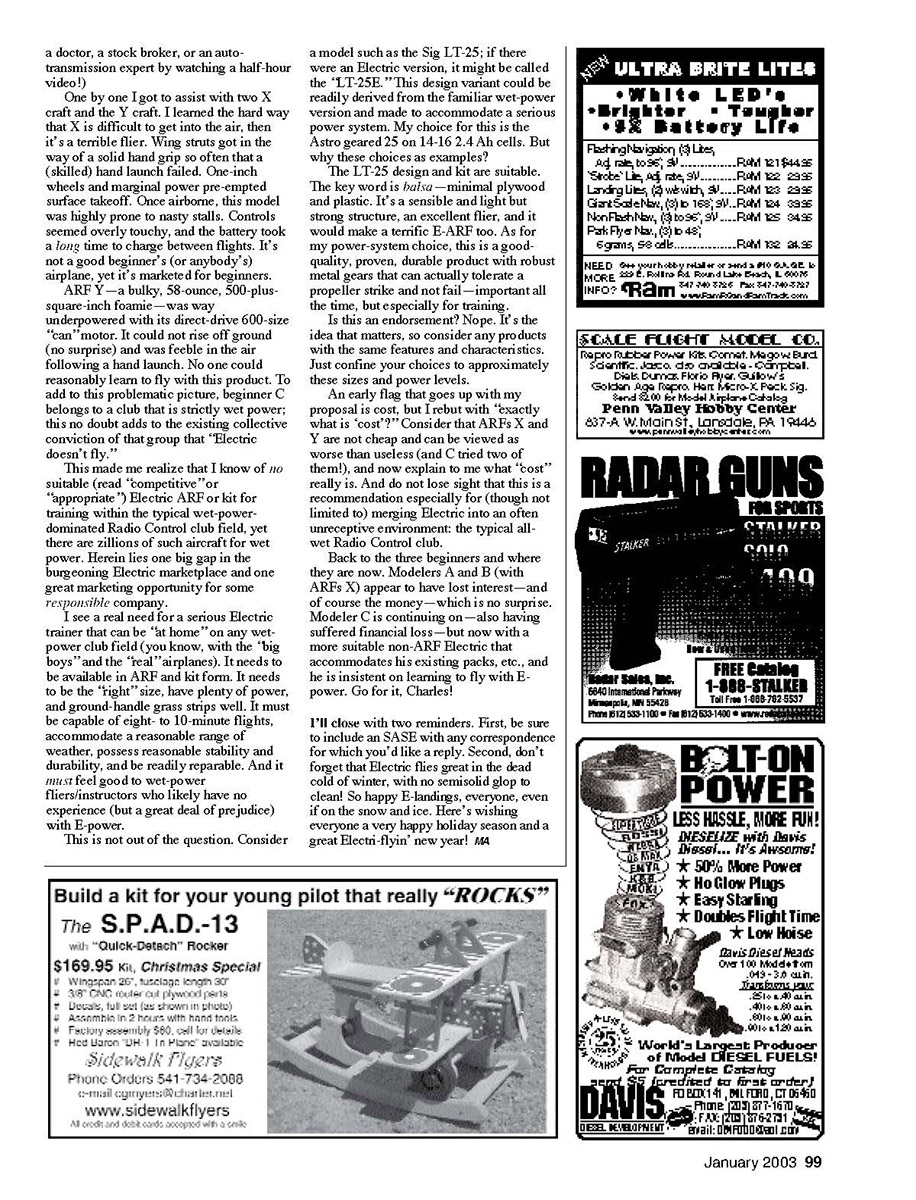
I bought a Campbell's Custom Kits reproduction of the Midwest Fubar kit from my local hobby shop (Penn Valley Hobby Center in Lansdale, which stocks a huge selection of FFG and rubber kits and offers mail order). FFG was my specialty in the 1950s, so I knew the model would fly well, but I refused to use glow or gas power again. The Fubar had to be an electric Free Flight (FFE), which raised the usual questions: which motor, which battery, how to mount things, etc.
Early goals:
- Replace the original skyrocketing climb with a gentler one.
- Provide an adjustable motor timer.
- Install a motor battery with capacity for several flights without recharging.
- Use MonoKote instead of tissue and dope for added durability.
I estimated finished weight, applied Electric Rules of Thumb, and began construction.
Motor mount solution
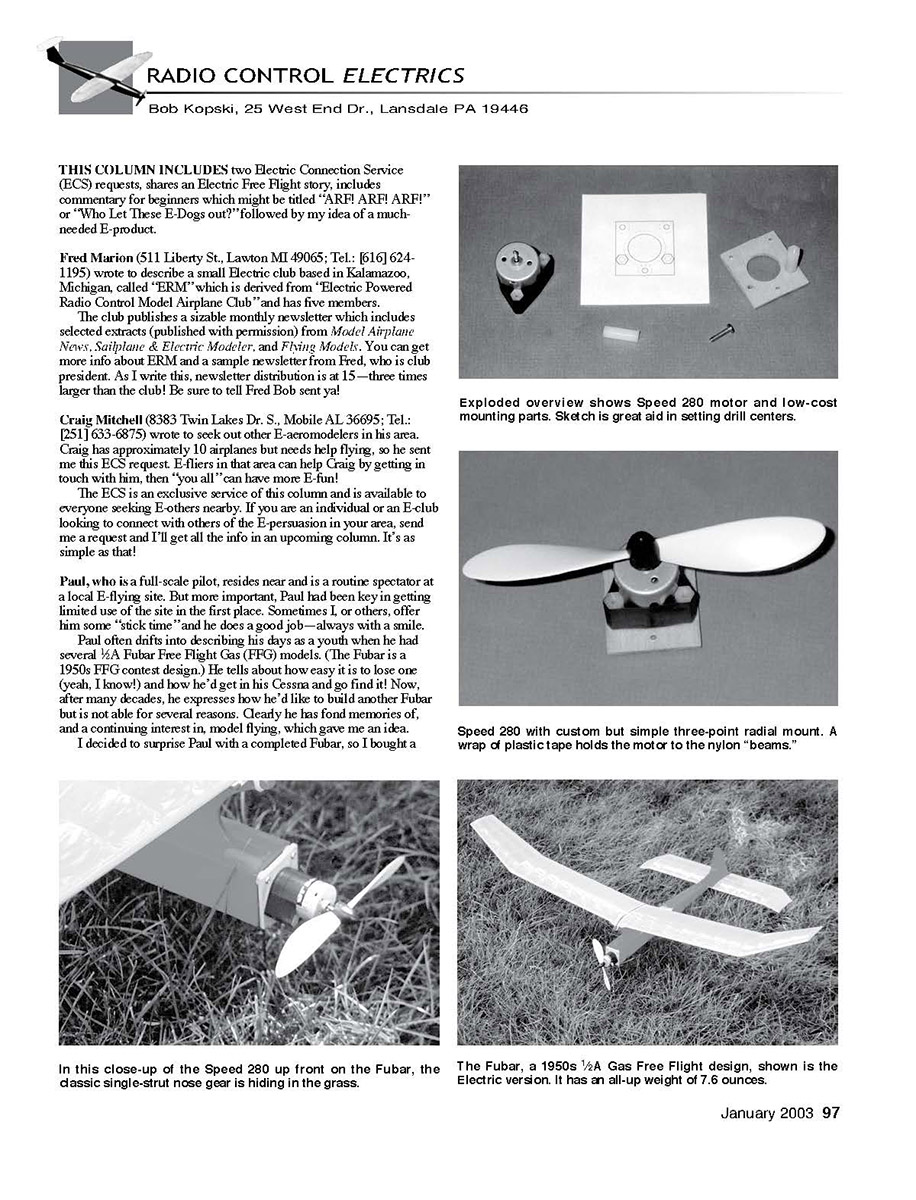
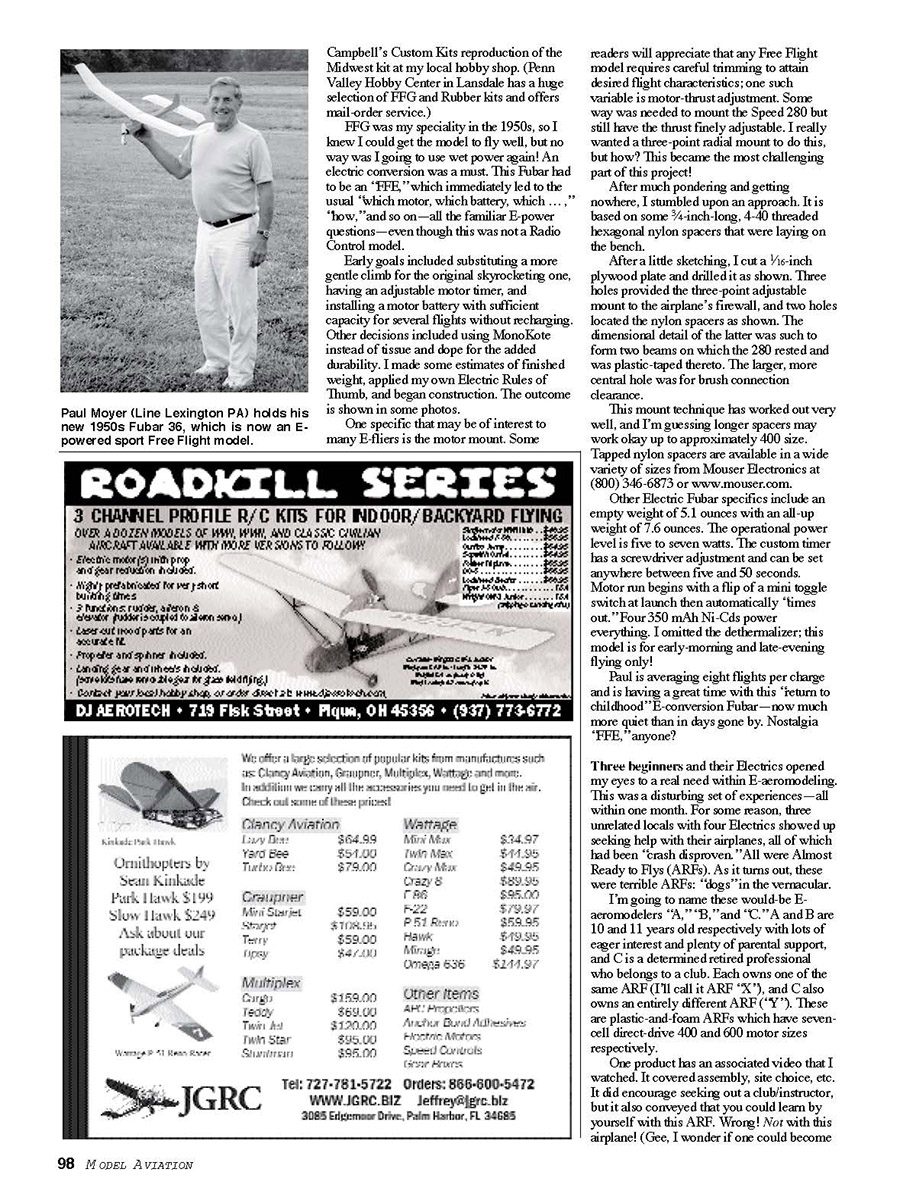
Free Flight requires careful trimming, and motor-thrust adjustment is one such variable. I wanted a three-point radial mount for a Speed 280 motor but needed adjustability. The solution came from 3/4-inch-long, 4-40 threaded hexagonal nylon spacers found on the bench.
After sketching, I cut a 1/16-inch plywood plate and drilled it for:
- Three holes to provide a three-point adjustable mount to the firewall.
- Two holes to locate the nylon spacers so they formed two beams on which the Speed 280 rested; the motor was taped to those beams.
- A larger central hole for brush-connector clearance.
This mount technique worked well. Longer spacers may work up to approximately 400-size motors. Tapped nylon spacers are available in many sizes from Mouser Electronics: (800) 346-6873 or www.mouser.com.
Fubar FFE particulars
- Empty weight: 5.1 ounces; all-up weight: 7.6 ounces.
- Operational power level: about 5–7 watts.
- Custom timer: screwdriver adjustment, settable from about 5 to 50 seconds.
- Motor run begins with a flip of a mini toggle switch; a launch then automatically “times out.”
- Power: four 350 mAh NiCd cells.
- No de-thermalizer installed; this model is intended for early-morning and late-evening flying only.
- Paul averages eight flights per charge; the plane is much quieter than the original gas version.
Nostalgia FFE? Paul is having a great time with his return-to-childhood electric Fubar.
ARF! ARF! ARF! — Who let these E-dogs out?
Three beginners and their electrics showed me a real need in E-aeromodeling. Within one month, three unrelated locals (two kids and a retired professional club member) brought four electrics for help — all were crash-prone, shrunken, poor-performing Almost Ready to Flys (ARFs). I’ll call the modelers A, B, and C.
- A and B are 10 and 11 years old, energetic, with parental support. Each owns the same ARF (call it ARF “X”).
- C is a determined retired professional and club member who owns that same ARF X and also another ARF (call it ARF “Y”).
- These plastic-and-foam ARFs used seven-cell packs with direct-drive 400- or 600-size motors.
One ARF product came with a video covering assembly and site choice. It encouraged finding a club or instructor but also implied you could learn by yourself — which proved wrong for these models.
What I saw:
- ARF X: difficult to get into the air and a terrible flier. Wing struts interfered with a solid hand grip, so even skilled hand launches failed. One-inch wheels and marginal power prevented surface takeoff. Once airborne the model was prone to nasty stalls, controls were overly touchy, and batteries took a long time to charge between flights. Marketed for beginners, it is not suitable.
- ARF Y: a bulky, roughly 58-ounce, 500-plus-square-inch foamie that was underpowered with its direct-drive 600-size "can" motor. It could not rise off the ground and was feeble after a hand launch. Not suitable for learning to fly.
- Beginner C belongs to a strictly glow/gas-power club, reinforcing that “Electric doesn’t fly” prejudice.
This exposed a major gap in the electric market: there is no widely available, appropriate electric ARF or kit for training at a typical wet-power RC club field.
Proposal: a serious electric trainer
There is a real need — and marketing opportunity — for a serious electric trainer that fits comfortably into wet-power club fields. Requirements:
- Available in ARF and kit form.
- “Right” size to blend in with club aircraft.
- Plenty of power and good ground handling on grass strips.
- Capable of 8–10 minute flights.
- Tolerant of a reasonable range of weather.
- Stable, durable, and readily repairable.
- Acceptable to wet-power instructors and fliers who may be prejudiced against electric power.
A practical example: a Sig LT-25 variant converted to electric (an "LT-25E"). The LT-25’s balsa-based, minimal-plywood/plastic structure is light, strong, and an excellent flier — a good foundation for an electric trainer. For power, consider a geared .25-size motor (Astro geared 25) and an appropriate pack (the column suggested 14–16 cells of 2.4 Ah), or equivalent systems with similar thrust and endurance. The key is a proven, durable geared motor (metal gears) that can tolerate a prop strike — important for training.
Cost may be raised as a concern, but consider that poor ARFs X and Y were neither cheap nor useful. Cost should be weighed against usefulness, training value, and longevity.
Where the three beginners are now
- Modelers A and B (with ARF X) appear to have lost interest — and the money — which is unsurprising.
- Modeler C persevered despite financial loss and now flies a more suitable non-ARF electric that accommodates his existing packs. He is determined to learn to fly with electric power.
Closing reminders
- Include a SASE with any correspondence for which you'd like a reply.
- Electric flying is great in the dead cold of winter — no semisolid glop to clean off gear. Happy E-landings, everyone, even if onto snow and ice.
MA
Transcribed from original scans by AI. Minor OCR errors may remain.

