
RADIO CONTROL ELECTRICS
Bob Kopski, 25 West End Dr., Lansdale PA 19446
This column covers
- Comments on the 2002 NEAT (Northeast Electric Aircraft Technology) Fair
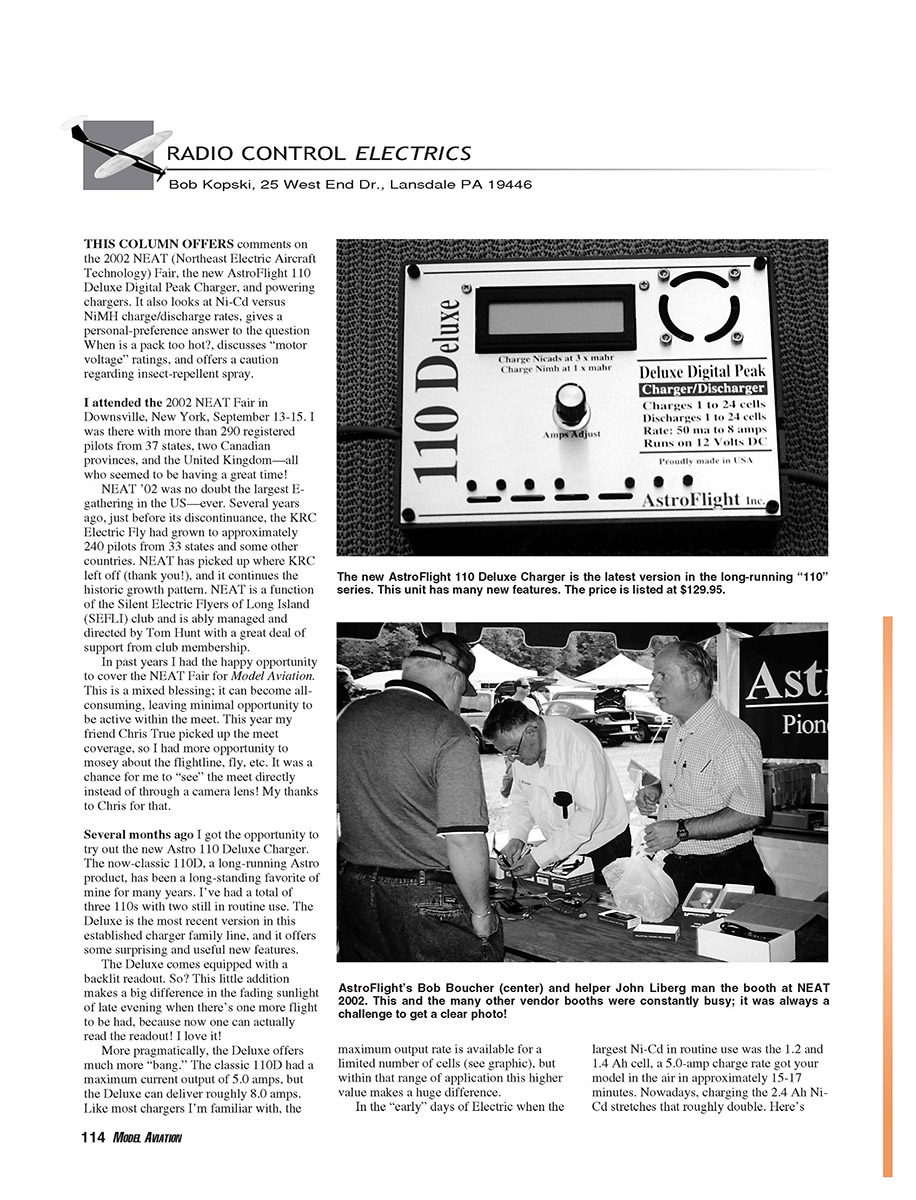
- The new AstroFlight 110 Deluxe digital peak charger
- Powering chargers
- Ni-Cd versus NiMH charge/discharge rates
- Personal-preference answer to "When is a pack too hot?"
- Motor voltage ratings
- A caution regarding insect-repellent spray
NEAT '02
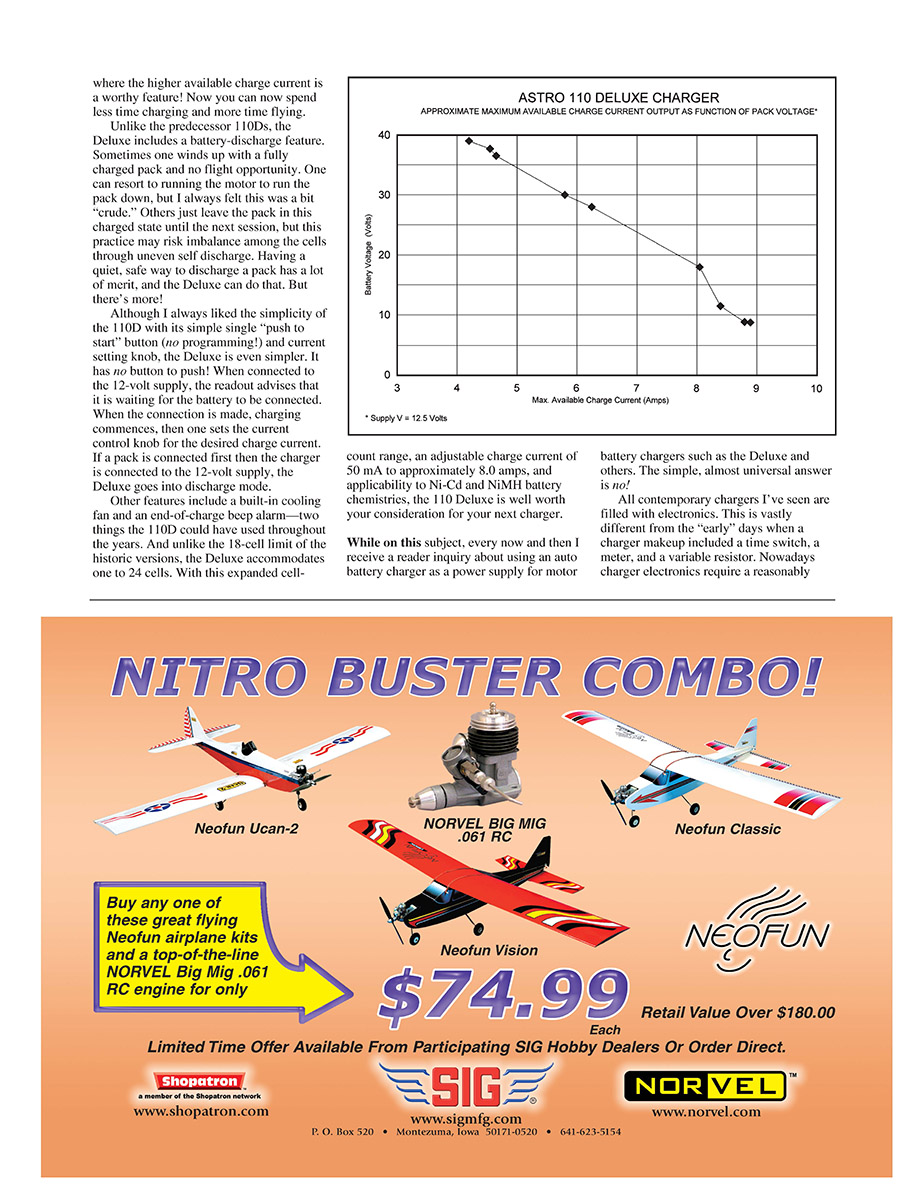
I attended the 2002 NEAT Fair in Downsville, New York, September 13–15. I was there with more than 290 registered pilots from 37 states, two Canadian provinces, and the United Kingdom — all of whom seemed to be having a great time!
NEAT '02 was no doubt the largest electric gathering in the U.S. ever. Several years ago, just before its discontinuance, the KRC Electric Fly had grown to approximately 240 pilots from 33 states and other countries. NEAT has picked up where KRC left off, and it continues the historic growth pattern. NEAT is a function of the Silent Electric Flyers of Long Island (SEFLI) club and is ably managed and directed by Tom Hunt with a great deal of support from club membership.
In past years I had the happy opportunity to cover the NEAT Fair for Model Aviation. This is a mixed blessing; it can become all-consuming, leaving minimal opportunity to be active within the meet. This year my friend Chris True picked up the meet coverage, so I had more opportunity to mosey about the flightline and fly. It was a chance for me to "see" the meet directly instead of through a camera lens. My thanks to Chris for that.
AstroFlight 110 Deluxe digital peak charger
Several months ago I got the opportunity to try out the new AstroFlight 110 Deluxe charger. The now-classic 110D has been a long-standing favorite of mine for many years; I’ve had a total of three 110s, with two still in routine use. The Deluxe is the most recent version in this established charger family and offers some surprising and useful new features.
The Deluxe comes equipped with a backlit readout. This little addition makes a big difference in the fading sunlight of late evening when there's one more flight to be had — now one can actually read the display.
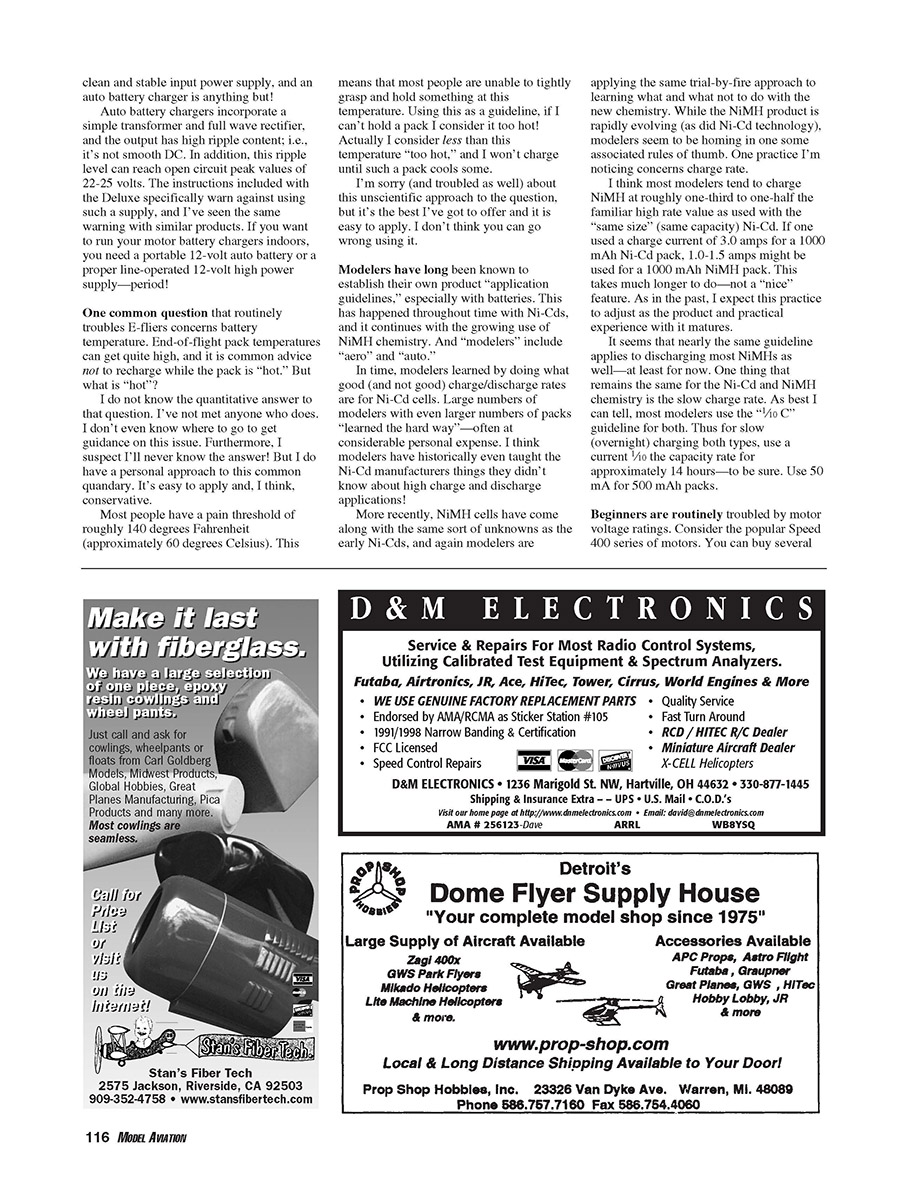
More pragmatically, the Deluxe offers much more output capability. The classic 110D had a maximum current output of 5.0 amps; the Deluxe can deliver roughly 8.0 amps. Like most chargers, the maximum output rate is available for a limited number of cells, but within that range this higher value makes a huge difference. In the early days of electric flight, the largest Ni-Cd cells in routine use were 1.2 and 1.4 Ah, and a 5.0-amp charge rate got a model in the air in about 15–17 minutes. Nowadays, charging a 2.4 Ah Ni-Cd stretches that time considerably. The higher available charge current is a worthy feature — you can spend less time charging and more time flying.
Unlike predecessor 110Ds, the Deluxe includes a battery-discharge feature. Sometimes you wind up with a fully charged pack and no flight opportunity. Running the motor to run the pack down feels crude, and leaving the pack fully charged risks cell imbalance from uneven self-discharge. Having a quiet, safe way to discharge a pack has a lot of merit, and the Deluxe can do that.
Although I liked the simplicity of the 110D — a single "push to start" button (no programming) and a current-setting knob — the Deluxe is even simpler. It has no button to push: when connected to the 12-volt supply, the readout advises that it is waiting for the battery. When the battery is connected, charging commences and you set the current control knob for the desired charge current. If a pack is connected first and then the charger is connected to the 12-volt supply, the Deluxe goes into discharge mode.
Other features include a built-in cooling fan and an end-of-charge beep alarm — two things the 110D could have used. And unlike the historic 18-cell limit, the Deluxe accommodates up to 24 cells. With this expanded cell-count range, an adjustable charge current of about 50 mA to approximately 8.0 amps, and applicability to Ni-Cd and NiMH chemistries, the 110 Deluxe is well worth considering for your next charger.
Powering chargers
I occasionally receive reader inquiries about using an automotive battery charger as a power supply for motor battery chargers such as the Deluxe. The simple, almost universal answer is no.
Contemporary chargers are full of electronics and require a reasonably stable, regulated DC input. An automotive battery charger is not a clean and stable input supply. Auto chargers typically use a simple transformer and full-wave rectifier; the output has high ripple content and is not smooth DC. This ripple can reach open-circuit peak values of 22–25 volts. The instructions for the Deluxe specifically warn against using such a supply, and I’ve seen the same warning with similar products.
If you want to run your motor battery chargers indoors, use either a charged portable 12-volt automotive battery or a proper, line-operated 12-volt high-power regulated supply.
When is a pack too hot?
A common question among electric fliers concerns battery temperature. End-of-flight pack temperatures can get quite high, and advice often says not to recharge while the pack is "hot." But what is "hot"?
I do not know a quantitative answer. I haven't met anyone who does, and I don't even know where to go to get authoritative guidance. I suspect we may never have a precise universal number. However, I use a simple, conservative, and easily applied personal rule of thumb.
Most people have a pain threshold of roughly 140 °F (about 60 °C). That means most people cannot tightly grasp and hold something at this temperature. Using that guideline: if I cannot comfortably hold a pack, I consider it too hot to charge and I wait for it to cool. In practice I often use a lower threshold and will not charge until the pack has cooled noticeably.
I realize this is unscientific, but it's an easy rule to apply and is conservative. I don't think you can go wrong using it.
Ni-Cd versus NiMH charge/discharge rates
Modelers have long established their own product application guidelines, especially with batteries. This happened with Ni-Cd and continues with NiMH chemistry. Modelers (including aero and auto folks) learned by doing what good — and bad — charge/discharge practices were for Ni-Cd cells, often at considerable personal expense. In many cases modelers even taught Ni-Cd manufacturers things they didn’t know about high charge and discharge applications.
NiMH cells have arrived with similar unknowns, and again modelers are discovering what to do by practical experience. Some emerging rules of thumb concern charge rate.
I think most modelers tend to charge NiMH at roughly one-third to one-half the familiar high-rate value used with a same-capacity Ni-Cd. For example, if you used 3.0 amps for a 1,000 mAh Ni-Cd pack, 1.0–1.5 amps might be used for a 1,000 mAh NiMH pack. This takes much longer — not a nice feature — but I expect practices to evolve as the products and experience mature.
A similar guideline seems to apply to discharging most NiMHs, at least for now. One thing that remains the same for both Ni-Cd and NiMH is the slow charge rate guideline. Most modelers use the "10 C" guideline for slow (overnight) charging of both types: use a current equal to 1/10 the capacity for approximately 14 hours to be sure. For example, use 50 mA for a 500 mAh pack.
Motor voltage ratings
Beginners are routinely troubled by motor voltage ratings. Consider the popular Speed 400 series motors: you can buy several versions of the "same" motor with different operating voltages on the labels. Popular voltages include 6.0, 7.2, and 8.4 volts. But what does this mean?
Using any motor with a speed control — which most people do — immediately imposes a varying voltage on the motor. (Varying voltage is how one varies motor speed.) Just because a motor label says "6 volts" does not mean you must always apply 6.0 volts. The speed control actually delivers voltages from full pack level to zero. The number of cells determines the maximum voltage. For example, a five-cell pack is commonly called a "six-volt pack" (five cells × 1.2 V/cell = 6.0 V total).
Applying somewhat higher voltages is routine practice. Limiting motor current is far more important than strictly observing a labeled voltage. Using the Speed 400 example, it is generally accepted that exceeding about 10.0 amps dramatically shortens brush and commutator life; but exceeding the nominal cell count by one or two cells is of little consequence if you control current.
Since power input is voltage times current, increasing the voltage (with more cells) while holding a safe current level does increase motor input power. To do this safely, reduce propeller size (diameter, pitch, or both) or lower the gear ratio if you use a gearbox, thereby reducing propeller rpm. Use motor input current — rather than voltage — as your primary guideline.
There is, of course, a limit. Motor speed increases with applied voltage, and at some point shaft rpm can physically damage the motor. One common manifestation of too-high rpm is thrown windings: armature wire can be spun off an armature running too fast. The same damage can occur to commutator segments. Actual limits vary with motor design and quality, but I’ve never seen a motor that would not tolerate roughly 30% more than its rated label voltage. So, running a 6.0-volt Speed 400 on six or seven (and some run eight) cells usually won’t hurt it — provided you watch the current.
Insect-repellent caution
Insect repellent is often necessary on the flightline, given the nature of flying fields. However, I experienced an adverse consequence from its use. I somehow oversprayed my transmitter face and didn’t realize it until the next day; then I saw a light-gray speckle all over the black and chrome surfaces and the LCD faceplate.
This speckle does not wash off; it seems to be small permanently etched spots on the plastic surfaces, and the effect was most pronounced on the LCD screen. The only thing that helped was carefully using a light rubbing compound with a Dremel buffing wheel. I got most of the screen cleaned up (polished) that way, but speckling remains over the rest of the transmitter face. Beware overspray on plastic surfaces, especially LCDs.
Closing
So ends another column. Come on — happy springtime electric flying!
Please include an SASE with any correspondence for which you'd like a reply. Everyone who does so gets one.
Transcribed from original scans by AI. Minor OCR errors may remain.

