
RADIO CONTROL ELECTRICS
Bob Kopski 25 West End Dr., Lansdale PA 19446
Overview
This column shares remarkable reader input, looks at the 14-year-old Skyvolt with contemporary power, tells a tale of "natural selection," and continues the discussion of basic electrical terms and concepts.
Reader response to past projects
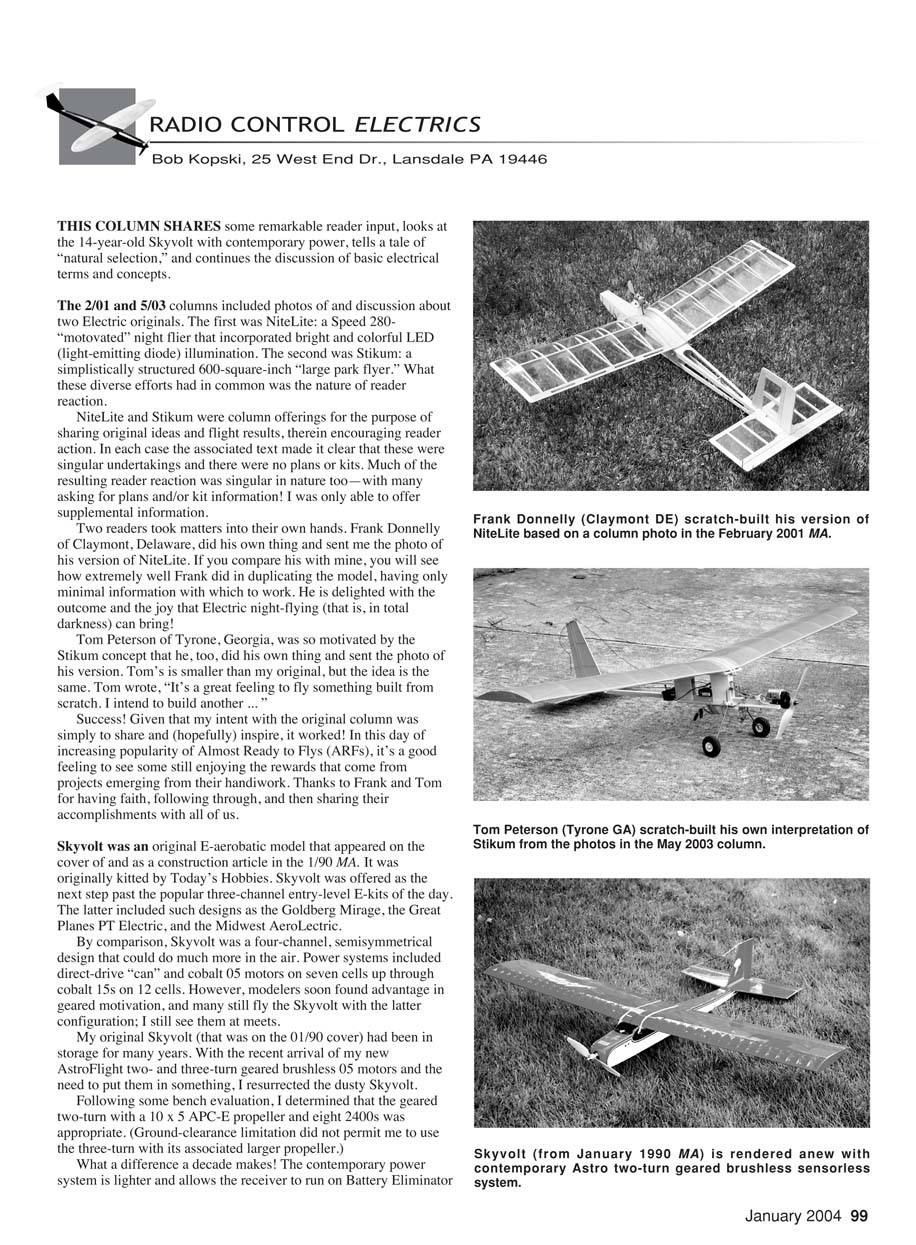
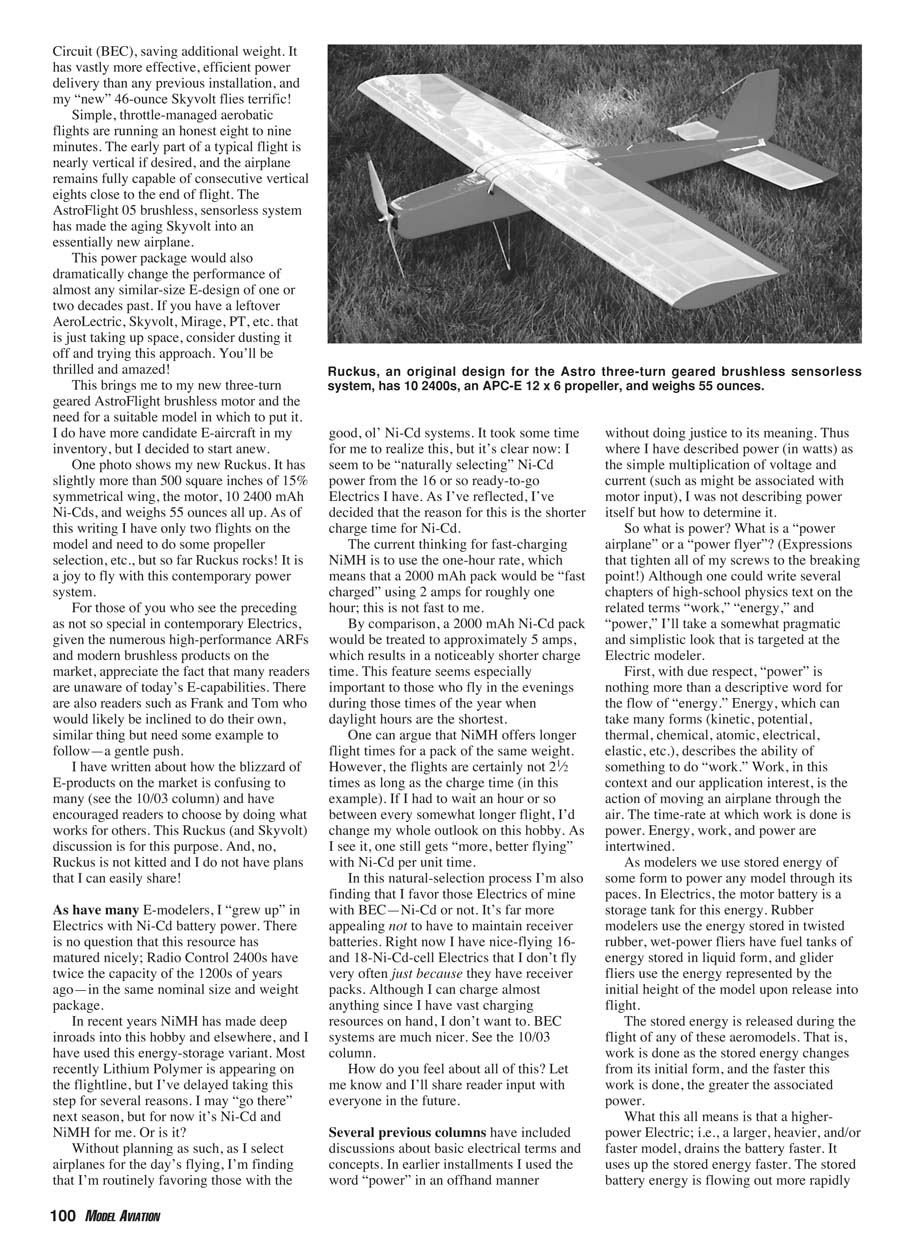
The 2/01 and 5/03 columns included photos of and discussion about two Electric originals:
- NiteLite: a Speed 280–motivated night flier that incorporated bright and colorful LED (light-emitting diode) illumination.
- Stikum: a simplistically structured 600-square-inch "large park flyer."
Both were column offerings intended to share original ideas and flight results and to encourage reader action. In each case the text made clear these were singular undertakings; there were no plans or kits. Much of the reader reaction, however, asked for plans and/or kit information. I was only able to offer supplemental information.
Two readers took matters into their own hands:
- Frank Donnelly, Claymont, Delaware, built his own version of NiteLite and sent a photo. With only minimal information, Frank duplicated the model extremely well and is delighted with the outcome and the joy of true night flying.
- Tom Peterson, Tyrone, Georgia, was motivated by the Stikum concept and built his own version (smaller than my original). Tom wrote: "It's a great feeling to fly something built from scratch. I intend to build another ..." Success — the intent to share and inspire worked.
In an era of increasing popularity of Almost Ready to Flys (ARFs), it's good to see people still enjoying the rewards of projects emerging from their own handiwork. Thanks to Frank and Tom for having faith, following through, and sharing their accomplishments.
Skyvolt resurrected with modern power
Skyvolt was an original E-aerobatic model that appeared on the cover of and as a construction article in the 1/90 MA. It was originally kitted by Today's Hobbies and offered as the next step past the popular three-channel entry-level E-kits of the day, such as:
- Goldberg Mirage
- Great Planes PT Electric
- Midwest AeroLectric
By comparison, Skyvolt was a four-channel, semisymmetrical design that could do much more in the air. Power systems originally included direct-drive "can" and cobalt 05 motors on seven cells up through cobalt 15s on 12 cells. Modelers soon found advantage in geared motivation, and many still fly Skyvolts with geared installations; I still see them at meets.
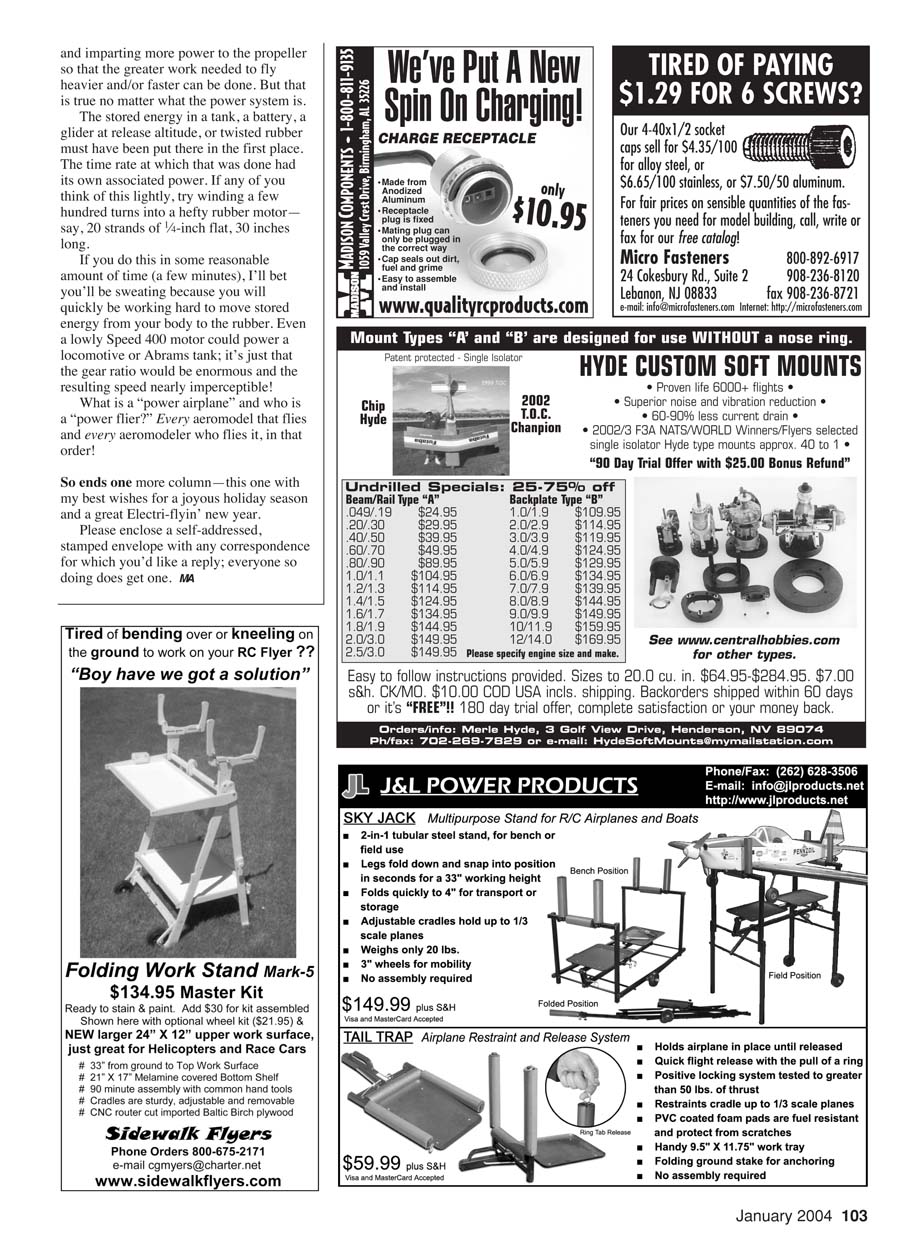
My original Skyvolt (the 01/90 cover plane) had been in storage for many years. With the recent arrival of new AstroFlight two- and three-turn geared brushless 05 motors and the need to put them in something, I resurrected the dusty Skyvolt.
After bench evaluation I determined that the geared two-turn with a 10 x 5 APC-E propeller and eight 2400 mAh Ni-Cd cells was appropriate. (Ground-clearance limitations did not permit me to use the three-turn with its associated larger propeller.)
What a difference a decade makes! The contemporary power system is lighter and allows the receiver to run on Battery Eliminator Circuit (BEC), saving additional weight. It has vastly more effective, efficient power delivery than any previous installation, and my "new" 46-ounce Skyvolt flies terrific.
Simple, throttle-managed aerobatic flights run an honest eight to nine minutes. The early part of a typical flight can be nearly vertical if desired, and the airplane remains fully capable of consecutive vertical eights close to the end of flight. The AstroFlight 05 brushless, sensorless system has made the aging Skyvolt into an essentially new airplane.
This power package would also dramatically change the performance of almost any similar-size E-design of one or two decades past. If you have a leftover AeroLectric, Skyvolt, Mirage, PT, etc., consider dusting it off and trying this approach — you'll be thrilled and amazed!
Ruckus — a new build
I also have a new three-turn geared AstroFlight brushless motor and needed a suitable model. Rather than use an existing airframe I started anew.
One photo shows my new Ruckus. It has slightly more than 500 square inches of 15% symmetrical wing, the motor, ten 2400 mAh Ni-Cd cells, and weighs 55 ounces all up. As of this writing I have only two flights on the model and need to do some prop selection, but so far Ruckus rocks — it is a joy to fly with this contemporary power system.
For those who see the preceding as unremarkable given numerous high-performance ARFs and modern brushless products on the market, appreciate that many readers are unaware of today's E-capabilities. There are readers such as Frank and Tom who would likely be inclined to do their own similar thing but need an example to follow — a gentle push.
I have written about how the blizzard of E-products on the market is confusing to many (see the 10/03 column) and have encouraged readers to choose by doing what works for others. This Ruckus (and Skyvolt) discussion is for that purpose. And no, Ruckus is not kitted and I do not have plans that I can easily share!
Batteries and "natural selection"
I "grew up" in Electrics with Ni-Cd battery power. Ni-Cd has matured nicely; Radio Control 2400s have twice the capacity of the 1200s of years ago in the same nominal size and weight package.
In recent years NiMH has made deep inroads into this hobby and elsewhere; I have used NiMH packs. Most recently Lithium Polymer (LiPo) has appeared on the flightline, but I've delayed taking that step for several reasons. I may "go there" next season, but for now it's Ni-Cd and NiMH for me. Or is it?
Without planning, as I select airplanes for the day's flying I'm finding that I routinely favor those with Ni-Cd systems. It took some time to realize this, but it's clear now: I seem to be "naturally selecting" Ni-Cd power from the 16 or so ready-to-go Electrics I have. The reason appears to be shorter charge time for Ni-Cd.
Current thinking for fast-charging NiMH is to use the one-hour rate: a 2000 mAh pack would be fast charged using 2 amps for roughly one hour — and that is not fast to me. By comparison, a 2000 mAh Ni-Cd pack would be treated to approximately 5 amps, resulting in a noticeably shorter charge time. This feature seems especially important to those who fly in the evenings when daylight hours are shortest.
One can argue that NiMH offers longer flight times for a pack of the same weight. However, the flights are certainly not 2½ times as long as the charge time (in this example). If I had to wait an hour or so between every somewhat longer flight, I'd change my whole outlook on the hobby. As I see it, one still gets more, better flying with Ni-Cd per unit time.
In this natural-selection process I'm also finding that I favor Electrics with BEC — Ni-Cd or not. It's far more appealing not to have to maintain separate receiver batteries. Right now I have nice-flying 16- and 18-cell Ni-Cd Electrics that I don't fly very often simply because they have receiver packs. Although I can charge almost anything (I have extensive charging resources on hand), I don't want to. BEC systems are much nicer. (See the 10/03 column.)
How do you feel about all of this? Let me know and I'll share reader input with everyone in a future column.
What is "power"?
Several previous columns have discussed basic electrical terms and concepts. In earlier installments I used the word "power" in an offhand manner without doing justice to its meaning. Where I described power (in watts) as the simple multiplication of voltage and current (such as motor input), I was not describing power itself but how to determine it.
So what is power? What is a "power airplane" or a "power flier"? Although one could write several chapters of high-school physics text on the related terms "work," "energy," and "power," I'll take a pragmatic, simplified view aimed at the Electric modeler.
- Power is a descriptive word for the flow of energy.
- Energy (which can be kinetic, potential, thermal, chemical, electrical, etc.) describes the ability of something to do work.
- Work, in our application, is the action of moving an airplane through the air.
- Power is the time-rate at which work is done.
As modelers we use stored energy in some form to power a model through its paces. In Electrics the motor battery is a storage tank for this energy. Rubber modelers store energy in twisted rubber, fuel fliers carry energy in liquid fuel, and glider fliers use the energy represented by initial height.
The stored energy is released during flight; work is done as stored energy changes form, and the faster this work is done the greater the associated power. A higher-power Electric — that is, a larger, heavier, and/or faster model — drains the battery faster. The stored battery energy flows out more rapidly and imparts more power to the propeller so that the greater work needed to fly heavier and/or faster can be done. But that is true no matter what the power system is.
If you try transferring stored energy quickly by hand (for example, winding rubber in a few minutes), you'll likely be sweating because you're working hard to move stored energy from your body to the rubber. Even a lowly Speed 400 motor could power a locomotive or Abrams tank; it's just that the gear ratio would be enormous and the resulting speed nearly imperceptible.
What is a "power airplane" and who is a "power flier?" Every aeromodel that flies and every aeromodeler who flies it — in that order.
Closing
So ends one more column — with my best wishes for a joyous holiday season and a great Electri-flyin' new year.
Please enclose a self-addressed, stamped envelope with any correspondence for which you'd like a reply; everyone so doing does get one.
Bob Kopski 25 West End Dr., Lansdale PA 19446
Transcribed from original scans by AI. Minor OCR errors may remain.

