
RADIO CONTROL ELECTRICS
Bob Kopski, 25 West End Dr., Lansdale PA 19446
Issue of concern
This column shares an issue of concern, reviews the "Dump'r" feature, and shares some related reader comments and questions.
There's no question in my mind that electric power is directly responsible for many new aeromodelers entering the hobby. The specific driver is the park flyer—a concept popularized, if not directly created, by quiet, capable electric power within the last few years.
Simultaneous with this is the explosion in available radio-control flying sites: parks and the like that were not previously available as flying sites because of noise. Parks and the quiet electric-powered park flyer are a perfectly wonderful aeromodeling pair—good for all of aeromodeldom!
However, there is an issue that may warrant concern: the disturbing, intruding thought of glow-powered park flyers that would be unwelcome in some, or maybe even in most, park sites. The associated noise could easily be so unwanted that I can imagine "No Model Flying" signs popping up at these now-quiet spots.
We need to demonstrate responsibility and restraint here. And in case anyone is interpreting this as my glow/gas/electric issue, it's not. I used to fly, and I still have many friends who fly wet power, and I know that this mode continues to be dominant within aeromodeling.
My point is that we need to fly whatever we fly in the appropriate location. Losing a park site because of noise is a grossly disturbing thought! Hobbywise, could there be a more awful prospect than that?
Two decades ago a friend lightheartedly quipped that the difference between a glow flier and an electric flier is that the latter can take a shower before flying, and the former has to shower afterward! I can add to that distinction; an electric flier can fly everywhere flying is allowed, but a wet flier cannot!
Please exercise great care and good judgment in this matter, everyone.
Dump'r feedback and corrections
Reader response to "Dump'r" has been heavy! The simple battery discharger for four- to 18-cell packs was presented as a feature in the October 2003 MA. Reader reaction was quick and gracious.
It seemed as though the 10/03 issue had barely hit the street when calls and letters came rolling in. I can't believe how fast this happened! The earliest inputs were a mix of "Thanks" and "Did you know...?" The latter had to do with errors in writing that crept into parts of the article. Many readers quickly identified them, and after roughly two weeks of this I was able to compile a summary of these issues. This led to an advisory in the "Letters to the Editor" section of the December 2003 MA. If you have an interest in Dump'r, please check out this reference. These mistakes would disallow proper operation. If you do not have this issue available, write to me and I'll send you the information; you need it! Especially since most seem to be building more than one Dump'r! These were not errors in design but errors in presentation. (Basically I can't read my own writing, it seems!) Dump'r works exactly as described—not because I say so but because many readers have said so. To me, this is the "acid test"; i.e., others have duplicated and substantiated the design.
Although many readers quickly identified some of these writing glitches, no one picked 'em all out. Eventually it seemed as though all were made known, and I hope that's that. If you have any problems with or questions about Dump'r (or any of my electronic construction features throughout the years), please write and we'll work it out. If that approach fails, I will fix the problem for free, except for postage.
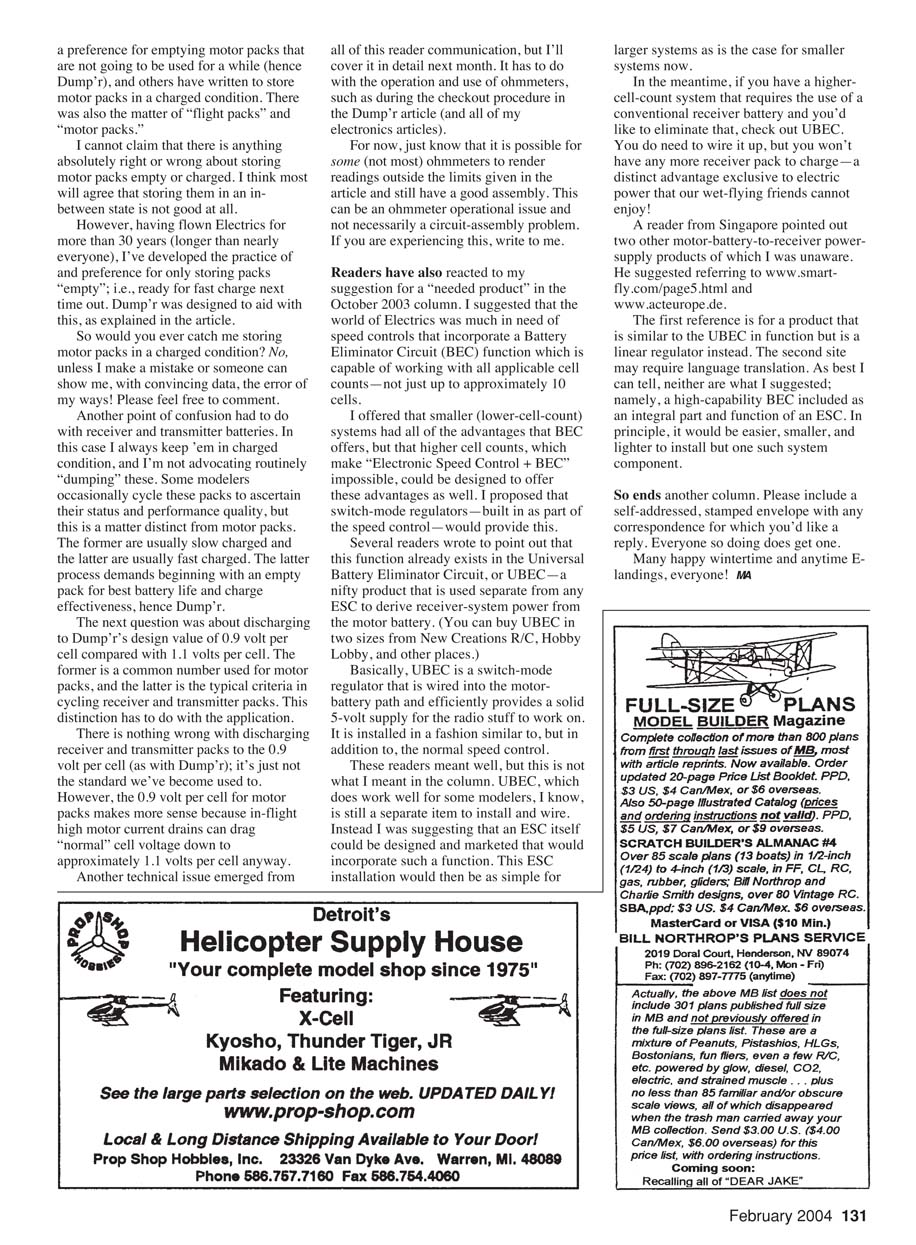
One reader constructed three Dump'r's. He was the first reader to inquire about some writing errors, so he had the corrected info early. He built accordingly, completing one Dump'r ahead of the other two. It did not work properly, and he caught up with me at the NEAT (Northeast Electric Aircraft Technology) Fair to say so. I brought his Dump'r home from that meet and checked it out. He was right; it did not work properly.
Construction and soldering note
His Dump'r was beautifully built and the problem was not obvious, so I immediately had a sinking feeling that there was still some yet-uncovered problem. After a more complete disassembly and inspection with a lens, I found the problem: three missed solder joints on the rotary switch. Once I touched these up, this reader's Dump'r worked perfectly. There may be more out there since this can happen to anyone, so I'll explain further.
The rotary switch has a series string of resistors all around it so that most of the switch lugs have two resistor leads in them. In this case the soldering caught one of the leads but not the other in some terminals. The bottommost lead—the one that is more difficult to see—was not soldered in three lug locations, and that was the problem. Make sure of your soldering, not just on the switch parts but throughout. Also, one part of that article's checkout procedure should have caught this switch problem.
Despite the errors in presentation and associated confusion and disappointment, every inquiry was polite. Readers ranged from first-time builders to those of considerable skill and experience. The former are the most adversely affected in matters such as this. To the best of my knowledge, everyone who inquired got Dump'r working. If anyone's doesn't work, I will make it work if you give me the chance.
Parts ordering and Mouser
Reader input also highlighted one matter of which I was unaware. In the article where I listed the majority of parts and supplies with Mouser (a parts supplier) catalog numbers, I included the website address and the company telephone number, either of which could be used to order the parts.
Those who called in orders received assistance from the salesperson with some troublesome catalog numbers, so some (but not all) issues were fixed on the spot. This service was unavailable on the website. Other comments included how nice it was to do business with Mouser. Yup!
Battery storage: motor packs vs receiver packs
Several readers were confused about the use of Dump'r with all batteries and with what seemed to be conflicts in advice. Since so many asked, I'll expand on this issue. It's common for variances in opinion and a preference to appear throughout a population. That is why there are so many competing products on the market—appliances, cars, toothbrushes, motors, batteries, etc. Similarly, there are differences and preferences in approach and technique, almost no matter the topic.
Some readers pointed out that I expressed a preference for emptying motor packs that are not going to be used for a while (hence Dump'r), and others have written to store motor packs in a charged condition. There was also the matter of "flight packs" and "motor packs."
I cannot claim that there is anything absolutely right or wrong about storing motor packs empty or charged. I think most will agree that storing them in an in-between state is not good at all.
However, having flown electrics for more than 30 years (longer than nearly everyone), I've developed the practice of and preference for only storing packs "empty"; i.e., ready for fast charge next time out. Dump'r was designed to aid with this, as explained in the article.
So would you ever catch me storing motor packs in a charged condition? No, unless I make a mistake or someone can show me, with convincing data, the error of my ways! Please feel free to comment.
Another point of confusion had to do with receiver and transmitter batteries. In this case I always keep them in charged condition, and I'm not advocating routinely "dumping" these. Some modelers occasionally cycle these packs to ascertain their status and performance quality, but this is a matter distinct from motor packs. The former are usually slow charged and the latter are usually fast charged. The latter process demands beginning with an empty pack for best battery life and charge effectiveness, hence Dump'r.
Discharge voltages
The next question was about discharging to Dump'r's design value of 0.9 volt per cell compared with 1.1 volts per cell. The former is a common number used for motor packs, and the latter is the typical criteria in cycling receiver and transmitter packs. This distinction has to do with the application.
There is nothing wrong with discharging receiver and transmitter packs to the 0.9 volt per cell (as with Dump'r); it's just not the standard we've become used to. However, the 0.9 volt per cell for motor packs makes more sense because in‑flight high motor current drains can drag "normal" cell voltage down to approximately 1.1 volts per cell anyway.
Ohmmeters
Another technical issue emerged from all of this reader communication, but I'll cover it in detail next month. It has to do with the operation and use of ohmmeters, such as during the checkout procedure in the Dump'r article (and all of my electronics articles).
For now, just know that it is possible for some (not most) ohmmeters to render readings outside the limits given in the article and still have a good assembly. This can be an ohmmeter operational issue and not necessarily a circuit-assembly problem. If you are experiencing this, write to me.
BEC, UBEC and related products
Readers have also reacted to my suggestion for a "needed product" in the October 2003 column. I suggested that the world of Electrics was much in need of speed controls that incorporate a Battery Eliminator Circuit (BEC) function which is capable of working with all applicable cell counts—not just up to approximately 10 cells.
I offered that smaller (lower‑cell‑count) systems had all of the advantages that BEC offers, but that higher cell counts, which make "Electronic Speed Control + BEC" impossible, could be designed to offer these advantages as well. I proposed that switch‑mode regulators—built in as part of the speed control—would provide this.
Several readers wrote to point out that this function already exists in the Universal Battery Eliminator Circuit, or UBEC—a nifty product that is used separate from any ESC to derive receiver‑system power from the motor battery. (You can buy UBEC in two sizes from New Creations R/C, Hobby Lobby, and other places.)
Basically, UBEC is a switch‑mode regulator that is wired into the motor‑battery path and efficiently provides a solid 5‑volt supply for the radio stuff to work on. It is installed in a fashion similar to, but in addition to, the normal speed control.
These readers meant well, but this is not what I meant in the column. UBEC, which does work well for some modelers, I know, is still a separate item to install and wire. Instead I was suggesting that an ESC itself could be designed and marketed that would incorporate such a function. This ESC installation would then be as simple for larger systems as is the case for smaller systems now.
In the meantime, if you have a higher‑cell‑count system that requires the use of a conventional receiver battery and you'd like to eliminate that, check out UBEC. You do need to wire it up, but you won't have any more receiver pack to charge—a distinct advantage exclusive to electric power that our wet‑flying friends cannot enjoy!
A reader from Singapore pointed out two other motor‑battery‑to‑receiver power‑supply products of which I was unaware. He suggested referring to:
The first reference is for a product that is similar to the UBEC in function but is a linear regulator instead. The second site may require language translation. As best I can tell, neither are what I suggested; namely, a high‑capability BEC included as an integral part and function of an ESC. In principle, it would be easier, smaller, and lighter to install as one such system component.
Closing
So ends another column. Please include a self‑addressed, stamped envelope with any correspondence for which you'd like a reply. Everyone so doing does get one.
Many happy wintertime and anytime landings, everyone! MA
Transcribed from original scans by AI. Minor OCR errors may remain.

