
Radio Control: Electrics
By Bob Kopski
Upcoming Electric meets
I'd like to remind readers that it's my policy and pleasure to spread the good word about your planned activities in this column—but I must know about them adequately in advance. (Hint!)
- June 21–22 (tentative) — Daniel Boone Silent Flyers' 7th Annual Two-Meter/Electric RC Contest
- The Electric event will use the "one-charge duration" proposal presented in my June column.
- Contact: Jerry Zeigenfuse, 8 Craig Dr., Reading, PA 19606; phone (215) 779-3229.
- June 28–29 — Boeing Hawks 4th Annual Electric Fly-In (Seattle)
- For all forms of electric-powered model aircraft. Prizes: "Best Entry of Event," "Most Aerobatic," "Longest Flight," and "Surprise Events." Mitch Poling (Model Builders' Electric columnist) will host an Electric Clinic.
- Contact: Bernard Cawley, 210 37th SE #43, Auburn, WA 98002; telephone (206) 939-1778. Also: Dave Katagiri, (206) 248-1024.
- July 13 — Polk County Soaring Eagles First Annual Electric Fly (Lakeland, FL)
- Plaques awarded through fourth place in two Soaring events.
- Contact: Leonard Postage, 6103 Andrea Dr., Lakeland, FL 33803; telephone 813/644-1942 (home) or 813/293-3434 (work).
- July 20 — South Shore RC Club Second Annual Electric Fly (Bridgewater, MA)
- Organized as a fun-fly with no classes or limitations. Prizes: "Best Model," "Most Aerobatic," "Longest Flight," and a "One-Charge Duration" event (format suggested in my June column).
- Contact: Charles Sylvia, P.O. Box 775, Middleboro, MA 02346; telephone 617-947-2805.
- July 27 — SAM 76 Old-Timers Annual Meet (Hatfield, PA)
- Electric event open to all models complying with applicable SAM Old-Timer model requirements. Nickel-cadmium electric power systems may be used.
- Contact: Dave Ritchie, 2908 Truman Drive, Hatfield, PA 19440; telephone (215) 362-2933.
- August 16–17 — Electric Model Flyers of Chicago First Annual Electric Fly-In
- Planning a "carbon copy of KRC." Events planned: "Most Aerobatic," "Best-Looking," "Longest Flight," "Best Design," and maybe an "All-Up Last-Down."
- Contact: Larry Sperling, 2517 Brush Road, #102, Schaumburg, IL 60195-3910.
- September 20–21 — Seventh Annual KRC Electric Fly (Hatfield, PA)
- Low-key, all-Electrics-are-welcome tradition plus scheduled events: "Longest Flight," "All-Up Last-Down," "Most Loops per Minute," "Aerobatic," and "Scale." For the first time, KRC members may actively compete in all activities.
- Contact: Ken Stinson, 140 Hopewell Lane, Telford, PA 18969; telephone 215-721-0248.
Do make a point to attend an Electric meet this year. Take a "non-believer" with you—you'll change his life!
Battery cooling
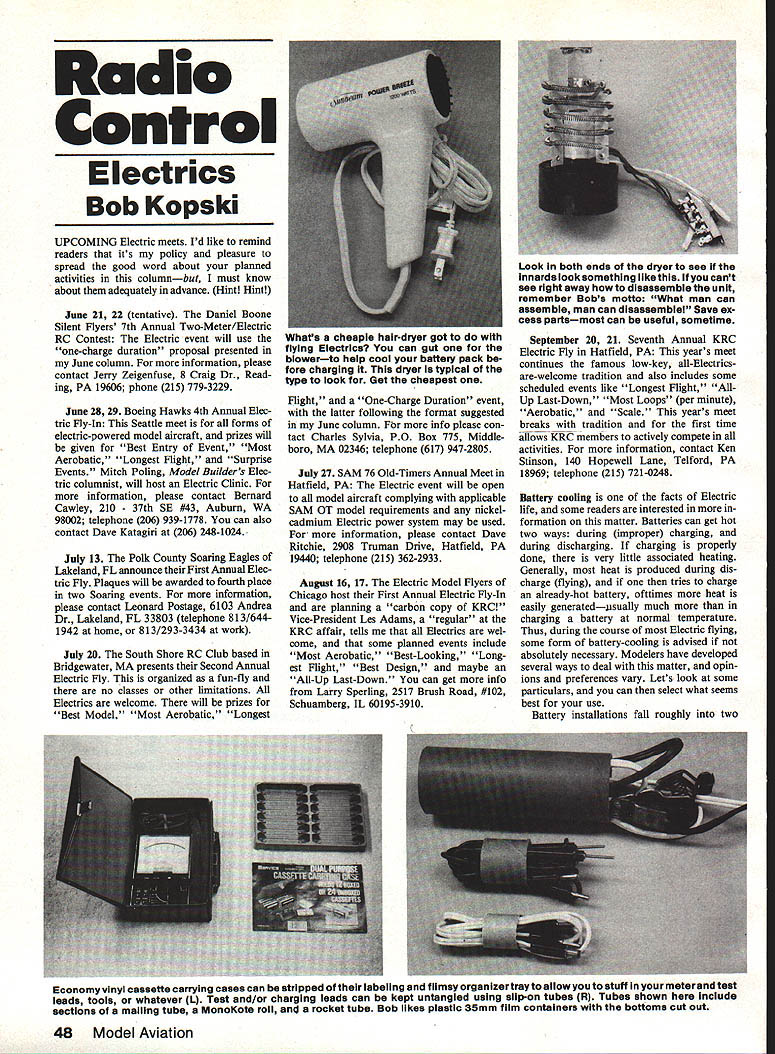
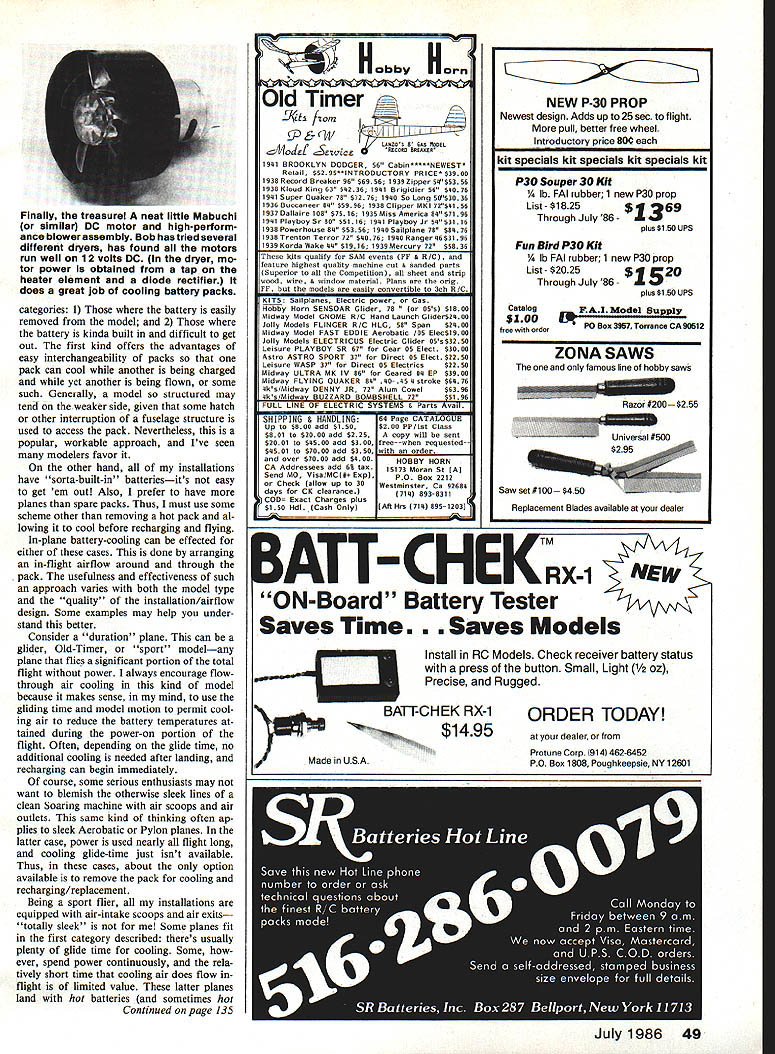
What's a cheapie hair-dryer got to do with flying Electrics? You can gut one for the blower—to help cool your battery pack before charging it. Get the cheapest one. Look in both ends of the dryer to see if the innards look serviceable; if you can't see right away how to disassemble the unit, remember Bob's motto: "What man can assemble, man can disassemble!" Save excess parts—most can be useful sometime.
Battery cooling facts. Batteries can get hot two ways: during improper charging, and during discharging. If charging is properly done, there is very little associated heating. Generally, most heat is produced during discharge (flying), and if you then try to charge an already-hot battery, even more heat is easily generated—usually much more than charging a battery at normal temperature. Thus, during the course of most electric flying, some form of battery cooling is advised if necessary. Modelers have developed several ways to deal with this matter; opinions and preferences vary. Below are particulars to help you decide what seems best for your use.
Battery installations fall roughly into two categories:
- Those where the battery is easily removed from the model.
- Advantages: easy interchangeability of packs so one pack can cool while another is charged or flown. Typically this requires a hatch or fuselage interruption, which may weaken the structure somewhat, but it's a popular, workable approach.
- Those where the battery is sort of built in and difficult to get out.
- Many installations are of this type. If you prefer to carry fewer spare packs, you may need alternate cooling schemes since removing a hot pack for cooling may be impractical.
In-plane battery cooling can be effected for either case by arranging in-flight airflow around and through the pack. Effectiveness varies with model type and quality of the installation and airflow design.
Consider a "duration" plane (glider, Old-Timer, or sport model)—a plane that flies a significant portion of the total flight without power. Flow-through air cooling is recommended for this kind of model because you can use glide time and model motion to permit cooling air to reduce battery temperatures attained during the power-on portion of the flight. Often, depending on glide time, no additional cooling is needed later; landing and recharging can begin immediately.
Some enthusiasts may not want to blemish the sleek lines of a clean soaring machine with air scoops and outlets. The same thinking often applies to scale aerobatic or pylon planes. In pylon models, power is used nearly all flight long and cooling during glide time isn't available. In these cases, the only option is to remove the pack for cooling and recharging/replacement.
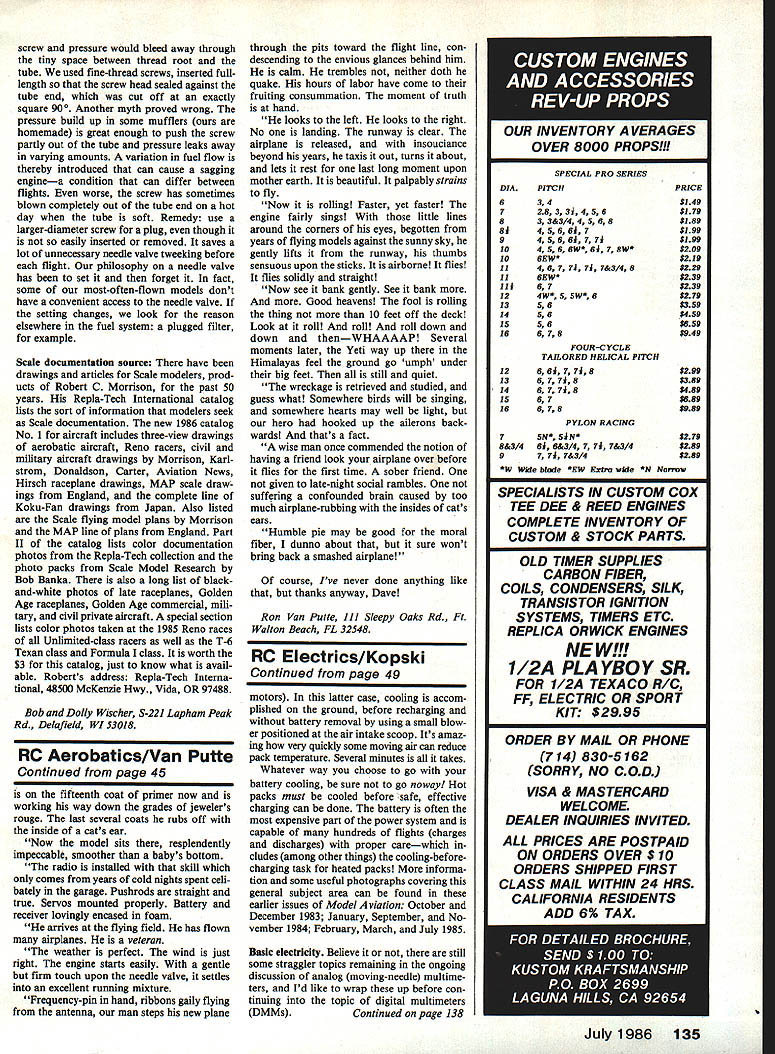
My installations are equipped with air-intake scoops and air exits—"totally sleek" is not for me! Some planes have sufficient glide time for cooling; others run power continuously and land with hot batteries (and sometimes hot motors). For the latter, cooling is accomplished on the ground before recharging and without battery removal by using a small blower positioned at the air-intake scoop. A little moving air can reduce pack temperature very quickly—several minutes is often all it takes.
Whatever method you choose, be sure not to go too long without cooling. Hot packs must be cooled before safe, effective charging can be done. The battery is often the most expensive part of the power system; its ability to deliver many hundreds of flights (charges and discharges) with proper care—which includes cooling before charging—is what you are buying. More information and useful photographs on this subject can be found in earlier issues of Model Aviation: October and December 1983; January, September, and November 1984; February, March, and July 1985.
Basic electricity
Believe it or not, there are still a few remaining topics in the ongoing discussion of analog (moving-needle) multimeters, and I'd like to wrap these up before continuing into the topic of digital multimeters (DMMs).
Two terms always associated with meters are "accuracy" and "sensitivity." Both are often used in varied ways and can be confused or misunderstood.
Accuracy is simply a description of how good a measurement made with a given meter is. For analog meters, accuracy is often expressed in "percent full scale" (FS). A typical number is ±3% FS. This means that, for example, if a meter had a 10-volt scale, the accuracy of that scale would be 10.0 ± 0.3 volts. Note that the same ±0.3 volts applies over the entire scale. Thus, taken literally, meter accuracy specified this way means the reading accuracy can be much worse as a percentage for readings taken on lower portions of a given scale. For example, if 3.0 volts were applied and read on a 10-volt scale, the accuracy would be 3.0 ± 0.3 volts, or ±10%—not ±3%. In actual practice, such degradation is rarely as bad as that literal interpretation suggests, but be wary.
Some instruments specify accuracy without the "FS" designation. For example, the Radio Shack 22-204 multimeter (discussed in earlier installments) is an excellent instrument and has a stated accuracy of simply ±3% for some ranges. Such a specification means that a given reading—anywhere on the scale—is within three percent of the true value, which is generally better than the FS-based specification.
In general, DC voltage and current ranges are usually the most accurate; AC and ohms ranges are often less accurate. Manufacturers differ, so check your manual for particulars. Later we'll see how DMM accuracy is specified and what it means.
Of the two terms, "sensitivity" is the more confusing. It has several uses:
- Voltage required to produce a full-scale deflection on the meter movement.
- "Ohms per volt" value of the instrument. For example, a meter rated at 50,000 ohms per volt on a 10-volt scale has an input resistance of 500,000 ohms. The current needed for full-scale deflection would then be 10 V / 500,000 ohms = 20 microamperes. That tiny current won't bother a motor or battery, but it can seriously affect some electronic circuits. For instance, if you use such a meter to measure the voltage across a 500,000-ohm resistor, the meter's input resistance in parallel would become 250,000 ohms—half the original—and the circuit and measurement would be severely altered; a 100% reading error could result.
- "How little it takes to make the needle move"—used this way, sensitivity is similar to "resolution" (how much input signal is required to move the needle one small step). In practice, this often describes pointer-bearing friction. Unless the instrument has mechanical damage or the movement is contaminated with dust, this form of sensitivity is usually not a concern.
As with accuracy, sensitivity varies among meters and even among scales within an instrument, so check your manual if it's important to you.
That's it again, folks. I've used up my space allotment for another month! Please direct any comment or question (with SASE, please) to:
Bob Kopski 25 West End Dr. Lansdale, PA 19446
Transcribed from original scans by AI. Minor OCR errors may remain.

