
Radio Control: Electrics
Bob Kopski
Introduction
My incoming letters are most often responses to a recent column, and the writer usually has some questions. Sometimes a letter will just be a friendly conversational offering. Whatever the case, I do appreciate knowing that the column is being read, and I do try to be promptly responsive to individual requests for help.
"RC Electrics" is itself often a reaction to incoming mail. One recent example was the April column in which I devoted space to the making of a high-current shunt—because several readers asked me how to measure large motor currents. This month's column is another example.
Many readers have requested information about how to get into electric flight at low cost. These readers have varied reasons for asking. Some simply can't spend much, and that's perfectly OK. Some can, but don't want to make a big investment initially "just in case." Then there's the related request for a simple, docile plane/system recommendation that "I can fly in the schoolyard down the street." Finally, there are requests from those who have never flown RC, have no equipment at all, and are faced with buying virtually everything at once. They are attracted by the idea of electrics and need an entry-level, economical trainer—and everything to go with it, including the radio. This month we'll take a closer look at these needs.
Easy, economical, entry-level electric recommendations that follow have been time-tested by many local fliers who have followed my suggestions, and I have no hesitation in sharing the same offerings here. Some of these modelers had prior RC gas experience and just wanted an electric "to try." Quite a few had never built a model and learned to build and fly RC this way. Virtually all continued on with their second and third electrics. What follows does break with my traditional preference of avoiding specific product recommendations, but there is no other way to approach this matter. So, if your interests sound like those above—read on!
Motor
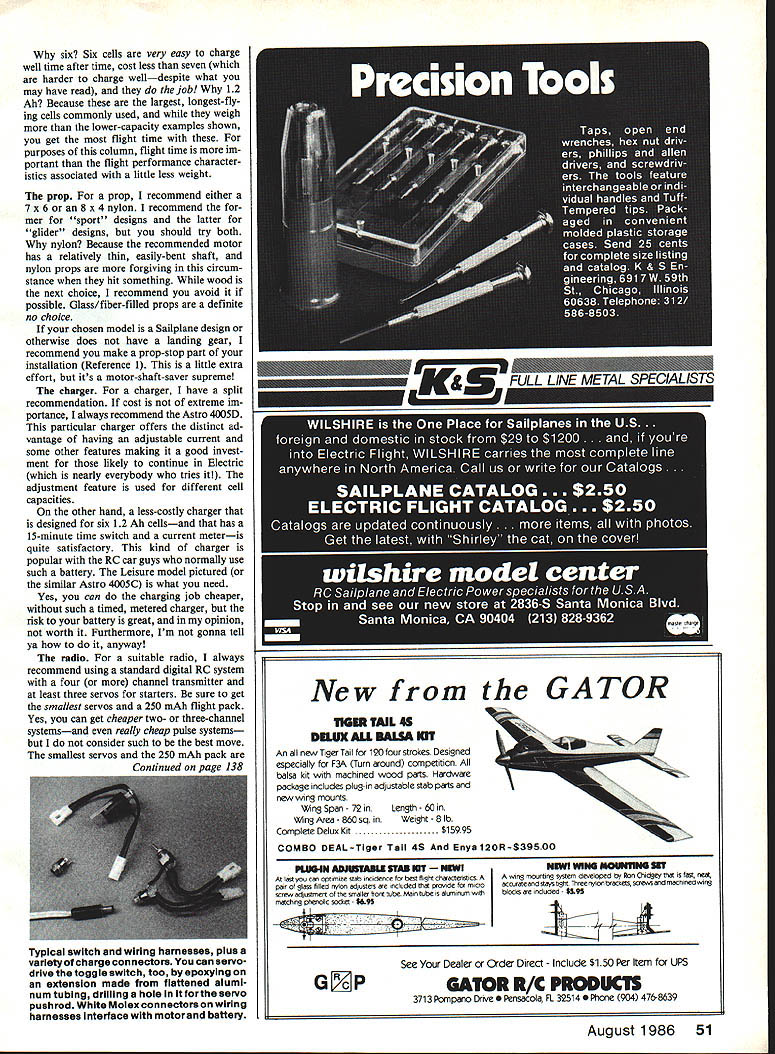
I heartily recommend the Astro plain-bearing ferrite .05/.075. It's Astro part no. 2102 and listed for $15.95 in the September 1985 price list. This economical motor will not blow a hole in the sky, but it has brought electric elation (first-time and continuing success) to many fellow modelers.
I recommend this motor for the purposes described because it is readily available, time-proven, economical, and large enough to fly a reasonably sized plane and radio combination. Yes, I know .02s and .035s are cheaper, but there is a much better selection of model designs suited to this larger motor. I consider it the best choice for this column's purpose.
A note of clarification: what is an ".05/.075"? There used to be both .05 and .075 products. Nowadays the same motor does both jobs by means of a battery and prop variation.
As a side point, I do not recommend the use of car motors to "try" electric flight. Car motors I've seen are wound to favor high RPMs; they are relatively small and fast-turning, best suited to faster-moving models—mostly out of line with the intent of this column. Those motors can be nicely geared with gear or belt speed-reducers, but that too is apart from the intent here, since speed-reducers add to the cost.
Battery
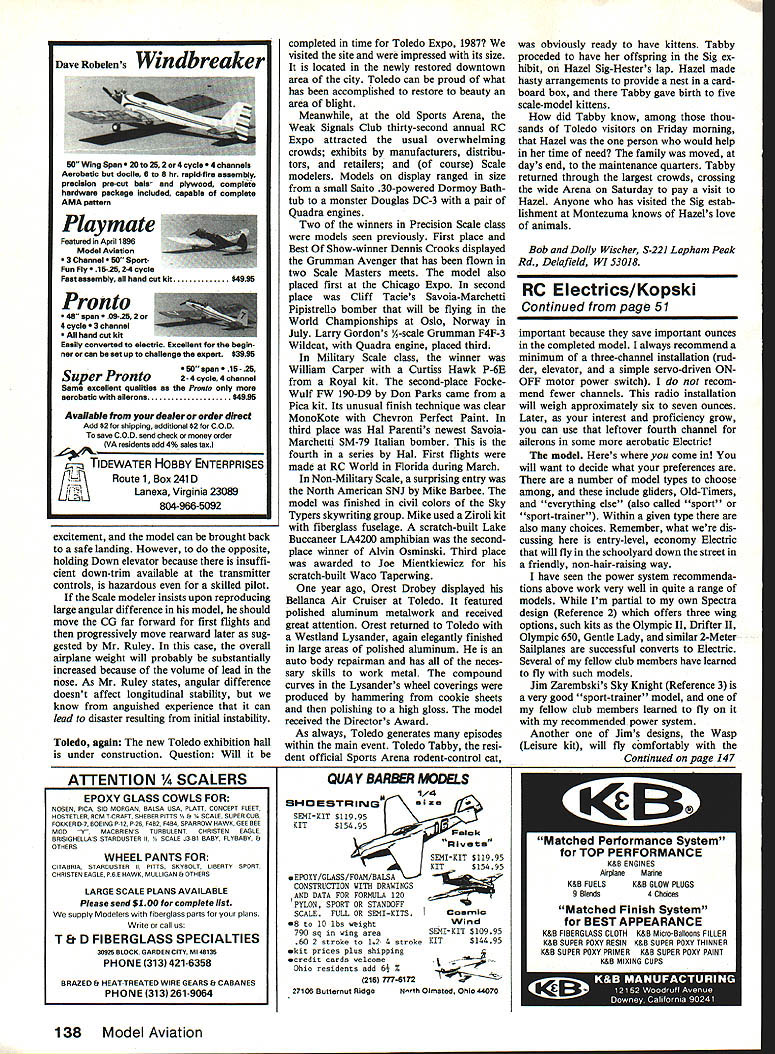
For a battery, I recommend six cells. Yes, some people use seven, but I recommend six. You have your choice of several cell capacities (milliampere-hours), but I nearly always recommend the 1,200 mAh (1.2 Ah) size—six of them.
Why six? Six cells are very easy to charge well time after time and cost less than seven (which are harder to charge well—despite what you may have read). Why 1.2 Ah? Because these are the largest, longest-flying cells commonly used, and while they weigh more than lower-capacity examples, you get the most flight time with them. For purposes of this column, flight time is more important than the marginal flight-performance gain of a little less weight.
Prop
For a prop I recommend either a 7x6 or an 8x4 nylon. Use the 7x6 for "sport" designs and the 8x4 for "glider" designs, but you should try both.
Why nylon? The recommended motor has a relatively thin, easily bent shaft, and nylon props are more forgiving if they hit something. While wood is the next choice, avoid it if possible. Glass/fiber-filled props are a definite no-no.
If your chosen model is a sailplane or otherwise lacks landing gear, make a prop-stop part of your installation. This is a little extra effort but a motor-shaft saver supreme.
Charger
I have a split recommendation for chargers.
- If cost is not of extreme importance, I recommend the Astro 400SD. This charger has adjustable current and other features that make it a good investment for those likely to continue in electric flight. The adjustment is used for charging different cell capacities.
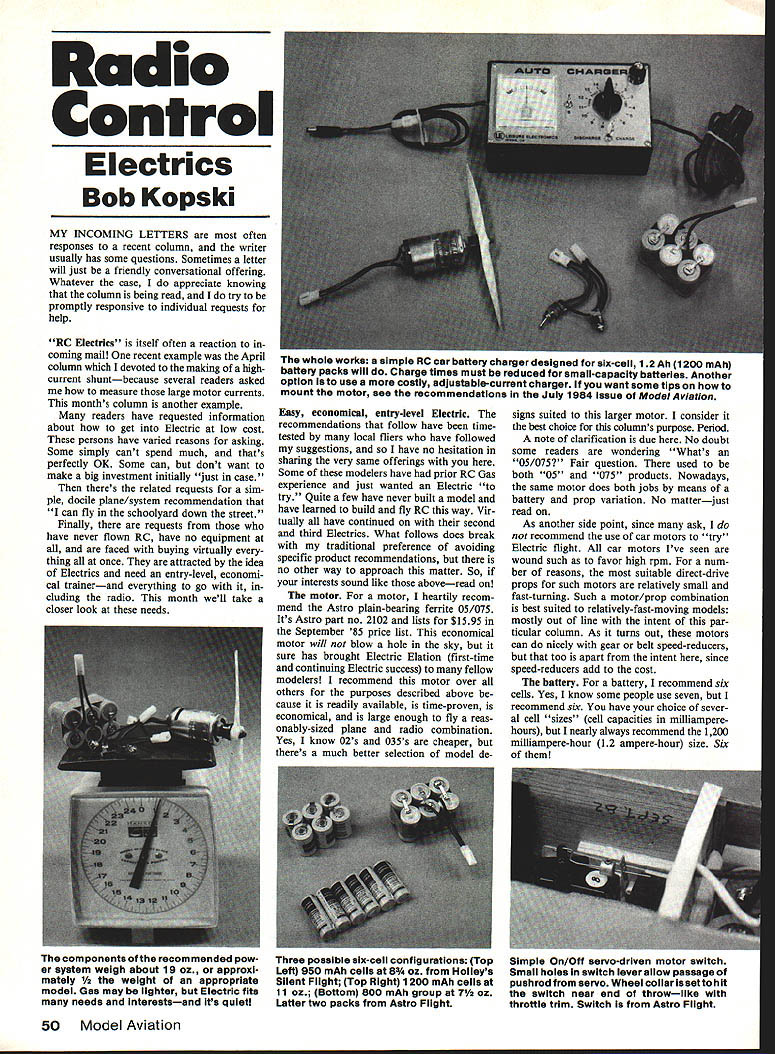
- If you need a lower-cost option, a charger designed for six 1.2 Ah cells that has a 15-minute time switch and a current meter is quite satisfactory. This type of charger is popular with RC car enthusiasts. The Leisure model (or the similar Astro 400SC) will serve your needs.
Yes, you can do charging cheaper without a timed, metered charger, but the risk to your battery is great and, in my opinion, not worth it. Also, I'm not going to explain unsafe charging shortcuts here.
Radio
For a suitable radio, use a standard digital RC system with a four (or more) channel transmitter and at least three servos to start. Be sure to get the smallest servos and a 250 mAh flight pack.
- Why small servos and a 250 mAh pack? They save important ounces in the completed model.
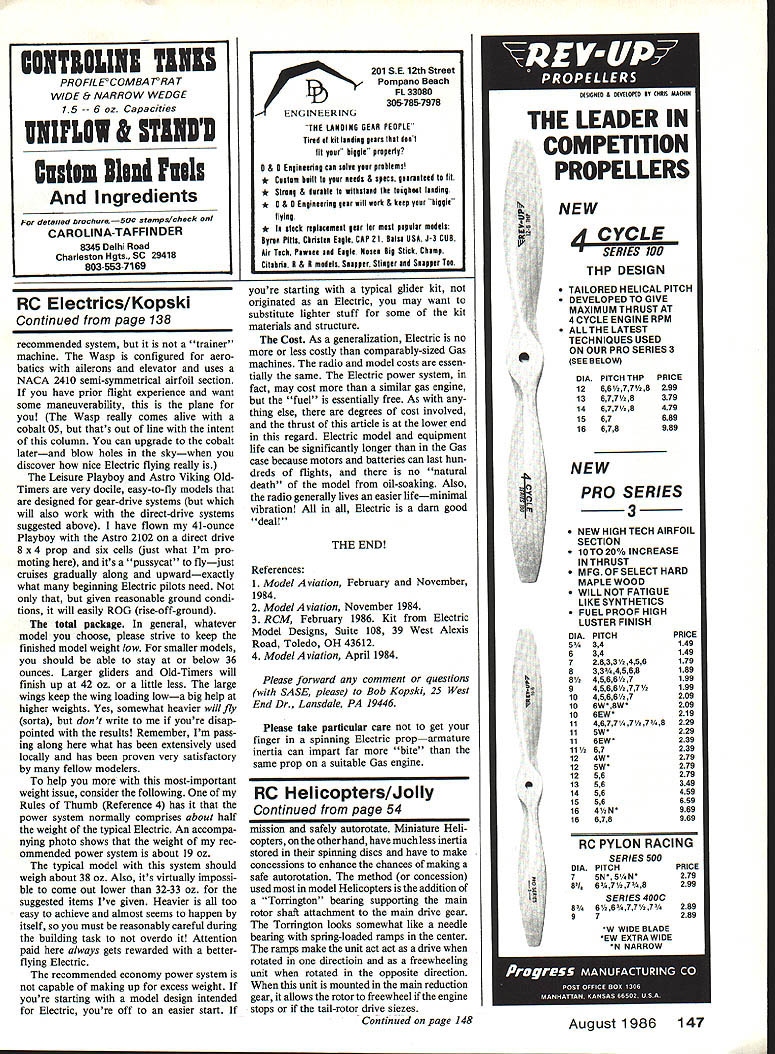
- I always recommend a minimum of a three-channel installation: rudder, elevator, and a simple servo-driven on/off motor power switch. I do not recommend fewer channels.
This radio installation will weigh approximately six to seven ounces. Later, as your interest and proficiency grow, you can use that fourth channel for ailerons in more aerobatic electrics.
Model
Decide what your preferences are. There are a number of model types to choose among: gliders, Old-Timers, and "everything else" (also called "sport" or "sport-trainer"). Within a given type there are many choices. Remember: we're discussing entry-level, economy electrics that will fly in the schoolyard in a friendly, non-hair-raising way.
I have seen the recommended power system work very well in a wide range of models. While I'm partial to my own Spectra design (offering three sizes), kits such as the Olympic II, Drifter II, Olympia 650, Gentle Lady, and similar 2-meter sailplanes have converted many to electric flight. Several club members learned to fly with such models.
Jim Zarembski's Sky Knight is a very good "sport-trainer" model; a fellow club member learned to fly on it with my recommended power system. Another of Jim's designs, the Wasp (Leisure kit), will fly comfortably with the recommended system, but it is not a trainer. The Wasp is configured for aerobatics with ailerons and elevator and uses a NACA 2410 semi-symmetrical airfoil. If you have prior flight experience and want maneuverability, this is the plane for you. The Wasp really comes alive with the cobalt .05, but that's beyond the intent of this column—you can upgrade later.
The Leisure Playboy and Astro Viking Old-Timers are very docile, easy-to-fly models designed for gear-drive systems (but which will also work with the direct-drive systems suggested above). I have flown my 41-ounce Playboy with the Astro 2102 on a direct-drive 8x4 prop and six cells, and it's a "pussycat" to fly—just cruises gradually along and upward—exactly what many beginning electric pilots need. Given reasonable ground conditions, it will easily ROG (rise off ground).
Total package and weight guidance
Whatever model you choose, strive to keep the finished model weight low.
- For smaller models, try to stay at or below 36 ounces.
- Larger gliders and Old-Timers will finish up at about 42 ounces or a little less.
Large wings keep wing loading low, which helps with higher weights. Heavier models will fly poorly, so don't write to me if you're disappointed with heavy construction—I'm passing along what has been extensively used locally and proven satisfactory.
One of my rules of thumb is that the power system normally comprises about half the weight of the typical electric. The weight of my recommended power system is about 19 ounces. The typical model with this system should weigh about 38 ounces. It's virtually impossible to come out lower than 32–33 ounces for the suggested items. Heavier is all too easy to achieve, so be careful during construction and avoid unnecessary weight. Attention paid here always gets rewarded with a better flying electric.
If you start with a model design intended for electric use, you're off to an easier start. If you begin with a typical glider kit not originated as an electric, you may want to substitute lighter materials for some of the kit structure.
Cost
In general, electric is no more or less costly than comparable-sized gas machines. Radio and model costs are essentially the same. The electric power system may cost less than a similar gas engine, and the "fuel" is essentially free. Electric equipment can be significantly longer-lived than gas equipment because motors and batteries can last hundreds of flights, and there is no oil-soaking of the model. Also, the radio generally lives an easier life—minimal vibration. All in all, electric is a darn good deal.
Safety
Please take particular care not to get your finger in a spinning electric prop—armature inertia can impart far more bite than the same prop on a suitable gas engine.
References
- Model Aviation, February and November, 1984.
- Model Aviation, November 1984.
- RCM, February 1986. Kit from Electric Model Designs, Suite 108, 39 West Alexis Road, Toledo, OH 43612.
- Model Aviation, April 1984.
Contact
Please forward any comments or questions (with SASE, please) to: Bob Kopski 25 West End Dr. Lansdale, PA 19446
THE END
Transcribed from original scans by AI. Minor OCR errors may remain.

