
Radio Control: Electrics
Bob Kopski
Electric rules — a follow up
It is now late in May, about one month since the June MAN hit the streets. The June column, you may recall, was different in that I strayed from the normal "how to" format and instead offered my thoughts on first-time AMA Electric rules. Surely, I thought, if anything would bring reader response, it would be my treading on the controversial turf of electric rules. Now don't get me wrong; I wasn't trying to stir controversy. It just seemed like an unavoidable risk associated with the true purpose—the development of first-time AMA Electric rules everyone can live with.
To date I've had seven letters of reaction. All seven were very favorable to the suggestions I made, and two of these were from well-known figures in electric modeldom.
My first feelings toward this seemingly small response were simply that "I guess not many really care." Also, I felt that, because of such little show of interest, maybe it really is too soon for Electric rules. But my feelings quickly changed, for despite the numerically small response (so far), the positive sentiment was totally dominant and cannot be ignored. Then, of course, there's the age-old question: if (x) number of people took the trouble to respond, how many almost took the trouble to respond? Ten times more? A hundred times more? What really continues to stand out is that there were no negative or opposing responses to the rules suggestions.
There was one more positive response. Mitch Poling, Model Builder's electric columnist, wrote in his July column a summary of these rules, fully endorsing them and even supplementing them with additional suggestions for Pylon and ROW activities. Add to this major endorsement the further encouragement of there being (at least) three scheduled meets using my "Duration Event" rules suggestions, and you can see why I'm feeling rather gratified so far.
Regarding the meets, I certainly appreciate the willingness shown to give it a try. I welcome these field tests of the proposed Duration event, and naturally I'm most anxious to see how well (or not) everything works. Whatever the case, I'll offer a follow-up in a later issue. But for now—thank you to those who did take the time to share your feelings with me and to those who are trying the rules suggestions. You may, in fact, be making a major contribution to the successful installation of first-time AMA Electric rules that everyone can live with.
One question has come up concerning my suggested Duration rules: what do I do in case of a tie? I suggest that flyoffs be made using any remaining charge. Of course, this must be announced at the beginning of the meet. Thus, pilots who are doing very well should "save a little juice" just in case they have to deal with a flyoff situation—one more fun "burden" to deal with!
Reprints query
As an aside, the same June column concluded with a query. I asked for a show of interest in reprints of MA Electric articles by yours-most-truly over the past three years; the query brought a grand total of six positive responses to date. For all practical purposes, such an undertaking would only be considered if a few hundred reprints were needed. A sincere thank you to those "yes" respondents, but it looks like a no-go for now.
Trade shows and model cars
I just finished reading an editorial by Dan Santich in the July issue of Model Airplane News. In his writing, Dan reflects on this year's model trade shows and what clues to the future of RC aeromodeling they offer. Dan sees the message of the future "big boom" in aeromodeling residing in electrics. In particular, Dan envisions the hobby's current largest modeling growth element—RC electric cars—as being a steppingstone to similar large growth in electric model aircraft.
I think he's right; I admit I had not viewed model car enthusiasts in this light before, but many of today's drivers can be tomorrow's pilots. It's a natural. But herein lies a plea: please remember that there are frequencies for model cars, and frequencies for model aircraft—don't mix 'em. And to you future driver/pilots—a most sincere welcome!
Electric ARFs
Let me start off this topic by making it very clear that I have not had the opportunity to fly every electric ARF on the market. Among those I have flown is the Etude. Several local modelers have shown up at the field with Etudes and asked me to check them out. From these experiences, I can wholeheartedly and unconditionally recommend the Etude for modelers having some prior RC flight experience.
I do not suggest this model for folks who have never flown before—the Etude can be a bit quick. But for those with some flight experience who simply want to "give Electric a try," do consider the Etude.
The Etude is an excellent airplane and flies best with the smallest optional propeller reduction gear ratio (largest pinion). While the Etude does fly with standard radio equipment, I recommend the use of lightweight radio systems (smallest servos, 250 mAh pack). Spare parts are available—like props—and this is a plus. However, everyone so far has lamented the seemingly excessive costs involved in structural spares, and this does somewhat diminish the otherwise total attractiveness of the Etude. And just in case anyone is wondering if someone gave me one to try out—the answer is NO! My purpose here is simply consistent with the purpose of this column—to share electric elation with everyone.
Folding props
I sometimes get readers' letters inquiring about folding props. While I like to view myself as having a lot of electric experience, I have to admit one area of relative experience deficiency—folding props. Stated simply—I haven't used any. However, the "Watts Up" column by Bob Sisk in the June MAN has considerable coverage of this topic, and if your interests lie in this area, I suggest you check out that issue. In that column Bob names several folders and sources of supply.
Generally, folders are used in electric-boosted sailplanes where the best L/D (lift-to-drag) performance in the glide is sought. Most often folding props are relatively large and used with geared drives or belt drives. The large blades fold back along and against the fuselage in the power-off state to minimize drag. Folding props unfold when power is reapplied and then refold when power is switched off—so sailplanes (and Old Timers, too) can do what they do best—glide!
Radio Control: Electrics
Bob Kopski
Excessive elation?
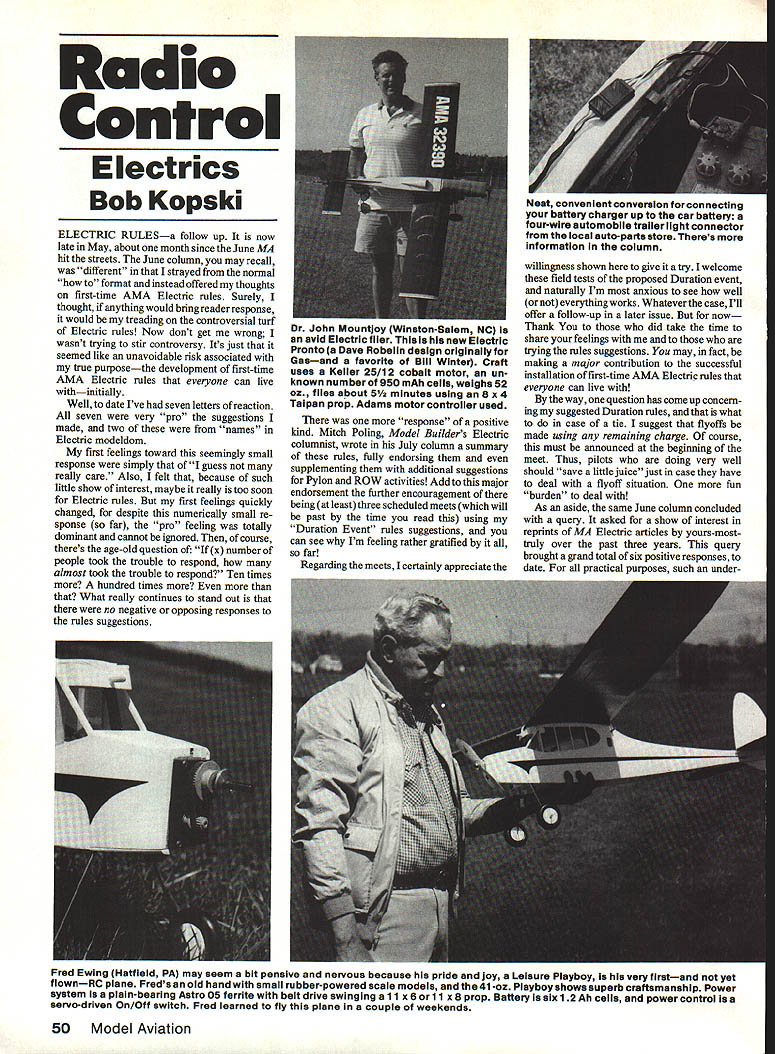
One of the photos is of a pleasure modeler, Fred Ewing. Fred has a long history of Peanut and FAC (Flying Aces Club) rubber participation and is an excellent craftsman. Being local, it was convenient for him to attend last year's Electric Fly as a spectator. Being used to quiet flying, Fred immediately took an interest in electric. Never having tried RC before, Fred had to start from scratch.
Sometime during the winter he called and described what he thought he wanted to try—something that was easy to fly and that flew slow. It sounded like Fred needed a Playboy. Since he is an expert rubber modeler, I knew all the stock of this excellent Old-Timer would be no problem, and I knew from first-hand experience that this Leisure kit would fit his flying needs. So Fred got the kit, a radio, and a power system and showed up at the field one April Saturday morning.
Everything worked perfectly, right out of the box, as they say. I handed the box to Fred, and he had no trouble getting the hang of it, and at the third weekend of first-ever RC flying, Fred had his "green sticker." In local language, this means he passed his flight test and was able to fly without instructor assist. This is the fastest I've seen anyone accomplish "green sticker," and it was done with about the slowest of electrics I've seen!
Ordinarily, I wouldn't devote more than several picture captions to such a story, but this one has a lot to tell. First, it follows nicely from last month's column wherein I made certain specific recommendations for first-time electric fliers. You can see who went to the story supports that last column! Also, it's another specific case of someone learning to fly RC from scratch with an electric—we have several such modelers locally. And, while an Old-Timer like the Playboy may be a bit of a construction challenge for inexperienced builders, it is a docile, dream "pussycat" for first-time RC pilots. Finally, the moderate capability, moderate cost power system is extremely well suited to this described need.
It's now about five weeks since Fred's first flights. At our last evening flying session two days ago, Fred mustered some comment (after an at-his-feet landing) like "I just don't know how much of this pleasure I can stand!"
We'll find out—if Fred survives the joy overdose that is, because he's now building an Astro Cobalt–powered Astro Viking, he's into an Olympic 650 conversion, and he's buying another radio!
Charger connections—again
Most modelers use the familiar, specially designed electric chargers, and all are faced with the chore of connecting the clip leads to the auto battery terminals. Frequently, the latter terminals are large and bulky, making it difficult to get those small charger alligator clips in place. Then, too, battery terminals are often corroded, taking away from the "purity" of electric power. What to do?
Some of this month's photos show one approach to this problem. Local modeler Herb Dirks had the connectors mentioned above on two cars. His overall solution was to purchase two sets of four-conductor male/female auto trailer connector sets at a local auto supply store. These particular connectors came outfitted with 16-gauge wires. Herb arranged the four wires in two sets of two, wiring one of the female connectors to the battery in each vehicle, as pictured. He then used one of the remaining male connectors to replace the familiar charger clips, again using two sets of two wires and connecting them to the charger cord in place of the clips.
The result of this small effort is a big reward in electric convenience. The connectors, always in place under the hood, are always ready to accept the matching mate from the charger. The four connector pins (two parallel sets of two) make an excellent electrical connection. There is no need to mess with the auto battery posts directly—saving an unpleasant aspect. (Besides, Herb's motto is: "Gas guys must shower after flying; Electric guys may shower before!") And it all costs but a few bucks and an hour or so of effort.
Keith Shaw and the Gee Bee
I had a call last week from an established Grand Master electric modeler—Keith Shaw of Ann Arbor, MI. Each year Keith seems to outdo his accomplishments of the year previous. In 1985 he dazzled Toledo and the KC Electric Fly with the overwhelming majesty of modeling and flying a DeHavilland Comet racer. This year, Toledo-goers saw Keith's latest "secret weapon." This one has a special purpose behind it—to demonstrate that electrics can fly anything that gas will fly.
Keith called with the question of whether I could guess the most unlikely scale monoplane for electric. I pondered it and got it first time—because everyone knows Bees can't fly! Well, Keith flew his Gee Bee R-1 for the first time that day. He tells me that the over-five-pound, 10-inch-diameter fuselage, 30-oz.-per-sq.-ft. wing-loading model hauled off in about 50 feet with its 14 cells connected via a wide-open Jomar SC-4 speed controller to the geared Astro Cobalt 25 and a 14 x 8 fan—and the rest of the flight was just great, too!
I don't think there's much more to say—for if Keith says something, that's the way it is. And for those of you who doubt it—come to the '86 Electric Fly and satisfy yourselves! In fact, that's why I'm not including a photo here—to get you to come out! (Besides, he hasn't sent one yet.)
Closing
Please forward comment or question (with SASE, please) to Bob Kopski, 25 West End Dr., Lansdale, PA 19446.
And please be very careful not to risk your mental and physical well-being by overpleasuring yourselves with electrics (Excessive Elation-itis)—just imagine what such occurrences would do to our already tenuous AMA insurance situation!
Transcribed from original scans by AI. Minor OCR errors may remain.

