
Radio Control: Electrics
Bob Kopski
Field tests
Field tests of my June 1986 column's electric rules suggestions took place on recent weekends. First came the Capital Area Soaring Association (CASA) Electric Contest on June 7–8 at the Sugarland Sod Farm in Maryland. Tom Dickey of Gaithersburg, MD, gave me a rundown of the weekend's activities.
The meet was a combined Two-Meter and Electric event. There were nine Electrics on Saturday and 13 on Sunday. Except for the absence of a graduated landing element, Electrics flew the same tasks as the sailplanes. There were a total of six flights (rounds) per day, and one charge was allowed for each set of three flights.
The Saturday task was seven minutes from launch to first ground touch, with one point per second deducted above or below the 420-second target time. The Sunday task consisted of two rounds of five-minute flights, two rounds of six minutes, and two rounds of seven minutes. Tom reports that all went well and that there were no problems or complaints with the plane impound—the latter used to assure one-charge integrity.
Since one intent of my rules suggestions is to accommodate most any plane and power system in first-ever AMA Electric rules, it's interesting to review the results.
CASA — Saturday
- Bill Meleske — flew an Astro Challenger with a geared Cobalt 15 on ten 800 mAh cells. He used an On/Off switch and a homebuilt folder giving about a four-minute total motor run.
- Tom Dickey — flew an Ultra 4 with a Cobalt 15, an On/Off switch, and an H. Myer folder; ten 800 mAh cells. This combination allowed about a four-minute motor run.
- Skip Schow — flew a modified Etude (two-meter wing) with a Tower Hobbies motor on six 1,200 mAh cells for about a six-minute run time with a Hobby Horn folder.
CASA — Sunday
- (tie) Tom Dickey — same as above.
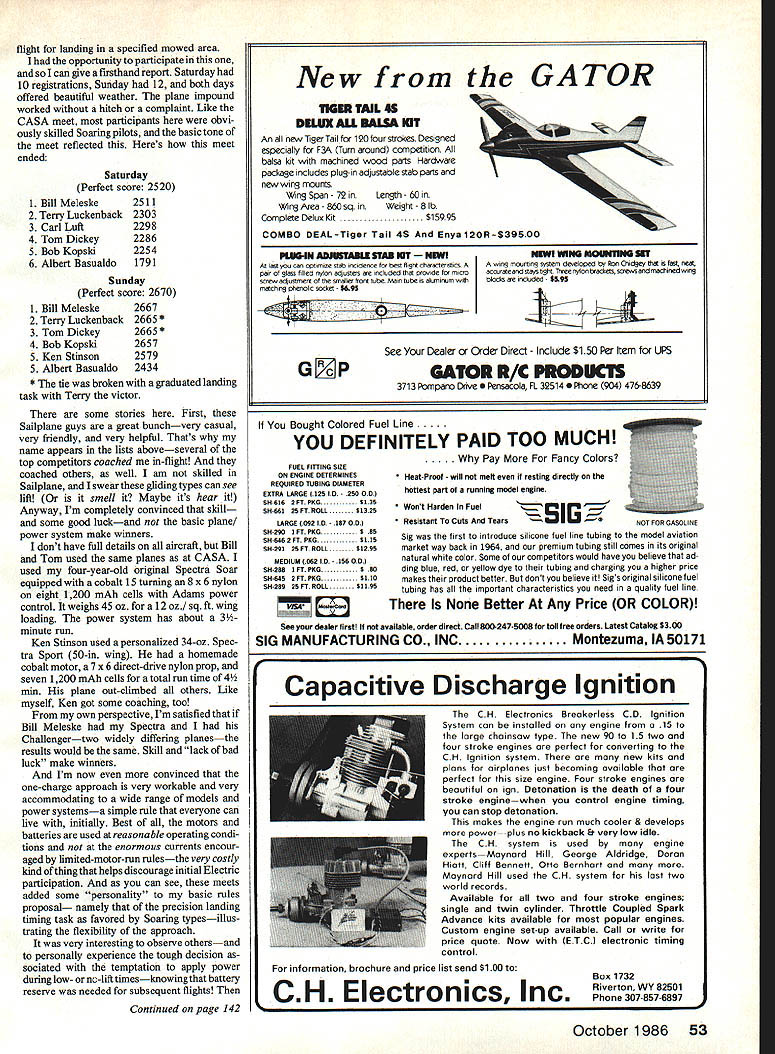
- (tie) Woody Blanchard — flying an original 100-in. Cutawacka. He used an Adams speed control, a Hobby Lobby motor/belt drive, a Hobby Horn folder, and a seven-cell 1,200 mAh pack that ran "forever."
- Skip Schow — same as above.
(The tie is to be settled at a later time.)
Daniel Boone Silent Flyers meet (Reading, PA) — June 21–22
Two weeks later, the Daniel Boone Silent Flyers held their first annual Electric meet using the same basic format with minor exceptions. Each day saw six rounds of flying with one charge-up per three flights, and a seven-minute task for all flights. Sunday added a bonus of 25 points each for the landing task in a mowed area. I was able to participate and can give a firsthand report. Saturday had 10 registrations; Sunday, 12. Both days offered beautiful weather. Plane impound worked without complaint. Like the CASA meet, participants were obviously skilled soaring pilots and the basic tone of the meet reflected that.
Here’s how the meet ended:
Daniel Boone — Saturday (top six)
- Bill Meleske — perfect score, 2520
- Terry Luckenback — 2511
- Carl Luft — 2303
- Tom Dickey — 2298
- Bob Kopski — 2286
- Albert Basualdo — 2254
Daniel Boone — Sunday (top six)
- Bill Meleske — 2667
- Terry Luckenback — 2665 *
- Tom Dickey — 2665 *
- Bob Kopski — 2657
- Ken Stinson — 2579
- Albert Basualdo — 2434 * (tie broken by graduated landing task)
*Tie between Terry Luckenback and Tom Dickey was noted; Albert Basualdo's tie was broken by the graduated landing task.
Observations and equipment notes
First, sailplane guys are a great bunch—very casual, very friendly, very helpful. Several top competitors coached flights and helped others as well. I'm convinced that skill, some good luck, and a basic plane/power system make winners.
I don't have full details on all aircraft. Bill and Tom used the same plane CASA used—a four-year-old original Spectra Soar equipped with a Cobalt 15, turning an 8 x 6 nylon prop on eight 1,200 mAh cells with Adams power control. It weighs about 45 oz., or roughly 2½ oz. per sq. ft. wing loading. The power system has about a 3½-minute run.
Ken Stinson used a personalized 34-oz. Spectra Sport (50‑in. wing). He had a homemade Cobalt motor, a 7 x 6 direct-drive nylon prop, and seven 1,200 mAh cells for a total run time of about 4½ minutes. His plane out-climbed all others. Like myself, Ken also got some coaching.
From my perspective, I'm satisfied that if Bill Meleske had my Spectra and I had his Challenger, results would be similar. Skill and lack of extra payload make winners.
I'm even more convinced that the one-charge approach is very workable and accommodating to a wide range of models and power systems—a simple rule that everyone can live with initially. Best of all, motors and batteries are used at reasonable operating conditions and not at the enormous currents encouraged by limited-motor-run rules—the very costly practice that discourages initial electric participation. These meets also added personality to my basic rules proposal—namely the precision landing task as favored by soaring types—illustrating the flexibility of the approach.
It was interesting to experience the temptation to apply power during low- or no-lift times, knowing that battery reserve was needed for subsequent flights. I overheard competitors debating choices: "Should I add a cell?" or "I think I'll try 800s next time!" Decisions, decisions—oh, fun decisions!
One more note: sixth place each day at Daniel Boone went to a very hard-working and nervous young lad—his first contest. Albert Basualdo of Philadelphia first saw Electric at the '84 KRC Electric Fly and returned to the '85 meet with his first plane. He had some bad luck at this meet—his electrified Oly 650 incurred damage on at least two landings (one reason I'm not a big fan of such tasks). He worked hard, performed on-field repairs with help from his father and encouragement from competitors, and completed all flights. Nice performance, Albert.
Charging and connectors
Electrical connections are particularly important in our hobby. Receiver and servo connectors must be very reliable—radio control depends on them! In electric power, charger and battery/motor connectors must be both reliable and very low contact resistance. This requirement is driven by the very large currents involved—thousands of times greater than the idle current of a typical receiver.
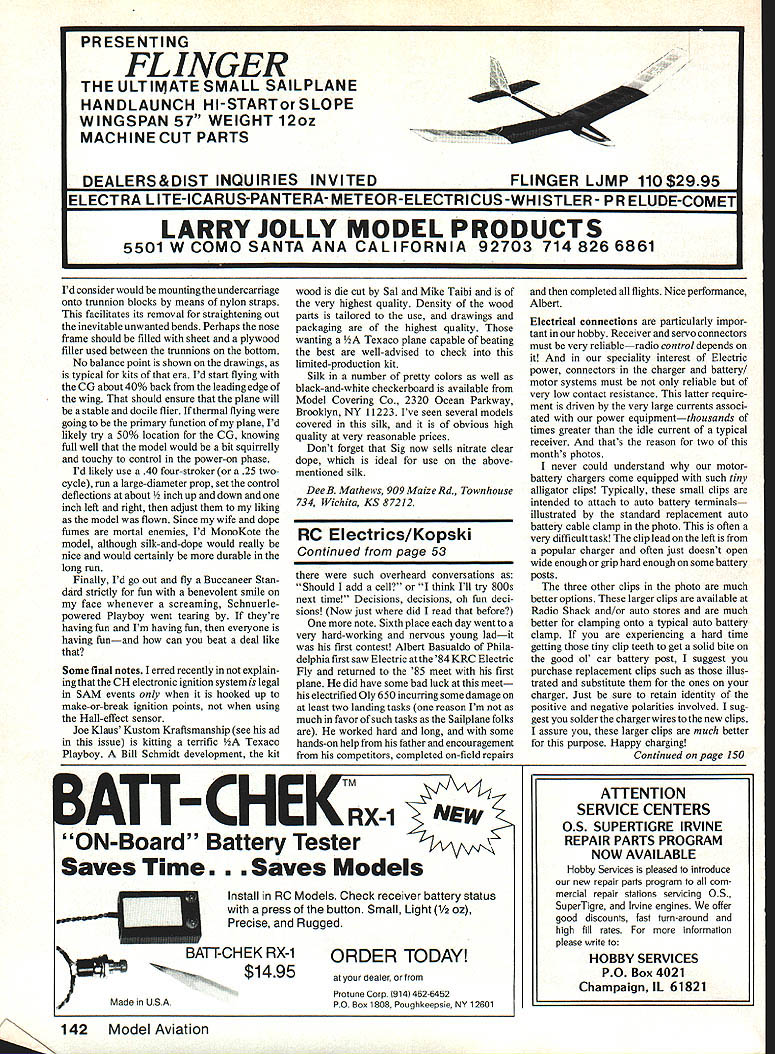
I never understood why our "standard" battery chargers come with such tiny alligator clips. Typically, these small clips are intended for auto battery terminals but are often too small to get a solid bite on a heavy pack or a car battery post. The larger clips available at Radio Shack or auto stores are much better for clamping onto a typical automobile battery post. If your charger clip won't get a solid bite, purchase larger replacement clips and substitute them for the ones on your charger. Be sure to retain positive/negative polarity and solder the charger wires to the new clips. These larger clips are much better for reliable charging.
New connector system
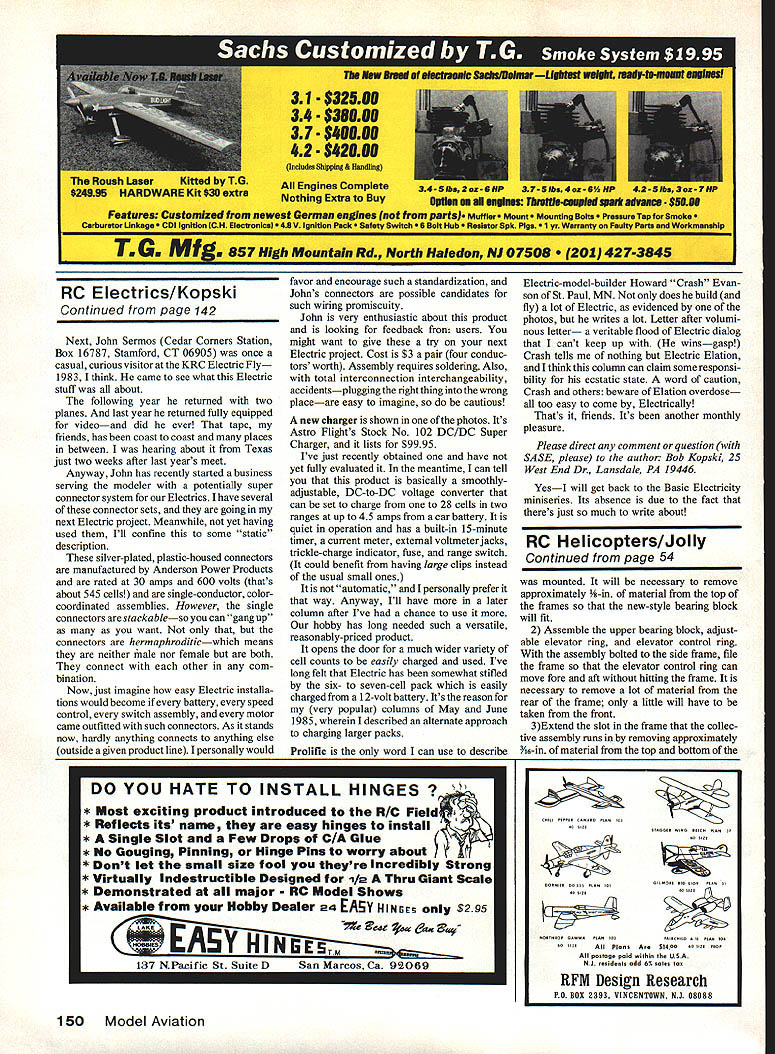
John Sermos (Cedar Corners Station, Box 16187, Stamford, CT 06905) has started offering a potentially excellent connector system for electrics. These silver-plated, plastic-housed connectors are manufactured by Anderson Power Products and are rated at 30 amps and 600 volts. As a single-conductor, color-coded assembled system, they are fast, convenient, and stackable—so you can "gang up" as many as you want. The connectors are hermaphroditic (neither strictly male nor female), so they mate with each other in any combination.
Imagine how easy installations would be if batteries, speed controls, switches, and motors came outfitted with such connectors. Hardly anything currently connects universally across product lines; these connectors are possible candidates for a useful standard.
John is enthusiastic and seeks feedback from users. I have several of these connector sets for my next electric project. Cost is about $3 a pair (four conductors' worth). Assembly requires soldering. With total interchangeability, accidents—plugging the right thing into the wrong place—are possible, so be cautious.
New charger
A new charger is Astro Flight's Stock No. 102 DC/DC Super Charger, list $99.95. I have recently obtained one and have not yet fully evaluated it. The product is a switch-mode DC‑to‑DC converter that can be set to charge from one to 28 cells at currents up to 4.5 amps from a car battery. It's compact and quiet and includes:
- built-in 15-minute timer
- current meter
- external voltmeter jacks
- trickle-charge indicator
- fuse and range switch
(It could benefit from having large clips instead of the usual small ones.) It is not "automatic," which I prefer. I'll report more after further use, but this is a versatile, reasonably priced product many have needed.
Other notes
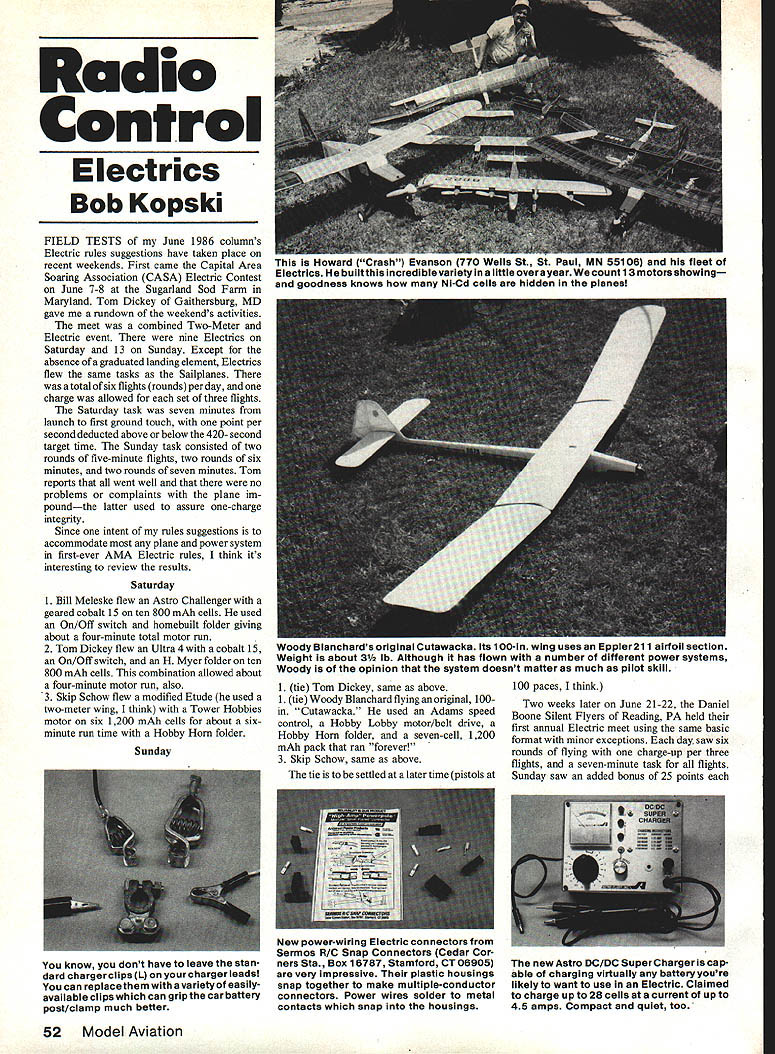
Prolific is the only word I can use to describe electric-model-builder Howard "Crash" Evanson of St. Paul, MN. He builds and flies a lot of electrics and writes a lot, too—letters in abundance. Crash reports nothing but electric elation; a word of caution to him and others: beware of elation overdose—too easy to come by.
Electrically, that's it for this month. It's been another monthly pleasure.
Please direct any comments or questions (with SASE, please) to the author: Bob Kopski, 25 West End Dr., Lansdale, PA 19446.
Yes — I will get back to the Basic Electricity miniseries. Its absence is due to the fact that there's just so much to write about!
Transcribed from original scans by AI. Minor OCR errors may remain.

