
Radio Control: Electrics
Bob Kopski
EVERY MONTH when I sit down to write this column I'm faced with the same basic problem: there is so much to write about I have to sort through and choose what to include and what not. This particular issue each year is "double trouble" because it's two months since I've written—the November issue is the annual Nats issue and has no regular columns—so the last week of June was the last time I wrote anything. That means that now I'm faced with most of the summer's wealth of information to condense.
Seriously, this is a real problem for me in that I strive very hard every month to offer items which I judge to be of greatest interest either to modelers in general or to Electric enthusiasts at large. And just as seriously, neither I nor any other columnist can fit it all into a monthly column. So, in order to deal with this problem, I'm going to try something new in the future.
Whenever I see something I deem of general interest to Electric modelers in other magazines that I'm not able to squeeze in here, I'll reference it. Of course by the time you see the reference that information will be three or four months old, but maybe not so old that you can't find someone with a back issue. Also, since I don't see every magazine every month, not everything will come to my attention. The best one can do is, in fact, the best one can do! And that includes me.
Reader reaction: August column
Wow! I must have pushed the right button—I've had near record-level reader reaction to the August column. That was the column about economical, entry-level Electrics that "won't blow a hole in the sky" but will satisfy a lot of flying needs.
It seems many of you found just what you wanted in that issue. The August column may have caused more people to try Electric than anything else I've written. Thanks to all who wrote so favorably in response.
Based on this experience, I'm thoroughly convinced there are a lot of modelers out there who are very close to trying Electric but need the right basic info and a little encouragement. These folks couldn't care less about "expensive," "complicated," or "state-of-the-art" Electrics—some are turned off by such things—but they do want simple, economical starters.
Interestingly, about the same time the August issue appeared, the current issue of The Electric Fly Sheet (publication of the Electric Aeromodeling Association, EAA) arrived. The EAA is basically structured to promote the "leading edge" of Electric modeling first and relegates the beginner's needs to a lower priority. The fact is that covering everything thoroughly to everyone's interest and satisfaction is impossible for any publication. I'll always try to offer something for everyone, but I especially enjoy peddling Electric elation—first-time and continuing Electric success. I get lots of jollies (not you, Larry) by showing non-believers (there still are many) that Electric really is a very workable and rewarding alternative.
One very rich form of this is when a reader tells me how his new Electric flew right off to the amazement of everyone else in his club—where, of course, he is the first and only to try Electric! Right now, successful Electric beginners are Electric's most important resource.
Electric rules — more
The same issue of The Electric Fly Sheet presented the (proposed) EAA Electric contest rules. These consist of 14 proposed categories, including:
- Free Flight
- Control Line Speed and Aerobatics
- RC Sailplane Precision Duration
- Sailplane Endurance
- Pylon Racing
- Old Timers (OT)
- OT Texaco
- Precision Aerobatics
- Sport Scale
Unfortunately, too many of these proposals are structured such that they pretty much dictate using absolutely the best (and most costly) equipment in order to be competitive—an approach consistent with the organization's expressed purpose. It is also consistent with the way many existing AMA contest events are approached.
For example, who in their right mind would even think of participating in 1/4 A FF Gas without the best custom-reworked Tee Dee? But there's something different here. The 1/4 A FF event has been around "forever" and is solidly established (though perhaps not growing). Electric is relatively new, and Electric competition is yet to be formalized within the AMA. At this point, attracting entries to Electric and to Electric competition is far more important than advancing the costly state of the art. How do I know that? Please go back and reread the August column experience! Besides—if we don't have enough successful beginners now, the EAA won't have enough experts in the future.
September reader response and charger safety
The September issue also brought reader reaction. Much of it related to the story of a first-time RC flier's experience with the Playboy, but more reaction was to the discussion of charger safety connections, which is worth passing along.
That column pictured a convenient way to routinely and easily connect your charger to your car battery using an automotive trailer light connector. The connector set I have seen (and routinely used) consisted of two male and two female contacts, all shielded (protectively covered). Well, it seems not all trailer lighting connectors are made that way—some have one or more contacts exposed while the two halves are not mated.
If you have such a connector set, be sure the exposed pins are the ones wired to the outside of the car battery (ground—usually negative) so there is no danger if these pins come in contact with the metalwork of the car. And while on the subject, be sure the connector lead set attached to the car battery is dressed (positioned) when not in use so it cannot dangle into any of the auto engine belts and pulleys. All this is common sense, of course, but sometimes the obvious is not so! My thanks to reader Phil Mahony (Lime Rock, CT) for bringing the "other kind" of connector to my attention.
Charger safety tips:
- Use connector types with covered contacts when possible.
- If using exposed-contact connectors, wire the exposed contacts to ground (negative) side of the battery.
- Stow and secure leads when not in use so they cannot fall into belts or pulleys.
- Inspect connectors periodically for wear or corrosion.
Motor "feel" and armature construction
Motor "feel" seems to interest and confuse some modelers. To an Electric modeler, taking a motor in hand and spinning the armature is as natural and appealing as feeling compression is to a gas modeler. And just as the "feel of the compression" seems to give a clue as to how good a gas engine is, so the magnetic "pull" on an Electric motor armature seems to give a clue to how good the motor is—right? Not necessarily.
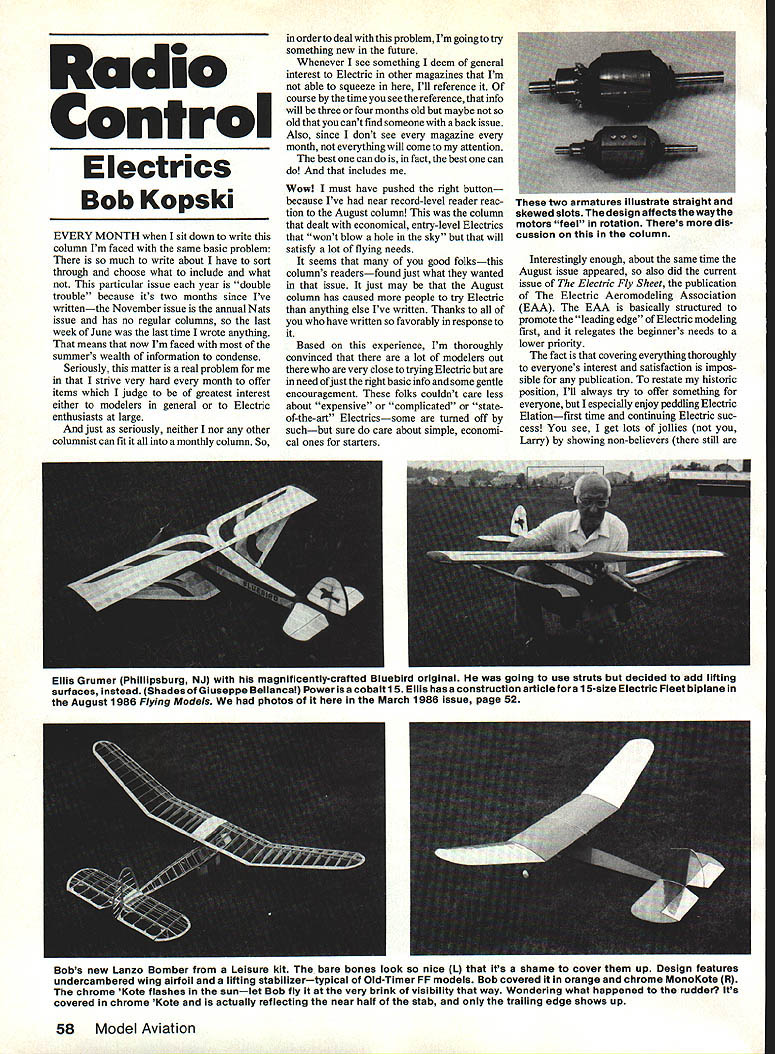
One photo shows two armatures that happen to be different sizes, but what's important is the difference in the nature of the armature stacks: the many thin iron laminations that comprise the armature poles. Notice how one armature has straight slots (the grooves holding the wire windings) while the other has skewed slots. Now imagine these armature assemblies installed between the permanent field magnets of the motor housing.
The armature with straight slots will tend to "index," i.e., the armature poles will line up with the magnetic field in the motor housing. The armature will "cog" from pole to pole as you manually rotate the shaft. This "indexing" is most prominent in motors having very strong field magnets (cobalt) and/or fewer armature poles.
By contrast, the skewed-slot armature structure reduces cogging because the rotating skewed armature poles gradually progress through the field of the permanent magnets—there is no sharp beginning or end to a given armature pole to snap into field alignment. So, if your American-made cobalt motor doesn't "feel as good" (like it doesn't have as much "compression") as some other motor, it's probably because it has skewed slots. That doesn't mean the motor is worse—just that it feels different.
Astro motor changes and new motors
Some improved motors have just been introduced by Astro—but you may not notice it until you look closely. Astro 05 and 15 cobalts shipped after August 1986 will have case modifications. In particular, the end bells will no longer be held in place with roll pins; the motors are now assembled with stainless steel through-bolts.
Advantages of the through-bolt assembly:
- Ability to adjust motor timing (similar in concept to adjusting spark timing on an ignition engine). Previously, roll pin assembly forced factory-set neutral timing so the motor ran equally well in either direction by reversing polarity.
- Easier disassembly and servicing.
- Ability to change motor rotation direction by rotating the rear end bell 180° rather than by removing and reversing leads.
This timing adjustment is not technically new and is routinely used in some foreign model aircraft and model car motors. The revised assembly design is destined to find its way into the 25- and 40-size cobalts in the future.
An advisory for owners of earlier 05s and 15s with roll pin case assemblies: it is virtually impossible to remove and replace the rear end bell without damaging the armature windings. Roll pins, if not driven in super-tight, can shear off winding leads when the end bell is pulled out. My recommendation is to leave such motors alone unless you have a very good reason to take the end bell off.
Astro has also introduced other new motors, including quite small and quite large ones. The time-honored 02 and 035 ferrites have been discontinued and replaced by cobalt versions with impressive power-handling ability. These new smaller cobalts are effectively shortened versions of the 05 cobalt, so you can picture what they look like. As of this writing, Astro is backordered for these new products, and it may be a while before you can see one hands-on.
At the other end of the size range, Astro has 60- and 100-size motors. Those interested should contact Astro for particulars. These big motors may present special problems for bench-running because their prop blast can be very energetic—one builder told me they "blew everything in his 100-foot-long shop away!" He's building special ductwork to safely carry the prop blast elsewhere.
New Old-Timer: Leisure's Lanzo Bomber
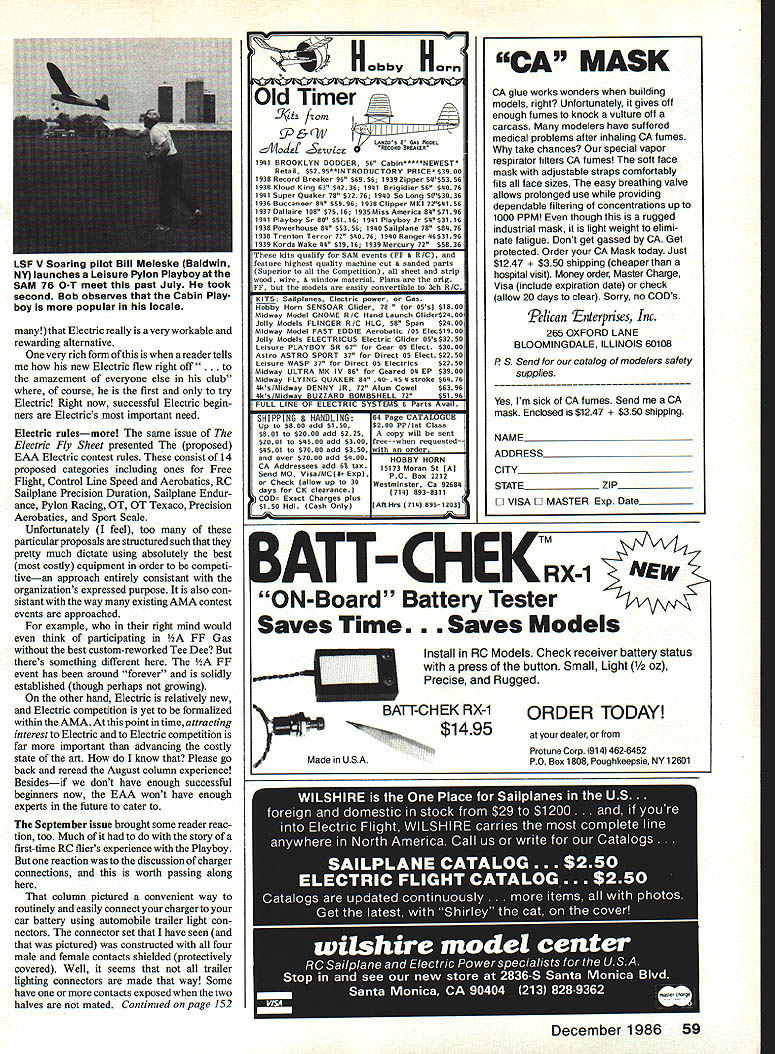
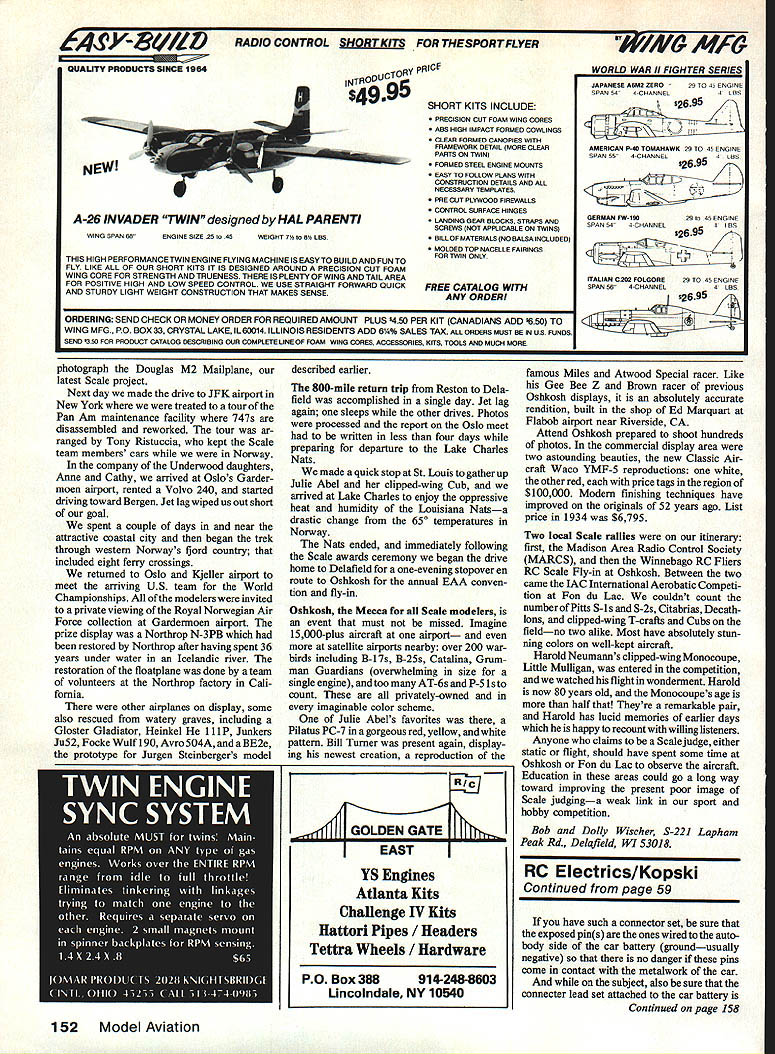
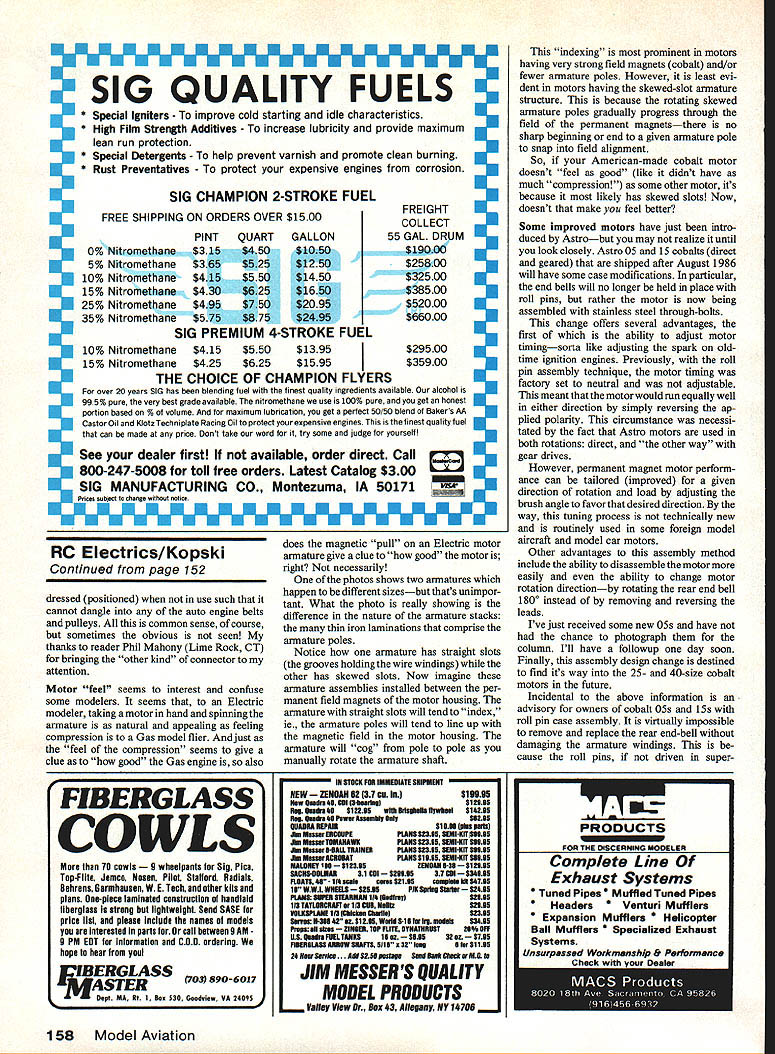
A new Old-Timer is pictured in two of the photos: Leisure's Lanzo Bomber. In general, it's a very nice kit with good wood and clean cutting. However, I would suggest beginners consider a possible alternate, because some aspects of the construction are difficult and the plans don't help much.
In particular, the diamond-shaped fuselage with pylons is a real challenge during assembly and equipment installation. For those inspired by the plane, keep all equipment as far forward as possible and work hard to keep the aft end light—otherwise it's tail-heavy city, and no one wants to add nose weight to an Electric!
I built the model for the recent SAM 76 OT meet in Hatfield, PA. I decided on the power system late in the construction—choosing a geared cobalt 15 on ten 800 mAh cells and a 12 x 8 fixed-blade fan. The radio controls rudder, elevator, and motor On/Off and uses a 250 mAh battery pack. All-up weight is 49 oz. The meet rules allowed a 90-second motor run time included in a seven-minute max limit for each of three flights. How did it fly? It maxed three times, leaving six Playboys behind. Not that I'm not appreciative—but my next OT will probably be another Playboy.
Events and contacts
Late news: The Polk County Soaring Eagles of Lakeland, FL have announced a second Electric Fun-Fly for December 7, 1986. This follows by popular demand their first meet of July 13. For more information, contact:
- Leonard Postage
6103 Andrea Dr. Lakeland, FL 33803 Phone: (813) 644-1942 and (813) 293-3434
Please forward reader (or any other) comments and questions (with SASE, please) to:
- Bob Kopski
25 West End Dr. Lansdale, PA 19446
Final note
Do you know what the primary concern of publisher Carl Wheeler was when he and I discussed starting this column a couple of years ago? It was whether available Electric material would soon dry up and I wouldn't have enough to write about!
Transcribed from original scans by AI. Minor OCR errors may remain.

