

Radio Control: Electrics
Bob Kopski
This column is usually fun to write—but not this time.
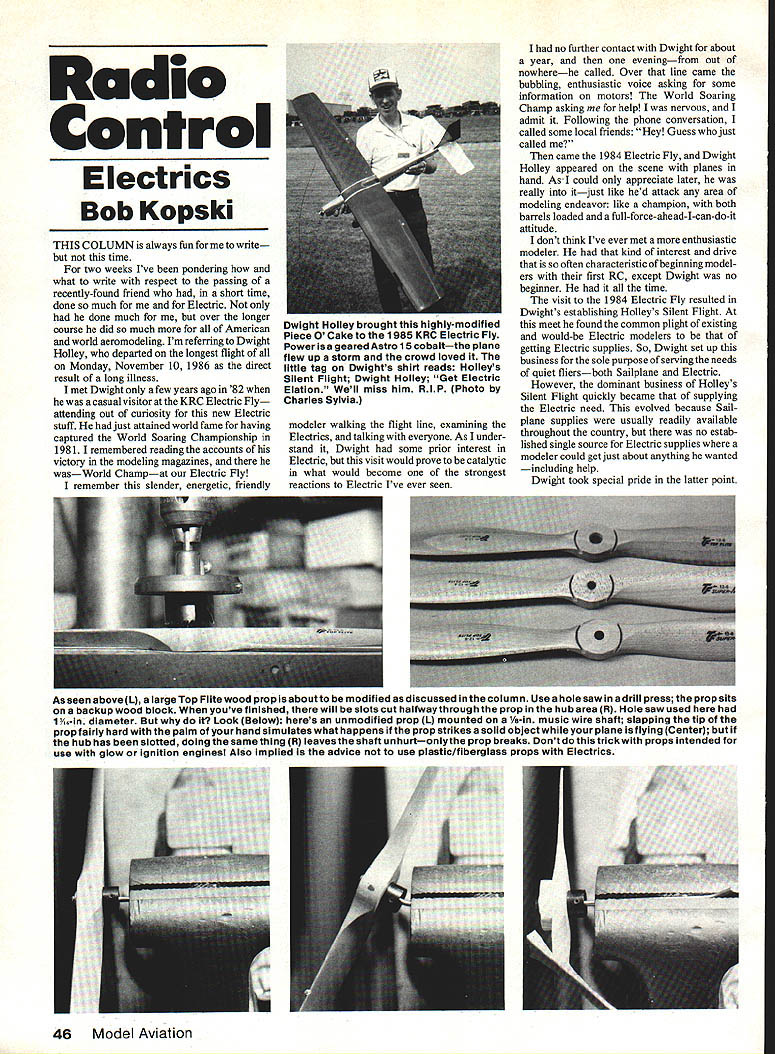
For two weeks I've been pondering what to write about the passing of a recently found friend who did so much, in a short time, for me and for electric flight. Over a longer course he did much more for American and world aeromodeling. I'm referring to Dwight Holley, who departed on the longest flight of all on Monday, November 10, 1986, as the direct result of a long illness.
I first met Dwight a few years earlier in 1982 when he was a casual visitor at the KRC Electric Fly—attending out of curiosity about the new electric stuff. He had just achieved world fame by capturing the World Soaring Championship in 1981. I remembered reading the accounts of his victory in the modeling magazines, and there he was—World Champ—at our Electric Fly!
I remember a slender, energetic, friendly modeler walking the flight line, examining electrics and talking with everyone. As I understand it, Dwight had some prior interest in electrics, but that visit proved catalytic to what became one of the strongest reactions to electrics I've ever seen.
Not long after the visit, Dwight called. Over the line came a bubbling, enthusiastic voice asking for information on motors—the World Soaring Champion asking me for help. I was nervous, I admit it. After the phone conversation I called some local friends: "Hey, guess who just called me?"
At the 1984 Electric Fly Dwight appeared on the scene with planes in hand. As I appreciated later, he attacked the area of modeling endeavor like a champion—both barrels loaded, full-force-ahead, "I-can-do-it" attitude. I don't think I've ever met a more enthusiastic modeler. That kind of interest and drive is often characteristic of beginning modelers—except Dwight had it all the time.
That 1984 visit resulted in Dwight establishing Holley's Silent Flight. He found a common plight among would-be electric modelers: obtaining electric supplies. So Dwight set up the business with the sole purpose of serving the needs of quiet fliers—both sailplane and electric. As business developed, Holley's Silent Flight quickly became a broader supplier of electric needs because sailplane supplies were usually readily available elsewhere; there was no established single source for electric supplies. Dwight stocked anything a modeler could want and, importantly, took pride in helping customers.
Holley's grew, stocking larger and larger supplies of domestic and foreign electric products. It soon became routine for me to receive letters from readers saying they'd bought electric goodies at Holley's.
In the summer of 1985 Dwight and his lovely wife Mary Ann invited us to stop at their place in Connecticut so we could travel together to the First Annual South Shore Electric Fly near Bridgewater, Massachusetts, in July. I had known for some time that Dwight was fighting a serious illness, but during the visit I came to understand fully the devastating extent of his condition. Dwight attacked the matter as he did his aeromodeling pursuits—full-force, "I'm gonna do it" mentality. It's the kind of stuff you see in movies; it's the kind of stuff I personally have great difficulty understanding.
September 1985 brought another Electric Fly. Dwight and Mary Ann were there bright and early, setting up planes and Holley's supply area, making many attendees very happy with electric goodies and modeling help. We talked and corresponded after the meet; little did I know that the 1985 meet would be the last time I'd see him. I remember some phone conversations in the months that followed—Dwight's outlook remained steadfastly positive—though others closer to him knew a less optimistic reality. Gradually it became harder for me to call; I felt stalled and sad.
It had been Dwight's hope to attend the 1986 Electric Fly, but he was too weak and too ill to make the trip. His absence was glaring, and many regulars asked about his condition. He still supported the meet with a fine merchandise donation—that was the way he was. John Sernos, a friend nearby, gave a not-too-encouraging report on Dwight's health. My wife, a nurse, kept urging me to call, but somehow I felt unable.
Then I finally got an idea for something I could do. One Tuesday, November 11, the thought came to me: I would get a full set of reprints of all the photographs taken at the 1986 Electric Fly—over 100 of them—and send them to Dwight. The idea occupied me all day and made me feel happy that I could do something for him.
Happy landings, Dwight.
Tribute video
On a related matter, John Sernos combined footage of the 1985 and 1986 Electric Fly rallies into a video dedicated to the memory of Dwight Holley. John was quick with the rushes and showed the video to Dwight not long after the recent Electric Fly. The tape is entitled "This Is Electric Flight" and is estimated to be available through the AMA by mid-1987. I will provide updates here as information becomes available.
Propeller strength and speed reducers
Speed reducers and large props are increasingly popular, based on what I saw at the recent Electric Fly and as I reported previously. I've used these for many years, and one continuing lament has been that large props—past about 10 inches—can be very strong chunks of wood. In fact, these wooden pushers can be much stronger than the gear drives and shafts they are attached to.
I've been using a 12 x 8 prop on my eight-year-old L-3 driven by an old-style Astro 15 and belt drive. The prop shaft is a sturdy 1/4-inch shaft, but every now and then—on an imperfect landing—the prop hits the ground. Often the prop doesn't break, but very often a slight bend is put in the prop shaft.
A much worse circumstance occurs when a large prop is mounted on an even smaller-diameter drive shaft. Some gear drives use an output shaft of about 1/8-inch diameter, and these simply don't stand a chance when the large wooden blades they're turning hit the ground.
What finally pushed me to do something about it was one bad landing on my new Lancer Bomber. Its geared Astro 15 cobalt turns a 12 x 8 or sometimes a 13 x 8. That gear assembly is strong and so is the prop, so guess what gave out when the prop blade hit? The entire nose section! There was nothing structurally wrong with the fuselage front end; the chunk of maple called a prop was much stronger than the balsa supporting the motor mount. That convinced me to act.
Prop modification technique
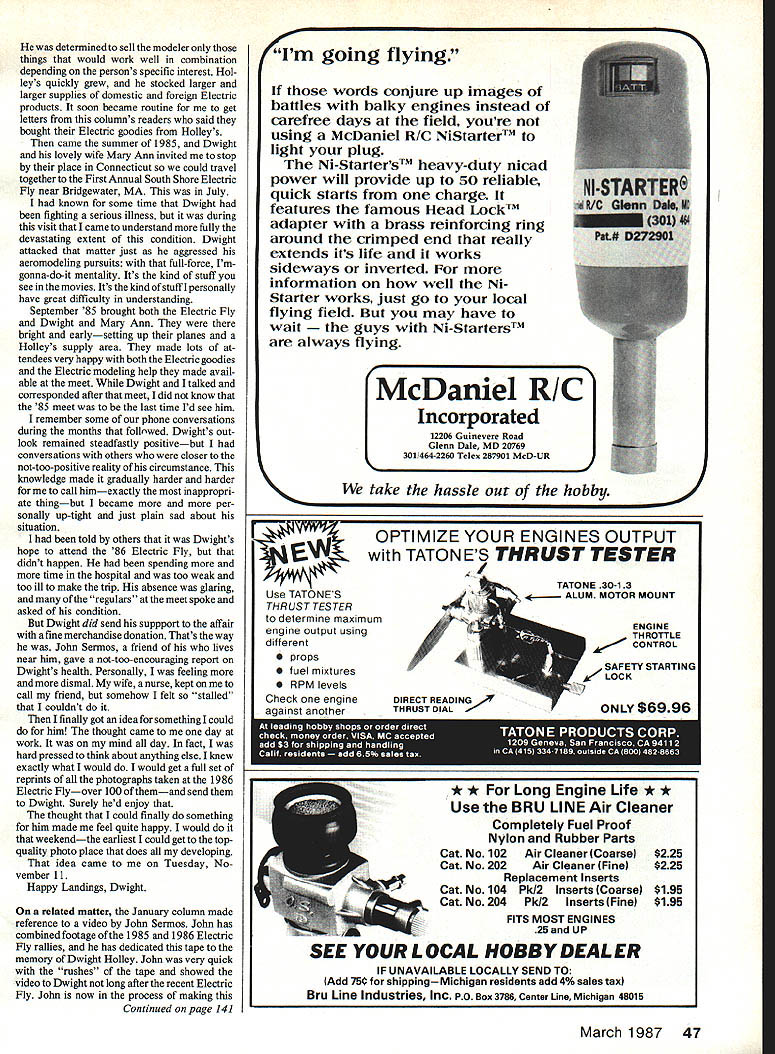
I chose to modify the props so that on impact the prop would sacrifice itself rather than bend or break the drive shaft or damage the airframe. I acknowledge that prop manufacturers would frown on this change, and the consequences are my personal responsibility. I was comfortable with the modification because the props were to be used for electric applications only, not on piston engines for which the props were originally intended.
Procedure:
- Using a drill press and an appropriately sized hole saw, carefully cut circular grooves into the prop hubs.
- The hole saw's pilot drill should match the original prop bore (I used a 1/4-inch pilot to fit the bore).
- Make the saw cuts about halfway through the hub thickness. This removes some material to reduce hub strength while leaving the prop sufficiently strong for electric use.
Testing and results
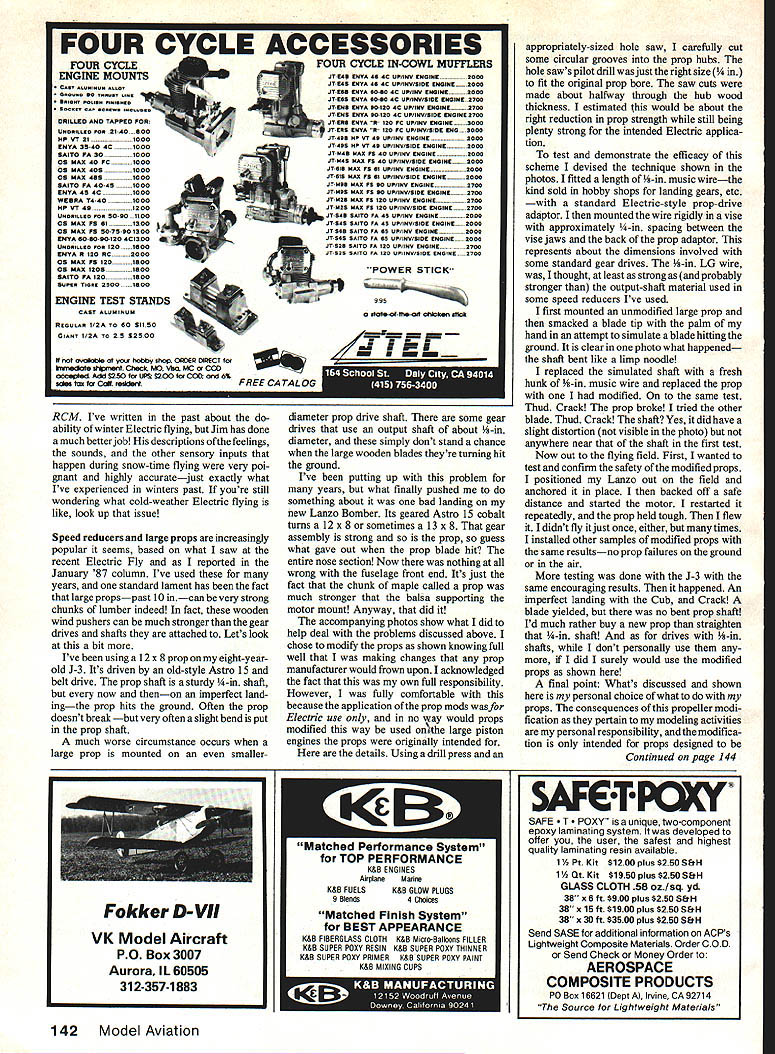
To test the scheme I devised a simple bench test. I fitted a length of 1/16-inch music wire (the kind sold for landing gear) with a standard electric-style prop-driver adaptor and mounted the wire rigidly in a vise with approximately 1/4-inch spacing between the vise jaws and the back of the prop adaptor—dimensions similar to some standard gear drives.
- With an unmodified large prop, I struck a blade tip with the palm of my hand to simulate a blade hitting the ground. The shaft bent like a limp noodle.
- I then replaced the shaft with fresh 1/16-inch music wire and tested a modified prop. On the same impact, the shaft did not bend; instead the prop blade shattered. The prop sacrificed itself without damaging the drive shaft.
I then went to the flying field for live tests. I anchored the Lancer, started the motor repeatedly, and the modified prop held up. I flew it many times with no failures. I tested other modified props with the same encouraging results. On the J-3 I had one imperfect landing: Crack! A blade yielded, but there was no bent prop shaft. I'd much rather lose a prop than have to straighten a 1/4-inch shaft.
As for drives with 1/8-inch shafts, while I don't personally use them anymore, if I did I would surely use the modified props as shown here.
A final point: this is my personal choice of what to do with props. The modification is intended only for props designed for use on gas engines but repurposed for electric applications as presented herein. I would not do this to props used on gas engines (glow, diesel, or ignition-equipped piston engines), where the prop shafts are appropriately strong and such a modification has no purpose.
Additional reading on speed-reducer damage and repair can be found in Mitch Poling's "Electric Power" column in the December 1986 issue of Model Builder magazine.
Correction and apology
A monumental blunder occurred in my January 1987 column, and I want to acknowledge it and apologize sincerely to Tom Kerr of K & W Enterprises of Philadelphia, PA. Tom manufactures folding props, and somehow I managed to get the wrong name in that column. Tom is a gentleman and didn't even hang up on me when I called to acknowledge the blunder. Tom is working hard to develop a line of folders for electric use. Interested readers can contact him at:
Tom Kerr K & W Enterprises 7824 Lexington Ave. Philadelphia, PA 19152 (215) 331-4890
That's all, folks. This column is finally ended. It took longer to write than any other in recent memory.
Please send any comment or question (with SASE please) to the author:
Bob Kopski 25 West End Dr. Lansdale, PA 19446
Next month — exclusive info on a new, unbelievable motor!
Transcribed from original scans by AI. Minor OCR errors may remain.

