
Radio Control
Electrics
Bob Kopski
June is almost ended, and there are some unusual electric projects both on the beach and in the air—creations of some of my fellow fliers. Two of these are pictured herein, and both are expected to be operational at the 1984 Electric Fly.
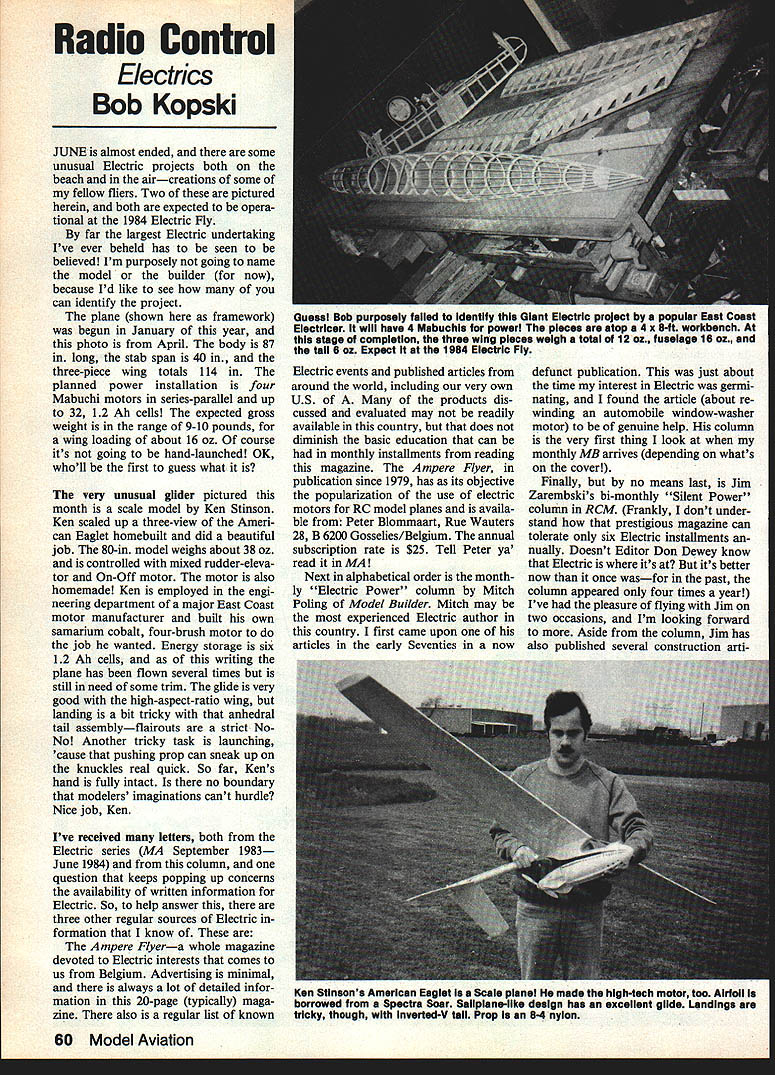
By far the largest electric undertaking I’ve ever beheld has to be seen to be believed! I’m purposely not going to name the model or the builder (for now), because I’d like to see how many of you can identify the project.
The plane (shown here as framework) was begun in January of this year, and this photo is from April. The body is 87 in. long, the stab span is 40 in., and the three-piece wing totals 114 in. The planned power installation is four Mabuchi motors in series-parallel and up to 32 1.2 Ah cells. The expected gross weight is in the range of 9–10 pounds, for a wing loading of about 16 oz. per sq. ft. Of course it’s not going to be hand-launched! OK, who’ll be the first to guess what it is?
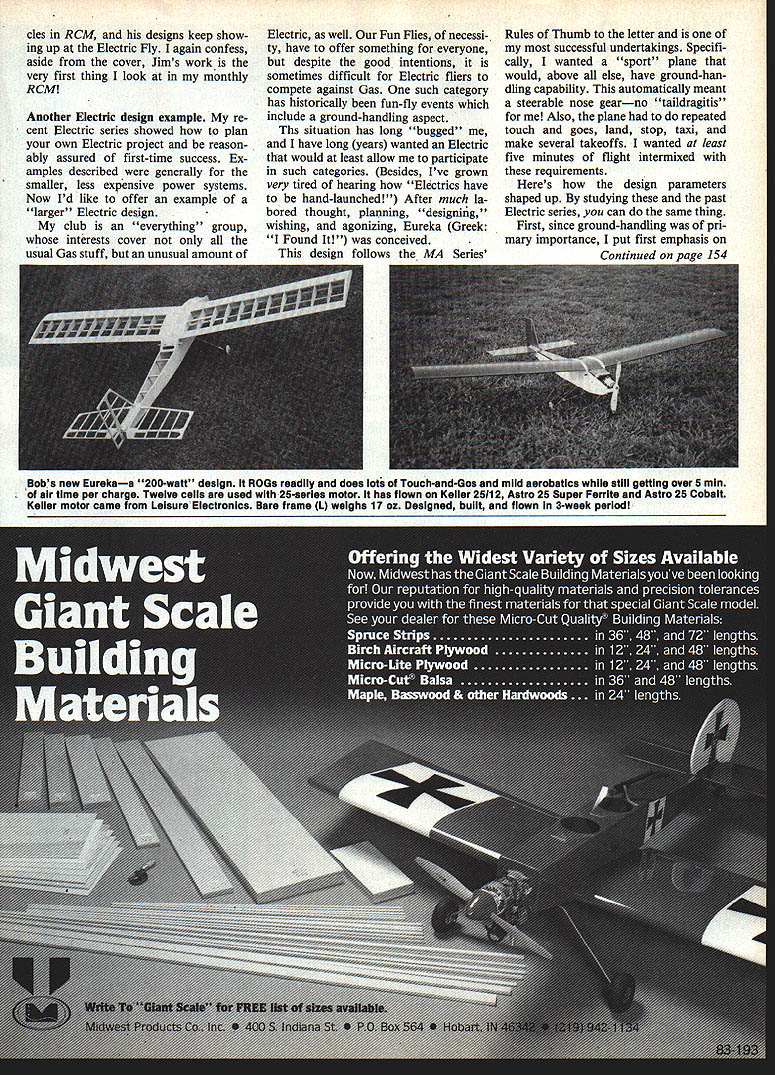
The very unusual glider pictured this month is a scale model by Ken Stinson. Ken scaled up a three-view of the American Eaglet homebuilt and did a beautiful job. The 80-in. model weighs about 38 oz. and is controlled with mixed rudder-elevator and on-off motor. The motor is also homemade! Ken is employed in the engineering department of a major East Coast motor manufacturer and built his own samarium-cobalt, four-brush motor to do the job he wanted. Energy storage is six 1.2 Ah cells, and as of this writing the plane has been flown several times but is still in need of some trim.
The glide is very good with the high-aspect-ratio wing, but landing is a bit tricky with that anhedral tail assembly—flare-outs are a strict no-no! Another tricky task is launching, ’cause that pushing prop can sneak up on the knuckles real quick. So far, Ken’s hand is fully intact. Is there no boundary that modelers’ imaginations can’t hurdle? Nice job, Ken.
I’ve received many letters, both from the Electric series (MA September 1983—June 1984) and from this column, and one question that keeps popping up concerns the availability of written information for electric flight. So, to help answer this, there are three other regular sources of electric information that I know of. These are:
- The Ampere Flyer — A whole magazine devoted to electric interests that comes to us from Belgium. Advertising is minimal, and there is always a lot of detailed information in this 20-page (typically) magazine. There is also a regular list of known electric events and published articles from around the world, including our very own U.S. of A. Many of the products discussed and evaluated may not be readily available in this country, but that does not diminish the basic education that can be had in monthly installments from reading this magazine. The Ampere Flyer, in publication since 1979, has as its objective the popularization of the use of electric motors for RC model planes and is available from: Peter Blommaert, Rue Wauters 28, B 6200 Gosselies, Belgium. The annual subscription rate is $25. Tell Peter you read it in MA!
- The monthly "Electric Power" column by Mitch Poling of Model Builder. Mitch may be the most experienced electric author in this country. I first came upon one of his articles in the early Seventies in a now-defunct publication. This was just about the time my interest in electric flight was germinating, and I found the article (about rewinding an automobile window-washer motor) to be of genuine help. His column is the very first thing I look at when my monthly MB arrives (depending on what’s on the cover!).
- Jim Zarembski’s bi-monthly "Silent Power" column in RCM. (Frankly, I don’t understand how that prestigious magazine can tolerate only six electric installments annually. Doesn’t Editor Don Dewey know that electric is what it’s at? But it’s better now than once was—for in the past, the column appeared only four times a year!) I’ve had the pleasure of flying with Jim on two occasions, and I’m looking forward to more. Aside from the column, Jim has also published several construction articles in RCM, and his designs keep showing up at the Electric Fly. I again confess, aside from the cover, Jim's work is the very first thing I look at in my monthly RCM!
Another electric design example. My recent Electric series showed how to plan your own electric project and be reasonably assured of first-time success. Examples described were generally for the smaller, less expensive power systems. Now I'd like to offer an example of a "larger" electric design.
My club is an "everything" group, whose interests cover not only all the usual gas stuff, but an unusual amount of electric as well. Our Fun Flies, of necessity, have to offer something for everyone, but despite the good intentions, it is sometimes difficult for electric fliers to compete against gas. One such category has historically been fun-fly events which include a ground-handling aspect.
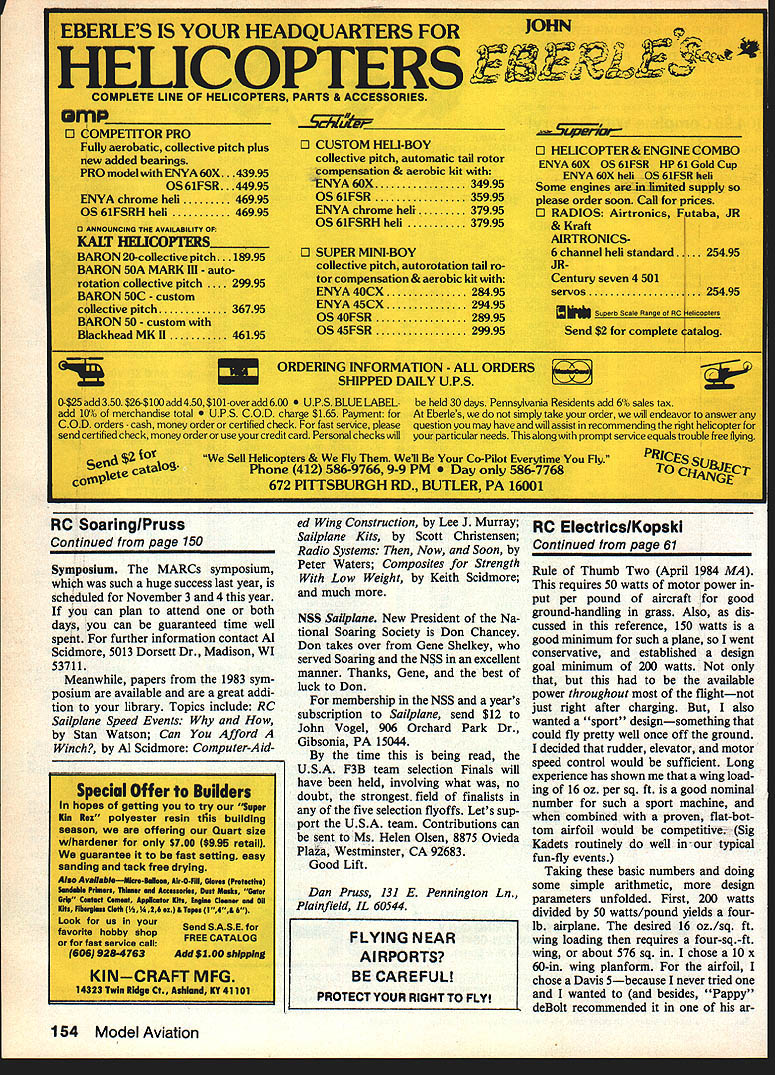
This situation has long bugged me, and I have wanted (for years) to own an electric that would at least allow me to participate in such categories. (Besides, I've grown very tired of hearing how "electrics have to be hand-launched!") After much labored thought, planning, "designing," wishing, and agonizing, Eureka (Greek: "I Found It!") was conceived.
This design follows the MA Series Rules of Thumb to the letter and is one of my most successful undertakings. Specifically, I wanted a "sport" plane that would, above all else, have ground-handling capability. This automatically meant a steerable nose gear—no "taildrag-itis" for me! Also, the plane had to do repeated touch-and-gos, land, stop, taxi, and make several takeoffs. I wanted at least five minutes of flight intermixed with these requirements.
Here's how the design parameters shaped up. By studying these and the past Electric series, you can do the same thing.
First, since ground-handling was of primary importance, I put first emphasis on Rule of Thumb Two (April 1984 MA). This requires 50 watts of motor power input per pound of aircraft for good ground-handling in grass. Also, as discussed in that reference, 150 watts is a good minimum for such a plane, so I went conservative and established a design-goal minimum of 200 watts. Not only that, but this had to be available to the power system without resorting to the motor for most of the flight — not just after charging.
I also wanted a "sporty" design — something that could fly pretty well once off the ground. I decided that rudder, elevator, and motor speed control would be sufficient. Long experience has shown me that a wing loading of 16 oz. per sq. ft. is a good nominal number for such a sport machine, and when combined with a proven, flat-bottom airfoil would be competitive. (Sig Kaos and Kadets routinely do well in our typical fun-fly events.)
Taking these basic numbers and doing some simple arithmetic, more design parameters unfolded. First, 200 watts divided by 50 watts/pound yields a four-pound airplane. The desired 16 oz./sq. ft. wing loading then requires a four-sq.-ft. wing, or about 576 sq. in. I chose a 10 x 60-in. wing platform. For the airfoil, I chose a Davis 5—because I never tried one and I wanted to (and besides, "Pappy" deBolt recommended it in one of his articles). The remainder of the model design is straightforward and nominal—and is very close to having Falcon 56 moments, etc.
Rule of Thumb Three advises that the electric system components should make up about 40% to 60% of the total model weight. This means that about 38 oz. of the total budget is available for the power system. I had three motors in mind for this plane: an Astro Super Ferrite 25, an Astro Cobalt 25, and a K & B 25/12. These weigh 14, 12.5, and 9.5 oz., respectively. This left about 25 oz. (nominal) available for the battery, and 12 cells fit this just fine. All I had to do was prop the motors appropriately to achieve the desired operating power level, and this was easily done. It turns out that a 10 x 6 on the first—and a 9 x 6 on the last two—does the job. This comes from static bench data I had taken.
From Rule of Thumb One, the power input to cruise is about 4 lb. x 16 oz./sq. ft., or 64 watts. Twice this gets the plane flying nicely, so I needed about 130 watts average power input. For a nominal five-minute flight from a conservative charge in the battery of about 65 ampere-minutes (MA December 1983), I could draw current at the average rate of 65/5 or 13 amps. This requires an applied motor voltage of 130/13 or 10 volts, average. The 12-cell battery has a nominal terminal voltage of 13 to 14 volts, so the Jomar speed control has something to do: namely, reduce the voltage, on the average, for the desired flight power and time. Then, for ground-handling, takeoffs, touch-and-gos, loops, etc., full throttle easily brings up the power past 200 watts, based on the previously-mentioned bench data.
Of course, the actual performance is a bit better than the conservative predictions, because the prop unloads in the air, and this manifests itself as longer flight time. Average flight time to date is over 6½ minutes. All of these flights included lots of touch-and-gos, loops, land, taxi, and takeoffs—on a grass field. Now, would you say the Rules of Thumb work?
To complete the story, here are some more facts and figures about Eureka. The completed wing weighs 8.5 oz. Go back and check Rule of Thumb Four! The complete airplane, with radio but no power system parts, weighs 27.5 oz. Of this, 4.8 oz. is the landing gear and wheels. By the way, covering is MonoKote. The radio flight pack is 250 mAh. A prop weighs about an ounce! (Remember those quarter-ounces—Rule of Thumb Five!)
So, guess what now? I'm bored with it! The real goal of the ground-handling machine worked out just great, and now I'm planning a new plane (or maybe just a new wing), with flaps and ailerons. One challenge after another—that's what keeps my electric "juice" flowing!
I hope this "larger" electric design example proves helpful. The intent of this column is basically "how to," and this seemed very appropriate to me. See — electrics don't all have to be hand-launched!
Happy landings!
Bob Kopski 25 West End Dr., Lansdale, PA 19446.
Transcribed from original scans by AI. Minor OCR errors may remain.

