
Radio Control: Electrics
Bob Kopski
Beginners
Based on incoming mail, Electric is enjoying strong, steady growth with many new participants joining in. I get lots of mail, and a substantial portion of it is from modelers new to Electric. These folks usually have beginner questions, and as such I'm continually reminded of the need to keep a substantial percentage of this column allocated to covering that need.
I personally know how very easy it is for experienced modelers to take some basic things for granted that may be major impasses for first-time Electric modelers. Here are some example subjects.
Batteries
Batteries and related matters continue to bring the most questions. Here is information on common points of confusion.
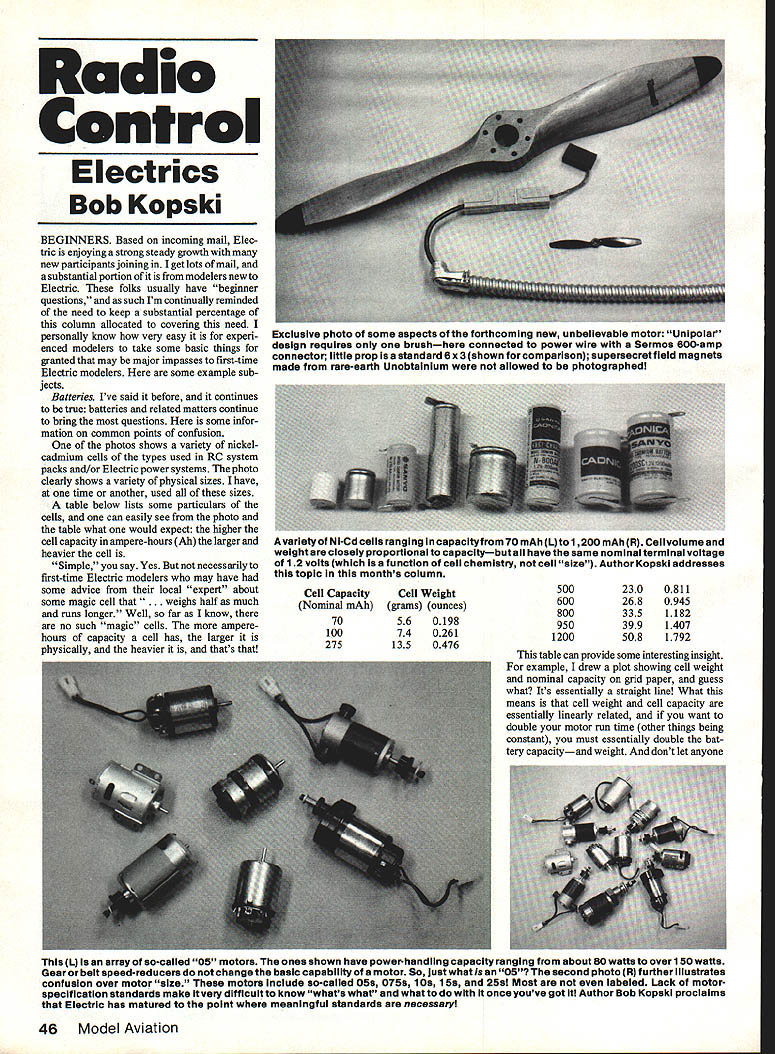
One of the photos shows a variety of nickel-cadmium cells of the types used in RC system packs and/or electric power systems. The photo clearly shows a variety of physical sizes. I have, at one time or another, used all of these sizes.
A table (not reproduced here) lists particulars of the cells, and one can easily see from the photo and the table what one would expect: the higher the cell capacity in ampere-hours (Ah) the larger and heavier the cell is. Cell volume and weight are essentially directly proportional to capacity. In fact, if you plot cell weight versus nominal capacity, you get essentially a straight line. What this means is that if you want to double your motor run time (other things being constant), you must essentially double the battery capacity—and weight.
There are no magic cells that "weigh half as much and run longer." The more ampere-hours a cell has, the larger and heavier it is.
All the cells shown are nickel-cadmium (Ni-Cd) and have the same nominal terminal voltage. Each cell has the same nominal voltage output: about 1.2 volts. Thus both a tiny 70 mAh cell and a familiar 1,200 mAh (1.2 Ah) cell have the same nominal 1.2-volt output.
However, under very heavy current loads—such as motors—the actual cell voltage decreases somewhat because of internal resistance. Voltage depression is generally greater in smaller cells.
A battery pack is a group of cells connected together. Hobby packs are almost always series-connected, meaning cells are wired end-to-end. Battery voltage is the sum of the cell voltages. Thus a four-cell battery has a terminal voltage of 4 × 1.2 = 4.8 volts.
It is very important that the cells in a battery are the same capacity and size. Always use, for example, 1,200 mAh cells in the same battery, or 800 mAh cells in the same battery—never mix different sizes.
Battery charging current is always determined by cell size and is independent of the number of cells. Thus you would charge an empty 1,200 mAh pack at about 4.2 amps for 15 minutes, no matter how many cells are in the pack.
In summary:
- Ni-Cd cells are available in a wide variety of sizes/capacities expressed in ampere-hours (Ah).
- Cell volume and weight are essentially directly proportional to capacity.
- All such cells have the same nominal terminal voltage of about 1.2 volts.
- A battery composed of several cells requires that the cells be the same size/capacity.
- Battery charge current is related to cell size, not the number of cells.
Additional in-depth discussion of these and other battery topics can be found in the December 1983 issue of Model Aviation.
Electric supplies
Charles Sylvia of Middleboro, MA has been gradually building an electric (and related) supplies business that offers reliable mail-order service and attractive pricing. Charlie has a catalog of his wares, and while this normally costs a few coins, Charlie is making a special offer to readers of this column. You can get a new catalog free simply by telling Charlie that you read about it in this column.
Send a letter to: CS Flight Systems 31 Perry St., Box 775 Middleboro, MA 02346 Telephone: (617) 947-2805
Motor size
A continuing trouble-spot in Electric is the question of "motor size" and the related question of "what motor goes with what plane?"
In the early days of electric modeling (early 1970s), a simple size description was adopted—describing electric motors in terms of more familiar gas motors. Thus an ".05" electric was taken to mean a motor that would turn the same prop and fly the same plane as a .049 glow engine—except for any weight considerations.
Electric has come a long way since then. The original "size" designation has continued in place, but what was once convenient and meaningful is no longer a good approach. For example:
- My first commercially-made electric system was an ".05" motor with eight 550 mAh cells by Astro. The operating power level was about 75–80 watts, and that number stuck in my mind as ".05" power. Today, a new Astro cobalt .02 can operate at about the same power level.
- Contemporary cobalt .05 motors can provide many times the power of my first .05 system, and the newer Astro FAI cobalt .05 goes much farther. Yet all are called ".05" and are about the same physical size and weight.
So which is the real ".05"? The designation is now confusing because it no longer conveys consistent power capability.
Note: Motors include various types and sizes such as OSs and motors described as .075s, .10s, .15s, and .25s, and most are not even labeled. Lack of motor-specification standards makes it very difficult to know what to expect.
I believe it's time for change. The Electric Aeromodeling Association (EAA) is well-positioned to establish and promote a standard. Below are my ideas for how motor "size" should be specified.
What motor "size" should not be:
- Motor "size" should not refer to gas engine displacement or "size."
- Motor "size" should not be related to or indicative of physical motor dimensions, characteristics, or material makeup.
- Motor "size" should not be tied to any specific battery description.
What motor "size" should be:
Motor "size" should be described in electrical and power terms so modelers can easily relate motors of all manufacture to each other and to model size requirements. I suggest describing model motors with nameplates that specify:
- First — Power Rating (tells how "big" the motor is)
- Nominal Power: the highest operating input that would assure the motor would operate continuously, failure-free, for some minimum EAA-standardized time (perhaps 100 hours). It would be the highest power the average modeler would routinely use for satisfactory flying and the power used to advertise the motor (e.g., "This is a 200-watt motor").
- Maximum Power: a much higher power level that the motor might be safely operated at intermittently for a much shorter EAA-standardized time (perhaps one minute), followed by a cool-down.
- Second — Current Rating (input amperes)
- Nominal Current: the highest input current for continuous duty, i.e., the current at which Nominal Power is specified.
- Maximum Current: the highest input current that could be safely tolerated for short, intermittent runs (e.g., one minute).
- Third — Voltage Rating (how many cells?)
- Nominal Voltage: the voltage which, with Nominal Current, attains Nominal Power.
- Maximum Voltage: the highest voltage that could be applied to an unloaded (no prop) motor such that the resulting rpm would not be damaging to the motor.
- Fourth — RPM (what your tach reads)
- Nominal RPM: the armature speed corresponding to Nominal Power, Nominal Current, and Nominal Voltage.
- Maximum RPM: the unloaded armature speed attained when Maximum Voltage is applied; the speed at which the motor could run for a sustained period (e.g., 10 minutes) without physical damage. This is more a "quality" limit than a normal operating spec.
The nice thing about voltage, current, and rpm ratings is that these are quantities the average modeler can easily measure with a multimeter and a tach. After familiarization with these ratings, a modeler could confidently optimize the power system—cell count, cell size, operating current, prop size, prop rpm, etc.—for the kind of flying desired.
A suggested motor nameplate might look like this: SUPER WISBANG 300 Input Power Nom/Max 300/700 watts Input Current Nom/Max 18/42 amperes Input Voltage Nom/Max 16/28 volts RPM Nom/Max 9,000/?
(Example values shown; the format is the important point.)
I'll follow up in later columns on what these ratings mean and how they can be easily understood and applied. Sizing motors this way would make it easier for modelers, motor makers, and kit makers to follow the same standard.
In review, the displacement-analogy method of describing electric motor "size" is no longer adequate. I strongly suggest a new convention for motor rating based on meaningful, measurable parameters. As a consumer I'd welcome manufacturer cooperation so all model motors, domestic and imported, could be classified using it. Competition brought about by such "truth labels" would benefit us all.
A new, unbelievable motor!
I've obtained exclusive information about a new motor currently under speculative development. Reliable sources provided a photo showing some aspects of this motor. The motor is claimed to be of unprecedented size and power for modern model applications and to incorporate "ultra-high technology" including an as-yet undisclosed "unipolar" electromagnetic principle allowing a motor to run with only one brush.
The most exciting (and satirical) aspect of this new product is its use of a supposed rare-earth field magnet material called "Unobtainium"—claimed to be 37 times more powerful than the best cobalt material at only 1% the weight.
No more information is available except that the motor is expected to be available on April 1, 1988.
So much for another April Fool. Please forward any comment or question (with SASE, please) to the author.
Bob Kopski 25 West End Dr. Lansdale, PA 19446
P.S. My current winter project is a Davey Systems Caliph. Photos and comments in a later column. Also in the works—how to easily modify the new Astro DC-DC Super Charger to make it a constant-current charger. This will remove the need to frequently readjust the control knob and will even allow use with the car engine running!
Transcribed from original scans by AI. Minor OCR errors may remain.

