
Radio Control: Electrics
Bob Kopski
Reader reaction and call to action
Early reader reaction to the April column has been swift, sure, and voluminous. This month's column is being written just a few days after the April 1987 issue of Model Aviation (MA) has begun to appear across the country (not everyone has received their subscription copy yet), and reader response is coming in at record levels. Never before has one of my columns brought such strong initial reaction! (Electric suppliers, take note!)
What's all the fuss about? The April column offered my thoughts on establishing meaningful electric model motor specification standards, and evidently this offering "hit home" with lots of readers. Large numbers of you have made it very clear that you, too, want more meaningful motor descriptions/specifications/standards, and absolutely no one has written to the contrary.
One response that impressed me came from a major mail-order hobby provider who described difficulties answering "What motor goes with what plane?" customer inquiries. Another person called from many states away with a hearty "Congratulations," to which I replied, "Thank you — but for what?" He answered, "Your April column."
Since you are so positively reactive to this motor-matter, let me suggest one simple thing: write letters to the Electric Aeromodeling Association (EAA). This is the official, AMA-recognized Special Interest Group for electric flight. They are best positioned to guide electric matters for all of us and to represent the desires of many. Their address is:
- EAA, P.O. Box 9, Midway City, CA 92655.
Consider joining the EAA. Annual membership is $10 and includes regular newsletters dedicated to electric flight.
Also write to the model industry and the manufacturers of electric equipment. Refer to my April column and don't let anyone make you feel like you don't know what you're talking about. Remember: you are electric, and you hold the $$$!
Other places to make your feelings known:
- The electric columnists and editors at the other model magazines. Columnists welcome readers' letters; if enough of you press this subject, responsible writers will react through their columns.
- Editors are usually very accommodating via their Letters to the Editor columns. Your letter could wind up there and help influence the adoption of meaningful, simple electric motor-specification standards.
Thank you for making me feel very good, too!
Upcoming electric events
An Electric meet is scheduled for May 9, 1987, by the Union Lake Flying Organization of Union Lake, MI. This is the Third Annual Electric Fly-in. Scheduled activities include:
- Best Aerobatic
- Best Scale
- Most Unique
- Best Finish
- Triple Duration
Plaques will be awarded in all categories. A free breakfast will be given to all who enter. The meet is close to the home of Keith Shaw — Grand Electronaire Supreme — and if he participates you'll get the show of your life. More information:
- Ken Myers, 9043 Satellite Dr., Union Lake, MI 48085. Phone: (313) 698-4668.
SAM 76 announces an Old-Timer meet scheduled for Sunday, May 17, 1987 at the Penfield Middle School grounds in Hatfield, PA. Among several Gas Old-Timer events, an Electric event is simple:
- Open Electric O-T planes must conform to SAM model requirements.
- Power system will be three-flights-on-one-charge format.
- Seven-minute maximums.
Contest Director (CD): Ralph Biddle, 2156 Street Road, Warrington, PA 18976.
The Eastern Free Flight Conference has announced the 1987 East Coast Free Flight Championships to be held at the Army's Galeville, NY Training Facility June 27–28, 1987. The meet offers events including electric ones. Information:
- CD: Don Ross, 38 Churchill Rd., Cresskill, NJ 07626. Phone: (201) 568-5272.
The Keystone RC Club of Hatfield, PA (near Philadelphia) has scheduled the Eighth Annual Electric Fly for the weekend of September 19–20, 1987. This meet has grown in size and is being moved to a larger field in nearby Quakertown — only a 20-minute drive from the previous KRC Electric Fly gatherings. More detailed information:
- Send a SASE to CD Bruce Fenstermacher, 636 Schoolhouse Rd., Telford, PA 18969.
A sidelight: Bruce has flown several electrics over the years and also enjoys flying gas helicopters — both model and full-scale. If plans come to pass, Keith Shaw (the Grand Electronaire Supreme) will again attend this year's meet — and I happen to know what new goody he has in the works. I ain't tellin' what it is here! You won't want to miss the biggest and best electric fly in the country.
Bench motor power supplies
A motor power supply for the bench is an item of growing interest. Many folks want a way to bench-check motors and props without having to charge the flight battery. Many readers have inquired about the power supply I used in the "All About Electrics" series (the instrument pictured in the November 1983 issue). That particular instrument is a one-of-a-kind built from junk-box parts, and if a major component failed I'd be hard-pressed to replace it. Buying or building an equivalent from new parts would cost a small fortune.
A suitable bench supply should have a smooth, variable output up to about 30 volts and 30 amps to cover most needs — almost one kilowatt of capability. Some readers want to run "40s" on the equivalent of 18 cells (about 28 volts). Others want to try their Cobalt 05s, which are six- or seven-cell motors (a 12-volt supply would suit them) but which have 20-amp (or more) current-handling capability. Thus, a bench supply should combine the voltage and current capabilities mentioned — features that make such a unit costly, bulky, and heavy.
I am still looking for a reasonably priced approach and will report it in a future issue if I find one.
A warning: No — you cannot take a household auto battery charger or an Astro 4005B AC/DC charger and connect its output to the Radio Shack Voltage Inverter to get higher voltages to bench-run your Cobalt 15/25/40. If you try that, I think the only thing that wouldn't be burned to a crisp would be the motor!
Twins (dual-motor installations)
I asked readers in February 1985 whether it is better to spend the same total electrical power in a twin-motor installation versus a single motor (i.e., are two props better than one, assuming the same power expenditure?). Opinions varied, with "Yes" responses outnumbering "No" and "I-don't-know." I still am not certain of the definitive answer, but twins are showing up more and more. They are often natural for scale projects, they’re fun, and they’re easy to implement. Many readers have asked about installation details, so here are some answers.
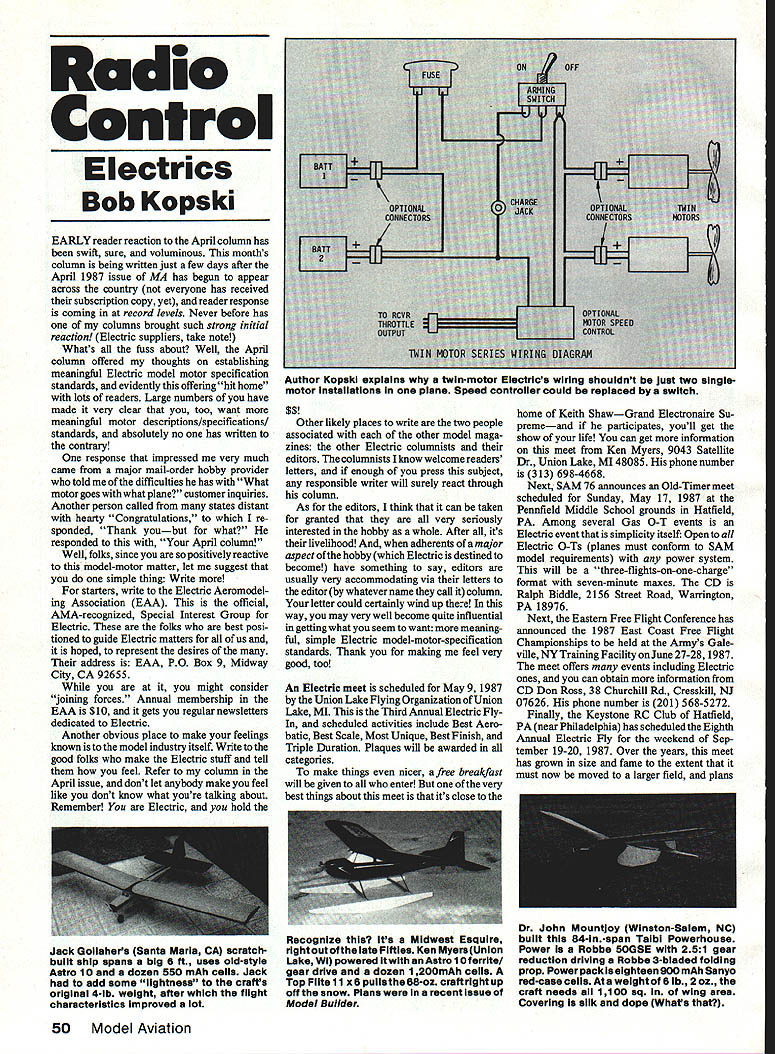
In general, the best way to wire twins is in series:
- Connect the positive terminal of one motor to the negative terminal of the second motor.
- The remaining free positive terminal and free negative terminal become the combined motor leads that connect to the rest of the system (battery, fuse, switch, etc.).
Similarly, wire the battery packs in series. For example, if one motor normally runs on 12 cells, two series-connected motors will run on a 24-cell battery (two 12-cell packs wired in series).
Advantages of series-twin installation:
- The total current drain of the battery is the same as for a single motor. This is efficient.
- If the motors and batteries were connected in parallel, the total current drain would double, increasing wiring losses (which rise with the square of the current) and requiring much higher-rated fuses, switches, and speed controllers.
Practical notes:
- Wiring losses increase with the square of the current; parallel wiring would increase losses by a factor of four compared to series wiring for the same total power.
- Fuse ratings would have to double in a parallel system — small 40-amp fuses are hard to find. Switches and speed controllers may be overwhelmed by the high currents.
- A recommended wiring layout for twins would normally include a speed controller. If you only want an On/Off switch, omit the controller wiring.
- You must provide a means to charge the battery. The best way is to charge all cells in series at once, which requires a charger capable of high-voltage outputs. Examples: Robbe Automax, the Astro DC/DC Super Charger, and the system described in my May/June 1985 column.
- If you lack a high-voltage charger, section the battery into smaller packs, disconnect and charge these subpacks individually with popular low-cost six- or seven-cell chargers, then reconnect the subpacks to form the larger battery. Astro twin-motor systems are provided with wiring harnesses to allow this approach with the Model 0045D twin charger.
Finally, do not make a twin by installing two completely independent systems (two motors, two batteries, two switches, etc.). One beauty of the electric twin is that with one battery and two motors neither motor can stop independently. A single, series-connected electric circuit assures the same nominal performance from both motors throughout the flight: if one motor is running, both are — and at the same nominal speed.
Radio Control: Electrics
Electric competition rules
Those who follow this column know that I have argued in favor of simple, low-cost, first-time AMA electric competition rules. There were other points of view, such as that of the EAA, favoring more complex and demanding (financially and otherwise) rules proposals.
The final version of the rules proposal submitted by the EAA in this cycle of rules changes was published in the February "Competition Newsletter" (beginning on page 123) section of Model Aviation. This proposal was a compromise that allowed local Contest Directors (CDs) more options in how to run their events. The March "Competition Newsletter" reported that the EAA Contest Board cast its initial vote in favor of acceptance of the rule by 10 Yes, 0 No, 3 abstentions.
Compromise is often the best outcome when there are differing strong viewpoints. The new electric rules proposal represents compromise and is workable — provided that Electric CDs advertise which of the options they have selected for their events. This is very important.
If CDs elect the "three-flights-per-charge" approach (the one I have published and favored), then any and all modelers with planes and clones that can reasonably participate will be able to enter. If the CD elects to use the EAA-proposed option of limited motor runs, then only modelers with the most costly systems can reasonably compete. For contestants traveling considerable distances to a contest, it is important that the selected rules options be made known in advance. CDs take note, lest you invite strong reaction from the majority of electric modelers who simply can't afford (or don't want) the "very best."
The electric rules matter now seems largely settled (with a 10–0 victory in the initial vote, it looks likely the proposed rule will pass the final vote, too). I want to add a personal thank-you to Don Blatchford of Hampton, VA, for serving as the Electric Contest Board chairman. It must have been a sometimes frustrating and mostly unappreciated job.
Labels and specifications — a hopeful sign
Two recent observations: I examined a car motor, the Mabuchi RX-540SD, whose label read: "Max. Input Voltage DC 12V — Max. Input Power 80 W." Also, Hobby Lobby and RCM recently listed the Super Olympus belt-drive electric power unit (a product I have not yet seen) with part of the description reading: "This is a 10-watt Mabuchi motor." These are the sort of straightforward labels I advocated in my April column. While neither label was as complete as my ideal, it's a start. I look forward to reporting who first does a full, complete job on motor labels.
Contact and closing
Please send any comment or question (with SASE, please) to:
- Bob Kopski, 25 West End Dr., Lansdale, PA 19446.
For those who ask: writing this column is part of my total hobby enjoyment. I derive lots of ideas and information from this hobby and from exchanges with readers. First-time and continuing electric success — fun is what a hobby is for. I do not make a living from this hobby or this writing. By profession I am an electronics engineer.
Happy, quiet landings, everyone!
Transcribed from original scans by AI. Minor OCR errors may remain.

