
Radio Control: Electrics
Author
Bob Kopski
Upcoming electric meets
- Fifth Annual Boeing Hawks Electric Fly-In — weekend of June 27-28 at the Hawks' Kent field. This will be a low-key fun-fly format as in years past. For more information write to Bernard Cawley, 29838 48th Avenue South, Auburn, WA 98001.
- Polk County Soaring Eagles Second Annual Electric-Fun-Fly — August 1-2 in Lakeland, FL. Several competitive events are planned; the electric rules proposed for the 1988–89 AMA rules cycle will be used (see the February 1987 issue of MA, page 129). Contest director: Bill Futch, 530 West Lake Wales Rd. N., Lake Wales, FL 33853; telephone (813) 676-6740.
- Harbor Soaring Society FAI Electric competition — Costa Mesa, CA, August 15-16. A single, simple FAI competition with attractive cash prizes: $1,000 for first place and additional cash down to fourth. Any model compliant with the AMA/FAI published weight and size requirements using seven 1.2 Ah cells can compete. Felix Vivas was the team manager for the American team last year and is the event director for this AMA-sanctioned meet. I understand the meet is closed to last year's team members, so now everyone else has a chance. Entry fee $25. Contact: Felix Vivas, 1800 16th St., Apt. H310, Newport Beach, CA 92663; telephone (714) 645-3263.
Reader reaction
Reader reaction to the April column has been pouring in by mail and phone. Everybody is voicing strong support for the electric motor specifications/standards suggested in that column. Not one negative comment has been registered with this writer, although several readers offered additional suggestions. There's no question that this nation's electric modelers want more meaningful motor ratings. OK, industry and EAA, do something!
Unbelievable reader reaction to the April story about the Unbelievable Motor has also happened. A surprisingly large number of readers have written to add potentially significant technical contributions to this high‑tech marvel. Here are a few examples:
- Bob Hughley (Washington) wrote to describe what may be the brush to use with the single‑brush motor. His brush is cast from 97% pure Horsematite, an element found mostly around racetracks. Bob feels that the Unobtainium magnets will react with this material in such a fashion that motor operation will become virtually self‑sustaining.
- David McKeen (Texas) suggested that the fantastic power‑to‑weight ratio of the Unbelievable Motor would make it ideal for powering rotorless helicopters.
- Dick Gibbs (Pennsylvania) suggested the motor would be ideal for use with a new bladeless propeller of infinite pitch he has under development. On the negative side, Dick cautioned that, according to his computer analysis, the very tight brush clearances required by such a motor would dictate that if as few as three out‑of‑round electrons were introduced into the system, the brush wear would likely be unbelievably bad.
- Mr. D. Hall (California) stressed that it's not motor development that's needed, but rather battery development. To this end he is developing an electrochemical system based on Monel Mysterium. The development is being hindered somewhat by the fact that this battery can only be charged annually on April 1.
This writer is truly grateful for the reader acknowledgment and support given the April '87 MA column, and thanks all who have shown interest.
Twins and wiring
Twins were discussed in some detail last month; at that time I said that, with one exception that I knew of, the series connection was the best way to wire your twin motors. I ran short of space last month, so I deferred discussion of that exception to this month's column.
Readers who may have old Astro 15s (and other sizes) that were designed to run on relatively large numbers of lower‑capacity cells should wire the two motors in parallel. For example, I've used—with great success—early 15s as twins with each motor wired in parallel to the same 16‑cell, 1.2‑Ah pack. These motors, when used singly, were built for relatively small, lower‑capacity cells and would draw about 10 amps at full throttle on the specified propeller. In those days, the motor brushes simply would not hold up under the higher currents as do present‑day Astro motors.
My latest electric: Davey Systems' Caliph
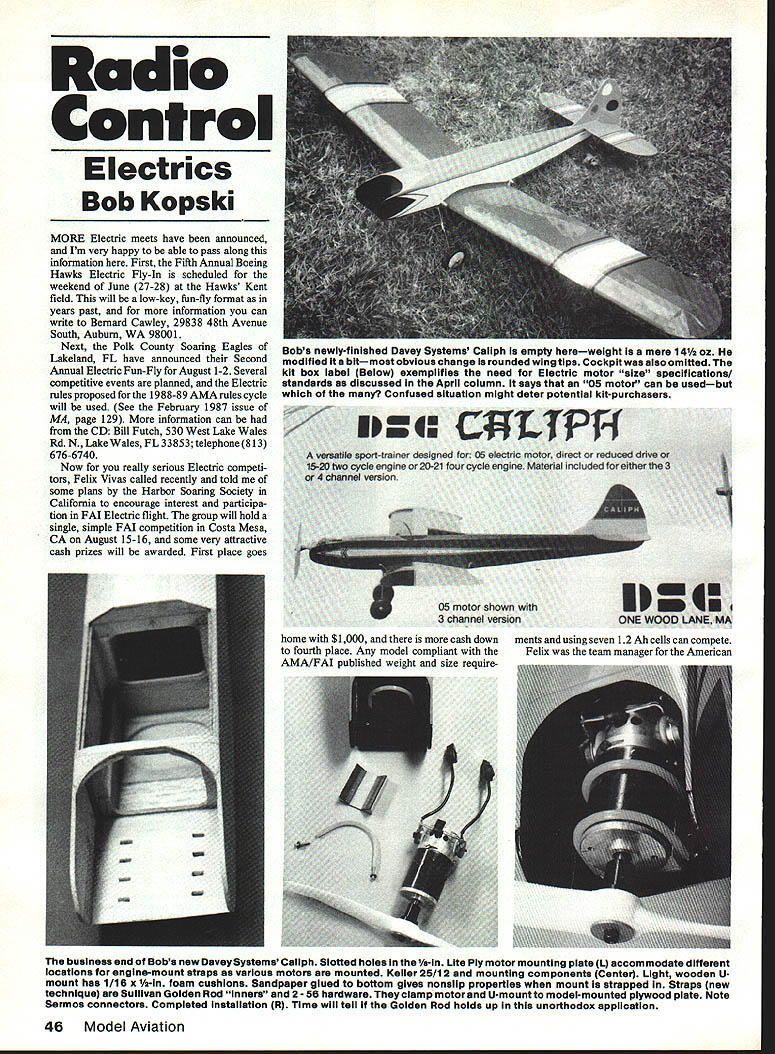
My latest electric is a Davey Systems' Caliph. I first saw Ted Davey's two prototypes last July and decided I'd get one for myself. Normally I'm a scratch‑builder and, in the last decade, have purchased only two other kits—both O.T.s. But the Caliph was very appealing to me—sorta like the gas‑powered Pompito I had many years ago—and I went with it. Of course, every once in a while the word "personalize" and my scratch‑building nature simply won't let me build the kit without some mods. Some of these are shown in the accompanying photos, and a short explanation follows.
To save weight, the Caliph finished with an empty weight of a mere 14-1/2 oz. I modified a few bits; the most obvious change was rounded wingtips. The cockpit was also omitted.
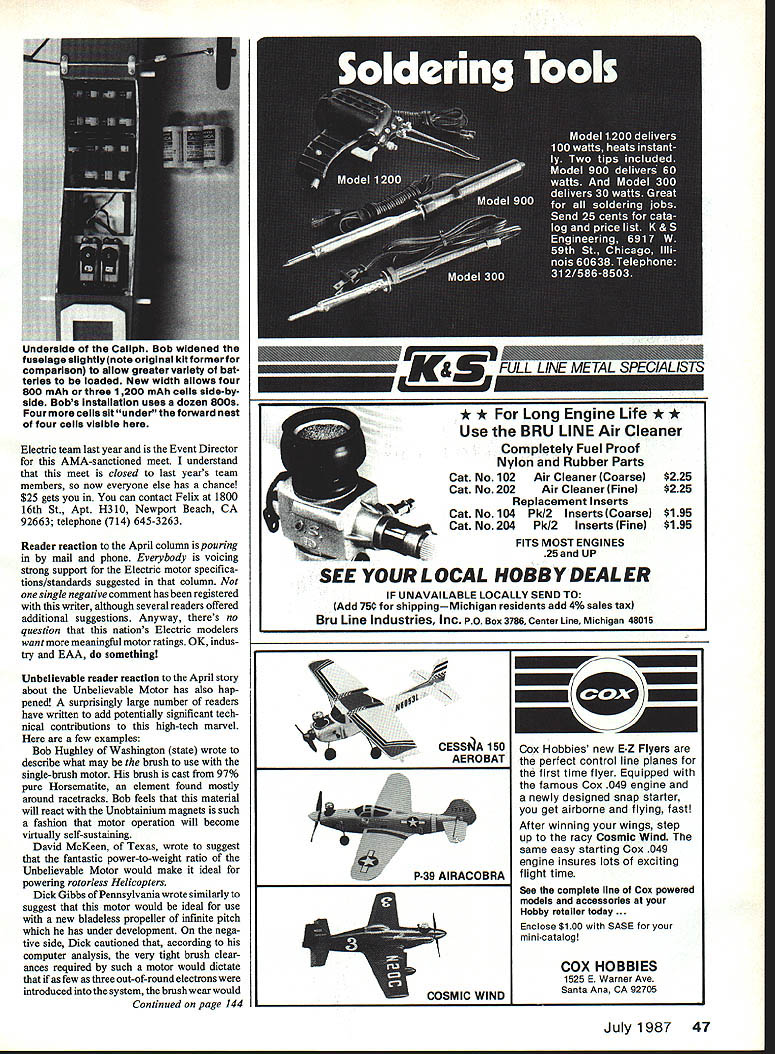
The kit box label exemplifies the need for electric motor size specifications/standards discussed in the April column. It states that an .05 motor can be used, but the confused situation might deter potential kit purchasers.
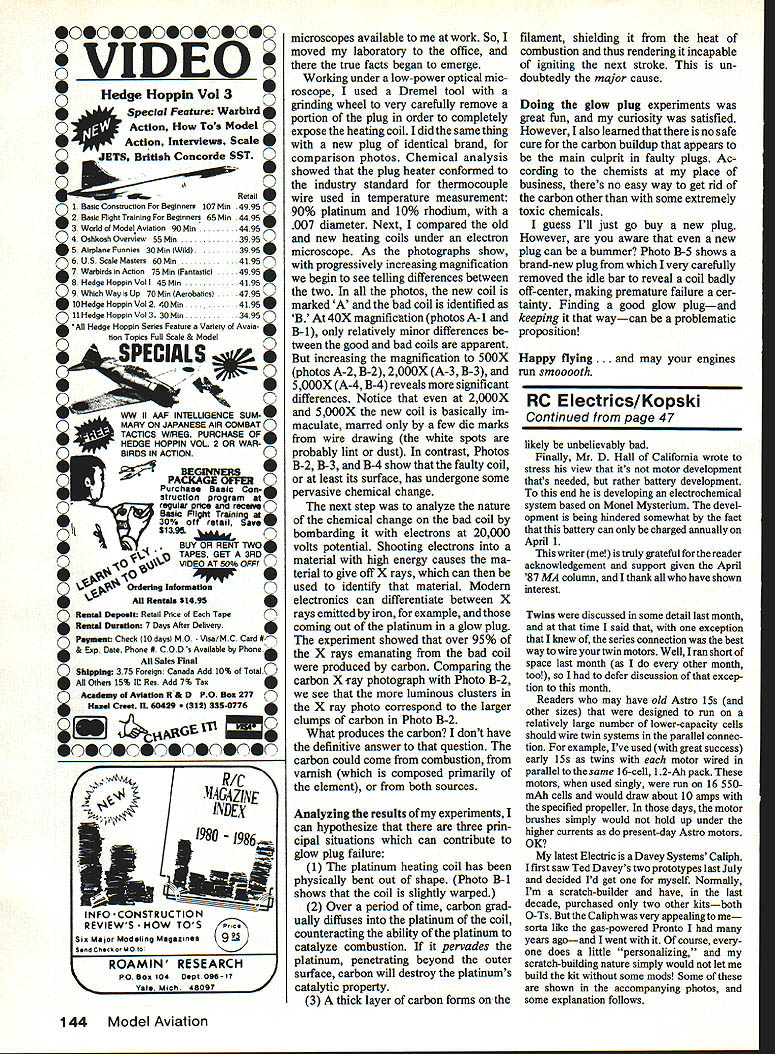
I used a slotted 1/8‑in. lite‑ply motor‑mounting plate to accommodate different engine locations. Engine‑mount straps allow various motors to be mounted. The center light wooden U‑mount has 1/16 x 1/2‑in. foam cushions; sandpaper glued to the bottom gives nonslip properties. I strapped the mount in place using a new technique: Golden Rod inners with 2‑56 hardware to clamp the motor U‑mount to the model‑mounted plywood plate. Note the servo connectors used. Completed installation — time will tell if Golden Rod holds up in this unorthodox application.
Transcribed from original scans by AI. Minor OCR errors may remain.

