
Radio Control: Electrics
Bob Kopski
Disappointing news
Bad news to open this month's column: Astro has discontinued the venerable Part No. 2102 "05/075" economy can motor that made so many new electric fliers quite happy.
This is unfortunate. While Astro continues (and expands) its higher-quality, higher-cost line of Cobalts, it no longer offers anything for those who want to try electric flight with a minimal initial investment. (Word I hear is that the Goldberg Electra/motor combination is selling well.)
There is no question that the Cobalts are top performers, but not everyone starts out with a Cadillac. With this hole in what I can recommend for economy electrics, I'm trying to find alternatives. With luck I'll have some good news soon. It is difficult and costly for me to buy and try all possibilities, and I won't recommend something without trying it. I have no personal requirement to do this—six of my seven electrics are cobalt-equipped—but I want to help those who need to go easy at first because that's how I had to start.
References and recent articles
Other columns and articles readers may find of interest have recently appeared in other publications. Consistent with my policy of passing on as much information as possible, here are some references:
- Bob Aberle (Flying Models, April):
- The EMF, a sport-pylon design configured for economy motors. The EMF is a pretty T-tail and the article has many good detail photos.
- An article on the care, feeding, and flying of 50-mAh receiver Ni-Cd packs—these small packs seem well-suited to small electrics and hand-launched RC sailplanes (AMA Class A).
- Model Builder (May):
- Mitch Poling ("Electric Power") had interesting offerings on pod-mounted motors. If you're interested in the motor-on-pod idea, check his references.
- RCM (May):
- Bob Sliff ("Silent Power") argued for beginning electric fliers to start with the very best and most costly equipment—illustrating that "different strokes for different folks."
On/off switches
On/off switches have been discussed many times (see MA: Feb 1984, Jan 1985, Aug 1986). I've routinely used servo-driven toggle switches and microswitches for motor control for many years. In the past I recommended Radio Shack Part No. 275-016 Lever Switch ("microswitch") for this purpose.
Those days are essentially gone—not because the product was bad, but because our power/motor systems have evolved. Early electric motors favored higher-voltage (greater cell count), lower-current (smaller cell) operation. In recent years most contemporary domestic motors are configured for relatively lower voltage and higher current; they tend to draw substantially higher continuous current (above 10 A). So I now generally encourage using a larger "micro-switch." In particular, I'm now using the Astro Part No. 4032 (priced around $6).
Cell size and capacity (clarification and charging examples)
Cell "size" is generally expressed in ampere-hours (Ah) or milliampere-hours (mAh). These expressions refer to the amount of charge a cell can accept and deliver—the size of the electrical "tank."
Examples and conversions:
- A 1.2-Ah cell can deliver about 1.2 A for one hour, or 0.12 A for 10 hours. For a six-minute (1/10-hour) motor run, the average motor current would have to be 12 A to completely drain a 1.2-Ah cell (12 A × 1/10 hour = 1.2 Ah).
- The same 1.2-Ah cell can be said to have 72 ampere-minutes (1.2 × 60 = 72).
- 1.2 Ah = 1,200 mAh (1 Ah = 1,000 mAh).
- Combining units is possible but cumbersome (e.g., "72,000 milliampere-minutes").
Fast-charge examples (using a 15-minute = 1/4 hour timer):
- 250 mAh: 0.25 Ah. To charge in 15 minutes you need 4 × 0.25 A = 1.0 A (1.0 A × 1/4 hour = 0.25 Ah).
- 100 mAh: 0.1 Ah. To charge in 15 minutes you need 0.4 A (100 mA for 1 hour = 200 mA for 1/2 hour = 400 mA for 1/4 hour).
- 800 mAh (0.8 Ah): charging in 15 minutes requires 3.2 A (0.8 Ah ÷ 0.25 hour = 3.2 A).
My practice: I rarely try to "fill the tank" to 100% because I'm a sport flier and want to avoid accidental overcharge and cell damage. I normally charge to about 90% of full, starting with an empty pack. For example:
- For 1.2-Ah cells I use about 4.2–4.4 A for a 15-minute recharge (1.2 Ah × 4 = 4.8 A; 90% of that ≈ 4.32 A).
- For 800-mAh cells I normally use a 3-A charge current for 15 minutes.
I hope this helps clarify cell-size and fast-charge calculations.
Geared Cobalts — benefits and care
Geared Cobalts from Astro are popular because the speed reduction and corresponding torque increase allow larger props to be used, which benefits many models. But gears require care.
My tale of woe: I was anxious to try a geared Cobalt in my new Caliph and neglected to apply grease to newly installed metal gears. After three or four flights the gears started sounding terrible. Lack of lube ruined them. Lesson: keep gears clean and carefully greased (I use a small amount of white lithium auto grease).
Caliph experiments and installations
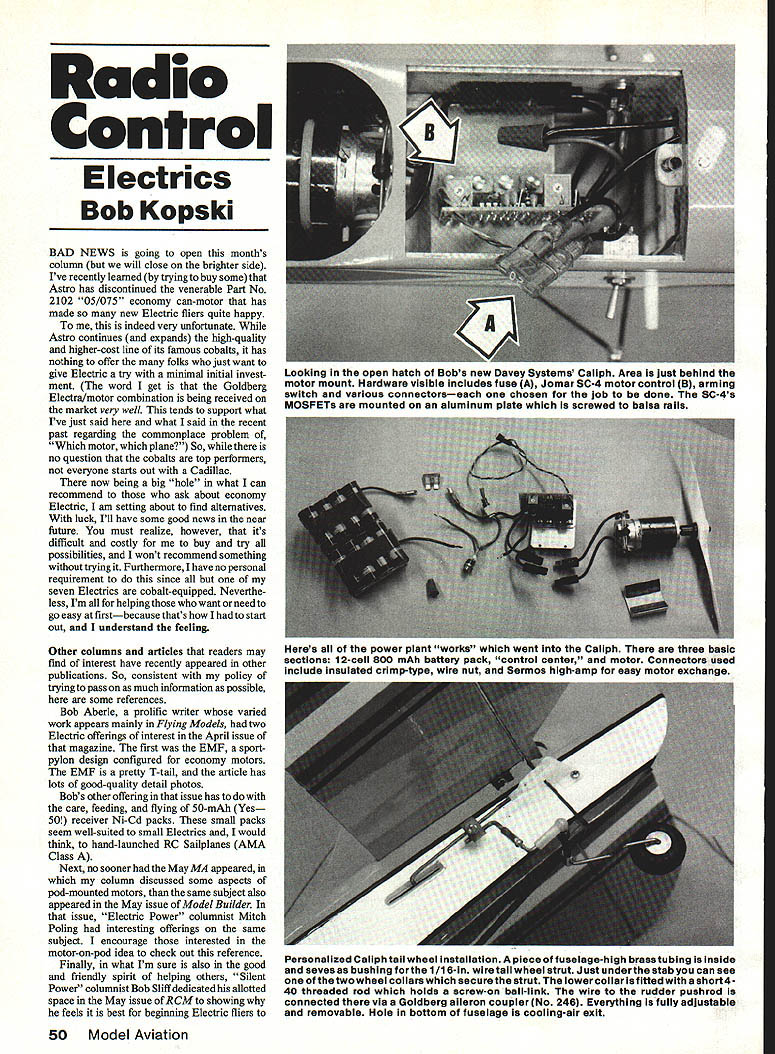
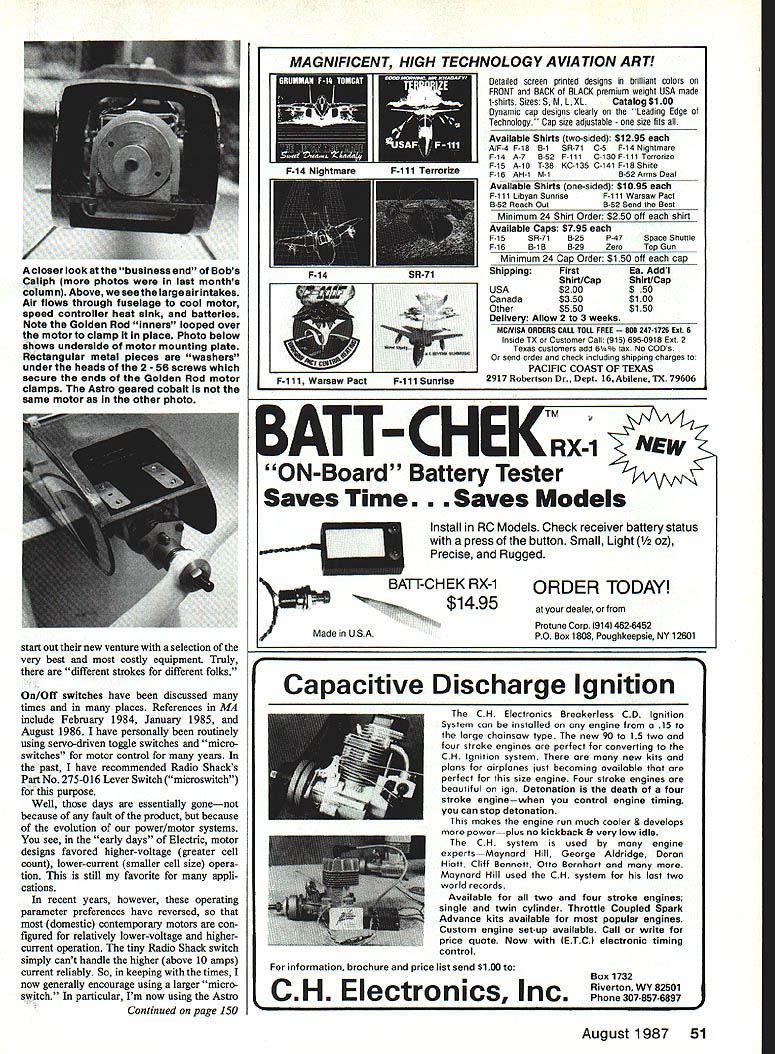
My new Caliph continues to please me. I've tried several motors in it with limited flight time (much of it in bad weather). Motors used so far include:
- Keller 25/12 (pictured last month)
- Astro geared "05" and "15" Cobalts
- Kyosho geared 360PT (Tower Hobbies)
Two of these motors were used rather unconventionally; there isn't enough space to go into full detail yet, and I want more flight time first. Brief teaser: with the right prop selections I've been flying the Caliph with the geared Cobalt 05 on 12 cells and an economy geared Kyosho 360PT on nine cells. Initial results are exciting—more to come.
Installation tips and photos (described)
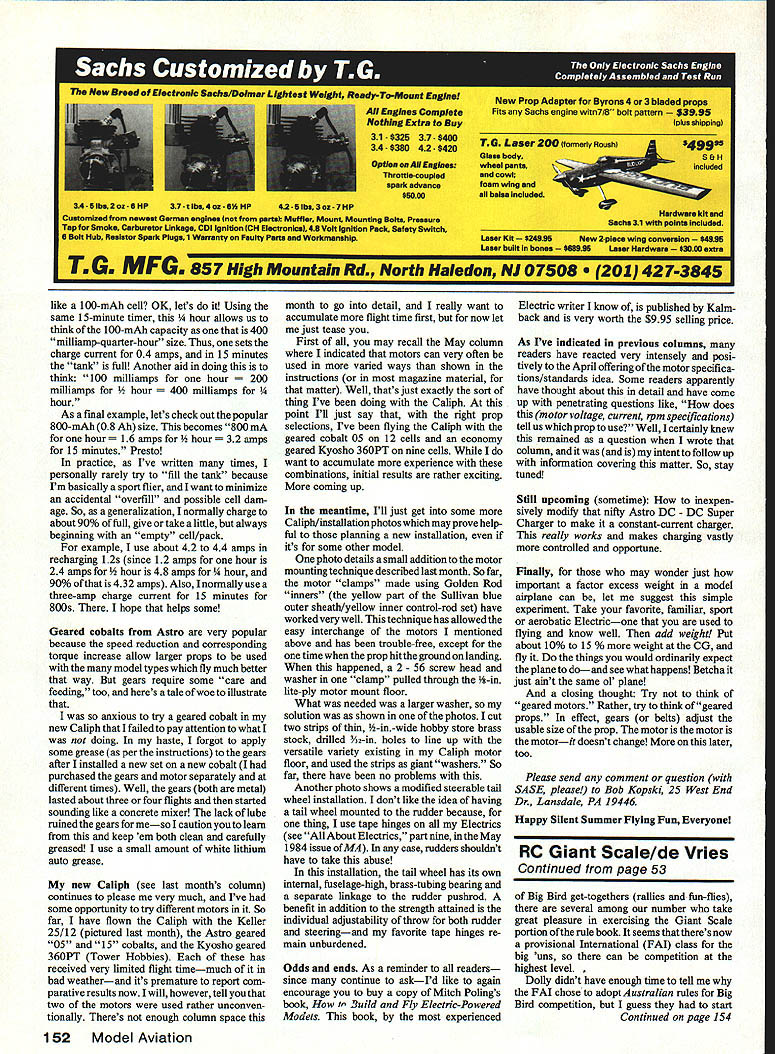
- Motor clamps: Motor "clamps" made using Golden Rod "inners" (the yellow part of Sullivan's blue outer shell) work well and allow easy motor interchange. One problem I had: when the prop hit the ground on landing, a 2-56 screw in a washer pulled through the 1/8-in. ply motor-mount floor. My solution: cut two strips of thin 1/4-in.-wide hobby basswood, drill 1/8-in. holes to line up with the screw holes, and epoxy the strips in as "giant washers." No problems since.
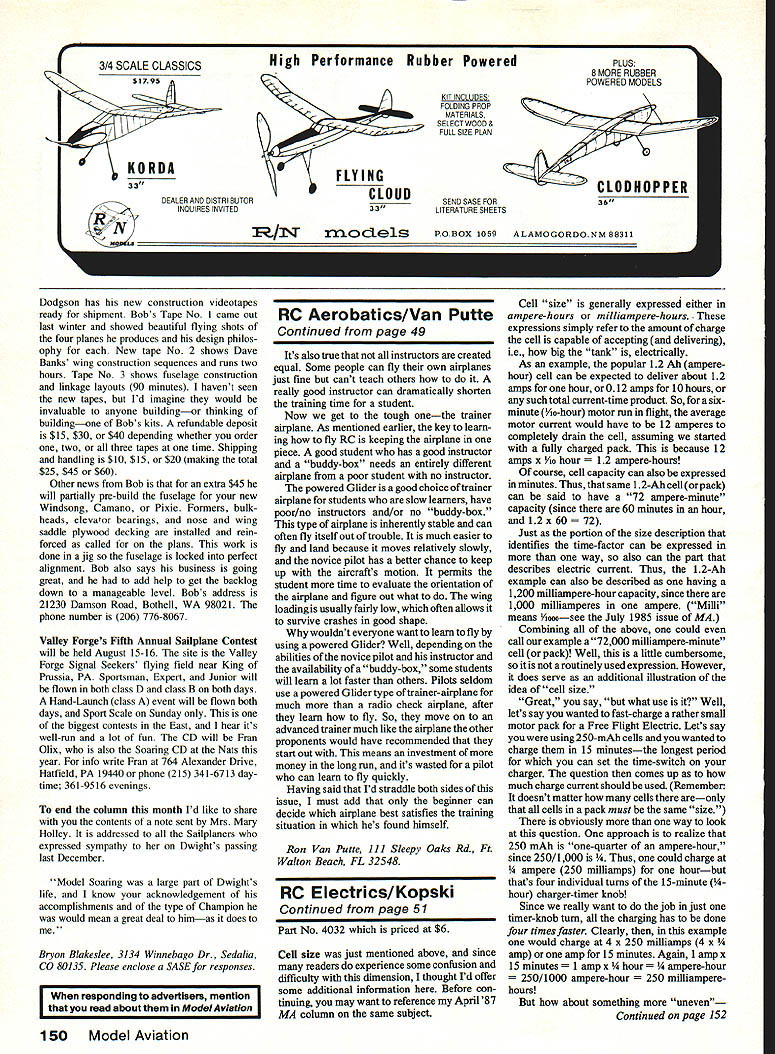
- Tail-wheel installation: I don't like mounting a tail wheel to the rudder because I use tape hinges on all my electrics (see "All About Electrics," part nine, May 1984 AMA). Rudders shouldn't have to take that abuse. My modified steerable tail wheel has its own internal, fuselage-high brass-tubing bearing and a separate linkage to the rudder pushrod. Benefits: greater strength, improved adjustability of throw for both rudder and steering, and tape hinges remain unburdened.
Odds and ends
- Book recommendation: Buy Mitch Poling's How to Build and Fly Electric-Powered Models (Kalmbach, about $9.95). It's the best, most experienced electric-writing resource I know.
- Motor specifications/standards: Many readers reacted strongly to my April column on motor specs/standards. A common follow-up question is, "How do motor voltage, current, rpm, torque affect which prop to use?" I intend to follow up with detailed information on this. Stay tuned.
- Charger modification (upcoming): I will show how to inexpensively modify the Astro DC-DC Super Charger to make it a constant-current charger. This works well and makes charging much more controlled.
- Weight experiment: To see how important excess weight is, try this: take a sport or aerobatic electric you know well, add about 10–15% more weight at the CG, and fly. Do the maneuvers you normally do and observe the difference—you'll see the plane is not the same.
A closing thought: Try not to think of "geared motors." Think of "geared props." Gears (or belts) adjust the usable size of the prop. The motor is still the motor—it doesn't change. More on this later.
Please send any comment or question (with SASE) to: Bob Kopski 25 West End Dr. Lansdale, PA 19446
Happy silent-summer flying fun, everyone!
Transcribed from original scans by AI. Minor OCR errors may remain.

