
Radio Control: Electrics
Bob Kopski
RECEIVER POWER
Strange title, right? Usually one would expect to see words like "motor power" in this column. What I'm really talking about is powering the receiver.
For some reason I've been getting a lot of reader mail lately with questions about powering the receiver from the motor battery, so I thought I'd share some thoughts.
Yes — I have done this in the past, and yes, there are products that allow it. Personally, I've discontinued the practice because I had some bad experiences with it and because the "savings" are questionable.
First, the bad experience. Depending on the radio equipment, any connection between the receiver wiring and the motor power wiring may manifest itself as motor noise in the receiver. Powering the receiver from the motor battery — just like using a speed control without optical coupling (i.e., without total electrical isolation) — invites motor brush noise to be "piped into" the receiver via the interconnecting wiring. This can show up in flight as unusual glitching and/or an apparent range reduction. The tricky part is that until you try it you may not know: some radio systems are more susceptible to this form of electrical noise than others. Mine — a variety of mixed products accumulated over the years — is. So I make no hard wiring connections between the motor power system and the radio guidance system.
There's a bit of an analogy to this. I overheard some SAM (Society of Antique Modelers) folks discussing ignition noise and radio-related problems. Evidently some radios do — and some don't — react adversely to ignition sparks. It's just about the same thing.
As to the questionable savings — it's the weight savings which are questionable, not the dollar savings, since the "battery eliminator" devices are comparable to radio batteries in weight, but cost more. All of my electrics (seven of them) are equipped with 250 mAh packs which weigh about two ounces. This provides totally reliable, independent, long-lasting radio power with absolutely no motor-connected noise concerns.
Of course, if you've seen a particular radio and a particular "battery eliminator" that work just fine, you should be able to duplicate that system successfully. But even then there's one last nagging question: what about the motor battery voltage getting too low? I dunno the answer to that one. Do you?
LEISURE AMPTIQUE
Readers have begun to inquire about the pretty-looking, nicely named Leisure Amptique. Until recently my reply was, "I don't have one and haven't seen one, so I can't comment." That changed when Keith Shaw of Grand Electric called and described flying his Leisure Amptique. He'd just flown his for the first time that day, along with some friends and spectators at the local park.
According to Keith, the Amptique "just about flies itself" — perfectly predictable, stable, docile and otherwise casual, safe fun. Normally I'm reluctant to publish anything I haven't firsthand experienced, but since Keith doesn't make mistakes (I've never seen one), I consider his input solid.
Keith used a geared Leisure system with, I think, seven 800 mAh cells, a 10 x 6 prop, and a Jomar SC5 speed controller. My reaction: if you're wondering, stop wondering — do it. I just ordered an Amptique for myself. Keith's how-to article also appears in the July issue of Model Builder.
FUSES AND FUSE HOLDERS
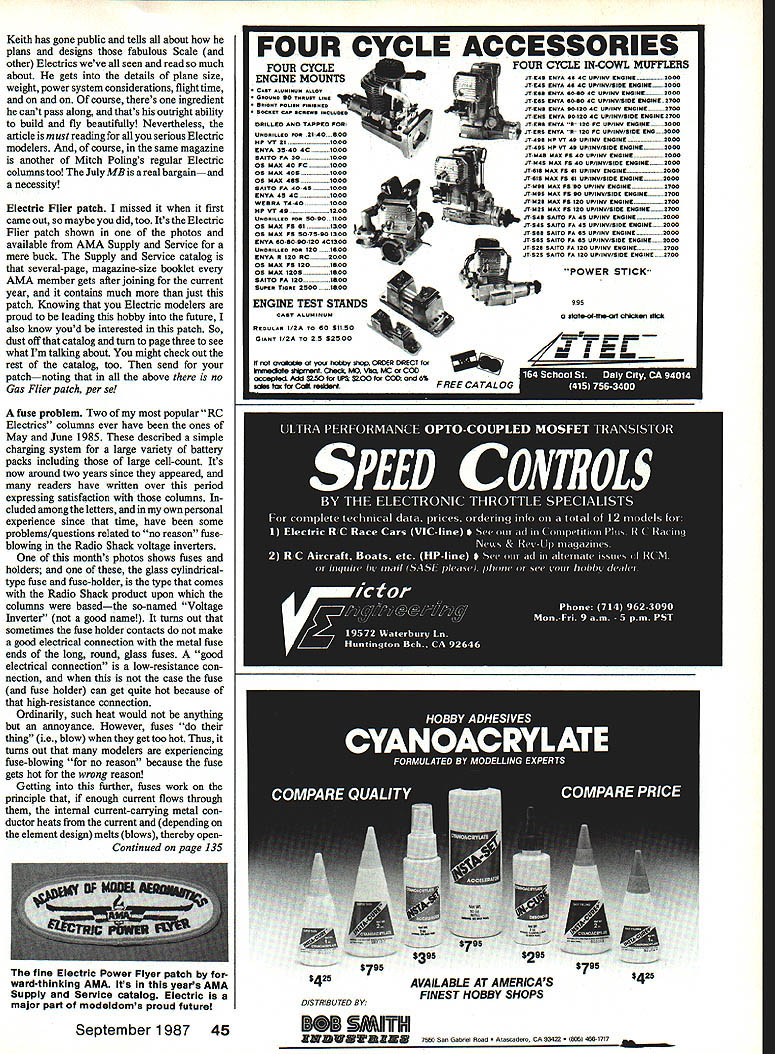
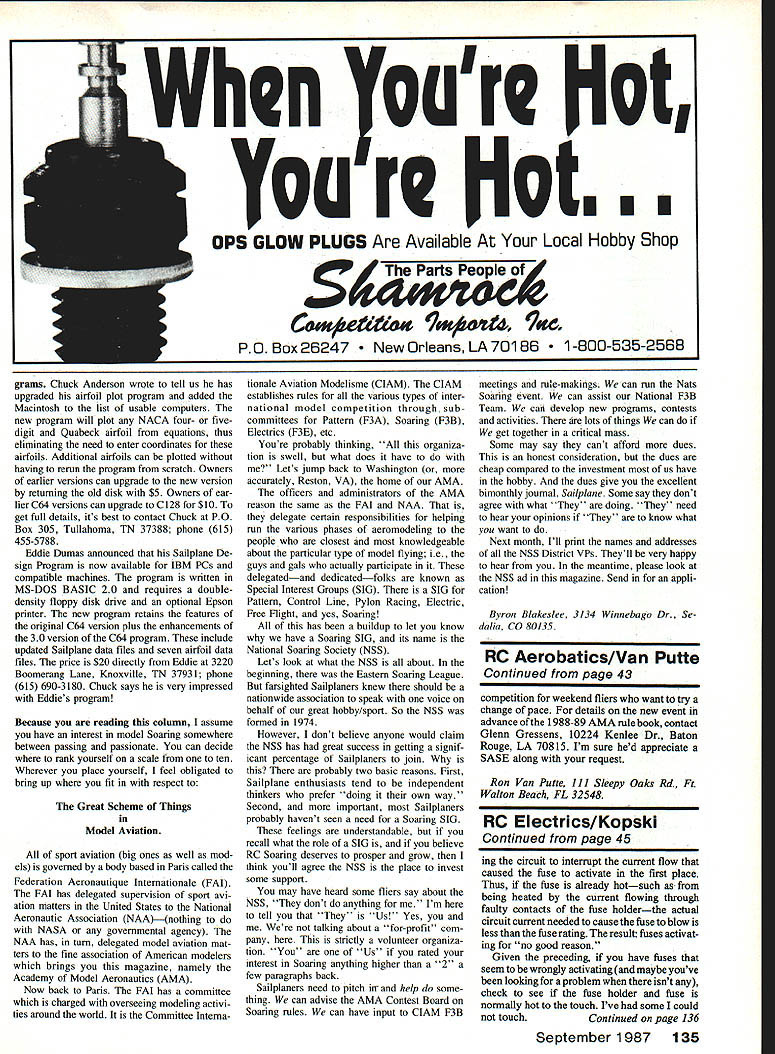
Fuses can cause unexpected headaches. If a fuse doesn't make good, low-resistance contact in its holder, it can heat and act as a resistor. One of this month's photos shows fuses and fuse holders; one of these, the long glass cylindrical fuse and its holder, is the type that comes with the Radio Shack product upon which the columns were based — the so-called "Voltage Inverter" (not a good name!). Sometimes the fuse holder contacts do not make good electrical connection with the metal ends of the long, round, glass fuses. A "good electrical connection" is a low-resistance connection, and when this is not the case the fuse (and its holder) can get quite hot because of the high-resistance connection.
Ordinarily such heat would be an annoyance only. However, fuses "do their thing" (i.e., blow) when they get too hot. Thus many modelers are experiencing fuse-blowing "for no reason" because the fuse gets hot for the wrong reasons!
Fuses work on the principle that if enough current flows through them, the internal current-carrying metal conductor heats from the current and (depending on the element design) melts (blows), thereby opening the circuit.
If you want to eliminate this problem, consider this simple fix:
- Cut the wires going to the fuse holder right at the holder and throw the holder away.
- Strip the two wire ends about 1/4" to 1/8".
- Install insulated female crimp-on terminals on both wires.
- Install an ATC-type auto fuse of the appropriate rating.
These ATC fuses are smaller than the cylindrical ones and have much better contact — and thus less associated overheating and premature blowing. If a female terminal becomes a bit loose, it's easy to squeeze it slightly with pliers (with no fuse in place) to tighten the mechanical — and thereby improve the electrical — connection.
ARMING SWITCHES AND ELECTRONIC SWITCHES
Arming switches are switches in the motor power system that act like the main switch box in a house. They turn the whole system On or Off, making the system ready to operate or deactivating it.
Points to consider:
- Systems with electronic speed controls apply or retard power flow to the motor via the radio "throttle" channel. Without an arming switch such a motor control system is always ready to go. This "always-armed" condition is risky because the motor can "glitch On" whenever the radio system's On/Off switch is moved.
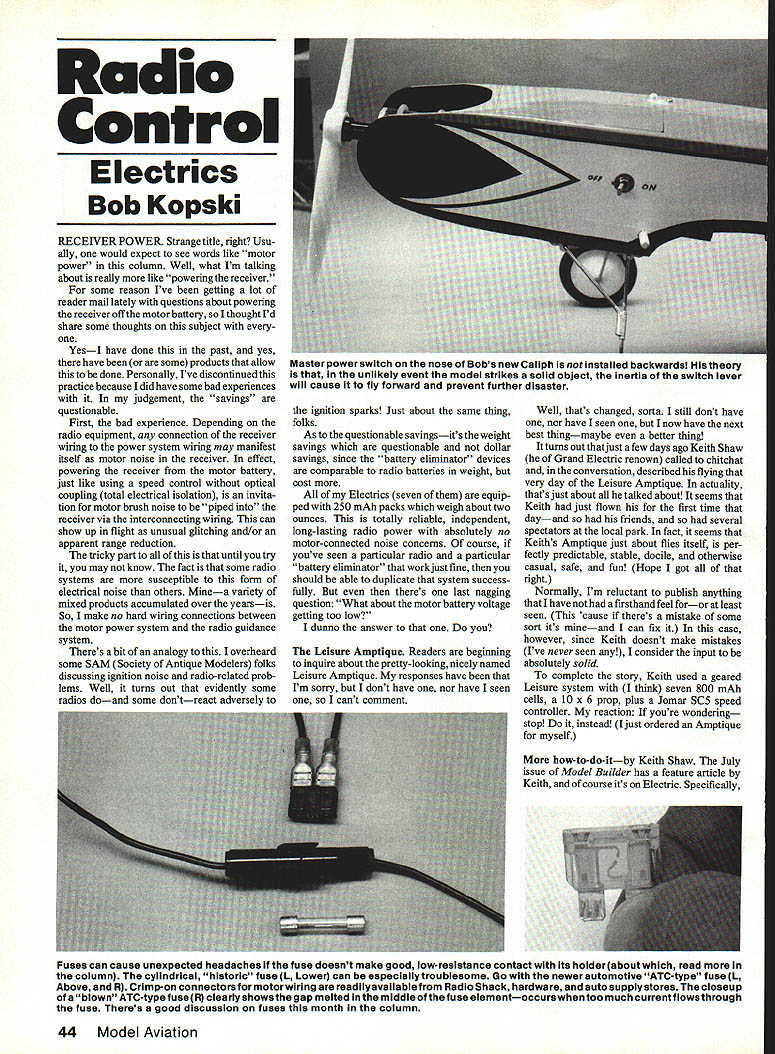
- A simple On/Off arming switch (a toggle switch will do) is an advisable part of the power system installation. All my planes with speed controls are equipped with toggle-type arming switches installed in the positive battery lead right after the fuse. In general either battery lead may be used; I use the positive-lead convention for myself. In any case, the fuse is first and the arming switch next, before the battery wire goes elsewhere in the motor system.
- I also use arming switches with electronic (radio-activated) On/Off switches for the same reasons. The only place I don't personally use such a "master switch" is in systems with servo-driven On/Off switches. These mechanical activations are generally slower-responding and far less likely to "glitch" the radio system. I arrange the linkage so nearly full servo rotation is needed to trip the switch On. There's nothing wrong with using an arming switch with servo-driven installations — it's a matter of relative need and desirability.
Problems with electronic (relay-type) switches:
- In-flight motor "glitching": motors turn off and on for no apparent reason. I think this happens because such switches are very quick-acting and thus respond to even slight radio signal disturbances. The motor control may react while the servos show no noticeable reaction. This can be minimal with some radios and worse with others — very unnerving, especially for Electric competition where motor run time is timed.
- Contact sticking: after turning the motor on it sometimes cannot be turned off. This relay sticking may be due to the closing contacts "microwelding" together and probably happens mostly with larger systems (more cells and/or greater motor currents).
So far I haven't solved either problem and for the present I've given up on electronic switches. I'm still pursuing the matter on the bench; if I'm successful you'll see it here in the column.
EVENTS, ARTICLES, CONTACT
Just in — late word from the Electric Model Fliers of Chicago announcing an Electric Fly-In for Saturday and Sunday, August 15 and 16 at Melas Park in Northwest Chicago. Prizes in many categories and a raffle. Contact D.T. Tom Kalleman, 1701 Cottonwood Lane, Apt. 2K, Mt. Prospect, IL 60056. Tell 'em "Bob at MA" sent you!
Check the index of this issue for a hot article by yours truly on how to modify that nifty Astro DC-DC Power Supply Charger and make it even more nifty.
Please send any comment or question (with SASE, please) to: Bob Kopski 25 West End Dr. Lansdale, PA 19446
Next month: More, more, more power systems for the Caliph and similar planes.
Transcribed from original scans by AI. Minor OCR errors may remain.

