
Radio Control: Electrics
Bob Kopski
Errata — "Mods to DC/DC Super Charger" (MA, Sept 1987)
There are two errors in the article "Mods to DC/DC Super Charger" (September 1987 issue of MA), both in the Circuit Board Pictorial (Figure 4, p. 83):
- Two wire labels are interchanged:
- The wire connected to the (–) terminal of capacitor C2 should be labeled "Green wire to charger ckt. board."
- The wire connected to the cathode (dark band) of diode D1 should be labeled "Yellow wire to terminal strip."
- Note: these wires are shown correctly in the assembled circuit board photograph and in the schematic (Figure 3, p. 83).
- The BASE and EMITTER labels associated with the transistor are reversed in the pictorial (they are correct in the schematic). The transistor BASE lead should be inserted where the EMITTER is shown (in the pictorial), and vice versa. The COLLECTOR location is shown correctly. Most transistors will have their leads fall naturally in this pattern, so check the particular type you have.
Failure to correct these errors will cause the modified charger to have high output current independent of the control knob setting. This should not cause component failures (assuming you have not been operating it in that condition). Proper operation should commence when the corrections are made. If anyone needs additional assistance, please write me and I’ll do my best to help. I sincerely regret any disappointment and inconvenience caused by these errors.
I’m so embarrassed I could die! This was the most checked part of my manuscript — I can’t stand it. I’m going to the Acme to buy some hemlock juice. I know this won’t seem better tomorrow when I wake up.
---
It is late June as I put this month’s column together. This October-dated installment should be in your hands by early September — just weeks before the Eighth Annual KRC Electric Fly (September 19–20, and at a new field location). For newcomers to Electric and this column, this meet is definitely the largest Electric meet in the East, possibly the largest in the country (maybe even in the world).
Attendance in recent years has represented 23 states and Canada, and there have been 135 flyable electrics on the flight line — honest! I can’t think of a single model type that has not flown (except helicopter). Some workmanship and piloting have been truly outstanding, and the atmosphere has always been quietly thrilling.
You still have time to plan for this year’s meet. For information contact the CD:
- Bruce Fenstermacher, 636 Schoolhouse Rd., Telford, PA 18969. Tel: (215) 723-0470.
If you’re not prepared to fly, at least come to be dazzled (but not deafened) by modeldom’s future: electric. And bring some friends!
Clubs and groups
Two electric clubs you should know about:
- Puget Sound Electric Model Fliers (PSEMF), a special interest group of the Boeing Hawks RC Fliers. Contact:
- Bernard Cawley, 29838 48th Ave. South, Auburn, WA 98001.
- Membership is a mere 500 pennies; newsletter: Charge Ahead.
- Westmoreland Electric Soaring Society — the first AMA-chartered electric club in the Greater Pittsburgh area. Founders:
- President: Bob Markie, Unit 23, Sandy Hill Rd., Irwin, PA 15642.
- Vice‑President: Neil Rossi, 3947 Murry Highlands Circle, Murrysville, PA 15668.
- The new club welcomes contacts from other clubs and newcomers to electric flight.
If you run an electric club or group, drop me a note with pertinent details and I’ll pass the information along in future columns. Too often I get mail from "the only guy anywhere around here" who flies electric — maybe he just doesn’t know of others nearby. Let me help the loose wires out there connect with a larger circuit.
Keller motor nomenclature
In July I referenced a Keller 25/12 and asked readers what the numbers meant. Two readers responded: Bernard Cawley and Steve Neu. Thanks to them:
- The "25" stands for 250 watts.
- The "12" means something like 12 volts or 12 cells (almost the same thing). There is some slight discrepancy across the Keller product line, so the "12" is approximate.
In that July column I also noted two 25/12 motors I had showed loose metal particles and loose rear ball-bearing assemblies. Steve explained that the particles are the result of drilling a timing screw hole after the motor is assembled and test-run; the particles tend to migrate into the housing magnets and have not caused problems in his experience. That’s better, but still not desirable, and the ball-bearing issue is not great either. I thank those who responded and welcome more input from readers.
Motor mount revisited
In July I showed a versatile motor mounting system that straps a motor to a mounting plate using two clamps made from Sullivan Golden Rod inners. At the time the technique was new to me.
Update: I have now made 133 flights with six different motors using that method. The clamps work very well. Motors have been installed and removed repeatedly; the screws in the Golden Rods have been removed and reinstalled many times without trouble. I heartily recommend the technique. My only remaining reservation is that I have not flown it in winter cold yet.
The Caliph: more
One frequently asked question is pronunciation. I had been saying "Kay-lif." Others say "Kal-leef." I called Ted Davey of DSC; he says the pronunciation is "Kal-leaf." Interestingly, Ted told me he now sometimes says "Kay-lif" as well — so take your pick.
As an item of interest, the name "Caliph" is a Middle Eastern title of distinction.
If you’ve been bitten by the infectious sting of designs like the Simitar (Robert E. Byrd, John Cole, Steve Hosner, Bill Winter, and many others), you’ll understand the attraction. It flies like any aircraft — only better. The real issue is not the flying wing itself but what it represents: change and innovation at the flying field. Change is often rejected by attitude and hearsay; it’s rewarding to try things yourself and keep an open mind. Join me in flying into the 21st century.
My Caliph is the test vehicle for what may be the most extensive power-system/power-plane study I’ve done. I also just plain like this plane — it really flies great. I’ve encouraged a few clubmates to build one, and I plan to build a second.
Varied Caliph power systems were mentioned previously. Last issue I promised coverage of multiple systems; this month I’ll report on direct-drive systems and save speed-reduction system performance for a future column.
Motors and battery sizes flown (battery data = number of cells / cell size):
- Keller 25/12 — 12 / 800
- Astro 15 cobalt — 12 / 800
- Astro 15 cobalt (geared) — 12 / 800
- Astro 05 cobalt (geared) — 9 / 1200
- Astro 05 cobalt (geared) — 7 / 1200
- Astro 15 super ferrite — 12 / 800
- Kyosho 360PT (geared) — 9 / 1200
- Kyosho 360ST — 7 / 1200
- Kyosho 360ST (R.P. gears) — 7 / 1200
Each combination was bench-run for voltage/current/rpm/prop/power data before flight. Many combinations were flown with more than one prop. This is no small project!
The Caliph on direct drive: recommendations
Typical flight profile used for evaluations:
- Taxi on grass (from "just cut" to "it needs to be up" conditions).
- Convincing takeoff and climbout.
- A few high- and low-speed flybys and touch-and-goes.
- Mixed in: cruising, climbs to altitude and spirals, inside loops (including loops from level flight after five minutes).
- Typical flight duration exceeded six minutes.
After many such flights I strongly recommend the Caliph with these direct-drive motors:
- Astro 15 cobalt
- Astro 15 super ferrite
- Keller 25/12
These motors have proved reliable and provide excellent, predictable performance and duration for the Caliph airframe. The super ferrite is larger and heavier than the cobalt but is cheaper; both work well.
Some geared systems also worked quite well and I’d be comfortable flying them in the plane, but none (so far) match the flyability of the direct drives in this airframe.
Notes from a reader — John Mountjoy
Today I received a letter from John Mountjoy (Winston-Salem, NC). He’s flown a Pronto with a 25/12 and recently tried a speed-reduced installation. The Pronto is similar to the Caliph; John reports direct drive works better. He also modified his Astro DC/DC Super Charger from my rough sketches and photos and reports the modification "works very well indeed." Thanks, John.
Power levels and performance
Each of the combinations above produced performance in excess of 150 watts at full throttle. At about three pounds all-up, that translates to roughly 50 watts per pound — the number recommended by my Rule of Thumb No. 2 (MA, April 1984) for good electric ROG performance.
However, power level alone is not the whole story. Examples:
- Several geared systems that produced similar power levels to direct drives did not match the direct-drive takeoff performance despite careful pitch selection.
- One RC car motor turning a 6x4 at over 16,000 rpm with comparable power input barely made it off the ground and flew unimpressively.
Conclusion: "Properly utilized power of adequate level" is critical. Power must be applied in the correct way for good performance.
Other notes and considerations
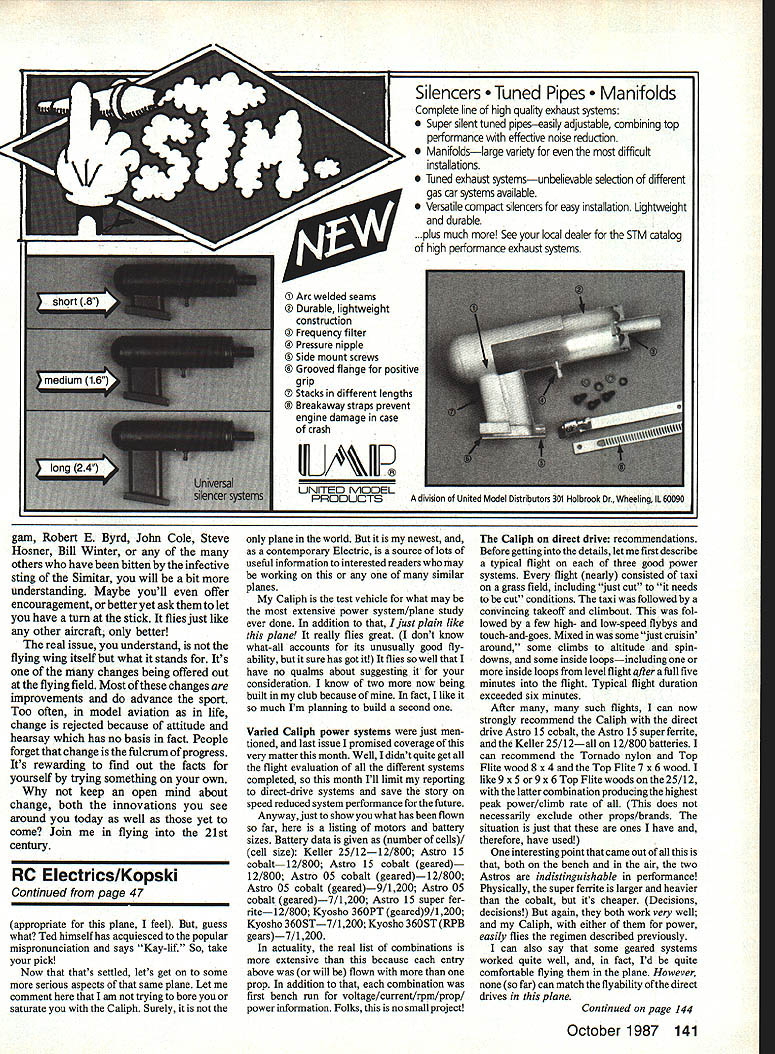
- Cooling: A previous photo showed the steerable tailwheel and rear cooling air exit; I’m including another photo this month to show the hole detail more clearly. Flight testing (constant flight–charge–flight–charge) put stress on the batteries; airflow through the model plus not running the power system full bore during the entire flight always left batteries cool enough to allow immediate recharge. I favor good air-cooling practice, especially for long-flight sport flying.
- New heavy-gauge wire: Jomar sent a sample of a new high-flex 12-gauge wire. Details:
- 665 strands of very fine wire arranged in seven bundles of 95 strands each.
- When carefully twisted, the wire fits Sermos connectors well.
- Packaged in five-foot lengths (one red, one black) for $6 (+ $1 shipping).
- This supplements existing 16-gauge high-flex wire (six-foot lengths, same price).
- Contact: Jomar, 2028 Knights Bridge Drive, Cincinnati, OH 45244. Tell Joe that Bob sent you!
A matter of thoughtful responsibility
I spoke with John Sermos (Sermos RC Snap Connectors) about the rapid growth of electric flight. One major advantage of electric models is that they can be flown almost anywhere: schoolyards, parks, parking lots, church grounds, etc. That advantage can become a liability if flyers act thoughtlessly.
Be thoughtful and responsible:
- Don’t just press "go."
- Explain what you’re doing and request permission where appropriate.
- Don’t let electric (or anything else) give model aviation a black eye.
Electric can open many field opportunities — if done properly. And always fly carefully, whatever you fly. Thanks to John Sermos for the sensitive insight.
Please send comments or questions (with SASE) to:
- Bob Kopski, 25 West End Dr., Lansdale, PA 19446.
See ya at the KRC Electric Fly!
Pencil points
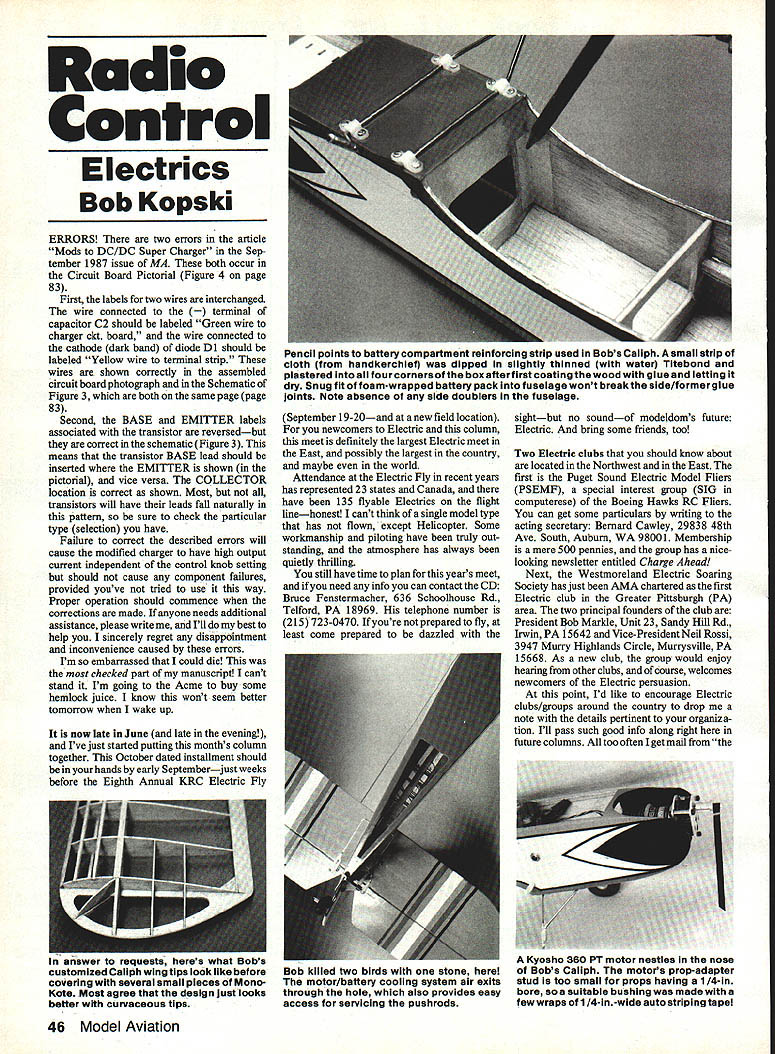
- Battery compartment reinforcing strip (Bob’s Caliph): small strip of cloth (handkerchief) dipped slightly in thinned water‑Titebond, plastered on the four corners of the box after first coating with wood glue; let dry. A snug-fit foam-wrapped battery pack in the fuselage won’t break side/former/glue joints. Note absence of side doublers — this answers requests.
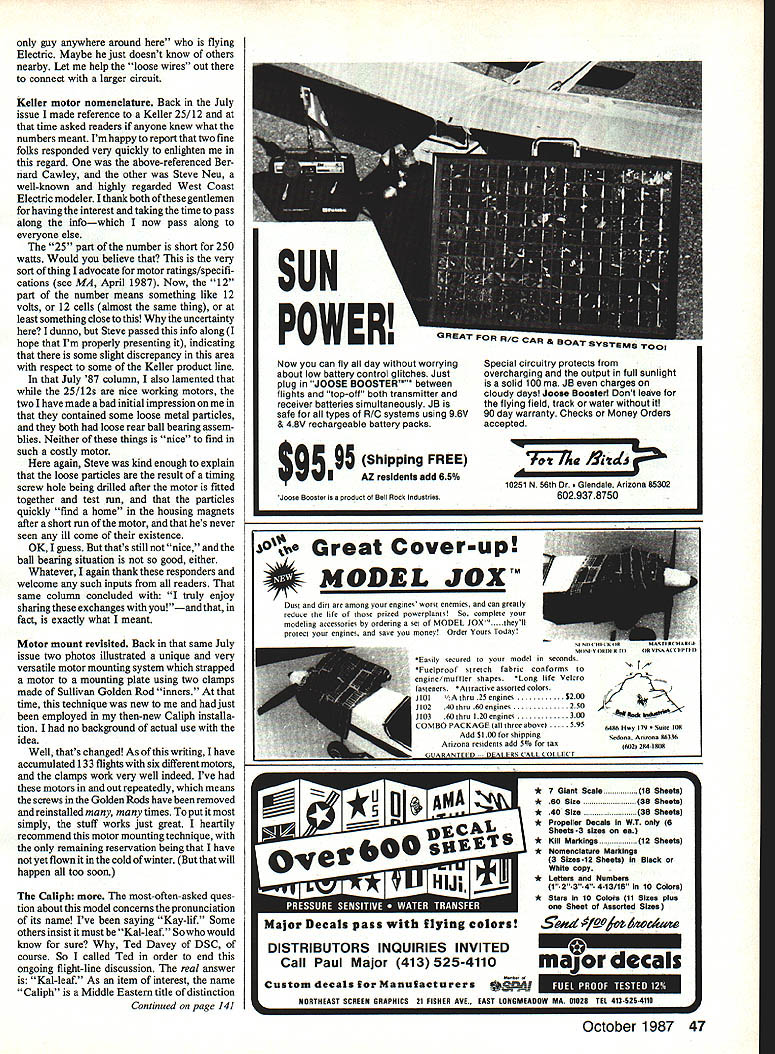
- Customized Caliph wing tips: several small pieces of MonoKote; look better before covering and add a curvaceous appearance.
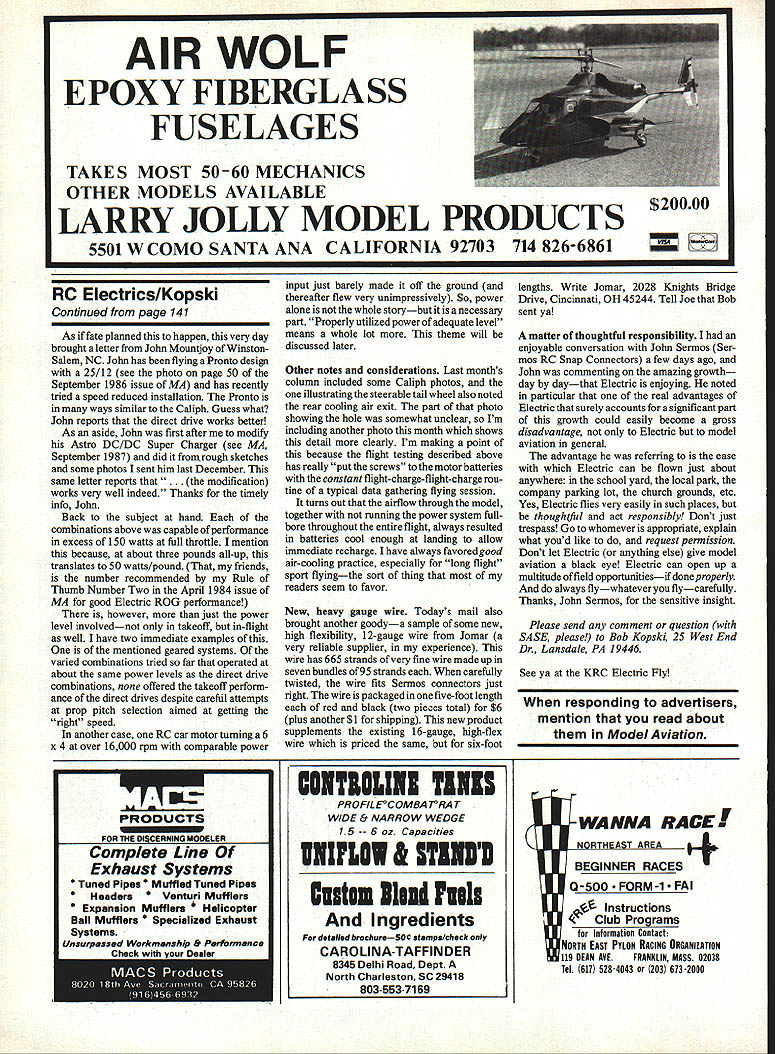
- Motor/battery cooling and servicing: the air exit hole also provides easy access for servicing pushrods. Kyosho 360 PT motors nestle in the nose.
- Prop-adapter note: Bob’s Caliph motor prop-adapter stud was too small; props with 1/4-in. bore are suitable. Bushing made from a few wraps of 1/4-in.-wide auto-striping tape.
Transcribed from original scans by AI. Minor OCR errors may remain.

