
Radio Control
Electrics
Bob Kopski
Please send any comment or question (with SASE, please) to Bob Kopski, 25 West End Dr., Lansdale, PA 19446.
REGULAR READERS will recognize the above opening as my regular closing! No—this is not a zero‑length column. It just seems that some readers never get to the end of a column because, while most of my incoming mail comes directly to me, some comes to me via the Model Aviation editorial office. The good folks at MA do forward my mail sent there, but you can get faster answers by using my home address above. Besides, it'll save the folks at AMA HQ some work. Nuff said.
Charger modification follow‑up. This is a follow‑up on the snafu which occurred in my article in the September issue. As you can imagine, a number of folks have contacted me about the "Mods to DC/DC Super Charger" article that appeared in the September 1987 issue of MA—complete with a major built‑in error. That error—mislabeling in two places in Figure 4, page 83—was corrected in two places in the October 1987 issue, namely in the "Letters to the Editor" column and in my regular column.
Some folks contacted me before the October issue came out and got the corrected info sooner. Some wrote or called to say that their modified charger worked just fine when the corrections were made. I'm happy to say that so far no one has been openly angry for the trouble, and I very much appreciate everyone's patience and understanding.
New Sanyo Ni‑Cd cell. Sanyo has announced a new nickel‑cadmium cell called the Extra cell, designated SCE. The new series offers about 40% more capacity (ampere‑hours) than previous cells of the same physical size, with almost no increase in weight. For example, the popular 1200 SC (1.2 Ah) weighs 17.7 oz; the new 1700 SCE (1.7 Ah) with the same dimensions will weigh 18.7 oz. The newer cell has 55 milliohms internal resistance compared to 42 milliohms for the familiar SC; this means the SCE will have relatively higher internal heating losses, small compared to the increased capacity. Sanyo will offer the new cells in familiar sizes (1200s, 900s, 800s) so you can substitute directly. Cost: about 35% more than current cells—not bad for about 40% more capacity. I expect to try some samples soon and will pass along firsthand info when available. Meanwhile I continue happily flying eight electrics—all 100% Sanyo‑powered—83 cells total in the air, counting spare packs.
Graupner and Hobby Lobby. Graupner electric products are readily available from Hobby Lobby; their extensive catalog lists other modeling products. The catalog is free—check the advertisers' index in the back of the magazine. A local flier has just completed a Silentius electric sailplane powered by the recommended Graupner gear‑drive power system. The system uses an extension shaft between motor and the prop drive so that the motor may be mounted closer to the plane's center of gravity, reducing frontal fuselage area to what is required by the prop bearing and hub. I saw the maiden flight—and several since then—and the plane flew very impressively for such a relatively economical package.
While on the subject of Hobby Lobby's Graupner systems and supplies, Jim Martin—head modeler at Hobby Lobby—tells me that all Graupner 1200 mAh packs have recently been re‑rated to 1400 mAh capacity at no price increase. The catalog also includes a stretched‑wing Electric version of the Pronto—one of my all‑time favorite gas models. There's lots more in the catalog, so the rest is up to you.
Mitch Poling's book. Mitch Poling's How to Build and Fly Electric Powered Model Aircraft (Mitch is the Electric columnist for Model Builder magazine) has been mentioned several times in this column. While I noted that the book was published by Kalmbach, I failed to include mail order information. To get Mitch's book, write to Kalmbach Books, 1027 North Seventh Street, Milwaukee, WI 53233. Cost: $9.95 plus $1 postage and handling.
The Leisure Amptique—more. Keith Shaw of Ann Arbor, MI, told me how pleased he was with his Leisure Amptique, and I passed along some of his comments in the September 1987 issue of MA. Since then I've had the opportunity to fly Amptiques for others and to build one (but not fly it) myself. Keith was right—the Amptique is a great flier. I unconditionally and wholeheartedly recommend it either as a plane to "just try this Electric stuff out" or as a first‑time RC flight trainer model.
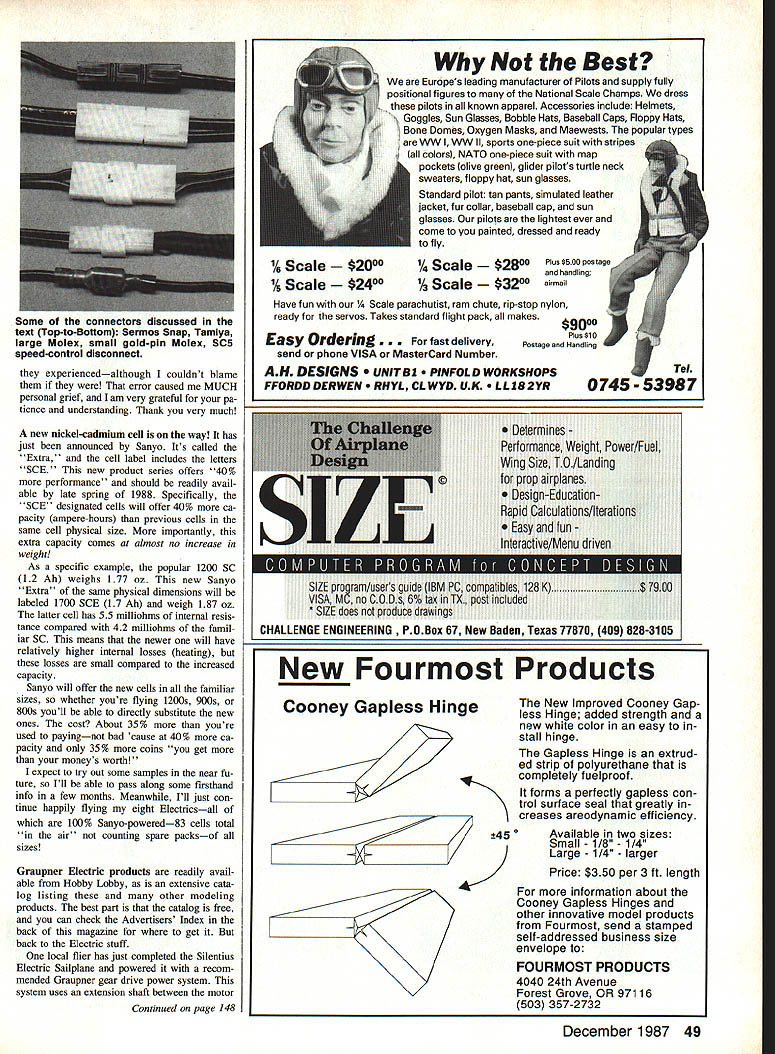
The Amptique is a graceful, forgiving flier—a delight in the air. It's effectively a "low‑aspect electric‑powered glider on wheels" that easily ROGs with low‑ to moderate‑priced power systems. One I flew was equipped with a Leisure LT‑50 2.5:1 geared motor on seven 800 mAh cells with a 10 x 6 prop. Another used a Kyosho 360 PT gear drive unit and a Kyosho 9 x 8 (Etude) prop on 800 mAh cells. Both installations used Jomar SC‑5 speed controls which, while not strictly necessary, added greatly to the flying enjoyment.
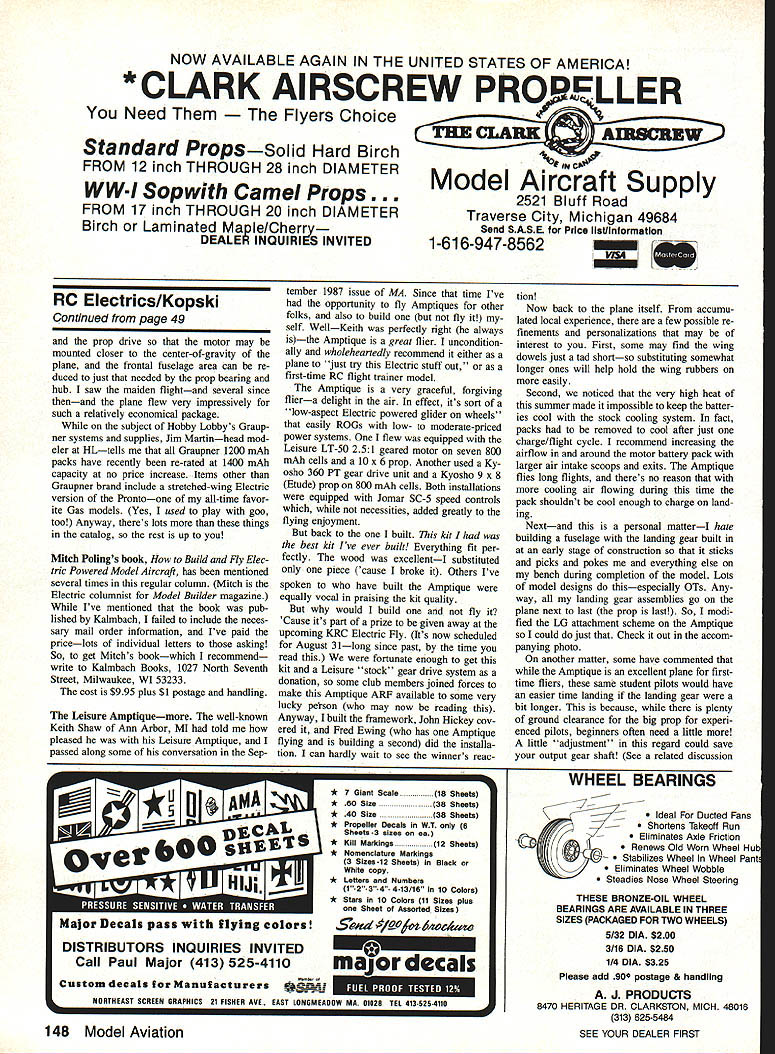
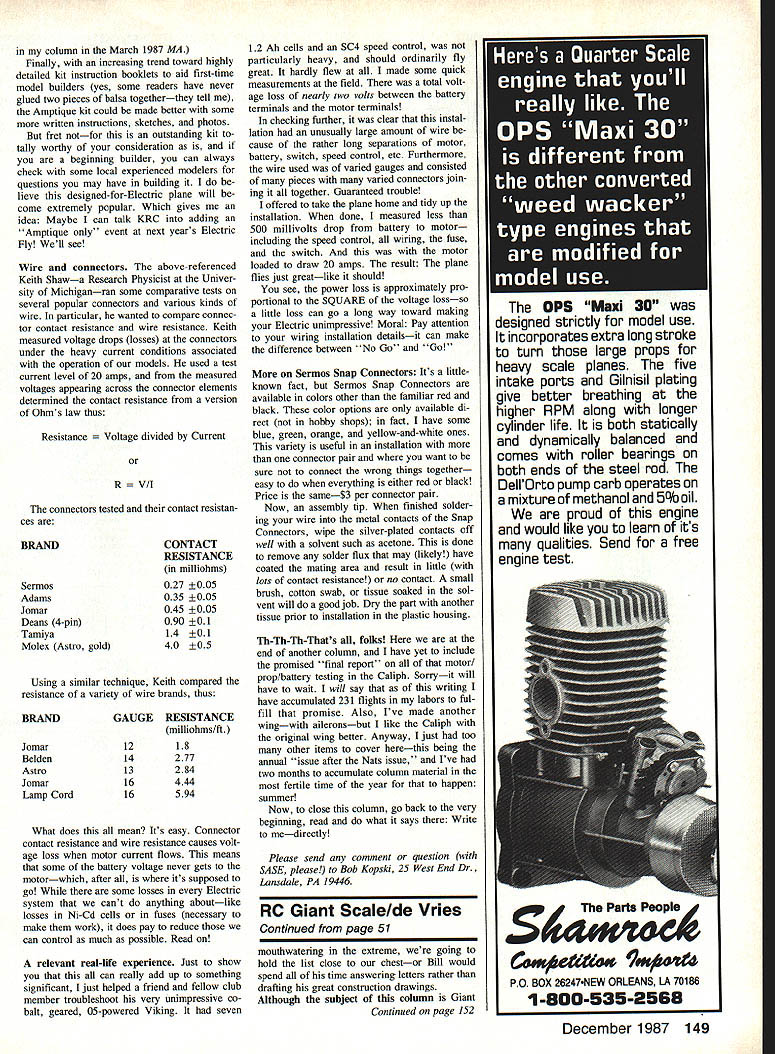
Kit quality. The kit I built was the best kit I've ever built—everything fit perfectly. The wood was excellent; I substituted only one piece because I broke it. Others I've spoken to who have built the Amptique praised the kit quality as well.
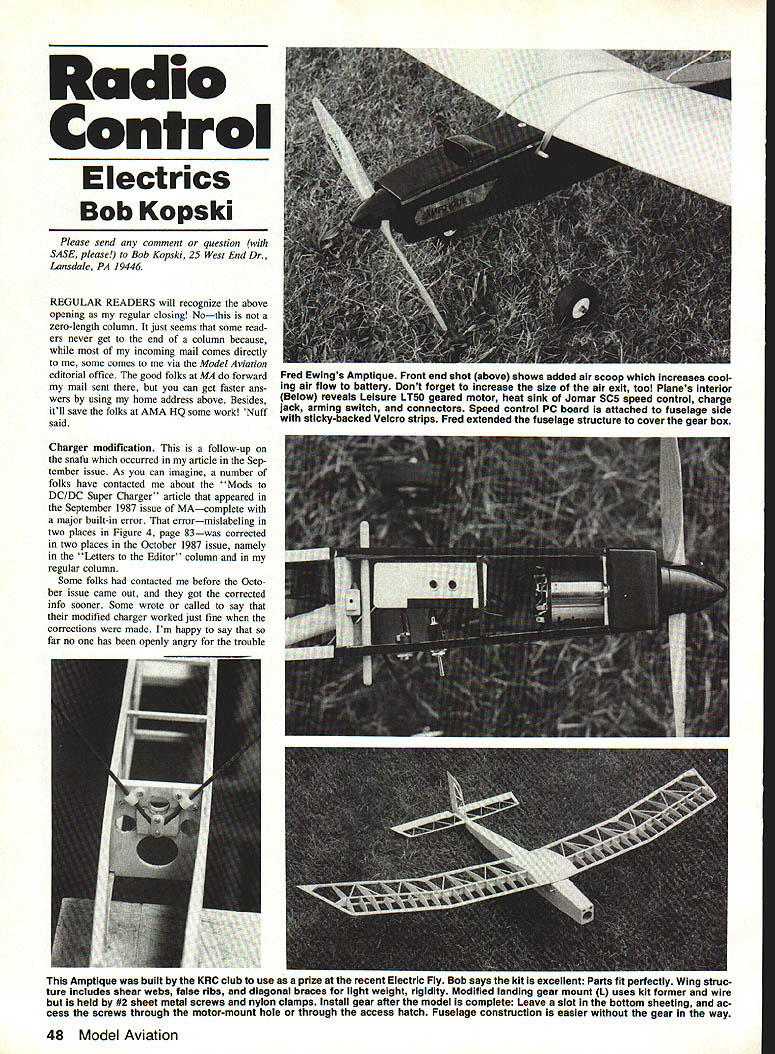
Prize and build team. The kit I built was part of a prize to be given away at the KRC Electric Fly (scheduled for August 31). We were fortunate to get this kit and a Leisure "stock" geared drive system as a donation, so some club members joined forces to make this Amptique ARF available to one lucky person. I built the framework, John Hickey covered it, and Fred Ewing (who owns one Amptique and is building a second) did the installation. I can hardly wait to see the winner's reaction.
Refinements and personalizations. From accumulated local experience, here are a few refinements that may interest you:
- Wing dowels: Some may find the wing dowels a tad short—substituting longer ones will help hold the wing rubbers on more easily.
- Cooling: Very high summer heat made it impossible to keep batteries cool with the stock cooling system. Packs had to be removed to cool after just one charge/flight cycle. I recommend increasing airflow around the motor and battery pack with larger air intake scoops and exits. The Amptique flies long flights; with better cooling the packs should remain cool enough to charge on land.
- Landing gear assembly: I prefer adding landing gear next to last during construction so it doesn't poke me while building. I modified the Amptique's landing gear attachment so I could install it later.
- Gear length for students: Beginners often need a bit more landing‑gear length for easier landings. A small adjustment could save your output gear shaft.
- Instructions: With the trend toward more detailed kit instructions to aid first‑time builders, the Amptique kit could be improved with more written instructions, sketches, and photos. That said, it's an outstanding kit worthy of consideration as is. If you're a beginning builder, check with local experienced modelers for help.
Maybe KRC will add an "Amptique only" event at next year's Electric Fly—we'll see!
Wire and connector tests. Keith Shaw—a research physicist at the University of Michigan—ran comparative tests on several popular connectors and various kinds of wire. He measured voltage drops (losses) at the connectors under heavy current (20 A) and calculated contact resistance using R = V/I.
Connector contact resistances (at 20 A):
- Sermos: 0.27 ± 0.05 milliohms
- Adams: 0.35 ± 0.05 milliohms
- Jomar: 0.45 ± 0.05 milliohms
- Deans (4‑pin): 0.90 ± 0.1 milliohms
- Tamiya: 1.4 ± 0.2 milliohms
- Molex (Astro, gold): 4.0 ± 0.5 milliohms
Wire resistances (milliohms per foot):
- Jomar, 12 gauge: 1.8
- Belden, 14 gauge: 2.77
- Astro, 13 gauge: 2.84
- Jomar, 16 gauge: 4.44
- Lamp cord, 18 gauge: 5.94
What this means. Connector contact resistance and wire resistance cause voltage loss when motor current flows. Some battery voltage never reaches the motor. While some losses (cell internal resistance, fuses) are unavoidable, reduce what you can control—wiring and connectors.
A real‑life example. I helped a club member troubleshoot a cobalt, geared, .05‑powered Viking that performed poorly. It had seven 1.2 Ah cells and an SC4 speed control and should have flown great. There was nearly a two‑volt total loss between battery and motor terminals. The installation had unusually long wire runs, varied gauges, and many connectors—guaranteed trouble.
I tidied the installation at home. After reworking the wiring and connectors the drop was less than 500 millivolts from battery to motor (including speed control, fuse, and switch) with the motor drawing 20 A. The result: the plane flew just great. You see, the power loss is approximately proportional to the SQUARE of the voltage loss—so small reductions in voltage loss can make a big difference between "No Go" and "Go."
Sermos Snap Connectors. Sermos Snap Connectors are available in colors other than the familiar red and black—but only by direct order (not in hobby shops). I have blue, green, orange, and yellow‑and‑white ones. These are useful when your installation has more than one connector pair and you want to avoid accidental cross‑connections. Price is the same: $3 per connector pair.
Assembly tip. After soldering wire into the metal contacts of the Snap Connectors, wipe the silver‑plated contacts with a solvent such as acetone to remove solder flux. Flux on the mating area can cause high contact resistance or poor contact. Use a small brush, cotton swab, or tissue soaked in solvent, then dry the parts before installing them in the plastic housing.
Closing notes. That's all for this column. I have yet to include the promised "final report" on the motor/prop/battery testing in the Caliph—I will have to wait. As of this writing I have accumulated 231 flights in my labors to fulfill that promise. I've also made another wing (with ailerons) but still prefer the Caliph with the original wing. I had too many other items to cover here—this being the annual "issue after the Nats issue," and I've had two months to accumulate column material in the most fertile time of year for that to happen—summer!
Now, to close this column, go back to the very beginning, read and do what it says there: write to me—directly!
Transcribed from original scans by AI. Minor OCR errors may remain.

