
Radio Control: Electrics
Bob Kopski
Overview
KRC's eighth annual Electric Fly, held the weekend of September 19–20, 1987, was a memorable, high‑caliber affair despite near‑disastrous weather. The meet featured several firsts, excellent flying demonstrations, a wide variety of high‑power electric systems, and strong public interest.
Weather and relocation
- Heavy rains in the days before the meet left the intended Buc‑Le Aerosports club field (Quakertown) underwater late morning Friday, September 18.
- CD Bruce Fenstermacher relocated the event to the KRC field (about 15 miles away). Mowing and other field work were hastily completed Friday afternoon, and signs were posted at the intended field and nearby motels to direct attendees to the relocation.
- Saturday opened with a cool drizzle that lasted a few hours; the drizzle stopped late morning and flying increased throughout the day. Pilots kept models in cars when not flying because of the constant threat of heavier rain.
- Sunday was forecast to be rainy and stormy but instead brightened and warmed somewhat.
Attendance and format
- Saturday registrations: 63 fliers.
- Sunday registrations: 45 fliers.
- Spectator attendance was high both days; the KRC field was near capacity.
- Saturday and Sunday were treated as independent days with separate awards, allowing attendees to enjoy a full day even if they could come only one day.
Firsts and highlights
- Nearly weathered out: first time the meet nearly had to be canceled due to field flooding and poor forecasts.
- Successful electric helicopters: the first widely successful flying of electric helicopters at the KRC Electric Fly.
- Hydro operations: bona fide floatplane takeoffs and landings were possible because parts of the KRC field were wet enough for hydro operations.
- Widespread use of higher‑power systems: notable presence of cobalt 60–powered planes along with many 25s and 40s.
Electric helicopters
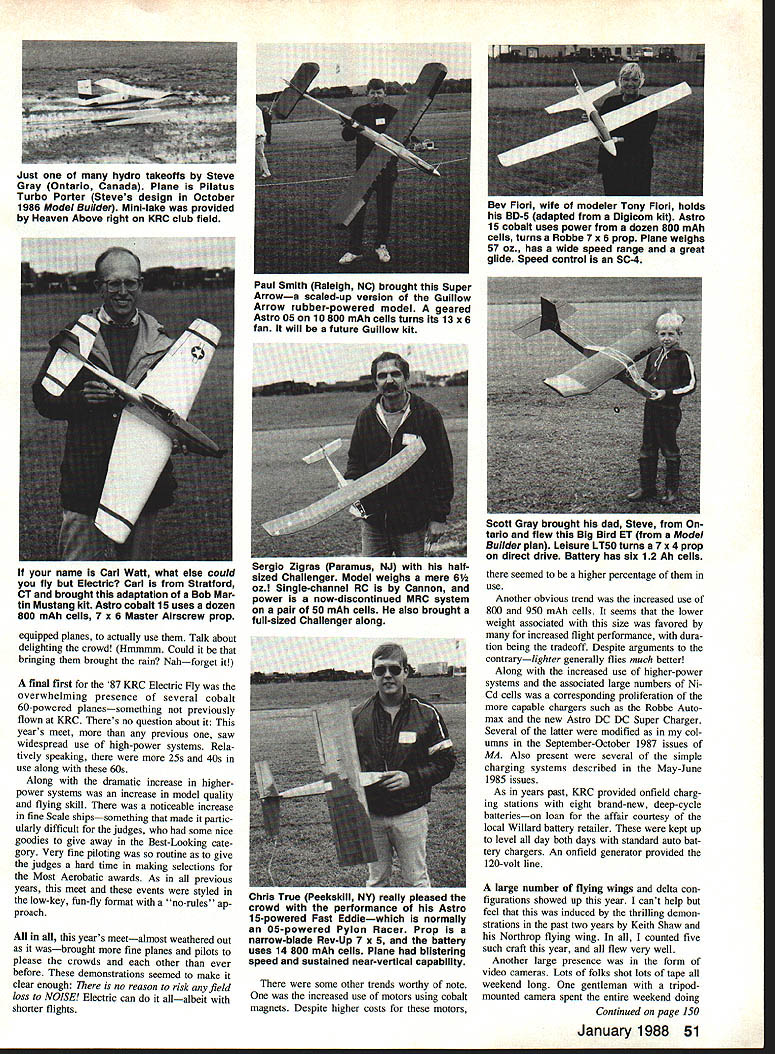
- Ray Naylor and Tony Fiori each flew Shuttle helicopters successfully.
- Ray: used an Astro 40 cobalt (120‑volt winding) powered via a long, light‑gauge two‑conductor tether. Power source was a gasoline generator with voltage controls (manned by Mike Murphy). Airtronics guidance and a gyro helped the craft perform beautifully.
- Tony: used a standard Astro 25 cobalt. He flew the Shuttle both on‑board batteries and tethered to two series‑connected car batteries. Throttle was via an on‑board electronic speed control; the battery pack was 17 cells at 800 mAh each. To save weight, no gyro was fitted.
Hydro (float) operations
- Nels Whitman and Steve Gray brought floatplanes and demonstrated takeoffs and landings from the wet area of the relocation field.
- Steve Gray (a first‑time Canadian participant, Scale columnist for Model Builder, and hobby‑shop owner) and his son Scott flew several fine models, including a crowd‑pleasing floatplane.
Notable models and pilots
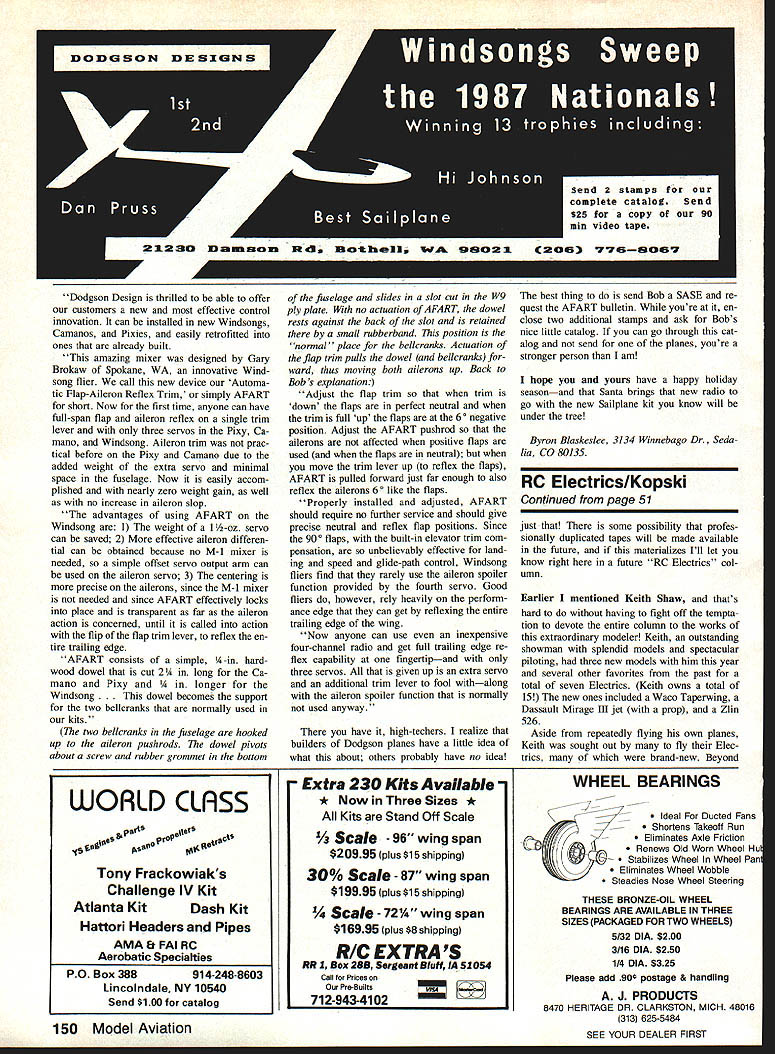
- L. John Mountjoy (Winston‑Salem, NC) and Cohn McKinley (Ann Arbor, MI) flew 84‑inch‑span Powerhouses:
- Mountjoy: Robbe geared system turning a 15×7 Master Airscrew from an 18‑cell pack (900 mAh); model weighed ~98 oz.
- McKinley: Astro 60 cobalt carrying about two dozen 800 mAh cells; model weighed ~100 oz.
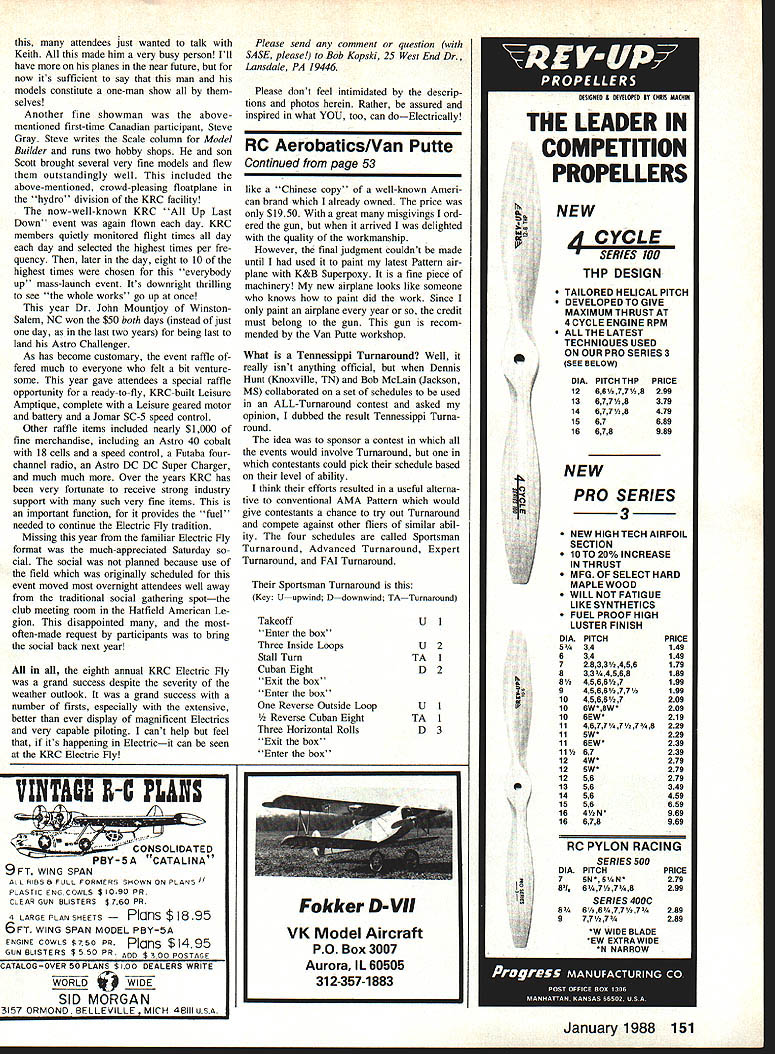
- Ralph Jackson (Endicott, NY) brought an Astro 25–powered Porterfield (direct drive) using a multi‑cell pack with an Adams speed controller and 4‑channel RC.
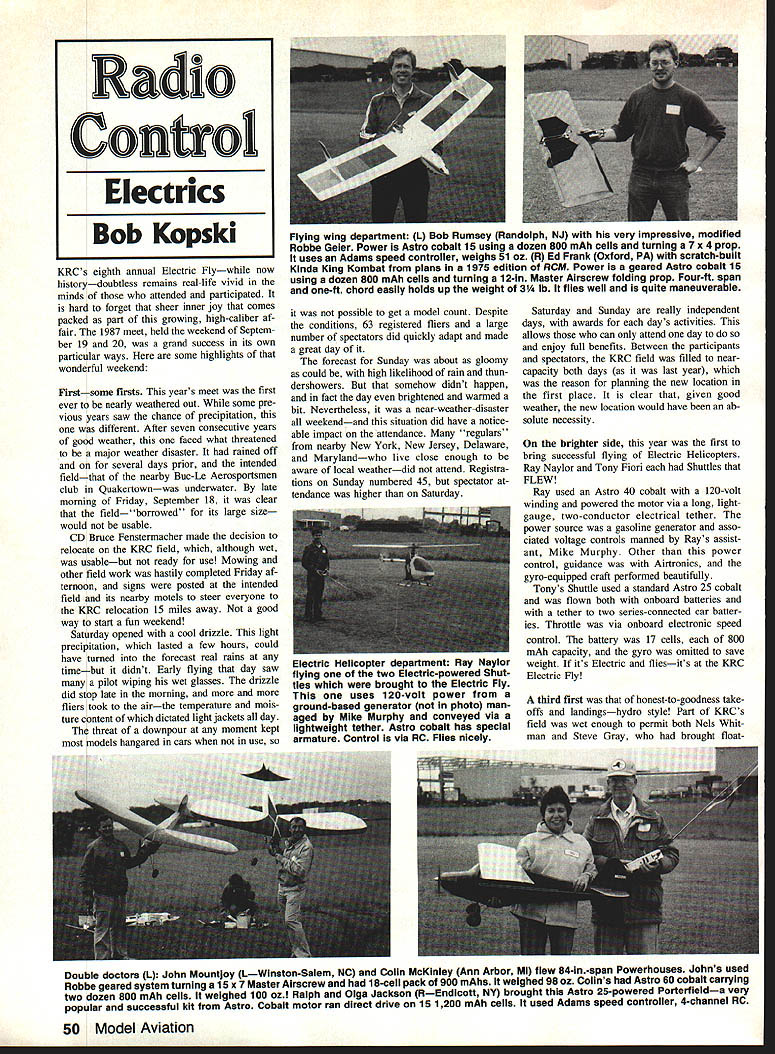
- L. Bob Rumsey (Randolph, NJ) brought a modified Robbe Geier Power — Astro cobalt 15 using a dozen 800 mAh cells turning a 7×4 prop with an Adams speed controller; weight ~51 oz.
- R. Ed Frank (Oxford, PA) scratch‑built a Kinda King Kombat (from RCM 1975 plans). Power: geared Astro cobalt 15 with a dozen 800 mAh cells driving a 12‑in Master Airscrew folding prop. The model (4 ft span) weighed about 3 lb and flew well.
- Keith Shaw and his Northrop flying wing continue to inspire many; there were five flying wings/delta configurations at the meet and all performed well.
Trends and equipment
- Cobalt magnets: increased use of motors with cobalt magnets, despite higher cost.
- Cell sizes: many fliers favored lighter 800 mAh and 950 mAh cells for better flight performance at the expense of duration.
- Chargers: proliferation of more capable chargers such as the Robbe AutoMax and the Anstron DC‑DC Super Charger. Several simple charging systems (described in past Model Aviation issues) were also in use.
- On‑field charging: KRC provided on‑field charging stations using eight new deep‑cycle batteries (on loan from the local Willard battery retailer). These were kept topped off with standard auto battery chargers and powered by an on‑field generator supplying 120 VAC.
Events and activities
- KRC "All Up Last Down": each day the highest flight timers were selected and 8–10 of the top timers participated in a mass‑launch. It’s a thrilling sight to see all models go up at once.
- Dr. John Mountjoy won the $50 prize both days for being last to land his Astro Challenger.
Raffles and industry support
- The raffle offered many prizes, including a special ready‑to‑fly KRC‑built Leisure 60 motor and battery with a Jomar SC‑5 speed control.
- Other raffle prizes totaled nearly $1,000 of merchandise: an Astro 40 cobalt with 18 cells and a speed control, a Futaba four‑channel radio, an Astro DC Super Charger, and more.
- Strong industry support remains important to sustain the Electric Fly tradition.
Social and media
- Many attendees videotaped the event; one person recorded extensively with a tripod‑mounted camera.
- The usual Saturday social was not held this year because the relocation moved most overnight attendees away from the traditional meeting room at the Hatfield American Legion. Many participants requested the social be reinstated next year.
Conclusion
Despite the near weather disaster, the eighth annual KRC Electric Fly was a grand success with many firsts, excellent demonstrations, and a larger-than-ever display of high‑power electrics and skilled pilots. The meet reinforced that electric power can deliver impressive performance — with the tradeoff of shorter flights.
Contact
Please send any comment or question (with SASE) to: Bob Kopski 25 West End Dr. Lansdale, PA 19446
Please don't feel intimidated by the descriptions here. Be assured and inspired in what you, too, can do — electrically!
Transcribed from original scans by AI. Minor OCR errors may remain.

