
Radio Control: Electrics
Bob Kopski 25 West End Dr. Lansdale, PA 19446
Introduction
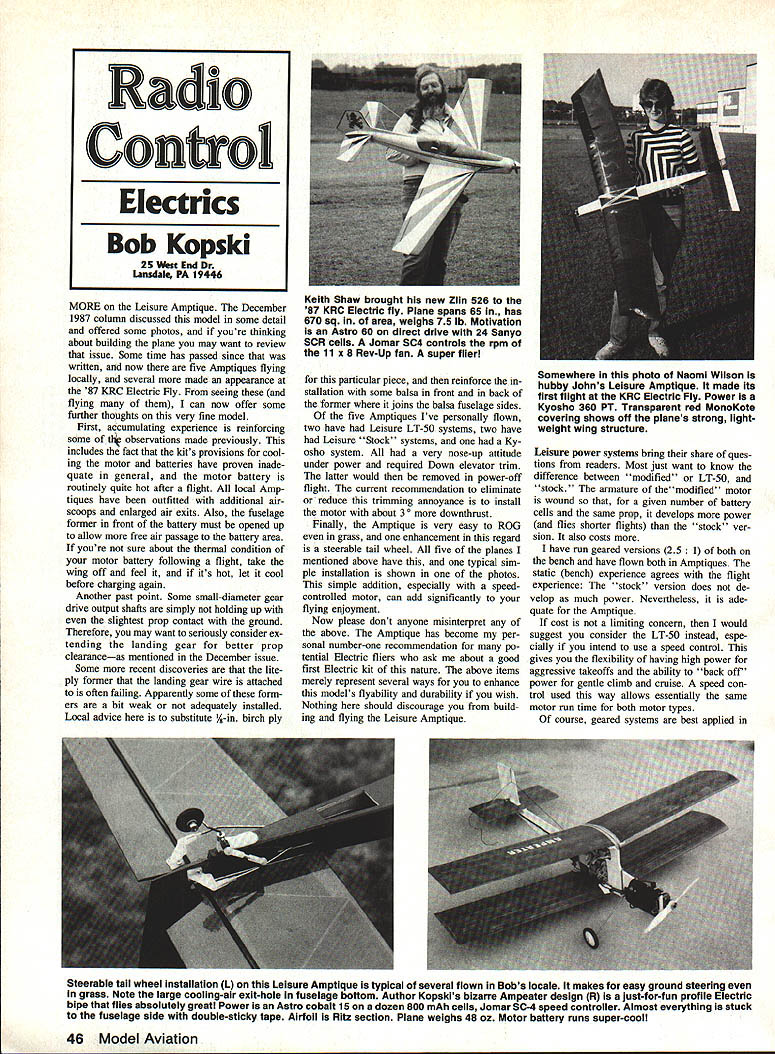
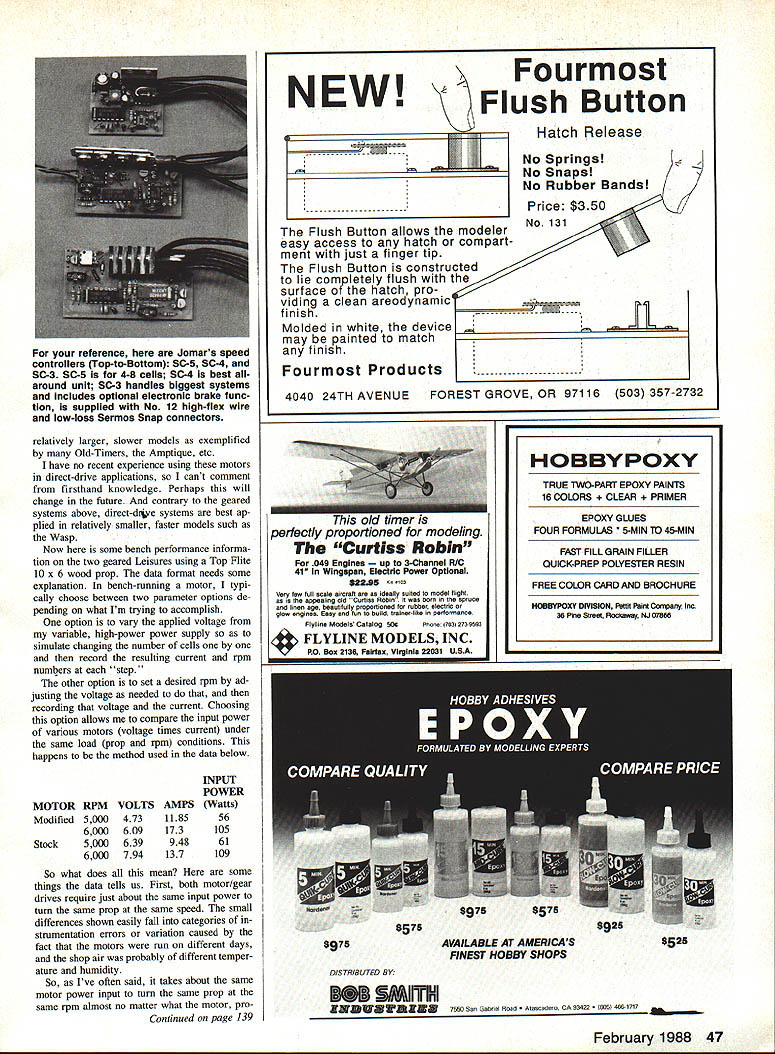
MORE on the Leisure Amptique. The December 1987 column discussed this model in some detail and offered photos; if you're thinking about building the plane you may want to review that issue. Since then five Amptiques have been flying locally and several more appeared at the '87 KRC Electric Fly. From seeing and flying many of them, I can now offer some further thoughts on this very fine model.
Leisure Amptique — Field Experience and Modifications
- Cooling: The kit's provisions for cooling the motor and batteries have proven generally inadequate. The motor battery is routinely quite hot after a flight. Local Amptiques have been fitted with additional air scoops and enlarged air exits. Also, the fuselage former in front of the battery must be opened up to allow free air passage through the battery area. If you're unsure about the thermal condition of the motor battery after flight, remove the wing and feel it; if it feels hot, let it cool before charging again.
- Landing-gear clearance: Some small-diameter gear-drive output shafts will not hold up to the slightest prop contact with the ground. Consider extending the landing gear for better prop clearance (as mentioned in the December issue).
- Former strength: The thin ply former that the landing-gear wire attaches to often fails. Some formers are weak or not adequately installed. Local advice is to substitute 1/4-in. birch ply for this piece and reinforce the installation with balsa in front and behind the former where it joins the balsa fuselage sides. (Some reports mention 1/8-in. birch; use the thickness that best matches your installation and adds adequate strength.)
- Thrust angle and trim: Of the five Amptiques I've flown, two had Leisure LT-50 systems, two had Leisure "Stock" systems, and one had a Kyosho system. All showed a very nose-up attitude under power and required down-elevator trim, which was then removed in power-off flight. To eliminate or reduce this trimming annoyance, install the motor with about 3° more downthrust.
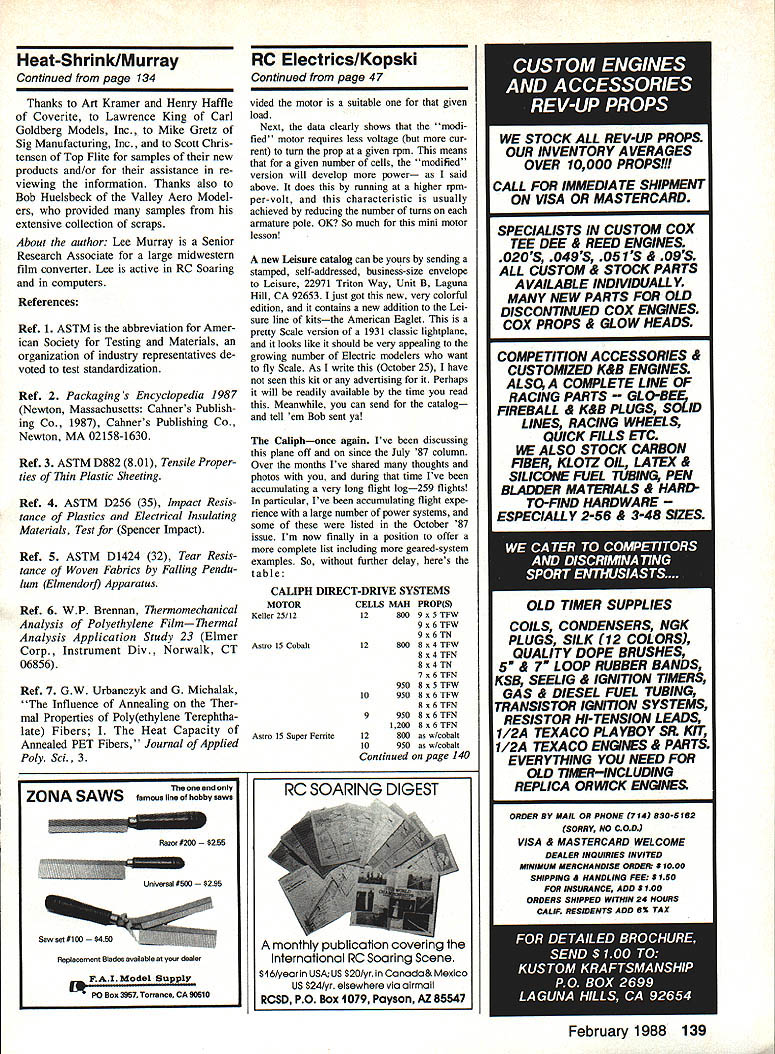
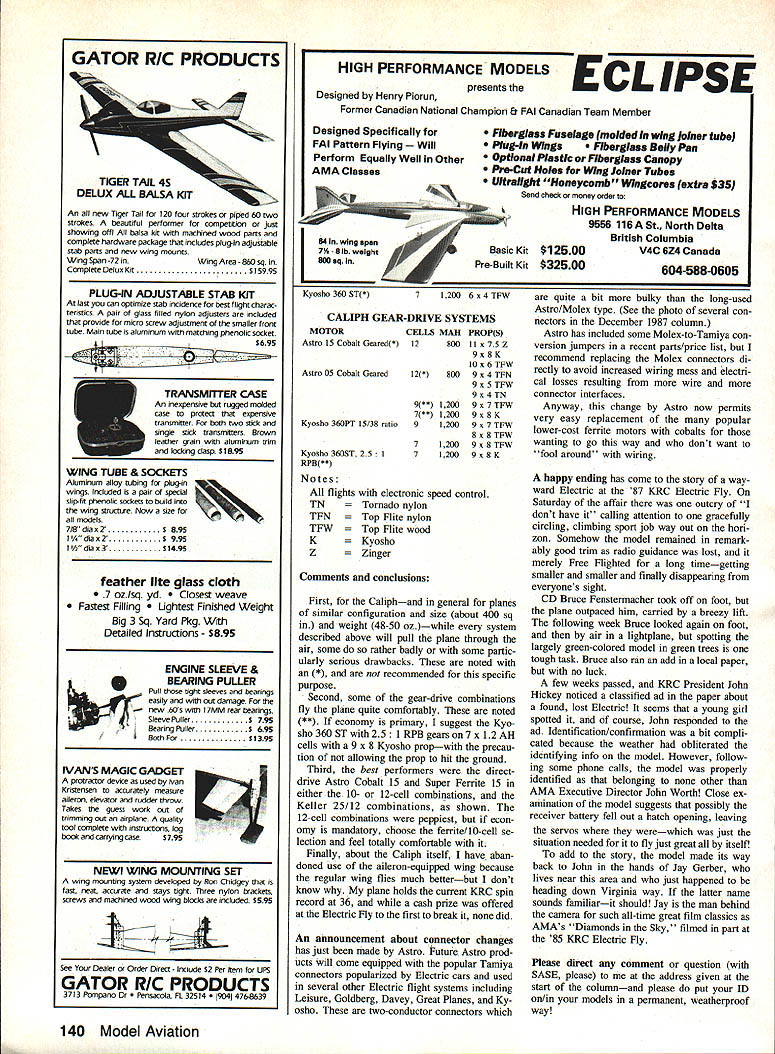
- ROG and tailwheel: The Amptique is very easy to ROG (rise off ground) even from grass. A steerable tailwheel is a useful enhancement; all five local planes have one. A simple steerable tailwheel installation, especially with a speed-controlled motor, adds significantly to flying enjoyment.
Note: The above items are enhancements to improve durability and flyability and should not discourage anyone from building and flying the Leisure Amptique. It remains my top recommendation for many potential electric fliers seeking a good first electric kit.
Leisure Power Systems: Modified vs. Stock LT-50
- Question most readers ask: What is the difference between a "modified" LT-50 and the "stock" LT-50?
- A modified motor, wound for a given number of battery cells and using the same prop, develops more power and typically produces shorter flights than the stock version.
- Bench and flight experience agree: the stock version does not develop as much power as a modified motor, but it is adequate for the Amptique.
- Recommendation: If cost is not a limiting concern, consider the LT-50 (modified) especially if you intend to use a speed control. A speed control gives flexibility: high power for aggressive takeoffs and the ability to back off for a gentle climb and cruise. Used this way, a speed control allows essentially the same motor run time with either motor type.
- Note: Geared systems are best applied in relatively larger, slower models (Old-Timers, the Amptique, etc.). Direct-drive systems are best for smaller, faster models (for example, the Wasp). I have no recent direct-drive experience with these particular Leisure motors.
Bench Performance Methodology
In bench-running a motor I typically choose between two parameter options depending on the goal:
- Vary applied voltage to simulate changing the number of cells one by one, and record the resulting current and RPM at each step.
- Set a desired RPM by adjusting the voltage as needed, then record that voltage and current. This allows comparison of input power (volts × amps) of different motors under the same load (prop and RPM) conditions.
The data below used the second method: same prop and RPM, and recorded volts and amps to compare input power.
Bench Data (Top Flite 10 x 6 wood prop, same RPM chosen)
Modified LT-50
- RPM 5,000 — Volts 4.73 — Amps 11.85 — Input power 56 W
- RPM 5,000 — Volts 6.09 — Amps 17.30 — Input power 105 W
- RPM 5,000 — Volts 6.39 — Amps 9.48 — Input power 61 W
Stock LT-50
- RPM 5,000 — Volts 6.00 — Amps 6.39 — Input power 38 W
- RPM 5,000 — Volts 7.94 — Amps 13.70 — Input power 109 W
What this means:
- Both geared motor/gear drives require about the same input power to turn the same prop at the same speed. Small differences fall within instrumentation error or variations in environmental conditions.
- The modified motor requires less voltage but more current to turn the prop at a given RPM. For a given number of cells, the modified version will develop more power because it runs at a higher RPM-per-volt, usually achieved by reducing the number of turns on each armature pole.
Catalog and New Kit
A new Leisure catalog is available by sending a stamped, self-addressed business-size envelope to: Leisure, 22971 Triton Way, Unit B, Laguna Hills, CA 92653.
The new catalog includes a new kit addition — the American Eagle — a pretty, scale version of a 1931 classic biplane that should appeal to electric modelers interested in scale. As of Oct. 25 (when I wrote this), I had not seen the kit or its advertising; availability may vary.
The Caliph — Flight Log and Power Systems
I've discussed the Caliph off and on since July 1987 and have accumulated a long flight log — 259 flights. I've gained experience with many power systems, including several geared and direct-drive examples. Below is a partial list of direct-drive systems used on the Caliph:
CALIPH DIRECT-DRIVE SYSTEMS
- Keeler 25/12 — Cells 12 — mAh 800 — Prop 9 x 6 TFW
- Astro 15 Cobalt — Cells 12 — mAh 800 — Prop 8 x 4 TFW
- Astro 15 Super Ferrite — Cells 12 — mAh 800 — prop similar to cobalt
- (other entries and variations with different cells, capacities, and props were used)
Connector Changes (Astro)
Astro announced that future products will come equipped with the popular Tamiya connectors (two-conductor) popularized by electric cars and used by several electric flight systems (Leisure, Goldberg, Davey, Great Planes, Kyosho). These are bulkier than the long-used Astro/Molex type.
- Astro included some Molex-to-Tamiya conversion jumpers in a recent parts/price list, but I recommend replacing Molex connectors directly to avoid increased wiring mess and electrical losses from additional wire and connector interfaces.
- This change makes it easy to replace lower-cost ferrite motors with cobalt motors for those wanting the upgrade without extensive rewiring.
A Happy Ending — Wayward Electric Recovered
At the '87 KRC Electric Fly, one model was spotted circling far out on the horizon. Several searches followed without success. Weeks later, KRC President John Hickey saw a classified ad about a found, lost electric and responded. The model was identified and returned — it turned out to belong to AMA Executive Director John Worth.
Close examination suggested the receiver battery may have fallen out at some point, leaving the servos in a position that let the model fly itself. The model was ultimately returned to John Worth by Jay Gerber, who lives nearby and happened to be traveling toward Virginia. (Jay is also the cameraman behind AMA's "Diamonds in the Sky," filmed in part at the '85 KRC Electric Fly.)
Closing Notes and Contact
Please direct any comment or question (with SASE) to me at the address at the start of the column — and please put your I.D. on your models in a permanent, weatherproof way.
Top-to-bottom: SC-5, SC-4, SC-3, SC-5. For 4–8 cells, the SC-4 is the best all-around unit. The SC-3 handles the biggest systems in...
Transcribed from original scans by AI. Minor OCR errors may remain.

