
Radio Control: Electrics
Bob Kopski
News and New Columns
Last month I mentioned all the regularly featured Electric writing I knew of. What I didn't know at the time was that Model Airplane News (MAN) is planning to add an Electric column. Bob Sliff will be the author. I don't know when this will begin, or what the format will be, but you can watch for it. "Attaboys" to both MAN and Bob.
Kits and New Models
Two months ago I mentioned that Leisure would be kitting the Wasp aerobatic model. It turns out they have been doing this for a while, but just haven't advertised it. The first kit run sold out quickly, and more are on the way. As I've said before, this design (by Jim Zarembski) is an excellent flier and is also available as a plan from RCM.
Astro has two new ones in the works: a two-meter glider and an Old-Timer. Tom Coyne of Electric Aeronautics (Box 602, Flint, MI 48501) tells me their new Humming Bird, an .05-size sport/aerobatic kit, will be available later this year.
There is no question in my mind that Electric needs more good kits—historic lack in this area has been a major holdup to the progress of successful Electric-powered flying. I hope all the above work out well and help fill the gap (which is more like a crater!).
Event: Second Annual Boeing Hawks Electric Fly
The Second Annual Boeing Hawks Electric Fly was held on June 30th and this year was not a rain-out as was last year's. Contest Director Bernard Cawley (210 37th St. SE, #43, Auburn, Wash. 98002) reports there were eight participants (not bad at all for a new activity) and most had at least two planes.
There was a large assortment of Electrics including powered sailplane, Old-Timers, sport planes, Scale, Pattern, and Pylon. The event format was an "open fly-in"—except for speed runs. Prize support came from the Hawks, Astro, Leisure, and SR Batteries and prizes were given for a variety of judged categories of the "fun-fly" nature, such as:
- Most Impressive
- Longest Flight
- Most Aerobatic
- Highest Speed
- Largest
- Smallest
This is the same sort of thing we do at the annual KRC Electric Fly, and it works very well. As yet, there are no established AMA Electric categories or classes, and most folks are quite happy with the "fun-fly" approach at this time.
Mitch Poling, Model Builder magazine's Electric columnist, was in attendance and spent much time helping with questions and taking pictures of the affair for MB. I don't know what issue this presentation is scheduled for, but you can watch for it.
You can also watch and wait for next year's event, which this column will be happy to announce when the information becomes available. In the meantime, congratulations to the Boeing Hawks and Contest Director Bernard Cawley! He is confident that the only way the activity can go is to grow.
Visitors, Growth, and Local Flying Habits
My mail frequently tells the story of how the writer is the only Electric flier in his area or club. Sometimes I get the feeling that if not for the other "loners" (who could unite in one area), it would be the largest club in the world! I know the feeling, for the same was true for me nearly a decade ago.
What I found was that one person can be the only Electric flier in an otherwise active group for a long, long time. However, as soon as the second person tries it and is successful, growth is much more rapid. It's as though two (or maybe three) is a "critical mass." Once a few fliers display routine success and fun with Electric, many more are likely to slowly but surely join the ranks. Have any of you out there had this happen in your group?
Occasionally we of KRC are privileged to have a visitor to the area drop by our field. This happens several times a year, and most often the visitor just wants to see some successful Electrics, "because the one guy back home who tried it could only get up about 50 feet for two minutes." What they wind up with after the visit is a strong conviction that Electric really does work—very well—nothing at all like the "near powered-sink" experience they may have had or seen.
This story continues, and soon you will see how very wide the range of Electric experience, viewpoint, and preference can be. One thing that characterizes local fliers is that there are no "hot-shot" performers—a relative description. Specifically, the stories we've all read about how some are not to be found locally. Rather, local guys (and there are quite a few) are quite content to fly rather long motor runs, slowly achieving very high altitudes if they wish, but always achieving comfortably long flights, particularly with glider, Old-Timer, and sport designs. For now, keep in mind that these terms are relative, too, but this is the very kind of flying that so very much impresses the less-successful visitors.
Photo Captions
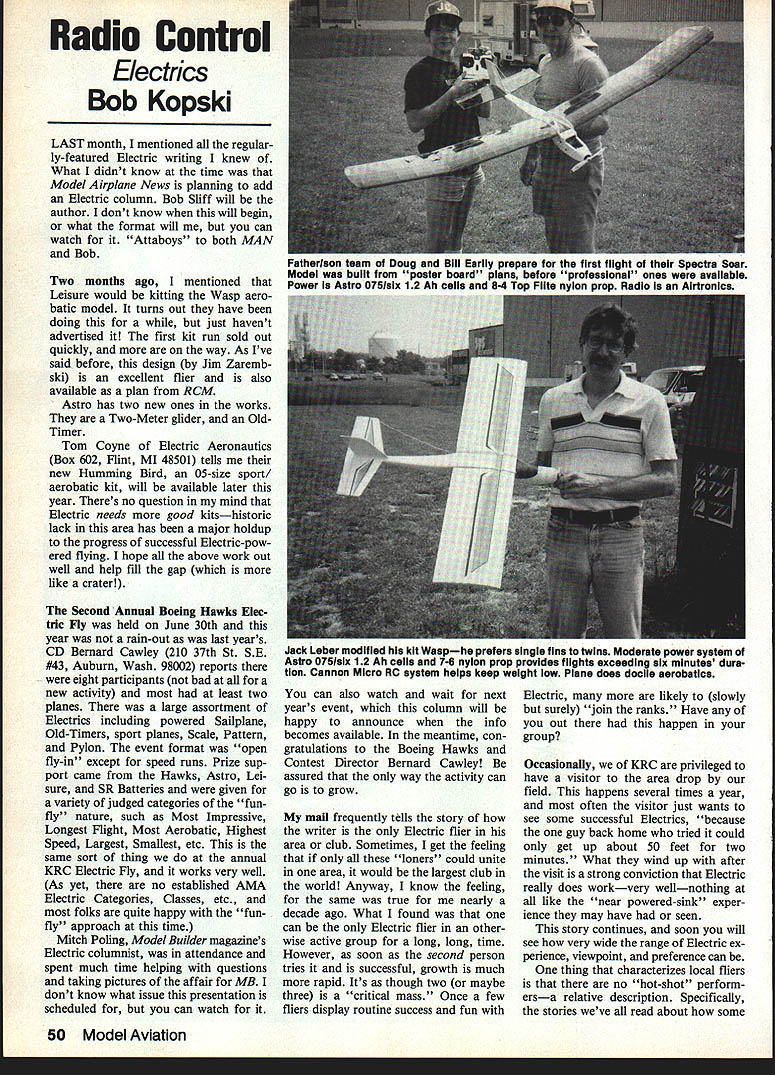
Fatherson team Doug and Bill Early prepare first flight. Spectra Soar model was built from poster-board plans before professional ones were available. Power: Astro .075, 12 AA cells, 8-4 Top Flite nylon prop. Radio: Airtronics.
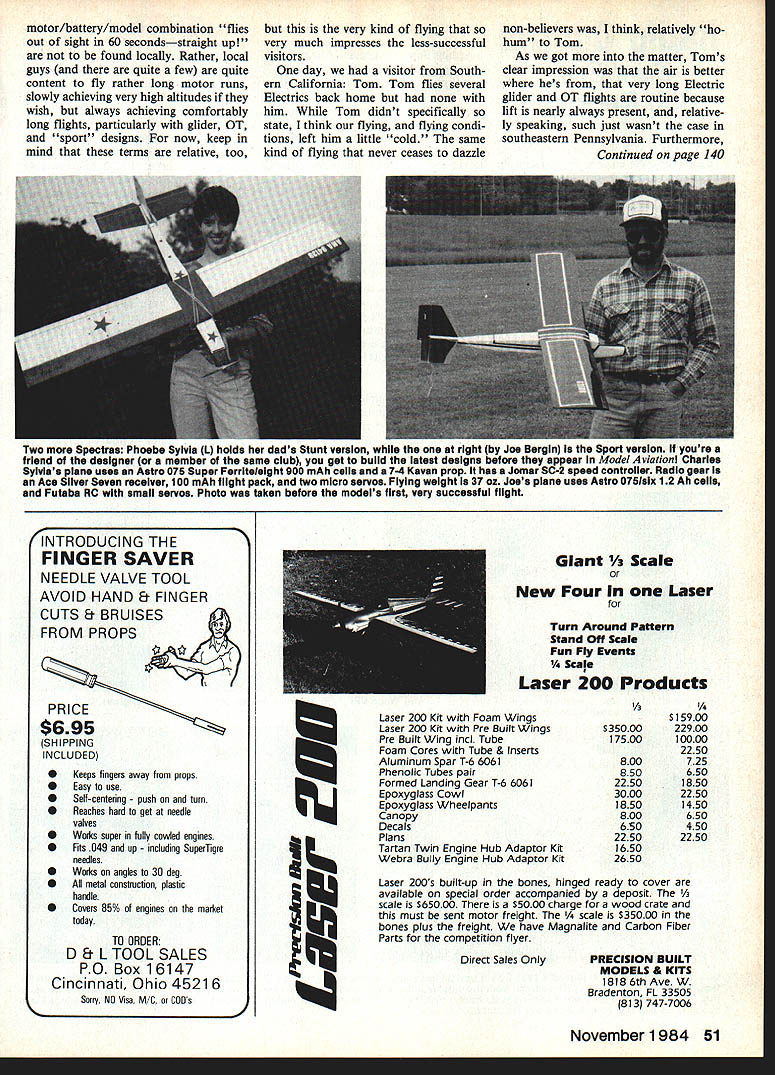
Jack Leber modified kit Wasp; he prefers single fins to twins. Moderate power system: Astro .075, 12 AA cells, 7-6 nylon prop provides flights exceeding six minutes duration. Cannon Micro RC system helps keep weight low. Plane does docile aerobatics; motor/battery/model combination "flies out of sight in 60 seconds—straight up!"
The Tom Visit and the Battery/Flight-Time Experiment
One day we had a visitor from Southern California: Tom. Tom flies several Electrics back home but had none with him. While Tom didn't specifically say much, I think our flying and flying conditions left him a little "cold." The same kind of flying that never ceases to dazzle non-believers was, I think, relatively "ho-hum" to Tom.
Tom's clear impression was that the air is better where he's from, that very long Electric glider and OT flights are routine because lift is nearly always present. Relatively speaking, such isn't the case in southeastern Pennsylvania. Furthermore, the typical Electric flier he had in mind preferred to use very large amounts of power for short motor runs and just get the very-high-climb part of the flight over with and concentrate on the gliding. No four- or five-minute motor run/climbs out there! You see, Tom's experience, reference, and preference were quite different from mine and other local fliers.
Following Tom's visit, I pondered these matters at length and decided to try an experiment. Throughout MAN's recent Electric series I took the position that for most successful Electrics the total average flight time in "neutral air" was determined by the battery, assuming an appropriate motor/model/battery combination. I wanted to try the kind of flying Tom described, and at the same time to further test my battery/flight-time argument. Limited results to date fully support my position, and expanded details will appear in the next column.
Rules, Classes, and a Proposal
The above leads me into the murky waters of the stagnated Electric rules-and-classes situation. You see, my aim is to promote Electric—making it easy, fun, and economical for everyone who desires to be successful with Electric and eventually to test their accomplishments against those of others, i.e., to compete. For these and other reasons, and motivated by the experiment I described above, I have to reveal some strong feelings about the continuing rules battle.
Before continuing, let me make it clear that what follows is my personal feeling. If it happens to be (or not be) also that of someone in the modeling industry, it's coincidental. I am not a party to the raging Electric battles. Mine is a personal preference based on lots of Electrics and Electric-Fly experience. No one has influenced me. I strongly object to any regulation that would discourage the use of any existing equipment — at least for a while (like the balance of this decade).
An example of such a requirement would be an event with a limited motor run, for clearly this would encourage very-high-power-spending systems—motors and batteries and techniques that automatically become the most costly. Another example would be events requiring some specific number of cells to be used, because there are a variety of batteries (numbers of cells) in use, and legislating against some is not making it easy for those affected.
Since this is a "how-to" column, permit me to suggest a solution to the rules and classes dilemma. I favor the use of any motor, battery, or run-time. In other words, I favor the (initial) allowance of any power system utilization. I do not believe in any restrictions on motors, batteries, cell count, model weights, and the like.
In effect, this reduces to the contestant being permitted to charge the battery of his choice as he wishes, and then using all the available energy. A battery can deliver only its fill, a rubber motor will accept only so many winds, and a winch line is only so long. It's up to the modeler to make the best use of what he has. A battery of any number of cells, in effect, is as useful as any other number (in an appropriate plane), for plane size and weight necessarily increase with the power system make-up, and as far as I can see, the only thing that changes with size is cost—not "performance." It kind of all evens out. Furthermore, everybody I know flies this way (empties the "tank") all the time, anyway.
Of course, some categorization of something is needed, just like Men's and Ladies' facilities! Simple enough—just have Electric model (not power-system) categories—the obvious ones being simply Glider, Old-Timer (OT), Scale, Aerobatic, Pylon, whatever. The immediate effect of all of the above is that any existing product, kit, model, or published design—anything—is eligible for competition—anyhow.
Another immediate benefit of this approach is that the ongoing industry bickering would tone down, and the modeling world would get on with national-level (AMA) rules. Another benefit is that immediate emphasis would shift to good building and flying practices rather than "does that guy have a legal motor, or battery, or whatever?" Another is that participants would find that an intimate knowledge of batteries and their care and feeding would be very much to their advantage. The RC car guys do it all the time—it is not unlike taking good care of a rubber motor. This "initial rule and cooling off period" would give us a nationwide experience basis from which future Electric class descriptions and rules would develop—a solid basis—rather than one charged with emotion.
While the details of the various model categories need to be worked out, that should be relatively easy, for each one named has an existing non-Electric counterpart. Of course, I expect there will be many questions and challenges to my "how-to." Some that come to mind are below.
Questions and Answers
- "It's OK for Glider and OT, but I fly Aerobatic."
- Good—use the available energy (the battery of your choice that you fill), and good flying technique to do as much of the "pattern" (whatever it is) as well as you can—you lose points for imprecision and incompleteness.
- "It's OK for Gliders, OT and Aerobatic, but I fly Pylon."
- Good—use the available energy to fly as many laps as fast as possible—incomplete laps cost more points than longer times (or something like that).
- "Yeah, but that other guy has a big shiny cobalt with 37 cells and I have a grass-shears motor with five cells."
- It doesn't much matter. He has a huge, heavy plane with all that stuff, and bigger is not necessarily better. In general, the relative proportions of the total model weight contributed by the motor, battery, and everything else are relatively constant. I maintain that, in the end, "large" and "small" power systems and planes will fare about even-up; no big differences.
- "But aren't motors really different?"
- Sure, there are some differences. Some have better brushes, or bearings. Cobalts can handle more power in a smaller, lighter case size. Differences in efficiency do exist. But there are no really big differences. Remember the battery/flight-time experiment I mentioned earlier? It mostly comes down to the total energy available, and how wisely and skillfully the pilot uses it (with a little luck thrown in, too!).
- "What about the 'hot-shot' who can afford—and is willing to abuse—motors and batteries to destruction for the purpose of 'winning'?"
- Initially, such presence will be very limited (or non-existent) and will stay that way for a long time. Why do I say this? I simply refer you to the earlier paragraph regarding "loners"!
Final Thoughts
Suppliers to the Electric field have to produce something, and it makes good business sense (better products at lower prices) to deal with a reasonable number of motor sizes, battery cells, and charger types. Right now, there are plenty of useful systems on the market, in a wide variety of power levels and price ranges. Until everything settles out and some "ultimate position" on classes is arrived at, this proposal permits the use of everything in past or present production. Sporting—but mostly competitive—use of our varied resources will surely expose users' preferences. It will take a few years.
So there you have it—more varied views on Electric power and performance—different strokes, as it were—and how these differences can result in more or less the same flying results, and how this in turn helps justify my suggestion of an initial set of Electric-powered model categories—not power-system rules. And many thanks to Tom for getting me off on this kick!
Now that you know where I stand, what is your position?
Happy landings,
Bob Kopski 25 West End Dr., Lansdale, PA 19446.
Transcribed from original scans by AI. Minor OCR errors may remain.

