
Radio Control: Electrics
Bob Kopski 25 West End Dr. Lansdale, PA 19446
Follow Up
My September/October 1987 columns described how to modify the Astro Model 102 DC/DC Super Charger so it becomes current-regulated—the charge current remains relatively constant over the charge cycle. The modification also allows the charger to be used safely while connected to an automobile electrical system with the engine running. Reader response has been positive and inquisitive; here are answers to some popular questions.
No! No! No! I do NOT recommend using the Astro Super Charger connected to the automobile cigarette lighter socket. In fact, I do not recommend using that receptacle even for ordinary, simple 6/7-cell chargers. Car cigarette lighter sockets and mating accessory plugs often form very unreliable, high-resistance (ohmic) connections. I’ve seen many modelers in the field unable to get a reasonable flight because of this.
Poor-quality connections to the auto battery cause even more trouble with high-capability chargers. Charging large packs means the charger must draw lots of current from the car battery—exactly the situation that demands a high-quality connection, not a wimpy lighter receptacle.
The modified Super Charger can be MUCH MORE DEMANDING on the input-connection quality because it maintains a relatively steady output charging current that is fairly independent of input voltage. It automatically increases its input current when input voltage drops so that input power (input voltage × input current) divided by efficiency equals output power (motor battery voltage × charging current). Conversely, input current drops as auto battery voltage rises (for example, when the engine is running). For the technically inclined, the charger’s input behaves like a negative resistance (it takes more current at lower voltage and vice versa).
Powering the modified charger through lossy (high-resistance) connections—like many lighter sockets—causes the charger to draw higher input current. That raises voltage drop at the poor contact, which causes yet more current draw, then more voltage loss, and so on. It’s a great way to blow fuses.
You may recall that the modification article recommended substituting LARGE battery clips for the rather small ones that come with the charger. Now you know why! That recommendation applies even if you do not perform the modification.
When I said I use the charger while driving to the field, I don’t mean using the cigarette lighter connector. I use additional heavy wiring run directly from the auto battery terminals to connectors in the rear of the car. (This installation was described in the March and July 1985 issues.) Serious electric fliers may want to consider such wiring.
Also in the July ’85 column I described a useful accessory for high-capability chargers: a charge-splitter. It’s a very simple device made from wire, charge connectors and a 35 mm film canister. Used with high-capability chargers when time is limited, the splitter lets you charge multiple packs simultaneously provided:
- The packs are made up of the same-size cells (same ampere-hour capacity).
- The total number of cells exceeds the capacity of the charger.
The charge-splitter connects the packs in series (in or out of models) and then to the charger so the same current flows through all cells. The example shown in that column was made for two packs, but the idea can be extended to more. For smaller packs, it’s almost like running several chargers at once.
Several readers asked why the “hi–lo” toggle switch pictured on my modified Astro 102 is labeled “1–14” and “10–22.” The modification used up about two cells’ worth of charger output capability. The Astro is specified for up to 28 cells, so 28 minus 2 would be 26—correct arithmetic. In practice, however, I could not reliably charge 28 cells at 4+ amps with my unmodified Super Charger; the actual per-cell-count limit depended on the condition of my auto battery terminals and other factors. Consistent with my conservative practice, I labeled the switch to reflect operational limitations across a wide range of conditions. I think you’ll find those ratings more proper.
Keith Shaw is a name familiar to this column and to many others. He may very well be this country’s best electric modeler. Keith has recently moved into a larger model-building facility and promises some unbelievably large electrics. He tells me he has a “biggie” on the boards right now—so watch out. 1988 Electric Fly goes!
Keith’s new address: Keith Shaw 2756 Elmwood Ann Arbor, MI 48103-6624
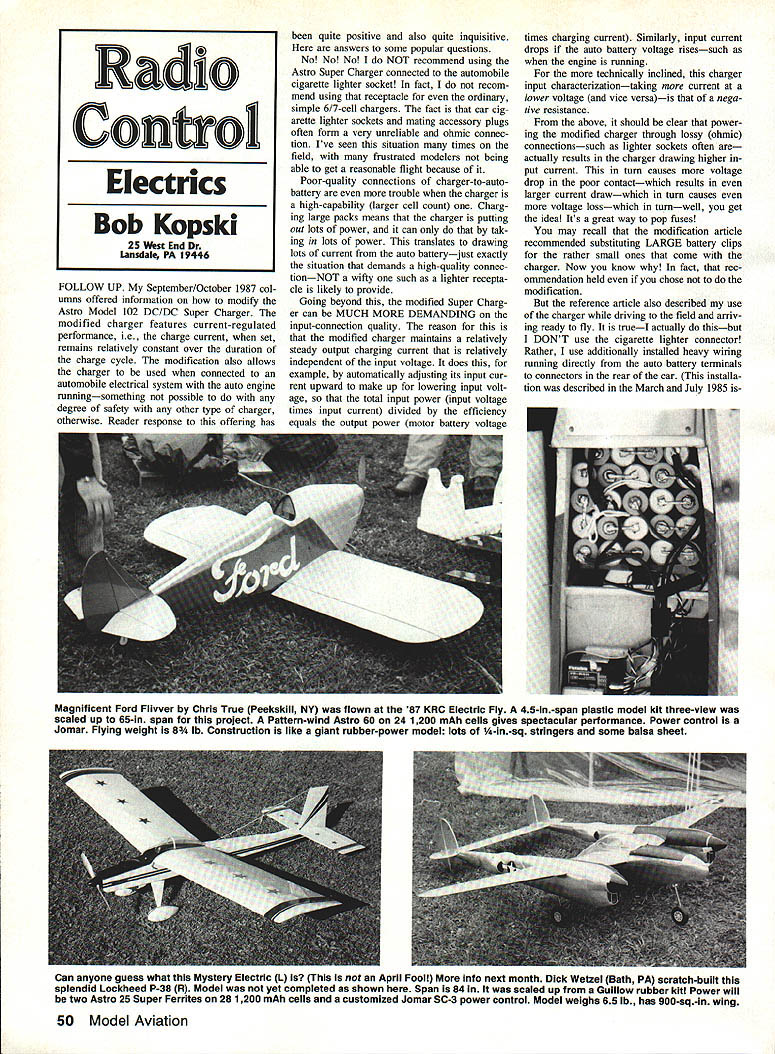
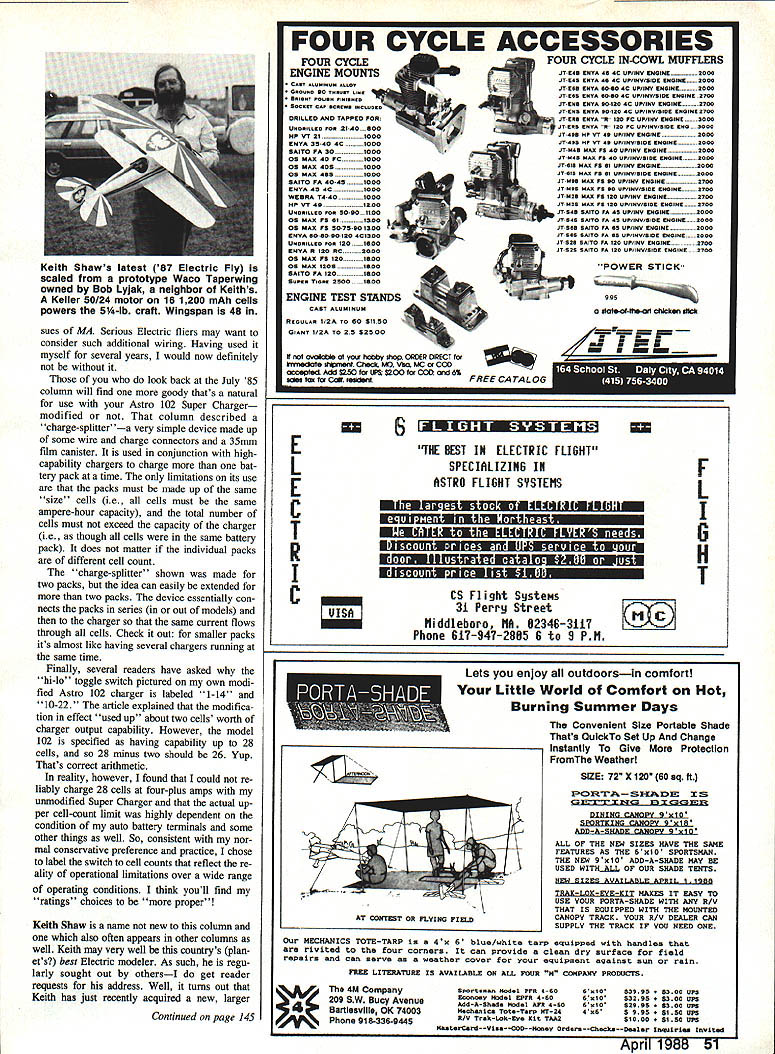
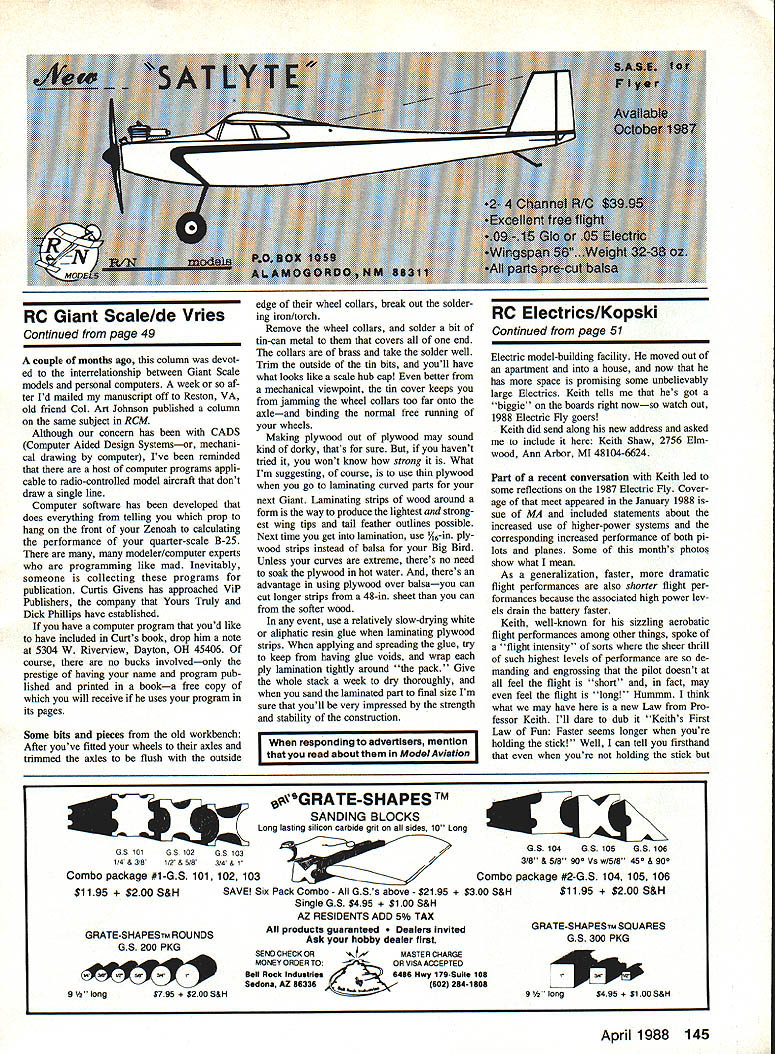
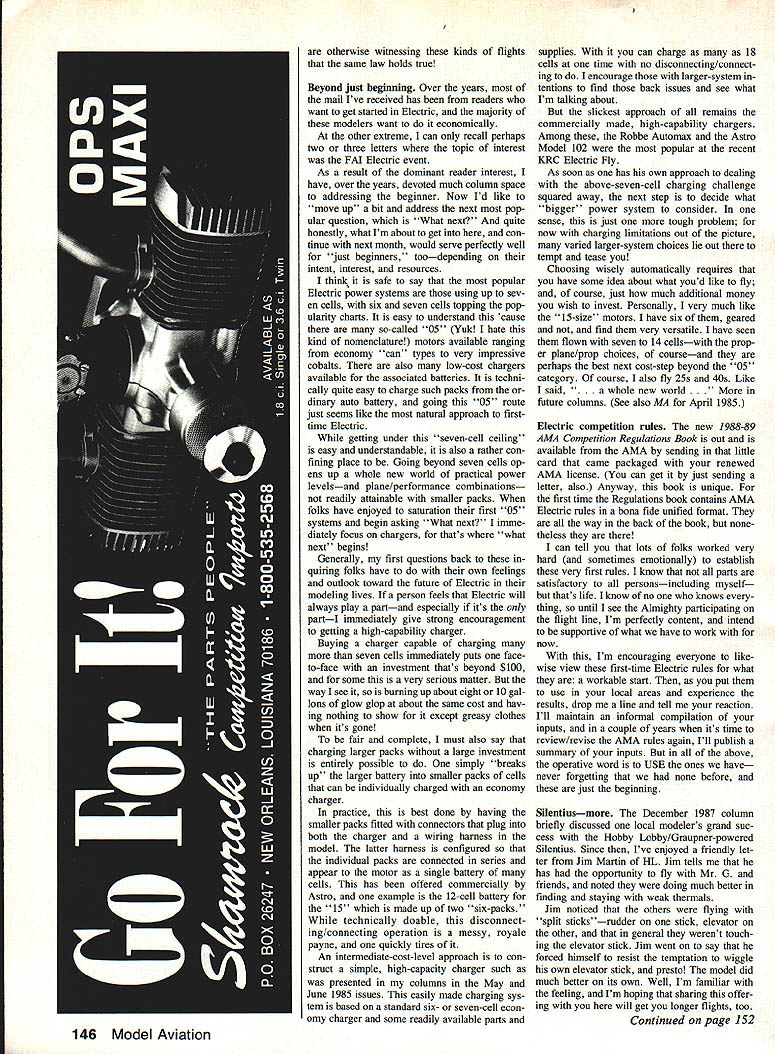
A recent conversation with Keith led to some reflections on the 1987 Electric Fly. Coverage of that event appeared in the January 1988 issue of Model Aviation and noted an increased use of higher-power systems and the corresponding jump in pilot and plane performance. Some of this month’s photos show what I mean.
As a generalization, faster, more dramatic flight performances are also shorter flights because high power levels drain the battery faster. Keith, well-known for his sizzling aerobatic performances, spoke of a “flight intensity” where the thrill of high performance is so concentrated that landing and recovering the model don’t make the pilot feel the flight was short—indeed the pilot may feel it was long. I’ll dare to dub it “Keith’s First Law of Fun: Faster seems longer when you’re holding the stick!”
Beyond beginning: most mail I receive over the years has been from readers wanting to get started in electric, and most of those want to do it economically. As a result, I’ve devoted much column space to beginners. Now I’d like to “move up” a bit and address the next question: “What next?” What follows (and next month’s column) will also serve beginners well depending on intent and resources.
I think it’s safe to say the most popular electric power systems use up to seven cells, with six and seven cells topping the charts. There are many so-called “05” motors available (I dislike that nomenclature) ranging from economy “can” types to impressive cobalts, and many low-cost chargers exist for those batteries. It’s technically easy to charge such packs from an ordinary auto battery, so the “05” route is a natural first step.
But staying under the seven-cell ceiling is confining. Going beyond seven cells opens a new world of practical power levels and performance not readily attainable with smaller packs. When fliers enjoy their “05” systems to saturation and ask “What next?” I immediately focus on chargers, because that’s where “what next” begins.
Buying a charger capable of charging many more than seven cells usually involves an investment beyond $100. For some that’s a big step; for others it’s comparable to burning eight to ten gallons of glow fuel for nothing but greasy clothes. To be fair, charging larger packs without a large investment is possible by breaking the larger battery into smaller packs that can be individually charged with an economy charger. In practice this works best when the smaller packs have connectors that plug into both the charger and a wiring harness in the model; the harness then connects the packs in series so they appear as a single large battery. Astro has offered this commercially—for example, a 12-cell battery made from two six-packs—but disconnecting/reconnecting is messy and tiresome.
Some approaches:
- Break the large pack into smaller packs that you charge individually (messy, but low cost).
- Build a simple high-capacity charger (described in my May and June 1985 columns). That system uses a standard six- or seven-cell economy charger plus common parts and can charge as many as 18 cells at once without reconnecting packs.
- Buy a commercial high-capability charger. The slickest approach, though the most expensive. At the recent KRC Electric Fly, popular units included the Robbe Automax and the Astro Model 102.
Once you’ve solved the charging challenge, decide what “bigger” power system you want. Choosing wisely requires an idea of what you’d like to fly and how much you’ll invest. Personally, I like “15-size” motors; I have several (geared and ungeared) and find them very versatile. They’ve been flown on seven to 14 cells with proper plane/prop choices and are a good next step beyond the “05” category. Of course, I also fly 25s and 40s—there really is a whole new world. More in future columns (see also Model Aviation, April 1985).
Electric competition rules
The new 1988–89 AMA Competition Regulations Book is out and is available from the AMA by sending in the card that came with your renewed AMA license (or by sending a letter). For the first time, the Regulations book contains AMA Electric rules in a unified format. They’re in the back of the book, but they’re there—in full.
Lots of people worked hard (sometimes emotionally) to establish these rules. I know not all parts will satisfy everyone on this first go-around. No one knows everything, and until I see the Almighty on the flight line I’m content to start with what we have and watch how it performs.
I encourage everyone to view these first-time Electric rules for what they are: a workable start. As you use them locally and gain experience, drop me a line with your reactions. I’ll maintain an informal compilation of input and, when it’s time to review/revise the AMA rules in a couple of years, I’ll publish a summary. Remember that day-to-day operational use is the best real-world test.
Silentium—more
The December 1987 column briefly discussed one local modeler’s success with the Hobby Lobby/Graupner-powered Silentium. Since then I received a friendly letter from Jim Martin of Pennsylvania. He told me he flew with Mr. G. and did one better by flying with two Silentiums at once. The two machines flew with “rudder on one stick, elevator on the other,” and Jim noted they generally weren’t touching the elevator stick. He forced himself to resist the temptation to fly with his own elevator stick, and the models did better on their own. I’m impressed with the idea and happy to share it—this may get you longer flights, too.
RC Electrics / Kopski
Thanks, Jim, for the input and insight. One local modeler is just completing an H.L. Electric Pronto, so I should have more about that in future columns.
Electric supplies continue to be available from CS Flight Systems. In a recent conversation with owner and electric modeler Charles Sylvia, I learned they’ve expanded and updated their catalog. For the latest discounted electric supplies, send for Charlie’s catalog at:
CS Flight Systems 31 Perry St., Box 775 Middleboro, MA 02346
Tell ’em Bob sent you!
Please forward any comment or question (with SASE, please) to me at the address listed at the very top of this column.
FLASH! Just announced—a new electric kit by Guillows: the Aeromac, designed by Woody Blanchard (Woody chaired the committee responsible for the first-ever AMA electric rules). This 53.5 sq. in., 67-in. span kit for “Q’s” should be available about the time you read this.
Transcribed from original scans by AI. Minor OCR errors may remain.

