
Radio Control: Electrics
Bob Kopski 25 West End Dr. Lansdale, PA 19446
Upcoming Electric Meets
- Westmoreland Electric Soaring Society Electric Meet — July 17, 1988
- Location: Mon Valley RC Club field (in a state park); readily accessible from Exit 8 (New Stanton) of the Pennsylvania Turnpike.
- Early info from Bob Markle, RIM Systems. For details write: Unit #3, Sandy Hill Road, RD #6, Irwin, PA 15642.
- Note: Despite the "Soaring" name, the club flies all kinds of electrics. WESS has 29 active electric fliers.
- Puget Sound Electric Model Fliers (PSEMF) two-day Electric fly-in — June 25–26, 1988
- Hosted by the Boeing Hawks RC Club at the club field in Kent, WA.
- Prizes: biggest, smallest, most aerobatic, best scale, and more.
- More info: Bernard Cawley, 29838 48th Ave. South, Auburn, WA 98001.
When you write to either Bob Markle or Bernard, tell 'em Bob sent ya!
New Products and Catalogs
- RIM Systems: upcoming items include new gear drives for .05 motors and an adjustable, audible peak-charge alarm.
- RIM catalog: 50¢ will get you a catalog (send to RIM address above).
Folding Props (K & W)
- K & W has expanded its folding-prop line with two new sizes: 7 x 4 and 12 x 7.
- See the Advertiser's Index for K & W's ad and where to write for details.
- Note: folding props were pictured and discussed in detail in my March 1988 column.
Feature: The Mystery Electric — Amptique / Sportique
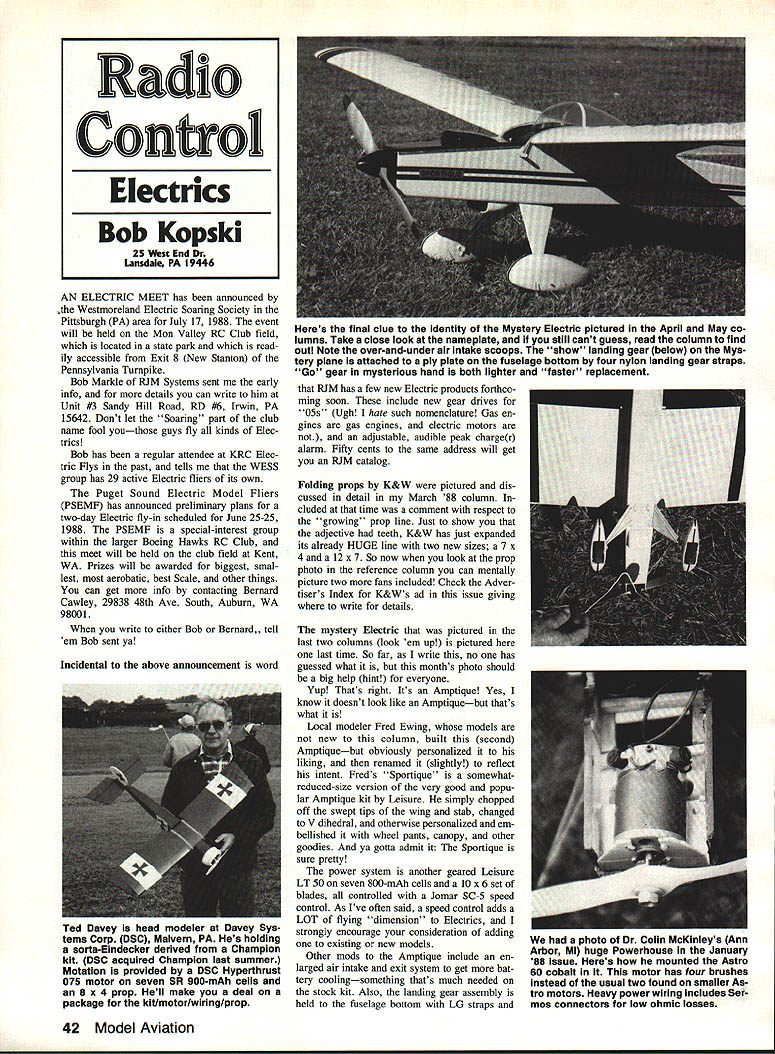
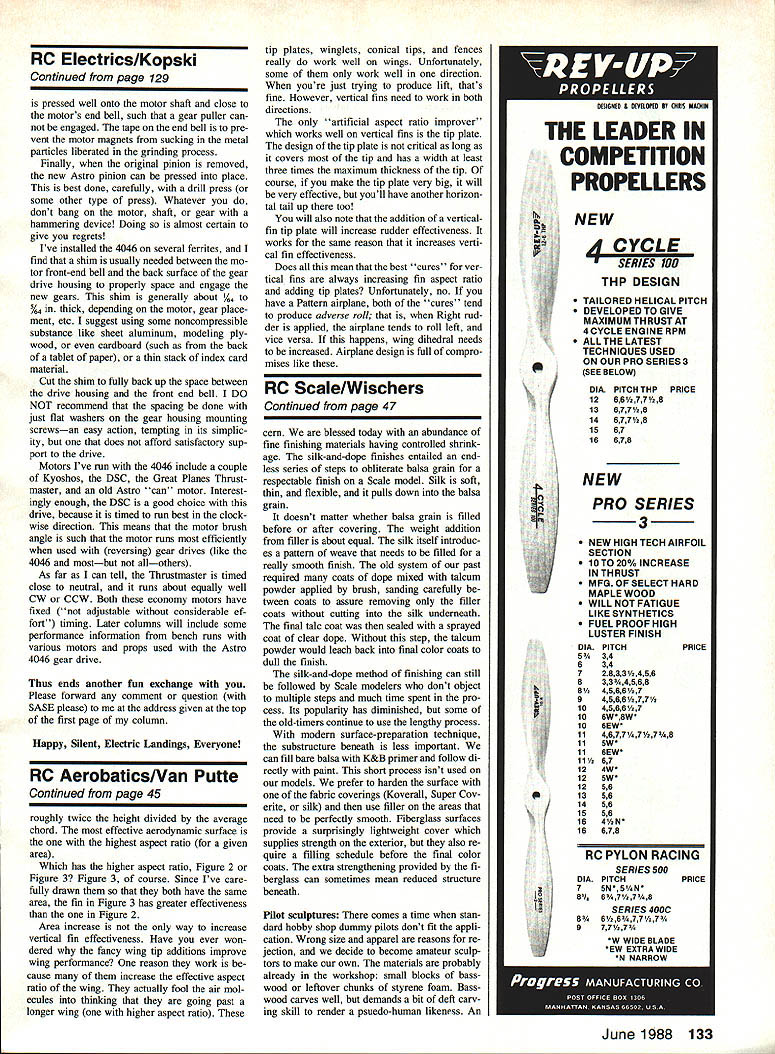
- The mystery electric pictured in previous columns is an Amptique — specifically Fred Ewing's modified version he calls the "Sportique."
- Fred built a modified (somewhat reduced-size) Amptique kit by Leisure and personalized it:
- Chopped off the swept tips of the wing and stabilizer.
- Changed to V dihedral.
- Added wheel pants, canopy, and other embellishments.
- Result: a pretty, slightly smaller, and peppier model.
- Power system on Fred's Sportique:
- Geared Leisure LT 50 motor.
- Seven 800‑mAh cells.
- 10 x 6 propeller.
- Jomar SC-5 speed control.
- Comment: a speed control adds a lot of flying "dimension" to electrics — strongly recommended.
- Other modifications and improvements:
- Enlarged air intake and exit system for better battery cooling (needed on the stock kit).
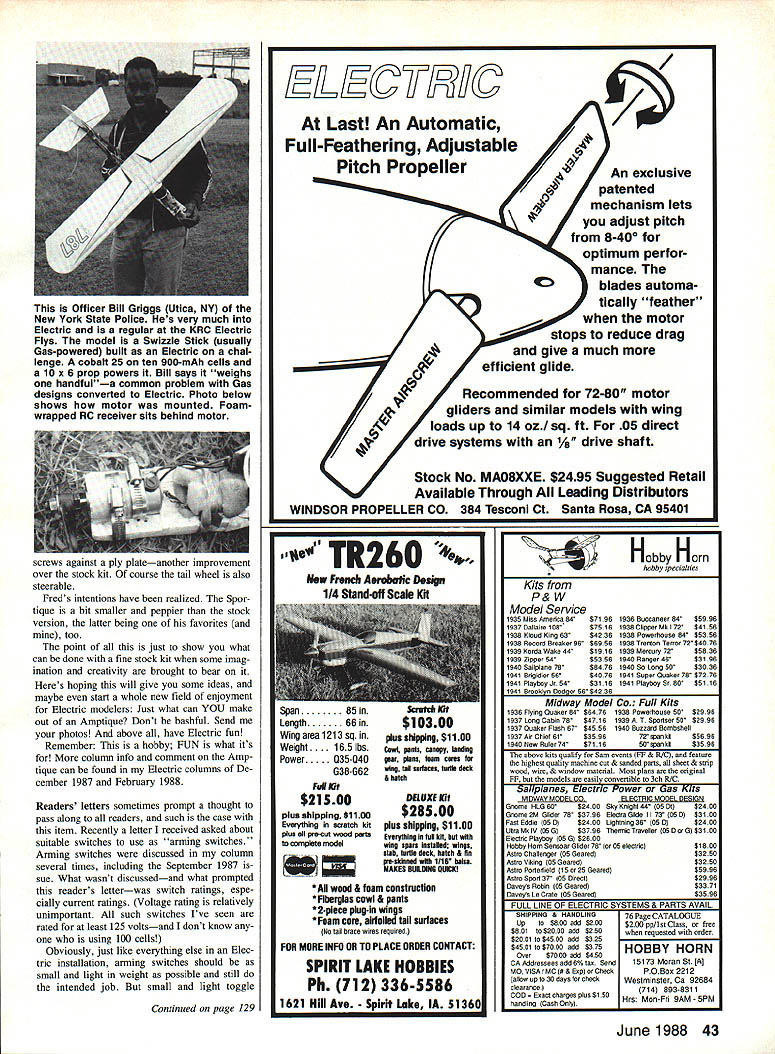
- Landing gear assembly held to fuselage bottom with LG straps and a plywood plate with screws against the ply plate — improvement over stock.
- Steerable tail wheel.
- The Sportique demonstrates what imagination and creativity can do with a fine stock kit. Send photos of your Amptique conversions — and above all, have fun. See my Electric columns of December 1987 and February 1988 for more on the Amptique.
Arming Switches and Ratings
- Reader question: Which switches are suitable as "arming switches," and what about switch current ratings?
- General points:
- Voltage rating is of relatively minor concern (most switches rated ≥125 V).
- Current rating matters, but small, light switches are preferred if they do the job.
- Practical experience:
- Miniature toggle switches rated 5–10 A have been used successfully for years as arming switches. Manufacturers supplying these include Astro and DSC (5 A) and Kyosho (6 A).
- Why lower-rated switches work: the operative word is "arming." Arming switches enable the circuit but do not directly carry the heavy motor current when used with radio-operated power controls (electronic switches, relays, or speed controls). When first turned on, radio-operated controls are normally off, so the arming switch switches "cold" and avoids arcing. The heavy current is handled by the radio-operated device, not the toggle.
- When arming switches are used as primary ON/OFF motor switches (for example, servo-driven main switches):
- This is an abusive application. Occasional failures occur (intermittent operation, heat). Switches may run many flights before showing symptoms, and can be replaced inexpensively. An in-flight failure is possible but usually not catastrophic for most models.
- If arcing or excessive current is a concern, use a switch designed for the motor current or use the arming switch to control a relay that handles the heavy current.
Column Index
- A reader asked about an index for the Electric columns. I have no current index available now but am considering developing one.
- The last index appeared in the September 1985 issue and covered columns from the beginning (September 1983). Look for an update later this year.
Feedback on the Astro No. 4046 Gear Drive
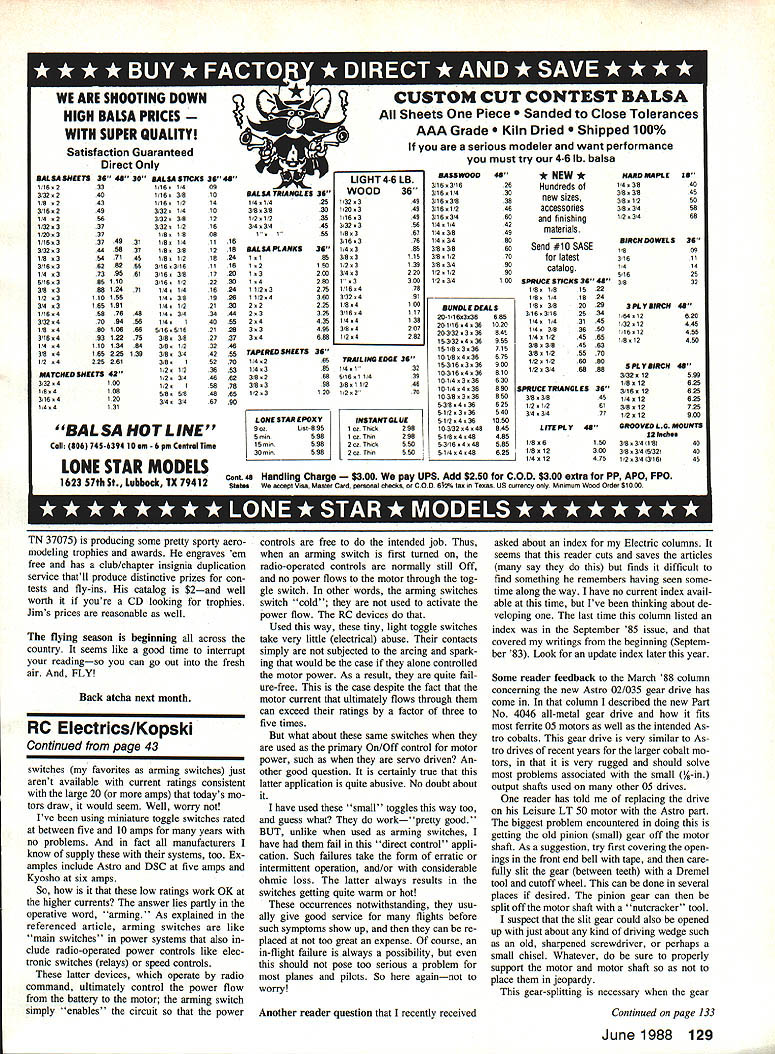
- The Astro No. 4046 all‑metal gear drive fits most ferrite .05 motors and the intended Astros. It is similar to Astro's drive for larger cobalt motors and uses the same size output shaft and small (4‑mm) output shafts used on many other OS drives.
- Replacement tips (Leisure LT 50 to Astro 4046):
- Biggest problem: removing the old pinion gear from the motor shaft. Suggested methods:
- Heat the open bell with a small torch to loosen the gear.
- Use a small gear puller if possible.
- If pressed well on and close to the end bell so a puller cannot engage, slit the gear between teeth with a Dremel tool and cut off the wheel in several places as needed, then pry the pinion off.
- Support the motor and shaft properly to avoid damage. Tape the end bell to prevent motor magnets from attracting metal particles from grinding.
- Installing the new Astro pinion: press it into place carefully with a drill press or other press. Do NOT hammer on the motor, shaft, or gear.
- Shimming:
- A shim is usually needed between the motor front-end bell and the back surface of the gear drive housing to properly space and engage the gears. Typical thickness: about 1/64" to 1/32", depending on motor and gear placement.
- Use noncompressible material such as sheet aluminum, modeling plywood, cardboard (e.g., back of a tablet), or a thin stack of index cards. Cut the shim to fully back up the space between the drive housing and the front end bell.
- Do NOT cut the bell in two or rely on flat washers on the mounting screws — those methods do not provide satisfactory support.
- Motors run with the 4046 include several Kyoshos, the DSC, the Great Planes Thrustmaster, and an old Astro "can" motor. Notes:
- The DSC is timed to run best clockwise (CW), making it a good match for reversing gear drives like the 4046.
- The Thrustmaster is timed close to neutral and runs about equally well CW or CCW.
- Both DSC and Thrustmaster have fixed timing (not easily adjustable).
- Later columns will include bench-run performance information for various motors and props with the Astro 4046.
Closing
Please forward any comments or questions (with SASE) to the address at the top of this column.
Happy, silent, electric landings, everyone!
Transcribed from original scans by AI. Minor OCR errors may remain.

