
Radio Control: Electrics
Bob Kopski 25 West End Dr, Lansdale, PA 19446
Electric Meets
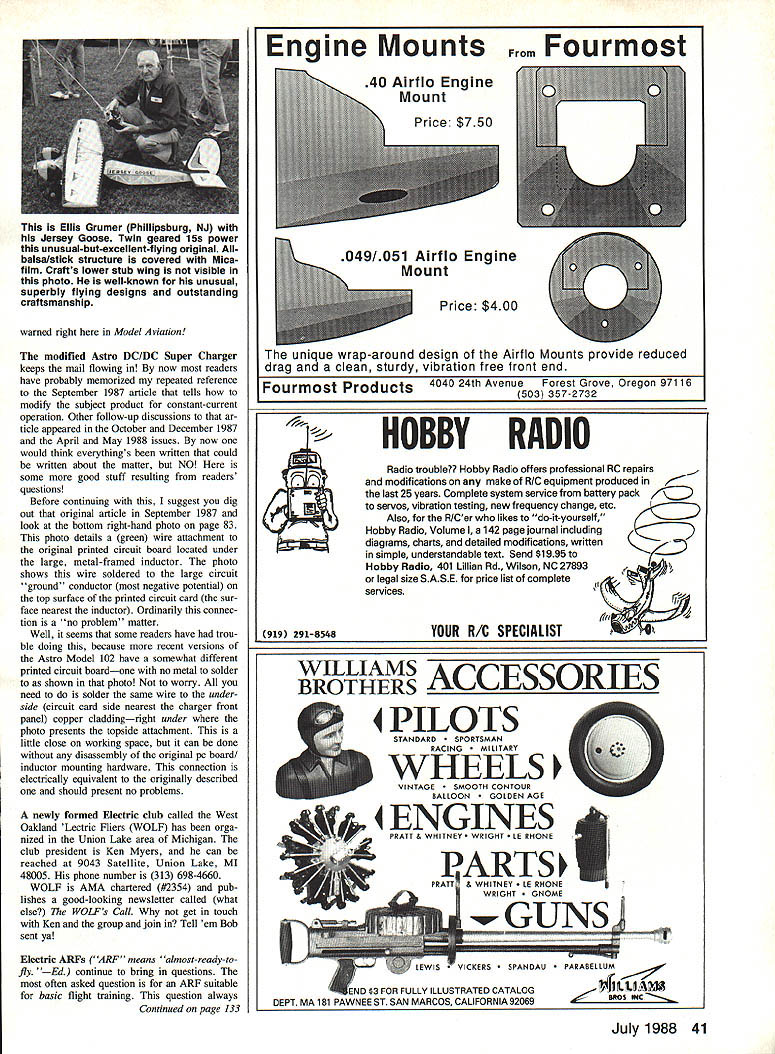
- First Annual Lehigh Valley Radio Control Electric Fun-Fly
- When: June 18–19
- Where: Lehigh Valley club field near Easton, PA
- Info: Contact Ellis Grumer, 321 Aurora St., Phillipsburg, NJ 08865; (201) 859-0959
- Second Annual Electric Meet (near Winston-Salem, NC)
- When: August 20–21
- Format: Mostly fun-fly with prizes for longest flight and an all-up, last-down event
- Info: Contact Dr. John Mountjoy, 1420 Plaza Dr., Winston-Salem, NC 27103
(Note: Both Ellis Grumer and Dr. John Mountjoy are regulars at the KRC meet and good sources for meet details.)
Astro DC/DC Super Charger (modified) — follow-up
- Many readers have written about the September 1987 article describing how to modify the Astro Model 102 for constant-current operation. Follow-ups appeared in Oct. and Dec. 1987 and Apr. and May 1988.
- A soldering tip: newer Astro Model 102 printed circuit boards may lack the topside metal area shown in the original photo (bottom right, p. 83 of Sep. 1987). If so, solder the (green) wire to the underside copper cladding on the circuit card directly under the original topside location. This is electrically equivalent and can be done without disassembling the PC board/inductor mounting hardware.
New Club: West Oakland Electric Fliers (WOLF)
- Location: Union Lake area, Michigan
- President: Ken Myers, 9043 Satellite, Union Lake, MI 48005; (313) 698-4660
- AMA charter: #2354
- Newsletter: "The WOLF's Call"
- Note: If you're local, consider getting in touch and joining.
Electric ARFs and Trainer Recommendations
- Common question: Is there an Electric ARF suitable for basic flight training?
- My view: There are no good Electric ARFs suitable for basic flight training for people with no prior RC experience.
- Manufacturers: Please design a proper trainer instead of lightweight, underpowered kits that give Electric a bad name.
- Personal recommendations:
- Leisure Amptique — my steadfast recommendation for first-time or general Electric flight (not an ARF).
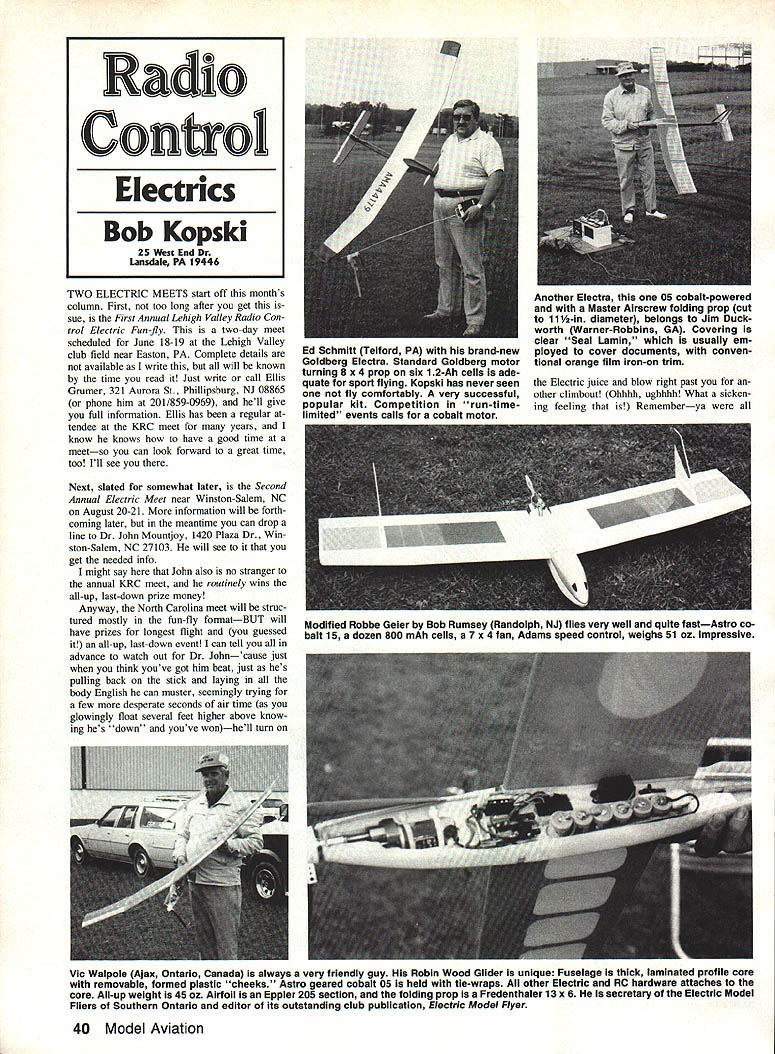
- Goldberg Electra — an excellent, low-cost glider configuration and the first truly successful complete Electric kit; it proved the market by packaging a suitable motor, wiring, and prop with a good flying design.
Rainy-day Anecdote: Caliph and Jomar SC-4
- On March 22, 1987, during drizzle, my new Caliph experienced erratic motor RPM and then the motor went full on until the battery depleted.
- Cause: A fine layer of water on the Jomar SC-4 speed control (ingested through air intakes) caused the malfunction.
- Fix: Careful "blow-drying" (not too hot) with a MonoKote gun restored normal operation. Lesson: moisture can cause unexpected speed-control behavior.
Larger Power Systems and "15" Motors
- Discussion continuation from Apr./May 1988 on moving beyond the "05" class.
- The "15" motor is an excellent choice for systems above about seven cells:
- Versatile, relatively low cost among larger systems.
- Especially the cobalt "15" is attractive because of its lighter weight.
- I have bench data on multiple Cobalt "15" samples (six Cobalts plus data on other "15s"), giving a useful performance comparison across samples.
Data Tables (descriptions)
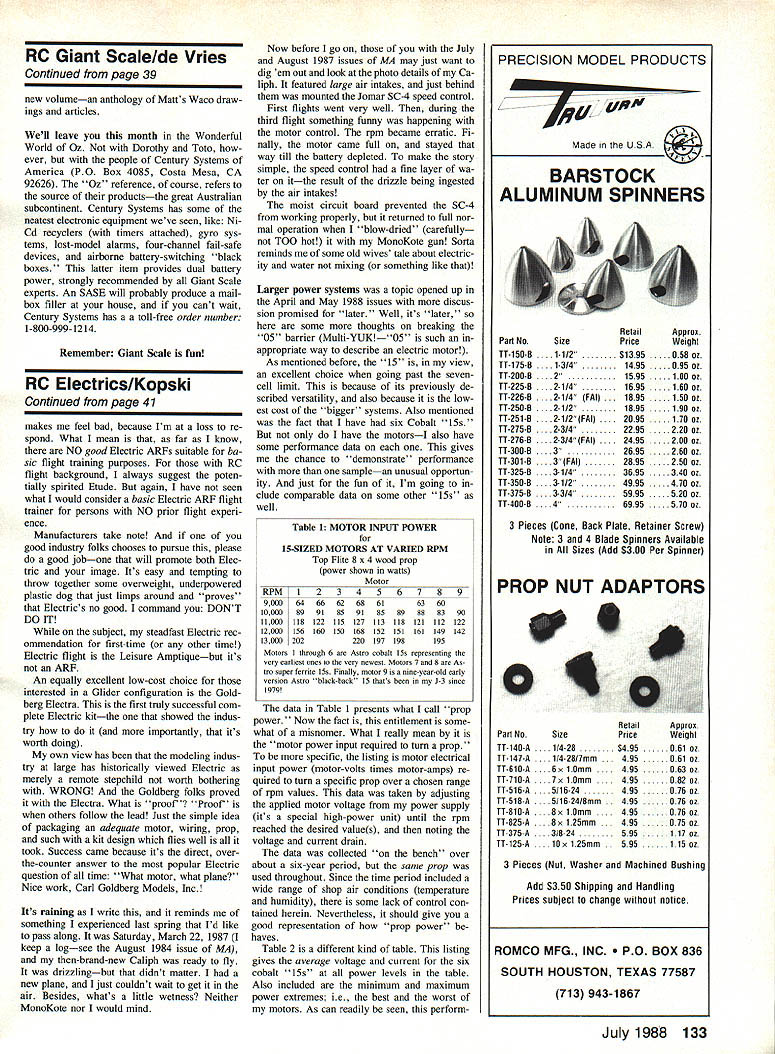
- Table 1: Motor Input Power for 15-Sized Motors at Varied RPM
- Test prop: Top Flite 8x4 wood prop
- Data: Motor electrical input power (watts) required to turn the prop at various RPMs. Power was measured by adjusting applied voltage on a high-power bench supply until desired RPM was reached, then recording voltage and current.
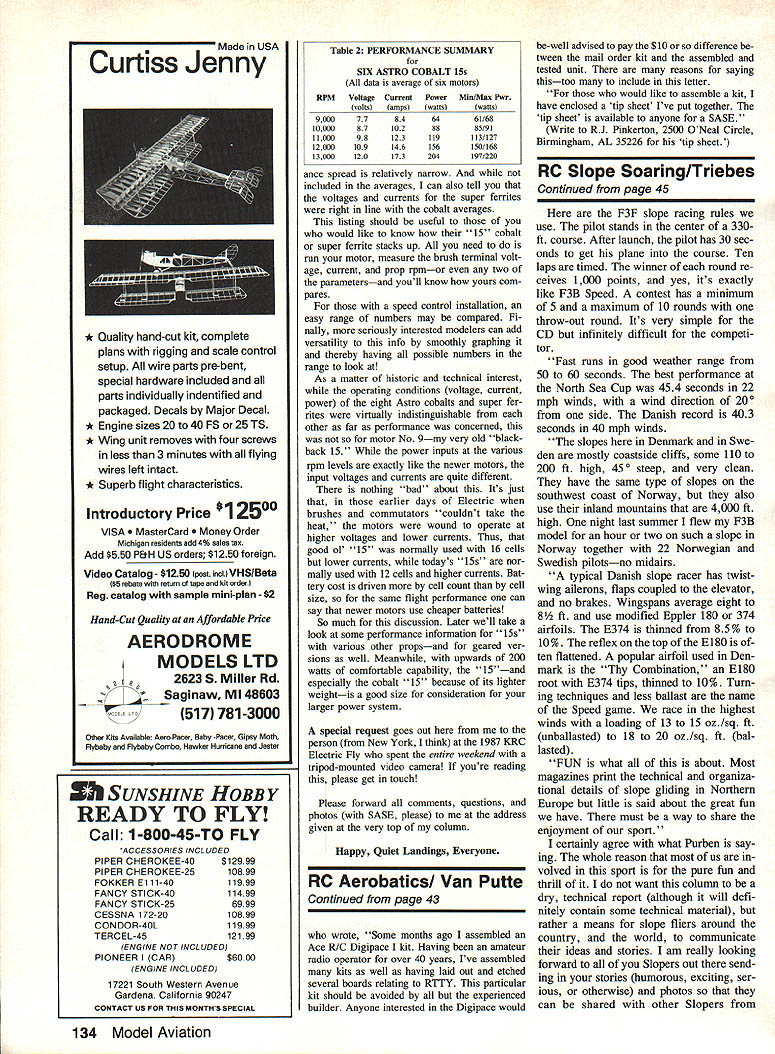
- Table 2: Average voltages and currents for six Cobalt "15s" at all power levels in Table 1
- Includes minimum and maximum extremes to show performance spread (relatively narrow).
- The super ferrites measured were in line with the cobalt averages.
Notes on the data and motor history:
- Data were collected on the bench over about six years using the same prop; shop temperature and humidity varied, so expect some variability.
- One older "black-back" 15 differs electrically: earlier motors were wound for higher voltages and lower currents (e.g., wired for 16 cells), whereas modern "15s" run at lower voltages and higher currents (e.g., 12 cells). This reflects changes in brush/commutator technology and battery cost structure.
Future topics: performance of "15s" with various other props and geared versions.
Reader Request and Contact
- A reader (from New York, I think) who spent the entire 1987 KRC Electric Fly with a tripod-mounted video camera — please get in touch.
- Send comments, questions, and photos (with SASE please) to:
Bob Kopski, 25 West End Dr, Lansdale, PA 19446
Happy, quiet landings, everyone.
Transcribed from original scans by AI. Minor OCR errors may remain.

