
Radio Control: Electrics
Bob Kopski 25 West End Dr. Lansdale, PA 19446
Announcements
- The Second Annual Dallas Electric Aircraft Fliers (DEAF) Electric Fun-Fly is scheduled for Saturday, October 1, 1988.
- Flying times: 9:00 a.m. to 5:00 p.m.
- Location: Eastfield College, Mesquite, TX.
- For complete information contact Frank Korman, 5834 Goodwin, Dallas, TX 75206; telephone (214) 821-0390.
Event reports
First Annual Lehigh Valley (PA) RC Club Electric Fun-Fly
Last weekend’s First Annual Lehigh Valley RC Club Electric Fun-Fly was an impressive success. Saturday saw the largest participation, with beautiful weather and a very nice field. During an afternoon lineup I counted 41 planes (with several more near cars). Many attendees came from surrounding states and everyone had a great time.
The meet was run in a fun-fly format with scattered simple events over both days, such as:
- “Most loops” in one minute
- A taxi event
- Timed events
Events were staged without shutting down the field so nonparticipants could continue flying. Sunday—Father’s Day—had lower attendance but still good weather. The positive reaction to this first-time meet will almost certainly bring another next year.
A notable story from the meet: several participants had unexpected difficulty getting their planes to take off from an otherwise excellent field. Planes that had always ROG’d (rise off ground) previously required hand launches. The cause: LVRC had planted high-quality grass seed and the young turf seemed to grab and hang on to wheels. Lesson: newer, thicker grass can require more power for ROG than you might expect.
Photos and follow-up
I’ll have photos and more details in a future column (some pix are still being developed). The next column will appear in the December issue.
Amptique derivatives
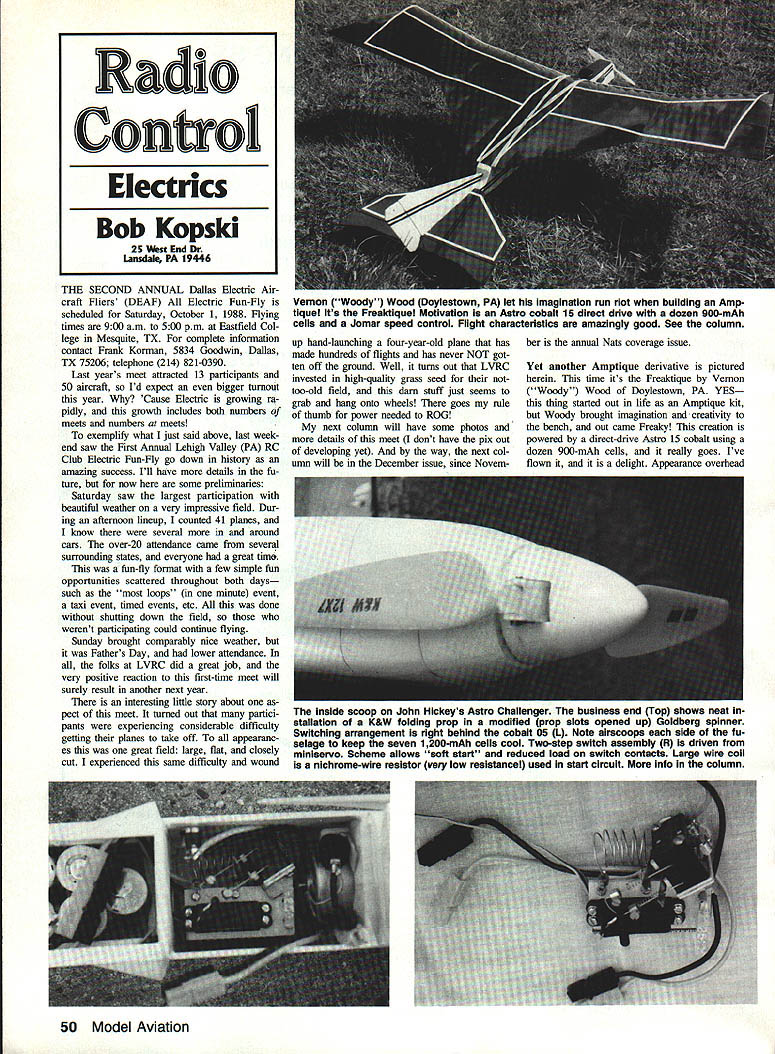
Freaktique
Another Amptique derivative appears this month: the “Freaktique,” built by Vernon “Woody” Wood of Doylestown, PA. Although it started as an Amptique kit, Woody personalized it heavily. Key details:
- Power: direct-drive Astro .15 Cobalt
- Battery: twelve 900-mAh cells
- Speed control: Jomar
Flight characteristics are excellent — I’ve flown it and it’s a delight. The Amptique kit is a great starting point for customization. Send photos and descriptions of your Amptique-based builds; I’ll try to feature them in the column. If we get enough, we might run a reader vote for best (or worst).
Challenge mini-sequence and installations
“Mini-sequence” concept
A “mini-sequence” is multi-issue coverage of a particular item or topic (examples: Caliph, Amptique, competition rules, larger power systems). This month continues coverage of the Challenge mini-sequence.
John Hickey’s Astro Challenger installation
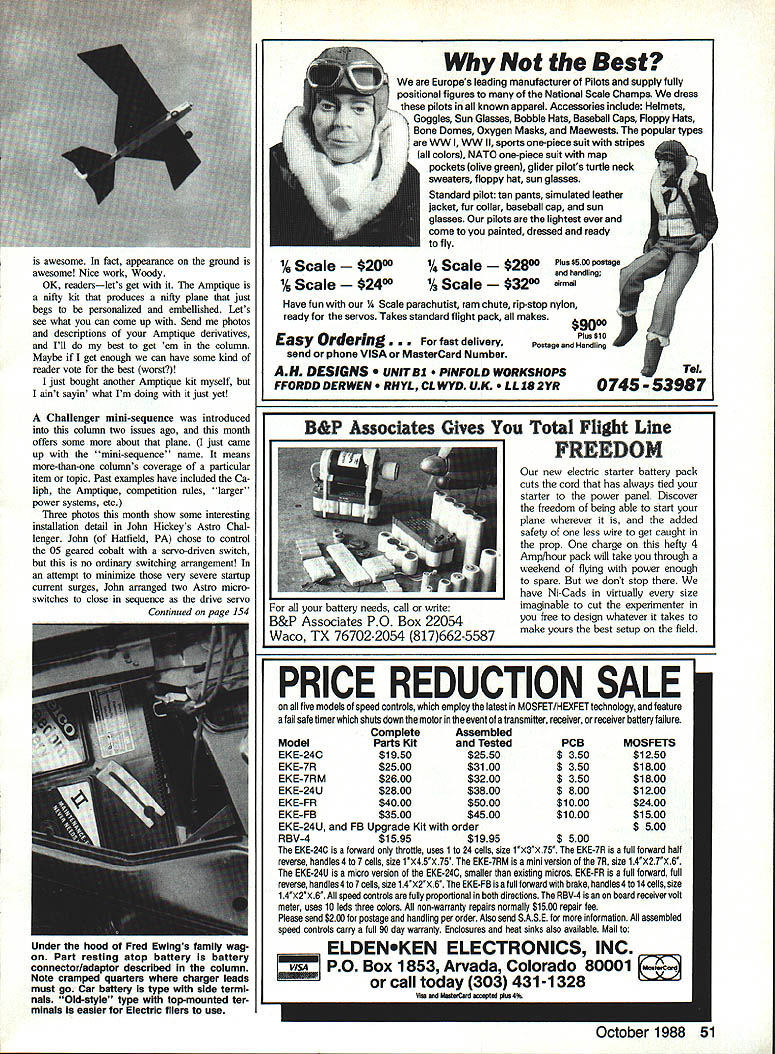
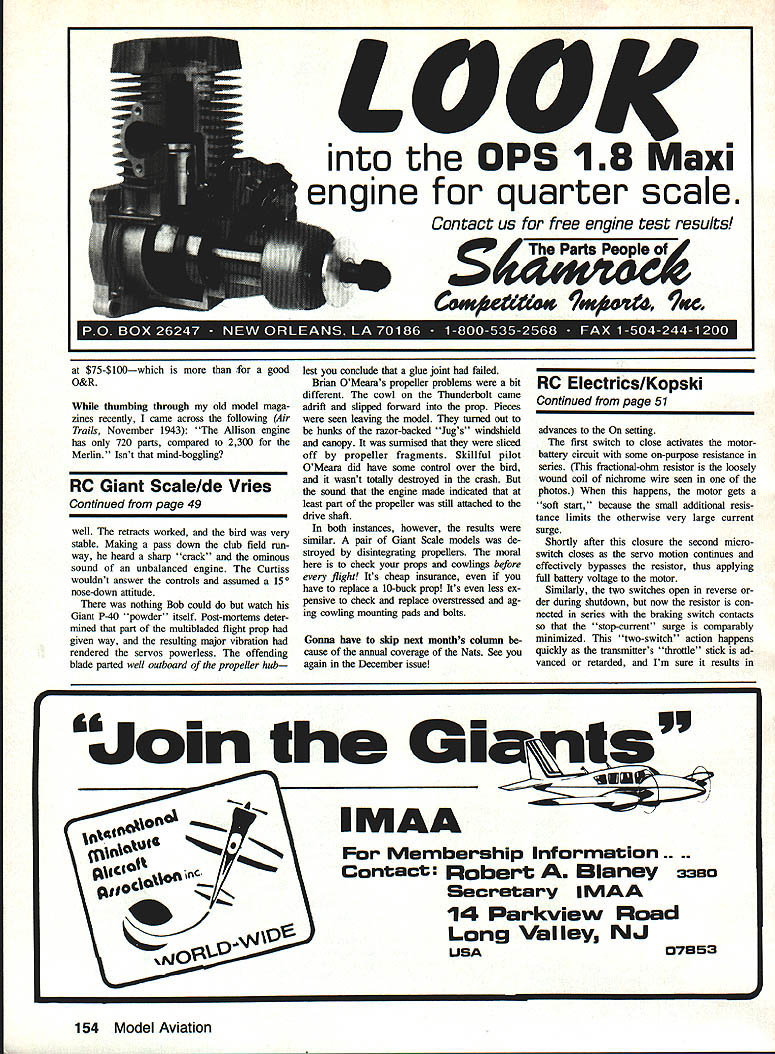
John Hickey (Hatfield, PA) controls a geared .05 Cobalt in his Astro Challenger with a servo-driven switching arrangement designed to reduce severe startup current surges. The installation uses two microswitches that close in sequence as the drive servo moves:
- The first switch closes and connects the motor-battery circuit with intentional resistance in series (a loosely wound coil of nichrome wire used as a friction-wound resistor). This gives the motor a “soft start” by limiting inrush current.
- Shortly after, the second microswitch closes and bypasses the resistor, applying full battery voltage.
On shutdown the switches open in reverse order; the resistor is placed in series with the braking contacts to reduce the stop-current surge. This two-switch action is quick as the transmitter throttle stick is moved and reduces stress on switch contacts and the battery.
Motor starting and braking currents
What is the stop-current surge?
Permanent-magnet motors used in model electrics act as generators when externally rotated. When power is removed, the spinning armature generates voltage and continues to produce current until it slows. Applying a short circuit or low resistance to the motor terminals immediately after switching off (i.e., braking) places an electrical load on the motor-as-generator and rapidly slows it.
The kinetic energy of the spinning armature is converted to electrical energy as a large, short-duration current that flows through armature windings, wiring, external resistors, and switch contacts. Thus, the surge experienced when braking can be about the same magnitude as the starting inrush surge. The two-switch soft-start/soft-stop arrangement described above helps minimize both types of surge and reduces contact wear.
Charging from a freewheeling prop?
Please don’t write asking whether you can recharge the motor battery from the prop during glide. The answer is no. A model prop turning in the slipstream simply can’t produce the current/power required to meaningfully charge a battery — it’s a gross mismatch of task and tool.
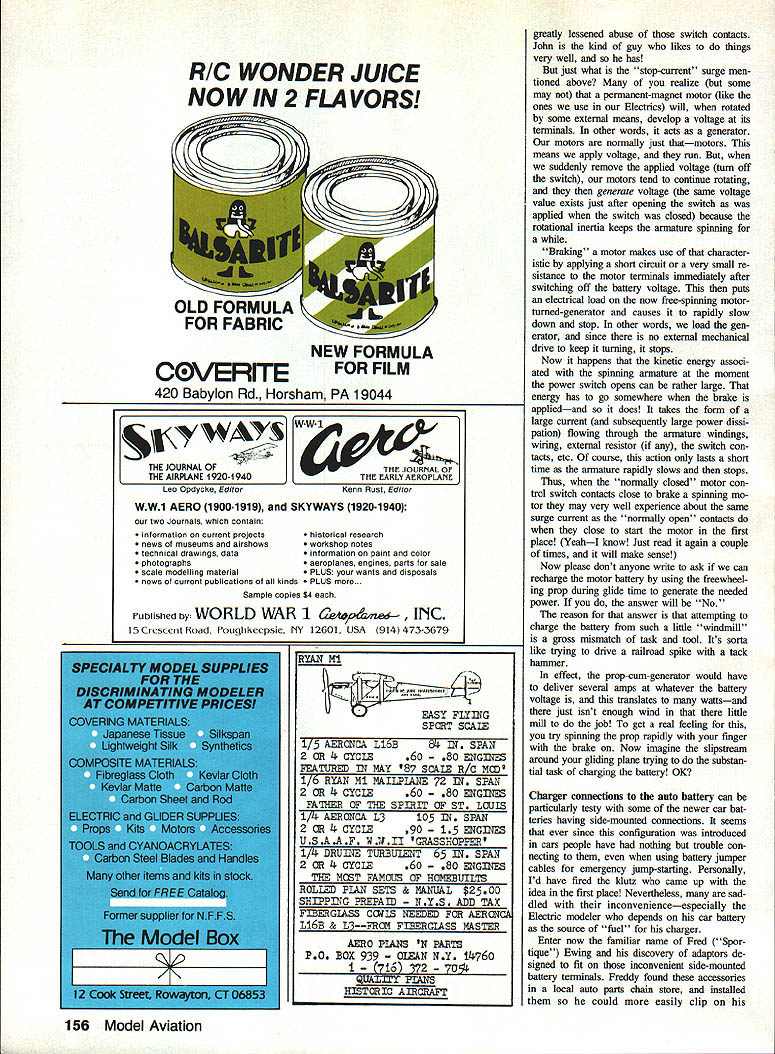
Charging adaptors and car clamps
A photo in this month’s material shows a charging adaptor. There are multiple adaptor types on the market; one common form is the “side-terminal charging clamp.” Shop at auto parts stores to find what best suits your car. A strong caution:
- Be very careful not to short the car’s hot battery terminal to the vehicle’s metalwork while working in cramped engine bays. Most cars are negative-ground; shorting the positive terminal will produce a dramatic demonstration of the energy in a fully charged car battery.
Gas vs Electric — fields and noise
Electric flying is growing and often begins to dominate flight lines at local fields. While most Electric and Gas fliers are friendly, the noise from glow or gas engines can be a community problem and can threaten field access. I flew glow/gas for many years, but now the noise sometimes bothers me on the flight line; I can understand neighborhood concerns.
Unnecessary loss of flying fields hurts the hobby. Electrics offer a viable alternative where noise is an issue. Don’t let anyone convince you that Electric isn’t good enough; if the alternative is “not flying at all,” consider the electric option.
A small anecdote: I recently replaced a 10-year-old lawn mower with a much quieter new model. If mowers can be made quieter, why not model engines? Better mufflers and quieter engines would help preserve fields.
Batteries — Sanyo “extra” cells
The Sanyo “extra” cells I mentioned previously have finally reached the hobby. These 1,700-mAh cells are the size and weight of 1,200-mAh cells. Preliminary reports suggest they are better suited to lower-current applications rather than the very highest-current demands. I have some on hand but haven’t had time to fully test them; I’ll report more later.
Contact and closing notes
Please forward comments or questions (with a stamped, self-addressed envelope) to the author at the address at the top of this column.
P.S. I’m in my sixteenth year of flying electric and there is one nagging nomenclature item that keeps bothering me: what on Earth (or in the air) is an “OHFIVE”? It sounds like something E.T. would say. Getting rid of such nonsensical nomenclature is long overdue — there are alternatives (see my column in the April 1987 issue of Model Aviation).
Transcribed from original scans by AI. Minor OCR errors may remain.

