
Radio Control: Electrics
Bob Kopski 25 West End Dr. Lansdale, PA 19446
This is the annual "tough column," because it follows the November Nats issue which has no column. Thus I've had two months to accumulate things to write about, and there is more to offer than can fit into one column. I have to pick and choose what I think is best to include for now.
Meets
Announcements
There are a steadily growing number of Electric meets throughout the country, which further supports the ongoing growth of Electrics in general. I am always anxious to support your meets, especially with announcements in this column. But you must get me the information three to four months ahead of the planned date (the earlier the better), because then more people have time to plan. I've missed promoting several meets this year because the info arrived too late. To bring this into focus: I'm writing this December-dated column in late August.
Recent / Past meets
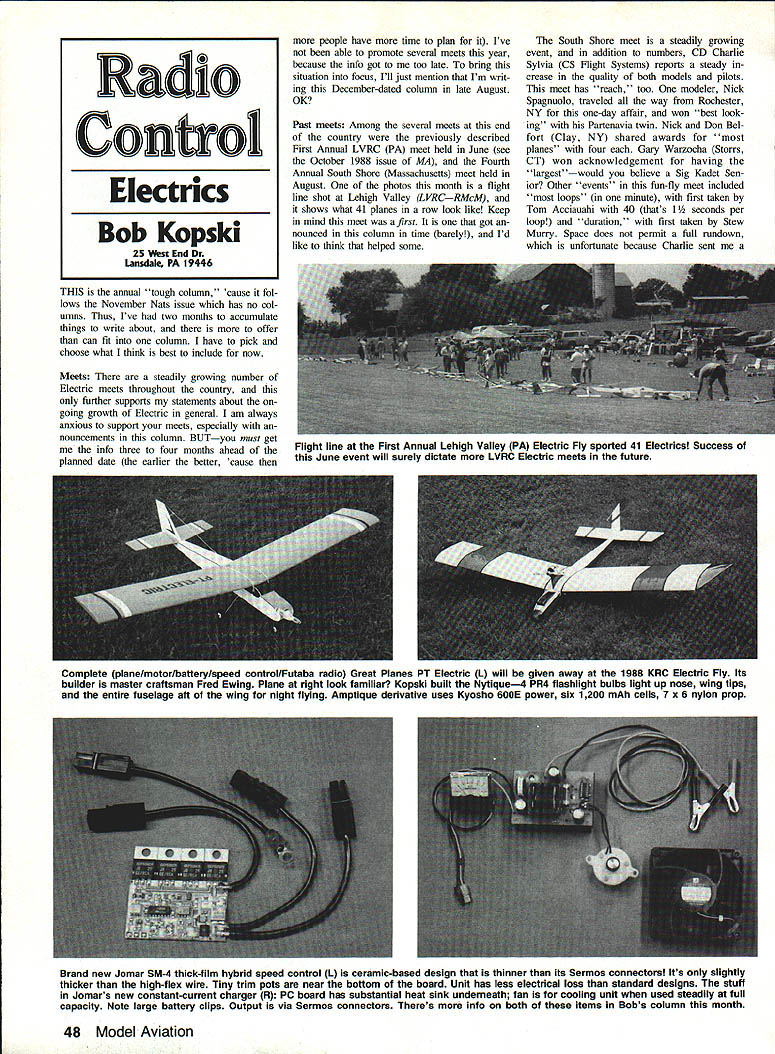
- First Annual LVRC (Lehigh Valley, PA) Electric meet was held in June. A flight-line photo from that meet shows what 41 planes in a row look like — an impressive turnout for a first event.
- Fourth Annual South Shore (MA) meet was held in August. CD Charlie Sylvia (CS Flight Systems) reports steady increases in both the number and quality of models and pilots.
Notable South Shore highlights:
- Best Looking: Nick Spagnuolo (Rochester, NY) — Partenavia twin (traveled a long way for the one-day event).
- Most Planes: Nick Spagnuolo and Don Belfort (Clay, NY) — four each.
- Largest Model: Gary Warzocha (Storrs, CT) — Sig Kadet Senior.
- Most Loops (one minute): Tom Acciachi — 40 loops (about 1.5 seconds per loop).
- Duration: Stew Murry.
Charlie sent a very nice write-up with many more details (plane, motor, battery, speed control, radio), but space does not permit a full rundown here.
I’m not surprised at the growth in quality and size of planes at South Shore — I see the same trend at KRC every year. We’re well past the point where Electrics are dubious performers. Folks now routinely undertake major scale projects, including multimotor and very large models, with full confidence that they will fly well. Anyone still thinking “Electric is for gliders” is behind the times — Electric is for gliders and for everything else.
If you sent meet news and didn’t see it here, thanks for the items and don’t be discouraged. Coverage matters. If you want more space for Electric coverage, write the publisher and tell him Electric — modeldom’s brightest hope for the future — needs more space each month!
Follow-up: Old-Timer rules proposals and reader response
In the August 1988 issue I described some Old-Timer rules proposals sent by a West Coast reader and invited input. I received two responses:
- A West Coast Old-Timer pilot wrote at length, lamenting how the strange proposals came about and saying they were basically an industry-driven compromise — not very good rules.
- A Midwest reader indicated a liking for the proposals.
So the responses ran right down the middle. I still think it’s silly to dictate armature volume of a motor, and no one is going to convince me otherwise.
That same August issue raised the subject of the “disappearing” Electric columns in popular model magazines. Many readers responded, most suggesting there weren’t qualified authors willing to write monthly. I find that hard to accept given the growth and knowledge in Electrics. Regardless, I’m happy to report that two magazines have reinstated Electric columns.
Glider wing center sections — follow-up and anecdote
The August column included photos and commentary about beefing up wing center sections and rubber-banding wings to the fuselage instead of using screw attachments. That touched a nerve — many readers said they wished they had done the same.
A few points:
- Many modern gliders use thinner, semi-symmetrical airfoils (e.g., 205 or 192). These sections can fly relatively fast but often result in not-so-deep spars, making wings easier to fold.
- Knowing this, I had the option to reinforce the center section of my Challenger wing (as shown in the August photos). The philosophy is described in my April 1984 "All About Electrics" installment No. 8 and the November 1984 Spectra construction article. One reader told me he went back to those references after his new wing folded.
- Does the technique work? Yes. About a month ago a friend was flying my Challenger and it experienced an obvious control failure (stuck full up and full left). The plane wrenched itself hard but the center section held; the rudder struck and incurred only minor damage. It was flying again the next day. I’m sold on the extra effort to beef up glider center sections. Check the references and consider reinforcing yours.
Night flying, Amptique/Nytique and prop notes
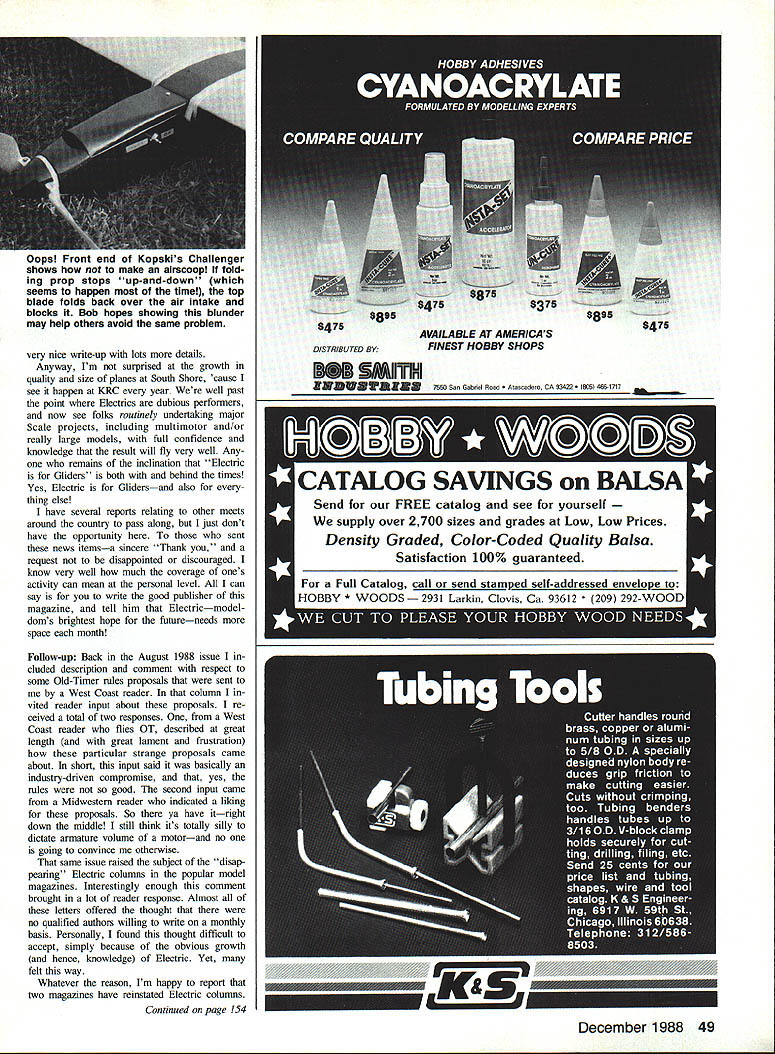
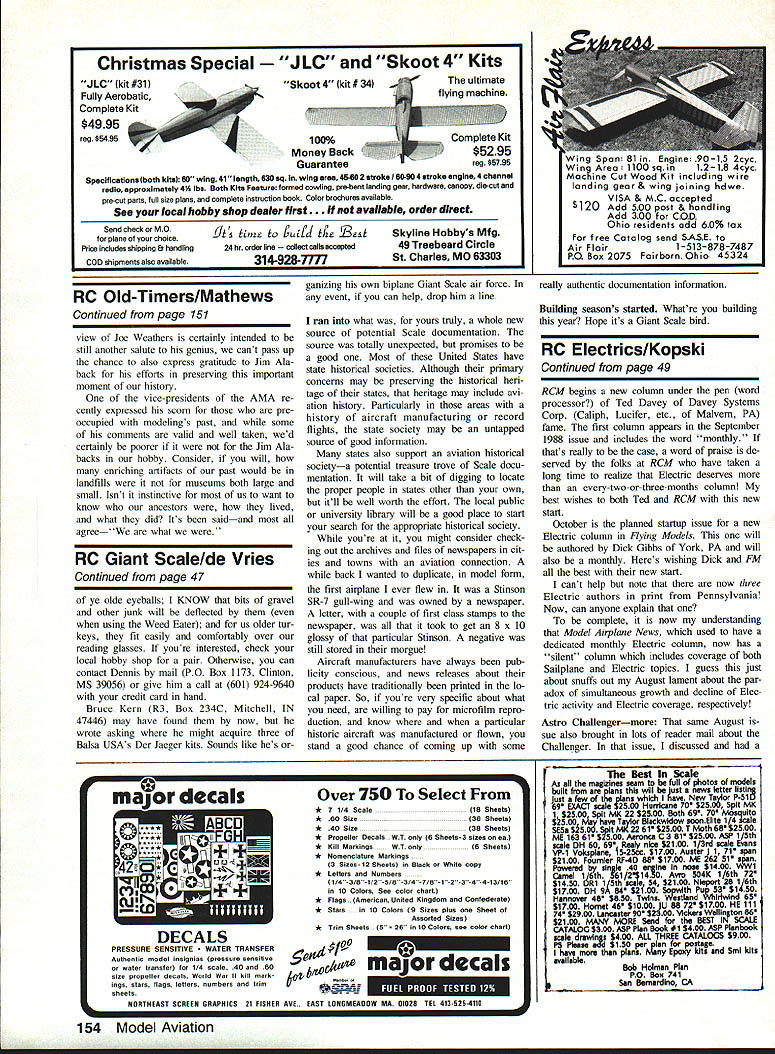
- The Leisure Amptique lineage continues: I built a Nytique, a fully illuminated night flier. As of this writing it’s two days old with three flights — it flies great and carries Amptique blood. I did a lot of night flying about ten years ago and had many difficulties with motors on pods; I think I’ve solved many of those problems and look forward to more night flying. I may do a how-to article in the future.
- One caution: folding props can stop with blades vertical, blocking the air scoop about half the time. That can kill performance and looks dumb — so heed this warning and avoid that arrangement where possible.
- Power pack experience: I've used both seven 800‑mAh cells and seven 1,225‑mAh cells on several .05 Cobalt setups. My folder has been the K&B 13 x 7; others locally use 12 x 7 and most run 800‑mAh packs. One local flyer runs a Cobalt .05 with direct drive to an 8 x 4. I plan to try a 15‑system in the future. Most people here fly for sport and total air time rather than maximum altitude on a limited motor run.
Prize note: A Great Planes PT Electric II will be given away at the 1988 KRC Electric Fly. The builder is master craftsman Fred Ewing.
New products
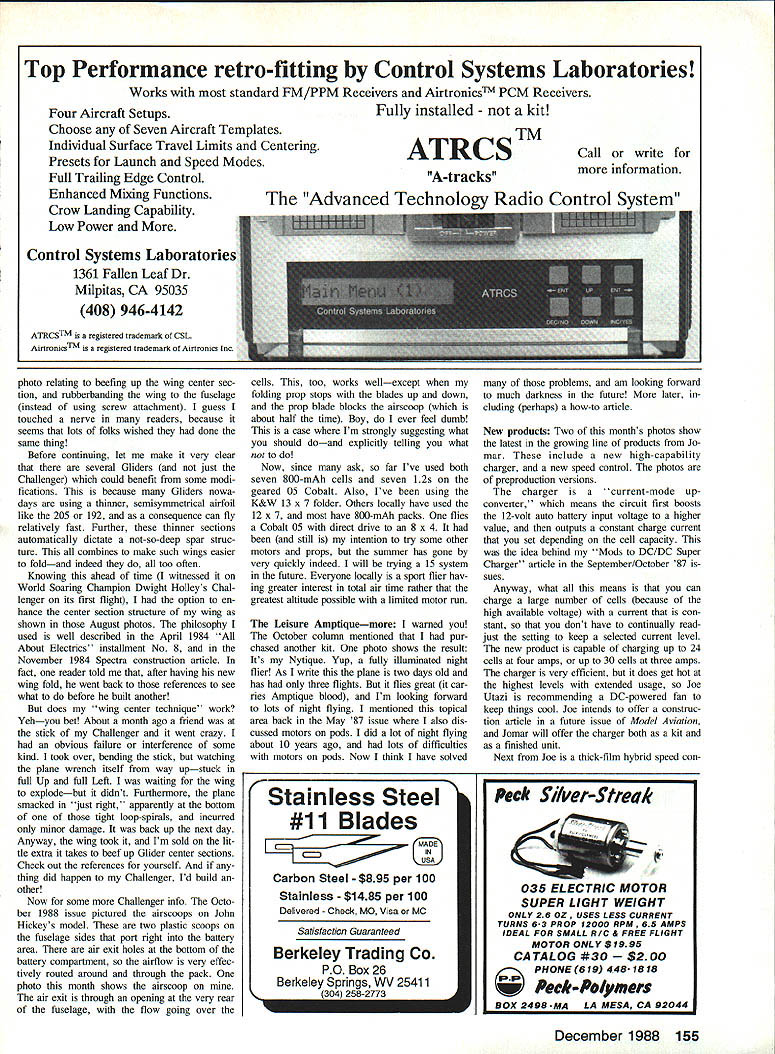
Two new items from Jomar:
- Jomar current‑mode up‑converter charger
- Boosts 12 V auto battery input to a higher charge voltage and outputs a user‑set constant charge current.
- Can charge up to 24 cells at 4 A or up to 30 cells at 3 A.
- Very efficient but gets hot at high sustained output; Jomar recommends DC fan cooling.
- Joe Utzai recommends a fan and plans to offer a constructed charger kit in a future issue of Model Aviation. Jomar will offer the charger board as a kit and as a finished unit.
- The PC board version shows a substantial heat sink underneath, large battery clips, and output via Sermos connectors.
- Jomar SM‑4 thick‑film hybrid speed control
- A ceramic‑based, physically thin design (thinner than its Sermos connectors).
- Uses slightly heavier, high‑flex wire and tiny trim pots near the bottom of the board.
- Designed for lower electrical loss than many standard designs.
There is more information and photos of both items in this month’s column.
Bob Kopski 25 West End Dr. Lansdale, PA 19446
Transcribed from original scans by AI. Minor OCR errors may remain.

