
Radio Control: Electrics
Bob Kopski 25 West End Dr. Lansdale, PA 19446
Ninth Annual KRC Electric Fly
This is the month when I happily report the happenings of the Annual KRC Electric Fly. Each year brings "more and better," and I find myself short of superlatives to describe the meet, the people attending, and the planes they bring. I have no words adequate to convey the awe and impact of the Ninth Electric Fly held September 17–18, 1988.
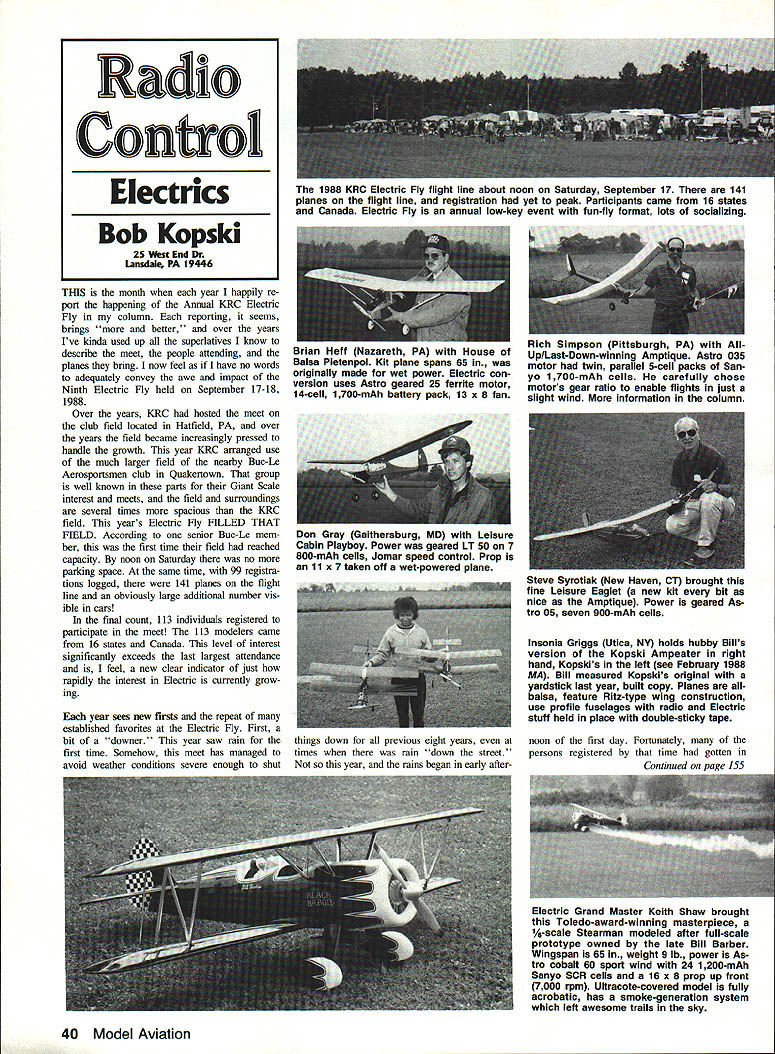
Over the years KRC hosted the meet at the club field in Hatfield, PA, but that site had become pressed to handle growth. This year KRC arranged use of the much larger Buc-Le Aerosportsmen field in Quakertown. The Buc-Le field is several times more spacious, and this year's Electric Fly filled that field. According to one senior Buc-Le member, it was the first time their field had reached capacity. By noon on Saturday there was no more parking space.
Although 99 registrations were logged early, the final count was 113 individuals registered to participate. The 113 modelers came from 16 states and Canada. At one point there were 141 planes on the flight line and many more visible in cars. This level of interest significantly exceeds prior attendance and clearly indicates how rapidly electric interest is growing.
Weather and interference
For the first time in nine years the meet saw rain. Rains began in early afternoon on Saturday. There was also a peculiar condition Saturday morning: an unusually large number of models experienced severe glitching, and many electrics incurred damage. In one instance three airborne ships crashed essentially simultaneously. We suspect interference from high-power communications equipment responding to a nearby fire at a manufacturing plant about 10 miles away.
Sunday started chilly with some breeze but warmed as the day progressed. There was continuous flying all day Sunday, beginning around 7:00 a.m.—two hours before the scheduled opening.
Highlights
- First successful electric ducted-fan model, a design by regular attendee Bob Rumsey (photo sequence to appear next issue).
- Keith Shaw’s magnificent, smoke-generating, half-scale Stearman performed an awesome acrobatic routine in memory of the late Bill Barber.
- Repeat and expanded success of electric helicopters—Bill Miller flew an onboard-powered Baron 30 MK with an Astro .25 cobalt motor in dramatic performances.
- This was the first year KRC presented the Electric Fly with free registration (Ed Bruce Fenstermacher offered free entry).
- The All-Up/Last-Down event was won by clever use of battery capacity and gear arrangement (see details below).
- The raffle featured its largest top prize to date—a completed, test-flown Great Planes PT Electric with two interchangeable packs of seven Sanyo 2.1–2.0 Ah cells.
Notable Aircraft and Pilots
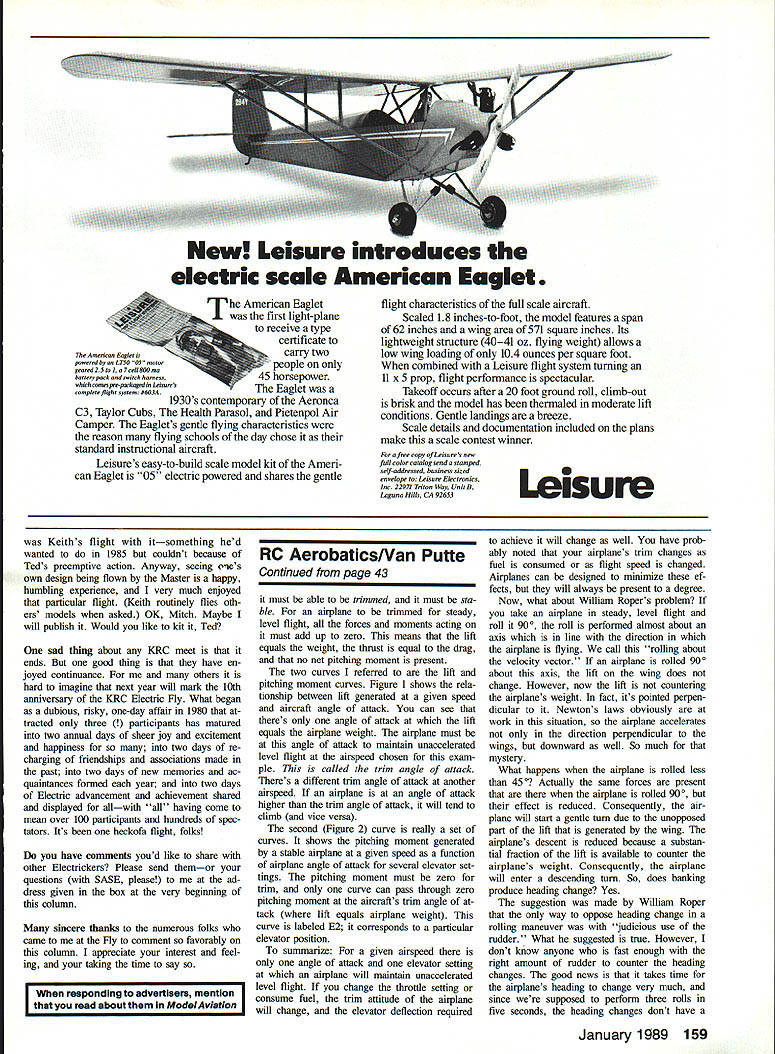
- Steve Syrotiak, New Haven, CT — Leisure Eaglet (new kit). Powered by an Amptique drive: geared Astro .05 with seven 900‑mAh Sanyo cells.
- Insonia Griggs, Utica, NY — flies her husband Bill’s version of the same design.
- Keith Shaw (Electric Grand Master) — Toledo-award-winning half-scale Stearman modeled after the full-scale prototype owned by the late Bill Barber. Wingspan 65 in., weight 9 lb. Power: Astro Cobalt 60 (Sport Wing 24), 1,200‑mAh Sanyo SCR cells, 16 × 8 prop up front, ~7,000 rpm. Ultracote-covered, fully acrobatic, with a smoke-generation system.
- Rich Simpson, Pittsburgh, PA and Brian Heff, Nazareth, PA — Brian’s Amptique/Astro .035 balsa Pietenpol kit spans 65 in. He employed clever battery/motor choices (see All-Up/Last-Down entry). Rich’s conversions and setups attracted a lot of attention.
- Don Gray, Gaithersburg, MD — Leisure Cabin Playboy powered with a geared LT-50, seven 800‑mAh cells, Jomar speed control, 11 × 7 prop (taken from a wet-powered plane).
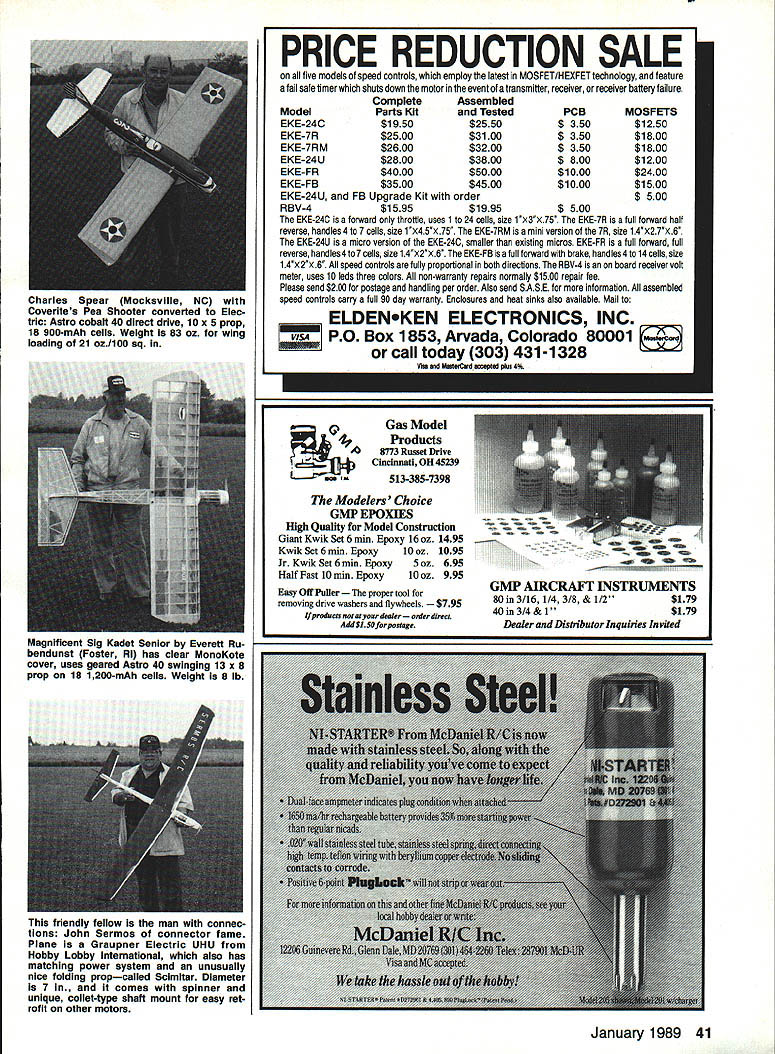
- Charles Spear, Mocksville, NC — converted Coverite’s Pea Shooter to electric with an Astro Cobalt 40 direct drive, 10 × 5 prop and 18 × 900‑mAh cells. Weight 83 oz.; wing loading 21 oz./100 sq. in.
- John Sermos (of connector fame) — Graupner Electric UHU (Hobby Lobby International) with matching power system and a 7 in. “Scimitar” folding prop, spinner, and a unique collet-type shaft mount for retrofit.
- Bob Rumsey — electric ducted-fan first successful demo (photos forthcoming).
- Bill Miller (KRC) — repeated, dazzling helicopter performances with onboard power (Astro .25 cobalt-equipped Baron 30 MK).
Incidents
- Severe glitching (likely RF interference) damaged several models on Saturday morning; three airborne models crashed nearly simultaneously.
- Despite rain and some Saturday interruptions, there was substantial flying on Sunday for those who registered in time.
All-Up/Last-Down
The All-Up/Last-Down event was won by Rich Simpson of Pittsburgh, claiming the $50 cash prize despite less favorable soaring air. Rich’s trick: an Amptique model equipped with an Astro Cobalt .035 driving a Kyosho gearbox and a glued spinner, energized by two five-cell packs of Sanyo 1,700‑mAh SCE cells charged separately but flown in parallel—effectively 3,400 mAh on board. He simply flew away from the other 11 pilots who launched simultaneously.
Second place went to Dr. John Mountjoy of Winston-Salem, NC, long known as a frequent winner; he congratulated Rich in good spirit.
The All-Up/Last-Down idea was borrowed by KRC from Roland Boucher of Leisure, and the Amptique kit is produced by Leisure.
Raffle
The raffle introduced a new scope of top prizes:
- Top prize: completed, test-flown Great Planes PT Electric (photographically documented), including a Futaba radio, Jomar SCS speed control, and two interchangeable packs of seven Sanyo 2.1–2.0 Ah cells. Mel Hall (Skippack, PA) held the first winning ticket and took the PT home.
- Second prize: four-channel Futaba radio.
- Other prizes: Nitro Cobra .02 and .035 gear-drive systems, a Jim Glascraft Songbird, and a Carl Goldberg Sophisticat Lady plus power pod.
Many attendees wanted to buy the battery packs outright; it was a very generous raffle—more like an auction.
Survey Results
A short questionnaire was completed by 74 registrants (out of 113). Assuming these returns are representative, highlights include:
- Of 72 answers, 24 were first-time participants (exactly 1/3).
- On average, respondents had attended 2.97 KRC meets.
- Based on 71 answers, shortest distance traveled was about 12 miles, longest about 1,100 miles, average 252 miles. At that average, the 113 participants traveled approximately 28,476 miles in total—more than once around the world.
- Of 64 answers, each participant brought an average of 1.98 planes. That suggests about 113 × 1.98 ≈ 224 planes at the meet.
- Motor usage (from 74 respondents): a number reported .02 motors; 19 used .035s; 58 used .05s; 3 used .075s; 3 used .10s; 31 used .15s; 21 used .25s; 14 used .40s; and 5 used .60s. A few listed less familiar motors (Kelsner 50/24, Keller 25/12, Ungar 24, etc.).
- Attendees indicated roughly equal use of direct drive and reduced drive.
- Of 67 answers, about 67% of electric fliers also fly gas power, 15% have never used gas, and 18% previously used gas but have stopped.
- Of 65 varied responses, reasons for liking electric included: 40 cited quietness, 36 cited cleanliness, 11 cited ease/convenience/safety, 8 cited higher technology or challenge. Others said they like it for fun or because “it’s the greatest.” Rich Simpson facetiously said, “Because I’m too heavily invested to get out!”
Personal Note: The Exciter
Several years ago I built a large aerobatic plane named the Exciter, only to have it ravaged and trashed at the 1985 Electric Fly in a brutal midair assault by my then-good friend Ted Davey of DSC with his newly kitted Le Crate. The combination shredded my model, which was then further damaged on large steel-laden truck tires.
Fortunately, real friends exist. Mitch Poling of Model Builder magazine convinced me to resurrect the Exciter (see Model Builder, August 1988). About 12 days before this meet I opened the carefully stored remains, and piece by piece rejoined the airframe with CyA alchemy. In the spirit of the phoenix, the Exciter again made both appearance and flight at the Electric Fly.
Many people recognized the design and were incredulous when I told them it was (more or less) the original rebuilt. The Exciter regained much of its old form and performance, and several pilots requested demonstration flights.
Keith’s flight with the Exciter (he often flies others’ models when asked) was especially meaningful to me. Seeing one’s own design flown by the Master is a humbling, happy experience.
Thanks, Continuance, and Contact
One sad thing about any KRC meet is that it ends—but one good thing is that it continues. Next year will mark the 10th anniversary of the KRC Electric Fly. What began in 1980 as a one-day affair with only three participants has matured into two days of excitement, friendships, new memories, and electric advancement—now drawing over 100 participants and hundreds of spectators.
Do you have comments or questions you’d like to share with other electric fliers? Please send them (with SASE if you want a reply) to:
Bob Kopski 25 West End Dr. Lansdale, PA 19446
Many sincere thanks to the numerous folks who came to make the Fly and who commented favorably on this column. I appreciate your interest, feedback, and taking the time to say so.
Transcribed from original scans by AI. Minor OCR errors may remain.

