
Radio Control: Electrics
Bob Kopski
Frequent Question
I am often asked about the Leisure Playboy. It seems that many builders are not sure where the cabin version CG (center of gravity) should fall. I can tell you where mine is—my Playboy flies just great! It is 1-1/4 in. behind the main spar, which is about 4-1/4 in. from the leading edge of the wing. This comes out to about 45% of the chord. If this seems unusual to you, it's because it is—by "present-day" design; it is an Old-Timer—and it has a lifting stab—the tail carries a bigger part of the weight, hence the relatively aft CG location. Mine is so stable, so forgiving, I've handed the box to a young, totally inexperienced boy and he had a ball—with no great worries on my part. Do something nice for a boy in your neighborhood—the hobby needs youth.
While on the topic of Old-Timers, SAM 76 held an OT meet this past July in my neighborhood—just a few minutes' drive from my home, and on the grounds of my daughter's elementary school. I'm not active in OT, but I am interested, and besides, I know some of the great guys who are heavily involved. I went over to take a look around.
Contest Director Ralph Biddle persuaded me to bring out some Electrics to demonstrate. Naturally, I went back home and got the Playboy—and my Spectra. I had recently outfitted the latter with a Cobalt 15, as described below. The Playboy was highly appropriate; the Spectra should dazzle at least a few eyes, I thought.
The OT guys are very casual—always seeming to have lots of fun. I tried to "blend in" and alternately flew the two planes several times. As is normal in any group, some folks were interested, and some were busy with their own contest interests—very understandable. Here's what the experience showed me.
My Playboy fell "in between." It could easily outclimb some marginally-powered ignition models. It was absolutely no match for those with contemporary engines. Also, when the sky was "up," everything flew well, and when the sky was "down," everything came down. As far as I could see, Electric could handily fit in among these Old-Timers. And, while my cobalt-powered Spectra was rather aggressive, it was not an Old-Timer. It simply didn't fit in that day.
In some of the conversation that followed the flying, I learned that Electric and OT are not progressing as a popular combination. What a shame. It seems that some of the Electric rules bickering I referred to in the last column has had adverse effects on OT Electric—to the extent that some of the OT leaders present at this affair want nothing to do with it. Yup, it is a shame. A natural combination has been stifled, it seems.
Perhaps I might offer a suggestion to SAM. It's just the same thing I said last issue. Why not try out an Electric OT category that allows anything Electric to participate—providing, of course, the model is an appropriate OT. Try a timed event, with ROG and precision landing if they seem appropriate. Don't bother yourself with size or weight rules for now. Allow the use of any battery/motor the modelers wish to use. Permit the pilot to "fly out" the battery as he wishes. Establish what initially would seem like appropriate flight time maxes, but allow flexibility here for local conditions. (After all, everyone knows Electric doesn't fly long—right? Hah!)
I guess the point of all this is to get a fresh, but very simple, start. The allowance of any Electric power system to be used is key to this. Flight times, on the average, are determined by battery "size" (battery weight is essentially the same thing), and the relative weights of an Electric power system and the total airplane are all pretty much the same for any plane. In most cases, the power system (motor and battery) will make up about half of the total model weight. A "bigger" system is not necessarily better. Run this a year or two, and then gradually adjust rules as the experience indicates. Getting a restart is the important thing, not everything else, provided you can accept the fact that nothing is perfectly satisfactory.
Table One — Spectra Soar Flight Times: High-Power Flight System
- 14:39
- 13:46
- 13:59
- 15:27
- 16:57
- 13:27
- 13:13
- 13:26
- 14:46
- 14:03
- 15:15
- 16:01
- 9:18
- 15:00
- 11:01
- 11:43
- 9:32
- 10:35
- 12:06
- 13:43
- 13:45
- 14:08
- 16:04
- 15:19
- 15:48
- 16:01
- 14:33
- 13:21
- 15:07
- 10:32
- 12:22
- 9:36
- 16:24
- 12:08
Average: 13:54
Why Electric OT, anyway? Same reasons as some folks fly Peanut scale, some CL Carrier, and some RC Helicopter—it's fun! But there's something else too, and this is becoming more and more a fundamental concern for any kind of gas-powered flying. Remember the schoolyard I mentioned above? Such an event in a schoolyard is the exception. From what I can determine, most schoolyards are closed to model flying. I bet a lot of that would change with the clean quiet of Electric power. (Get the point?)
Before getting into the "main event" this month, I want to recall your attention to the lead photo in my column in the September issue. The mystery plane pictured there as one structure brought three written responses—all correct in naming the model as a Lockheed Constellation. No one guessed the builder: Heinz Koerner. Heinz is the gentleman who runs the Clinic at the annual KRC Electric Fly, and this Connie is his second one! The first one was not completed for technical reasons. This larger one had a mishap a few weeks prior to this year's Electric Fly and was not repaired in time for the event. Look for it next year!
Spectra Soar — High-Power Experiment
As promised last column, this month I will describe the results to date of a several-month experiment involving power system makeup in one of my Electrics. You may recall that a visitor to our field this summer, Tom from southern California, told me of the high rate-of-climb performance for Electric gliders out on his turf compared to a slower (though longer) power arc out this way. It was then that I decided to try it this way, and at the same time put to the test my long-held tenet that it's the battery, all other things being equal, which determines the average total flight time for any such plane.
I chose a now-frequent example: my Spectra Soar design, not to be boring, but because I have lots of historic data. Some of this data was graphed in Part Seven of MA's Electric Series (March 1984). The flight histogram presented there showed very clearly an average flight time of about 13–14 minutes for hundreds of flights on a six-cell, 1.2 Ah battery and various .05-size motors. This data was for flying generally in the evening or weekend mornings with no obvious lift present.
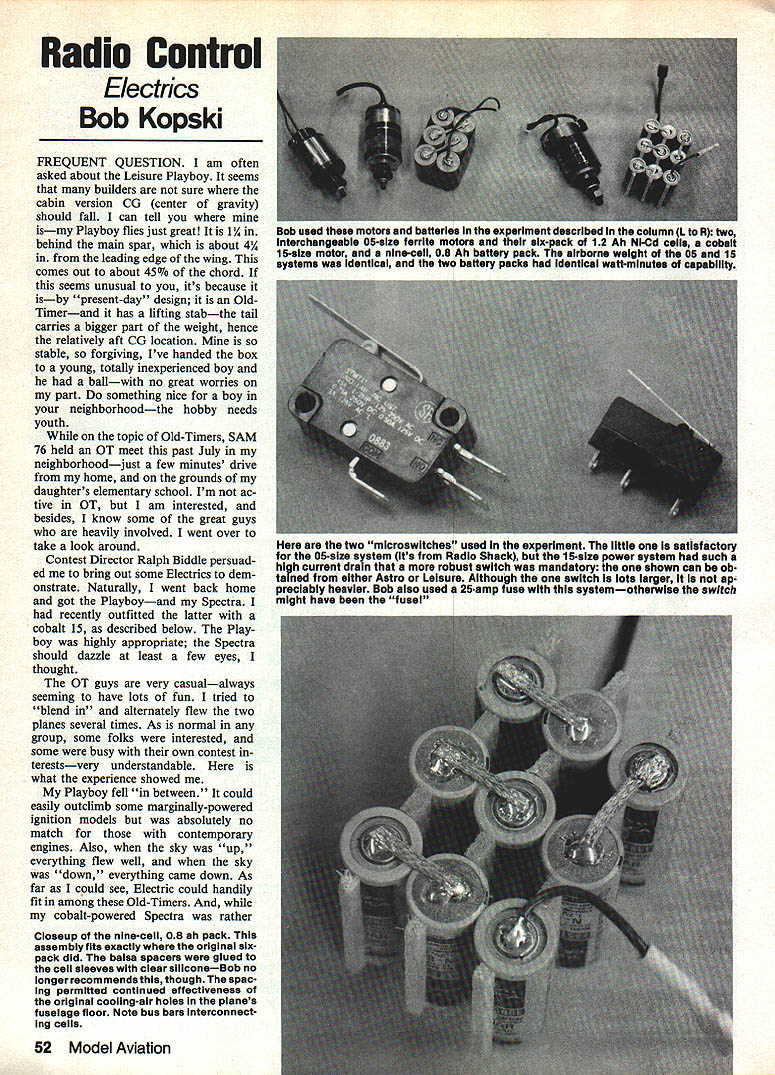
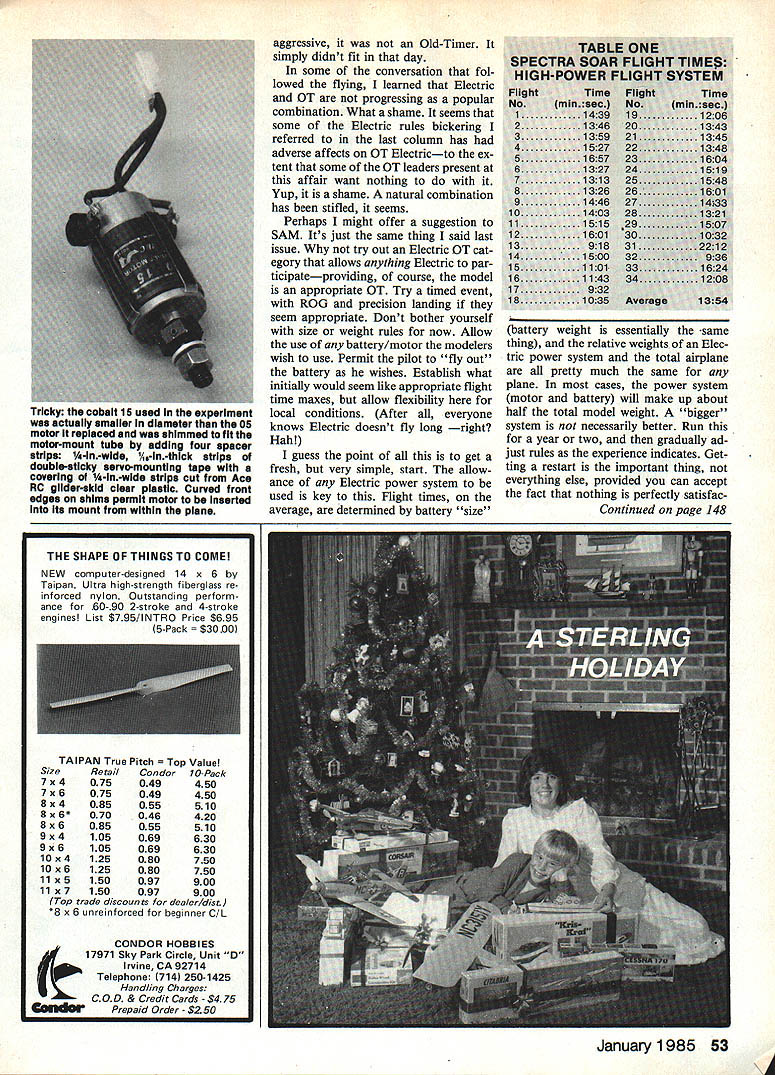
I decided to install a Cobalt 15 and suitable battery, while trying to maintain the same weight, balance, etc. From bench data, I knew that a Cobalt 15 with a 7 x 6 nylon on nine cells should have a static input power level of about 140 watts—much more than before, and vastly more than needed to just cruise the plane. This worked out very well. Both an .05 motor and a six-cell 1.2 Ah cell system and a Cobalt 15 and nine-cell 0.8 Ah cell system weigh about the same, although the new battery is about 1/2 oz. lighter. I felt this was certainly close enough to make a valid test of my argument that the total flight time should be about the same for both power systems and, at the same time, give me a taste of a significantly faster rate of climb (but shorter total motor-run time).
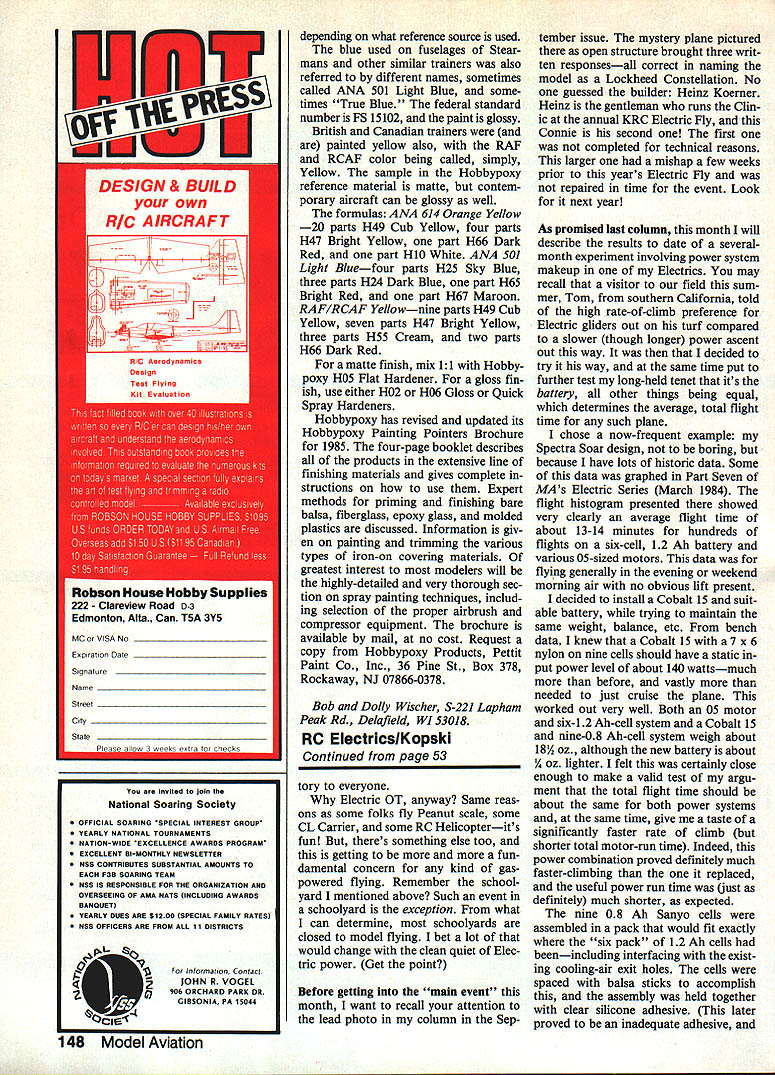
The nine 0.8 Ah Sanyo cells were assembled in a pack that would fit exactly where the "six pack" of 1.2 Ah cells had been—including interfacing with the existing cooling-air exit holes. The cells were spaced with balsa sticks to accomplish this, and the assembly was held together with clear silicone adhesive. This later proved to be an inadequate adhesive, and it failed to hold the cells together during some violent "power" vibration produced by the Cobalt 15 on climb-out. This caused one cell sleeve to split and expose the inner sleeve. Fortunately the glue failure occurred on the bench and not in the air. The cells were reassembled using epoxy and glass cloth tape and all was well.
Flight testing proceeded as expected. The climb rate was spectacular; the plane went almost straight up and out of sight in a very short time. The motor current peaked at about 18 amps and the pack voltage sagged slightly, giving about 150 watts of input. The flight time, however, averaged less—about 8 to 9 minutes. This is about half of the flight time recorded with the six-cell 1.2 Ah pack. The conclusion was predictable: more power produced a steeper climb but reduced total flight time. The ultimate "efficiency" must be judged by mission—if you want to get high fast and show off, the Cobalt 15 with nine cells is better; if you want long flights, the smaller motor and larger capacity cells are better.
To be consistent with previous data, the new battery was also charged in my normal safe (or conservative) fashion. Specifically, I charged this pack from "empty" to somewhat less than its "label capacity." This was done with a constant charge current of 3.0 amps for 15 minutes.
Now for the results. To date, I've logged 35 flights, as shown in the Table. This flying was done on 21 different days, either mornings or evenings, and some flights were by different pilots. Even though the data is limited, it's very clear to me that the nominal flight time of my Spectra Soar in "neutral air" is more or less the same as before; that is, in fact, the energy stored in the battery is apparently determining the total average flight time independent of the (appropriate) power system for the same plane at the same total weight. This also means that about the same average total flight time results whether the plane "skyrockets" for about two, one-minute, very-high-power runs or climbs lazily in an on-off fashion for a total of four to five minutes!
Some additional comments are in order. While my new installation doesn't take the plane "straight up out of sight in a minute," it does haul Spectra so fast that such performance may not be to the liking of those who would otherwise just "cruise around," for it is now necessary to "stay on the stick" during the climb. Also, the installation is significantly more costly—nearly three times that of the power system it replaced! Furthermore, charging nine cells would be an impasse to most fliers I know. (Regarding this, obviously, I have a way to charge this and other "odd" packs as well, and if there is enough interest, perhaps a construction article would be possible.)
On the other hand, I can see several distinct advantages of such a climb. It definitely affords quite a thrill, and would thereby be appealing to the "blow-a-hole-in-the-day" crowd. Of course, this extra power margin can make marginal-weather flying much more enjoyable—for there are times when it seems like a plane may never cut through the wind or turbulence or strong sink. Also, I've seen some occasions when, in looking for good thermals (in southeastern Pa. I found that such could only be had "high up"), it was not possible to get good lift at lower altitudes, and a high climb-rate was necessary to find them expediently. Further, this "fast-up" approach may be more to the liking of sailplane pilots used to a winch. Finally, as models equipped with a speed control become common, this high-power-spending capability can be called upon only when needed. Otherwise, such models can be flown at reduced power levels, thus extending total power-on time (but not necessarily the total flight time). This latter application can be quite a lot of fun!
So there you have it—for planes where the available energy is used to maximize total flight time, as in gliders and Old-Timers, the battery capacity (i.e., watt-minutes) determines the total flight time, independent of the rate at which power is expended (for the most part), with all other model parameters being equal. Roland Boucher of Leisure has conducted similar tests and has arrived at the same conclusion. Bob Boucher of Astro Flight puts the same result in different terms. He says that the final altitude reached, whether by means of a slow ascent or a rapid climb, is the same for the same battery! Are there any more questions?
Electric Categories — A Suggestion (Scale Example)
In my last column (November 1984), I argued for establishing initial Electric model categories, unburdened with the complexities of power-system rules and regulations. This reduces to permitting (yea, verily—encouraging!) any and all power systems to be used in AMA competition. It offers the modeler a way to get organized Electric competition off and running. I'd like to expand upon one such category—Scale—as a detailed example.
Consider the Scale enthusiast. He builds FF, CL, and RC Scale. He builds Precision Scale, Giant Scale, Stand-Off Scale, and Sport Scale. He builds Peanut Scale, static scale, and goodness-knows-what-else scale! Now, enter Electric Scale. Note that in all the above, the operative word is scale. Size and powerplants are variables. And all the above are long-established and polished categories.
With all this in mind, consider an "all-size" RC Electric Scale class—for starters. Some apartment dwellers may elect something of 30-in. (or so) span. Others, with the interest and facility, can elect Y-scale. While the size range will look bizarre indeed, it's only because we've become used to "size categories" over the years. I see no basic reason why an "any-size-gos" Electric category cannot be set up—initially. We are long learned in judging Scale, and I'm sure suitable rules can be developed to assure judging equivalency independent of the model size.
Similarly, flight requirements can be suitably "scaled." The important thing is to get Electric Scale (and Electric-everything-else) going. Give the modeler full freedom of power-system choice—just to get Electric introduced. There's plenty of time to complicate, categorize, and classify Electric's future. In the meantime, just think of all those 34-in., or 54-in., or whatever-inch quiet, Scale Electrics flying in the schoolyard down the block! And it should be perfectly clear that my proposal can be made to work with any model type—not just Scale.
Think about it. Without that first (and then continuing) breath, there is no life.
KRC Electric Fly — Seminar, Social, and Event Notes
The seminar is an informal, conversational, how-to part of the clinic activity. In the past, I have hosted this hour-or-two activity with Heinz and once with Roland Boucher. This is an opportunity for everyone to field questions of general interest. This year, with the generally light interest in the clinic, and the busy excitement of the flight line, we dropped the seminar on Saturday. Following the All Up, Last Down on Sunday, Heinz, Bob Boucher, Frank Heinrich, and Jeff Surgnier (the latter two representing Robbe) hosted the "round table" (stand 'round Heinz' work table) seminar discussions. There was something for everyone.
Earlier, I mentioned another Electric Fly institution—the informal Saturday Social. We've been getting attendance from visitors for several years, with many staying at a local motel over the weekend. Three years ago KRC offered some diversion for these guests with our social. Like the rest of the Electric Fly, this also is a low-key gathering. It takes place in our club's regular meeting place, the Hatfield American Legion Hall. KRC ladies bring many and varied goodies to snack on, and liquid refreshments are made available from the Legion. Guests can relax and enjoy a change of pace from the flight line. Wives and kids join in, too.
We have several door prize drawings for our visitors, including things for the ladies.
This year we were fortunate to have Bob Boucher in attendance at the social. I twisted his arm into telling us a few words about his experiences on the man-powered and solar-powered flight successes in which he played a key role. Bob was very entertaining, bouncing between light-hearted stories and some of a more technical nature. The social wrapped up just before midnight so there'd be enough time to "charge up" for Sunday's flying.
KRC tries to make the event easy and fun for everyone. One part of this was in providing flight-line batteries so visitors wouldn't have to continually return to their cars for recharging. In past years our several batteries had a hard time keeping up with the load, and we anticipated an even larger requirement this year. To help in this area we obtained loan of five high-power line-operated laboratory supplies to make up with five auto batteries on the flight line. In this way, fliers could drain amps out of the batteries to charge their planes, and the supplies would put amps back in so the next person would have a battery in the same good condition. As it turned out, with the very heavy attendance and the intensive flying, the supplies were a real salvation.
The recharging story doesn't end there. Frank Heinrich and Jeff Surgnier of Robbe were in attendance all weekend. Along with many other Robbe products, they brought several automatic chargers and were offering charging services to everyone. I personally know these products are not always easy to find, but Frank tells me that distribution of the Robbe charger is rapidly improving. Anyway, lots of people can say they saw and were "charged up" by these at the 1984 Electric Fly.
It is normal in an affair of this nature for most people to leave with vivid memories of the particular aspects most pleasing to them. I can't help but feel that this year's Electric Fly had several of them. Many such memories will stay with most visitors. Included among these must surely be the sheer delight of watching Keith Shaw (Ann Arbor, MI) fly. He brought four planes, three of them new, and one, the Comely Old-Timer, from his past visits. Keith is a very likable fellow, an excellent craftsman, and a truly outstanding pilot. In effect, Keith is a one-man Electric Fly. This year he flew his flying wing Banshee, his precision aerobatic Columbia, and his mono-retract equipped Spitfire. When Keith went up, all others came down to watch. He held the crowd with him. Every flight ended with an ovation.
For those of the "brute power" persuasion, Bob Boucher provided something to remember. His Astro Challenger (a new Astro kit) would burst upward, leaving no doubt as to who had the highest rate of climb.
It would be hard to imagine the casual spectator not finding something to his special interest and liking.
The three attendees of our very first Electric Fly have variously attended the meet since then, but not all at the same time. This year was a time of reunion.
Happy Landings.
Bob Kopski 25 West End Dr., Lansdale, PA 19446
Transcribed from original scans by AI. Minor OCR errors may remain.

