

Radio Control: Electrics
Bob Kopski 25 West End Dr. Lansdale, PA 19446
TODAY is the shortest day of the year. It's my last chance to do any evening flying, for tonight the clocks go back one hour, and hereafter—for what seems like forever—flying is confined to weekends, 'cause it simply gets too dark too early.
Well, that's not entirely true for us night-flyin' folks! I know this may sound like it's not something that can be easily done—but it is. It's actually very easy, at least with planes that are fairly docile and unsurprising. The easiest-to-fly and safest night fliers are of glider configuration or Old-Timers, or "honest" trainers. Just something for you to ponder. More in the future!
Ducted-fan Electric — Bob Rumsey's Cosmos
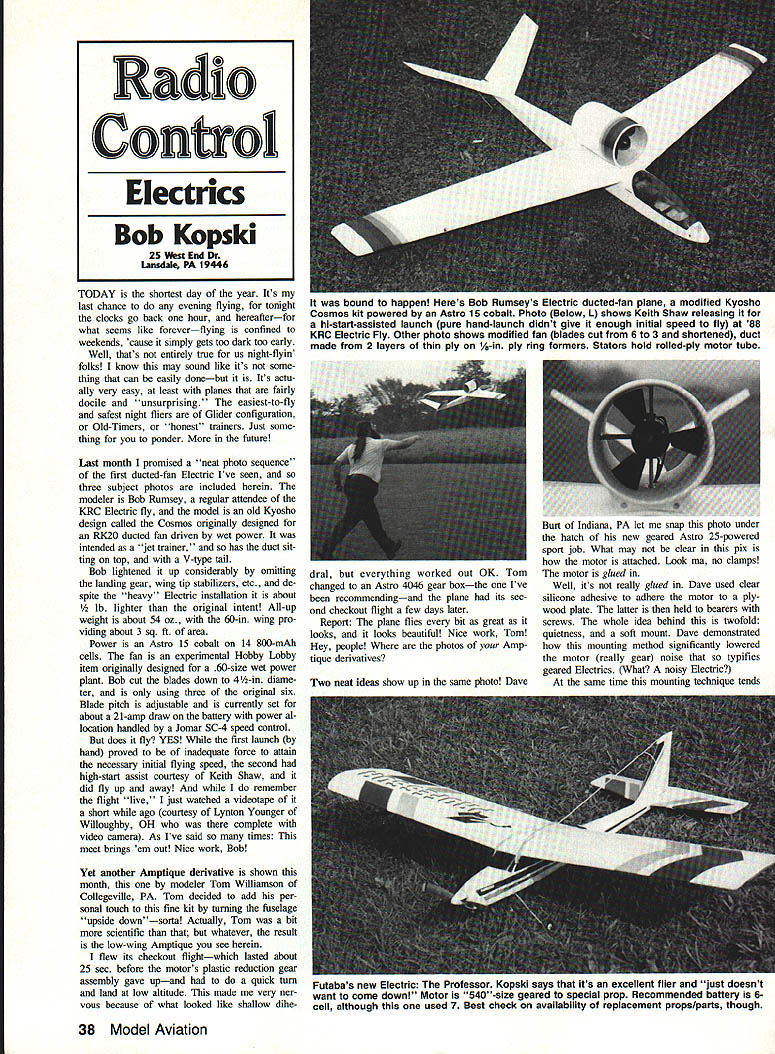
Last month I promised a "neat photo sequence" of the first ducted-fan Electric I've seen, and so three subject photos are included herein. The modeler is Bob Rumsey, a regular attendee of the KRC Electric fly, and the model is an old Kyosho design called the Cosmos originally designed for an RK20 ducted fan driven by glow power. It was intended as a "jet trainer," and so has the duct sitting on top, and with a V-type tail. Bob lightened it up considerably by omitting the landing gear, wing-tip stabilizers, etc., and despite the "heavy" Electric installation it is about 1 lb. lighter than the original intent. All-up weight is about 54 oz., with the 60-in. wing providing about 3 sq. ft. of area.
Power is an Astro 15 Cobalt on 14 800-mAh cells. The fan is an experimental Hobby Lobby item originally designed for a .60-size glow power plant. Bob cut the blades down to 4-1/2-in. diameter, and is only using three of the original six. Blade pitch is adjustable and is currently set for about a 21-amp draw on the battery with power allocation handled by a Jomar SC-4 speed control.
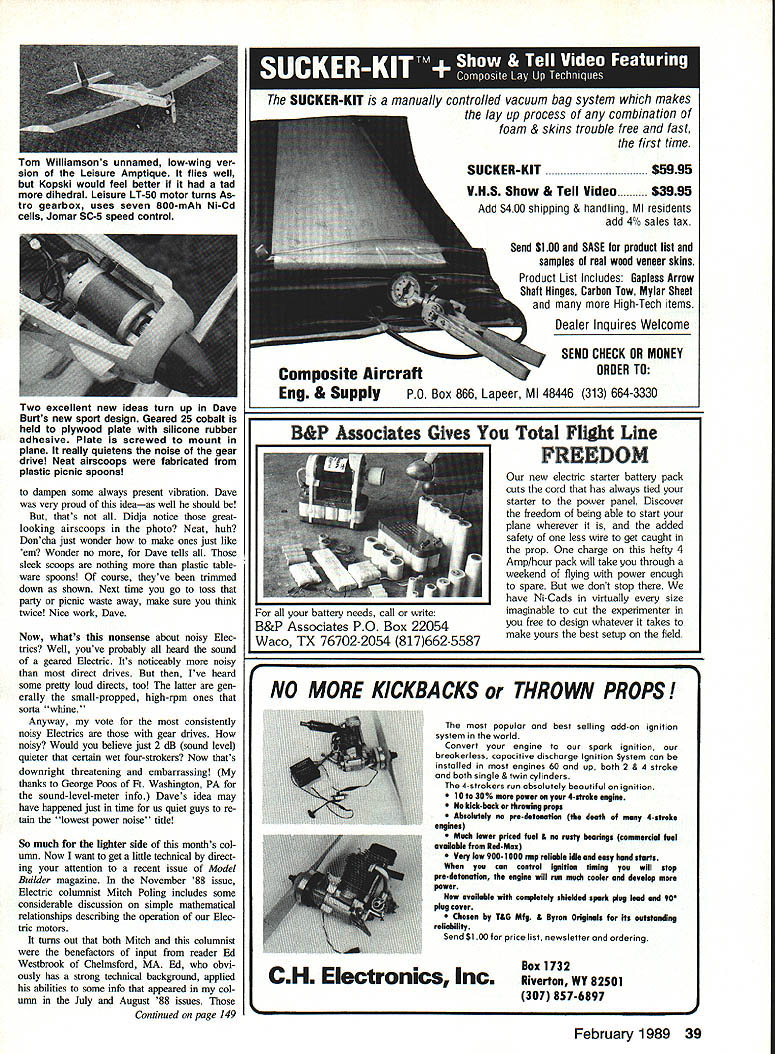
But does it fly? YES! While the first launch (by hand) proved to be of inadequate force to attain the necessary initial flying speed, the second had a hi-start assist courtesy of Keith Shaw, and did fly up and away! And while I do remember the flight "live," I just watched a videotape of it a short while ago (courtesy of Lynton Younger of Willoughby, OH who was there complete with video camera). As I've said so many times: This meet brings 'em out! Nice work, Bob!
Amptique derivative — Tom Williamson
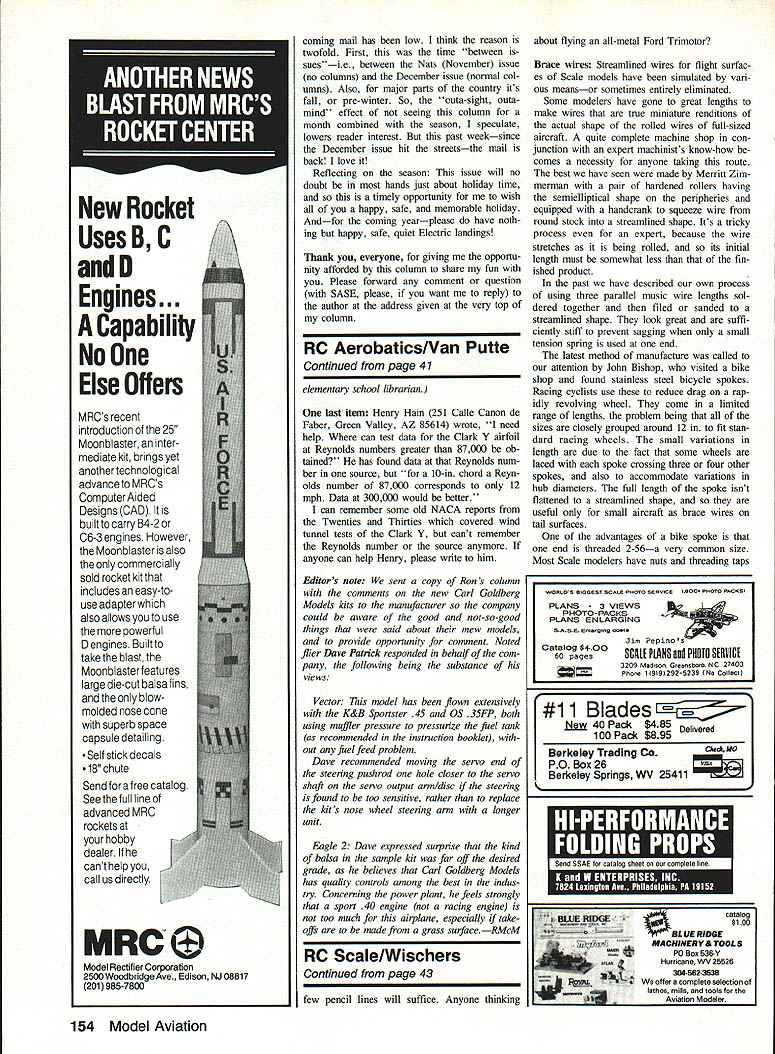
Yet another Amptique derivative is shown this month, this one by modeler Tom Williamson of Collegeville, PA. Tom decided to add his personal touch to this fine kit by turning the fuselage "upside down"—sorta! Actually, Tom was a bit more scientific than that; but whatever, the result is the low-wing Amptique you see herein. I flew its checkout flight—which lasted about 25 sec. before the motor's plastic reduction gear assembly gave up—and performed a quick turn and landed at low altitude. This made me very nervous because of what looked like shallow dihedral, but everything worked out OK. Tom changed to an Astro 4046 gearbox—the one I've been recommending—and the plane had its second checkout flight a few days later. Report: The plane flies about as great as it looks, and it looks beautiful! Nice work, Tom!
Hey, people! Where are the photos of your Amptique derivatives?
Two neat ideas in one photo
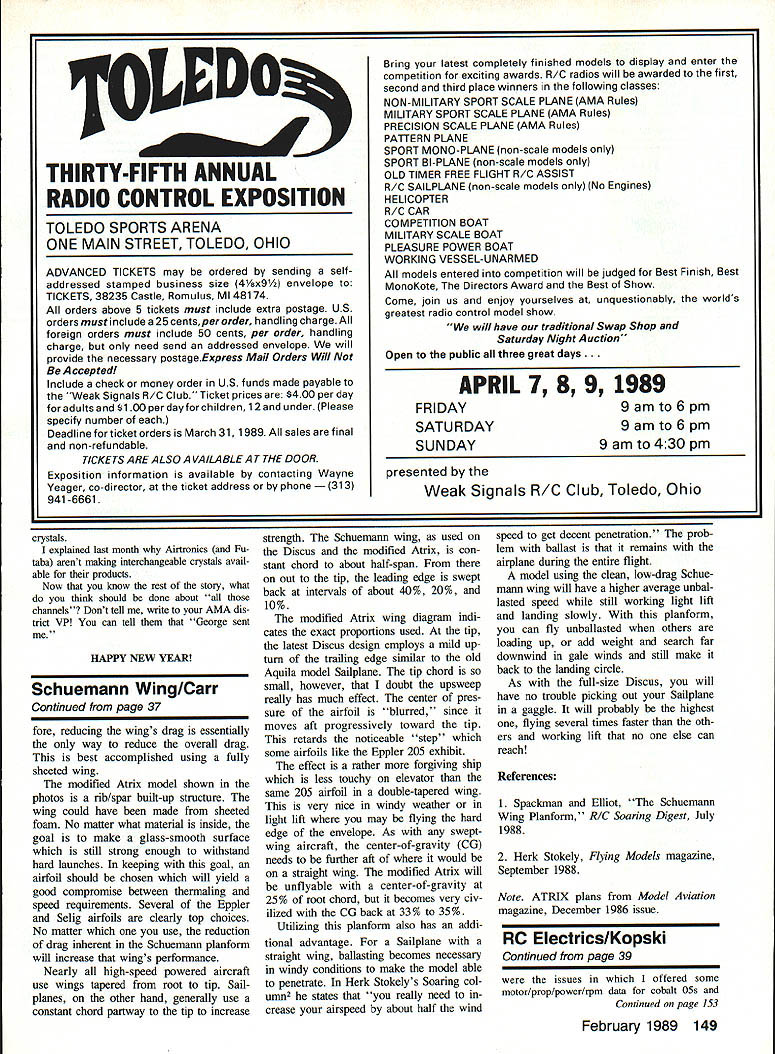
Two neat ideas show up in the same photo. One photo shows modified fan blades (blades cut from 6 to 3 and shortened), duct made from two layers of thin ply on 1/8-in. ply ring formers. Stators hold a rolled-ply motor tube.
Quiet mounting and air scoops — Dave's idea
Dave of Indiana, PA let me snap this photo under the hatch of his new geared Astro 25-powered sport job. What may not be clear in this pix is how the motor is attached. Look, ma, no clamps! The motor is glued in. Well, it's not really glued in. Dave used clear silicone adhesive to adhere the motor to a plywood plate. The latter is then held to the bearers with screws. The whole idea behind the twofold quietness/soft mount is to lower motor (really gear) noise that so typifies geared Electrics, and at the same time this mounting technique tends to dampen some of the always-present vibration. Dave is very proud of his idea, as well he should be.
Didja notice the great-looking air scoops photo? Neat, huh. Don't you just wonder how to make ones just like 'em? Wonder no more. Dave tells me the sleek scoops are nothing but plastic tableware spoons, of course trimmed down as shown. Next time you go to a toss-in party or picnic and have spoons to waste away, make sure you think twice before you throw them out. Nice work, Dave.
On Electric noise
Now what's nonsense about noisy Electrics? Well, you've probably heard the sound of geared Electrics—it's noticeably noisy. Direct drives? I've heard some pretty loud directs too. Anyway, my vote for the most consistently noisy Electrics are those with gear drives. How noisy? Would you believe just 2 dB (sound level) quieter than certain four-strokers? Now that's downright threatening and embarrassing! (My thanks to George Poos of Ft. Washington, PA for the sound-level meter info.) Dave's idea may have happened just in time for us quiet guys to retain the "lowest power noise" title.
A little technical: power, batteries, and flight time
So much for the lighter side of this month's column. Now I want to get a little technical by directing your attention to a recent issue of Model Builder magazine. In the November '88 issue, Electric columnist Mitch Poling includes some considerable discussion on simple mathematical relationships describing the operation of our Electric motors.
It turns out that both Mitch and this columnist were the benefactors of input from reader Ed Westbrook of Chelmsford, MA. Ed, who obviously has a strong technical background, applied his abilities to some info that appeared in my column in the July and August '88 issues. Those were the issues in which I offered some motor/prop/power data for cobalt .05s and .09s. In that article I gave a guideline for the amount of power needed to "just cruise" most Electrics. It goes like this:
Motor Power Input to Cruise (watts) = Model Weight (lb.) x Wing Loading (oz./sq. ft.)
Knowing the model's weight, the wing area, and the amount of charge put in the battery should allow one to predict the flight time under cruise conditions—i.e., just maintaining level flight. This is a relatively easy task for an Electric with speed control.
Well, even without complete data I can tell you that the predicted time came out to within a few seconds of the actual time—essentially dead on! Now I know some of you would be interested in the facts and figures, and so if I come across them I'll include them in a future column (or perhaps I can repeat the test).
#### Example: the Exciter (40-size aerobatic)
Last issue I made reference to my resurrected Exciter 40-size aerobatic (for a photo, see the October '85 issue of Model Aviation). This is a semi-symmetrical-airfoiled (NACA 2412) low-winger powered with a Cobalt 40 on 18 1.2-Ah cells. All-up weight is 89 oz. The wing planform is 10" x 60", or 600 sq. in. From this basic info we get:
- Model weight: 89 oz = 89/16 = 5.56 lb
- Wing area: 600 in² = 600/144 = 4.17 sq. ft.
- Wing loading: 89 oz / 4.17 sq. ft. = 21.36 oz/sq. ft.
- Calculated motor power input to cruise: 5.56 lb x 21.36 oz/sq. ft. ≈ 119 watts
The question now is, "How long can the described battery supply 119 watts?" Of course, that depends on how much charge is in the battery; i.e., how many amp-minutes were pumped in when I charged up! I set the charge current to a constant 4.4 amps, and charged for 15 min. That's a total of 66 amp-minutes.
During discharge under cruise conditions the current drain is relatively low. In fact, the current will be approximately: amps = watts / voltage. Using an average cell voltage of about 1.2 V and 18 cells, pack voltage ≈ 18 × 1.2 = 21.6 V. So:
- Current ≈ 119 W / 21.6 V ≈ 5.4 A
At this relatively low current the average cell voltage during discharge will be close to the classic 1.2-volt value.
To calculate available energy: a NiCd will typically deliver about 95% of the charge pumped in. Watt-minutes available ≈ pack voltage × amp-minutes × 0.95:
- Watt-minutes ≈ 1.2 V × 18 × 66 × 0.95 ≈ 1,354 watt-minutes
At the calculated required power level of 119 W to sustain cruise, expected flight time ≈ 1,354 / 119 ≈ 11.4 minutes.
So, what was the actual flight time attained? Would you believe 12 min., 10 sec.? Folks, that's not shabby! I'm convinced my rule of thumb is pretty good, and in this case the variance is on the plus side.
As an addendum, the very next flight of the Exciter was "wide open." I flew the field perimeter at more-or-less constant altitude at full power. The time: 4 min., 25 sec.
So what is "normal" flight time? For the Exciter, a "normal" flight consists of taxi/takeoff, rolls, inside loops, outside loops, stall turns, snaps, touch-and-goes, Cuban eights, etc. I tallied up my log of 30 typical flights, which represented a total of 187.2 minutes, an average flight of 6 min., 15 sec. Folks, that's a lot of good flying!
What's the secret? In a word: speed control. If you use the power needed to do the maneuver—and no more. I back off the throttle to position, then once up or nose-over to the proper attitude I open up the power again. Think of it as "power management." If you're not using speed control on a plane that could benefit from one, I suggest you give it a try.
I've written previously that a speed control adds just one more dimension of fun to Electrics—as if Electric flying were not fun enough!
Mail and season's greetings
An observation: This year has been much like every other year. During this past month my incoming mail has been low. I think the reason is twofold. First, this was the time "between issues" — i.e., between the Nats (November) issue (no columns) and the December issue (normal columns). Also, for major parts of the country it's fall, or pre-winter. So, the "outa-sight, outa-mind" effect of not seeing this column for a month combined with the season, I speculate, lowers reader interest. But this past week — since the December issue hit the streets — the mail is back! I love it!
Reflecting on the season: This issue will no doubt be in most hands just about holiday time, and so this is a timely opportunity for me to wish all of you a happy, safe, and memorable holiday. And — for the coming year — please do have nothing but happy, safe, quiet Electric landings!
Thank you, everyone, for giving me the opportunity afforded by this column to share my fun with you. Please forward any comment or question (with SASE, please, if you want me to reply) to the author at the address given at the very top of my column.
Transcribed from original scans by AI. Minor OCR errors may remain.

