
Radio Control: Electrics
Bob Kopski 25 West End Dr. Lansdale, PA 19446
Follow-up to Mitch Poling
Let's open with a follow-up to last month's column. In that issue I discussed Mitch Poling's "Electric" article in the November 1988 Model Builder, which covered motor characterization for technically inclined readers. For continuing information on the same subject, see Mitch's December 1988 MB article. Many of you will find this topical area of much interest.
Readers' interests
Readers' interests vary widely, as evidenced by incoming mail. The range covers very simple Electric matters—things some take for granted but which stop others cold—to more advanced technical issues. I try to cover a wide variety over time. Of course, most readers would like more attention to their particular interests, which is contradictory to a "something for everyone" format. The only topics I don't eventually cover are certain specialized areas with which I have no familiarity. If that happens, I will try to refer the writer to someone who does. If you want a topic covered and don't see it here, please write (include a SASE) and I'll do my best to provide a direct answer or a reference.
Great Planes PT Electric
The Great Planes PT Electric is proving to be a very good performer locally. I've flown several and have seen some that didn't fly well, but overall I would recommend the model. The kit instructions are excellent.
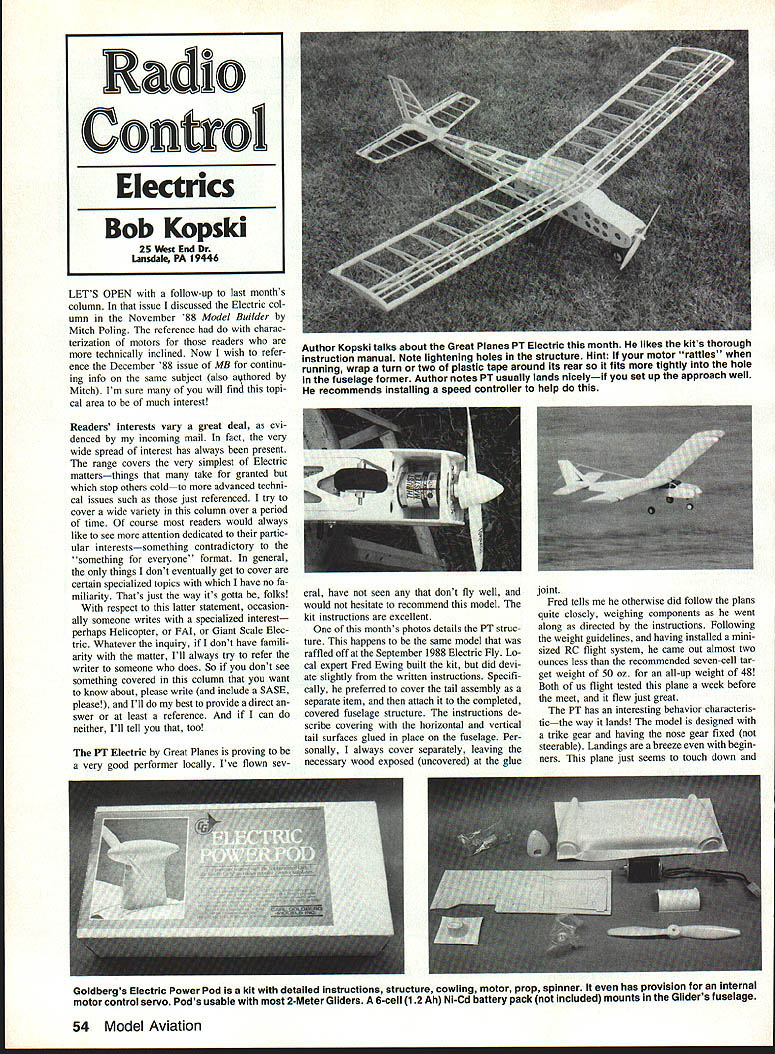
#### Covering and assembly One of this month's photos shows the PT structure. The particular model pictured was the one raffled at the September 1988 Electric Fly and was built locally by Fred Ewing. Fred deviated slightly from the instructions: he preferred to cover the tail assembly as a separate item and then attach it to the covered fuselage. The plans describe covering the horizontal and vertical tail surfaces glued in place on the fuselage. Personally, I always cover separately, leaving the necessary wood exposed at the glue joint so it can be clamped and glued cleanly.
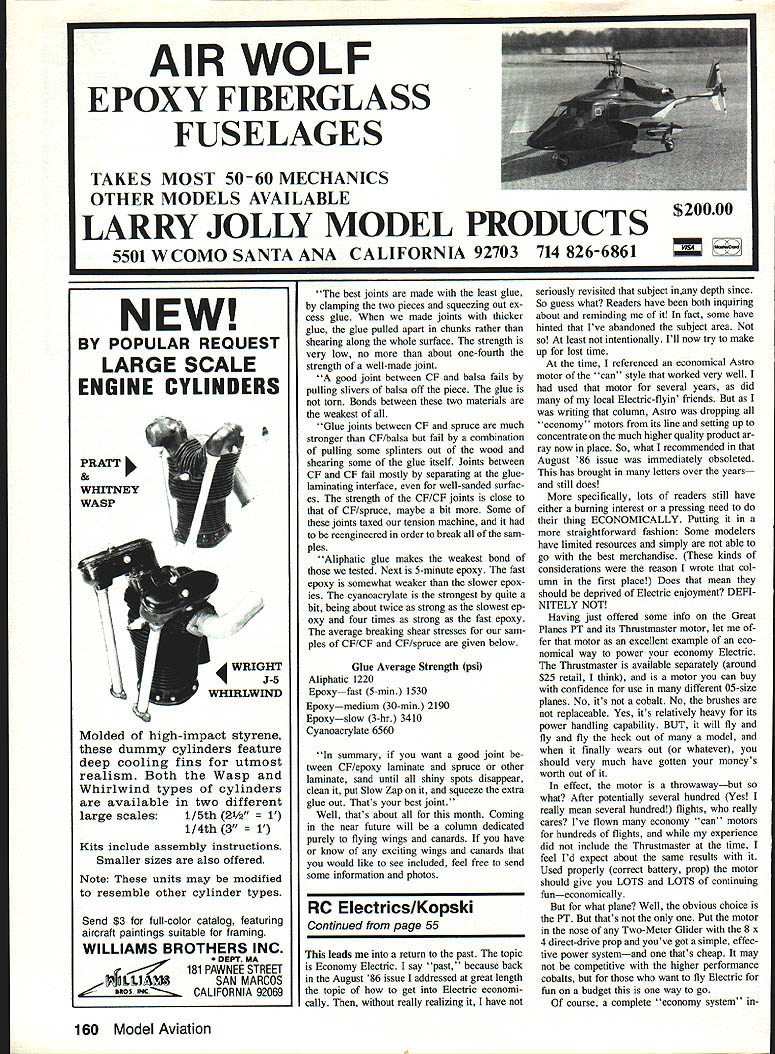
Fred otherwise followed the plans closely and weighed components as directed. Following the weight guidelines and installing a miniaturized RC flight system, the finished plane came out almost two ounces less than the seven-cell target weight of 50 oz.—an all-up weight of about 48 oz. Both of us flight-tested the plane the week before the meet, and it flew very well.
#### Flight characteristics and landings The PT has an interesting landing characteristic. Designed with tricycle gear and a fixed (non-steerable) nose wheel, landings are easy—even for beginners—if you set up the approach properly. I recommend installing a speed controller to help hold the approach and make touch-and-goes more predictable.
In fairness, takeoffs from grass strips with the stock power system can be marginal; hand launches are relatively easy. From a smooth hard surface the PT should ROG easily. Upgrading to a larger cobalt system (15-size) will significantly improve grass takeoff ability.
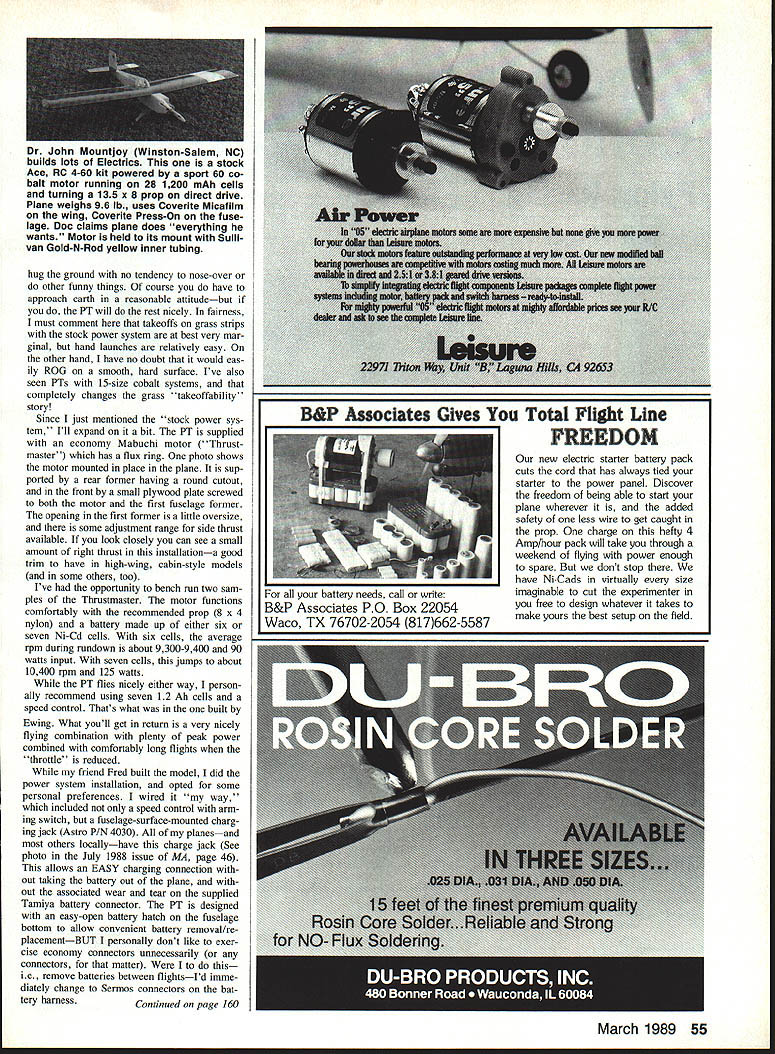
#### Power system and motor The PT is supplied with an economy Mabuchi-style motor; Thrustmaster offers a version with a flux ring. The motor is mounted with a small plywood plate screwed at the first fuselage former; that former is made a bit oversize to allow side-thrust adjustment. In the pictured installation you can see a small amount of right thrust—a useful trim for many high-wing cabin-style models.
I've bench-run two Thrustmaster samples and they perform comfortably. A recommended prop is an 8 x 4 nylon. The battery may be either six or seven Ni-Cd cells: six cells yield average RPMs suitable for many installs, while seven cells increase power and performance. I personally recommend seven 1.2 Ah cells plus a speed control. That combination, used in Fred's build, provides plenty of "go" and comfortably long flights when throttled back.
#### Installation tips I did the power installation on Fred's plane and wired it my way: a speed control with an arming switch and a fuselage-surface-mounted charging jack (Astro P/N 4030). A charge jack allows easy charging without removing the battery and avoids wear on the supplied Tamiya connector. The PT has an easy-open battery hatch on the fuselage bottom, but if you remove batteries between flights I recommend fitting Sermos connectors on the battery harness.
Tip: if the motor rattles in its opening, wrap two turns of plastic tape around the rear so it fits tightly in the hole in the fuselage former.
Glue joint testing and recommendations
Some recent tests on joints between carbon fiber (CF), balsa, and spruce produced these observations:
- "The best joints are made with the least glue, by clamping the two pieces and squeezing out excess glue. When we made joints with thicker glue, the glue pulled apart in chunks rather than shearing along the whole surface. The strength is very low, no more than about one-fourth the strength of a well-made joint."
- "A good joint between CF and balsa fails by pulling slivers of balsa off the piece. The glue is not torn. Bonds between these two materials are the weakest of all."
- "Glue joints between CF and spruce are much stronger than CF/balsa but fail by a combination of pulling some splinters out of the wood and shearing some of the glue itself."
- "Joints between CF and CF fail mostly by separating at the glue-laminating interface, even for well-sanded surfaces. The strength of the CF/CF joints is close to that of CF/spruce, maybe a bit more. Some of these joints taxed our tension machine, and it had to be reengineered in order to break all of the samples."
- "Aliphatic glue makes the weakest bond of those we tested. Next is 5-minute epoxy. The fast epoxy is somewhat weaker than the slower epoxy resins. The cyanoacrylate is the strongest by quite a bit, being about twice as strong as the slowest epoxy and four times as strong as the fast epoxy."
Average breaking shear stresses (psi):
- Aliphatic: 1220
- Epoxy—fast (5-min.): 1530
- Epoxy—medium (30-min.): 2190
- Epoxy—slow (3-hr.): 3410
- Cyanoacrylate: 6560
Summary recommendation: for a durable joint between CF/epoxy laminate and spruce (or another laminate), sand until all shiny spots disappear, clean the surfaces, apply slow epoxy (e.g., slow Zap), clamp and squeeze out excess glue. That's your best joint.
Economy Electric
This returns to the economy Electric topic I addressed at length in August 1986. At that time I recommended an economical Astro "can" motor, but Astro was dropping many economy motors to concentrate on higher-quality products, which made that recommendation immediately obsolete. Readers have continued to ask about low-cost ways into Electric flying—especially those with limited budgets—and the answer is: you can enjoy Electric flying economically.
A good example is the Thrustmaster motor supplied with the PT. It is an economical motor available separately (roughly $25 retail at the time) and is suitable for many .05-size planes. It's not a cobalt, brushes aren't replaceable, and it is relatively heavy for its power, but used properly (correct battery and prop) it will give many hundreds of flights—excellent value for the money.
A complete economy system involves more than the motor:
- A six- or seven-cell, 1.2 Ah Ni-Cd battery pack (many are available from model car supplies).
- An economy charger for those packs.
- Optionally, a speed controller as the next upgrade.
You can start with the minimums above and add a speed control later.
#### Examples of economical motors and installs
- Kyosho 600E: I used a Kyosho 600E ($18.89 discount price then) on my Nytrique (an Amptique derivative) with six 1.2 Ah cells turning a 7 x 6 Rev-Up prop. The setup provided adequate power to pull a 44-oz. model slowly but easily at low cost.
- Kyosho 360 PTT: A less economical choice than the 600E, but still a lower-cost option compared to cobalts. I've run it both direct-drive and geared using six and seven cells on the bench and in the air, and it performs well.
- Example: In my Persuader (a Wasp-like aerobatic design) the motor was direct on six 1.2s with a 7 x 6 nylon prop cut to 6 x 6 and produced brisk performance.
- Geared example: Used geared 2.5:1 on seven cells with a Kyosho 9 x 8 in my Caliph and achieved peak performance over 150 watts static (about 23 amps). That moved a 54-oz. plane with great ease—don't hold that load continuously.
Economy motors may not match cobalt performance, but they can provide long-lasting, economical fun for sport flying and informal events.
Kits, ARFs, and caveats
There is a rapidly growing number of Electric kits and ARFs on the market. Many kits (like the PT) include or offer economy motors. However, some stand-alone products and ARFs are disappointments—poorly chosen power systems or components can give newcomers the impression that Electric is no good, a throwback to the Seventies. Be cautious:
- Read the Electric columns in the hobby magazines for product experiences.
- Check with local flyers for real-world feedback.
I will always strive to report honestly about products I've used or seen in action.
Coming up and requests
Future columns will include:
- "Electric wormies"—small, useful field and shop buddies for serious Electric modelers.
- How a Massachusetts teacher runs model-building and flying summer classes where Electrics are a key part of the program.
- A column dedicated to flying wings and canards. If you have or know of any exciting wings or canards you'd like included, send information and photos.
Please send comments, questions, and photos (include SASE, please).
Transcribed from original scans by AI. Minor OCR errors may remain.

