
Radio Control: Electrics
Bob Kopski 25 West End Dr. Lansdale, PA 19446
An ugly opening — the WORMIES
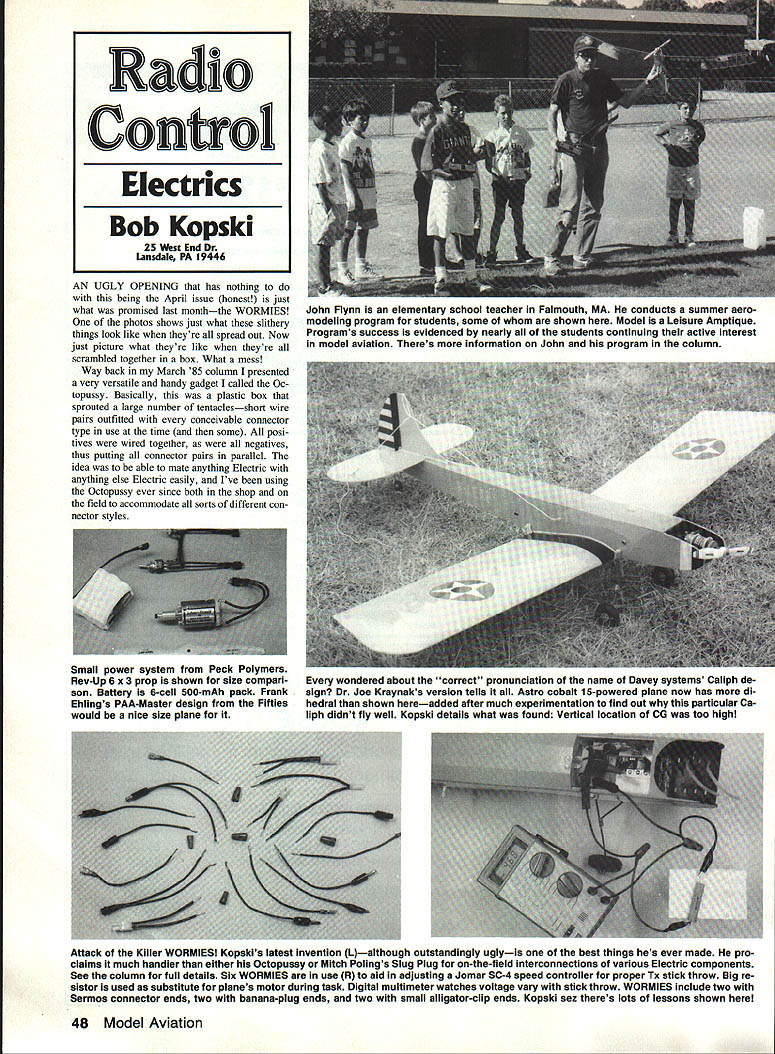
AN UGLY OPENING has nothing to do with the April issue—honest! Just what I promised last month: WORMIES. One photo shows what these slithery things look like spread out. Now picture them scrambled together in a box—what a mess!
Way back in my March 1985 column I presented a versatile gadget called the Octopussy: a plastic box with many tentacles—short wire pairs fitted with every conceivable connector type. Positives were wired together and negatives together, putting connector pairs in parallel. The idea was to be able to mate anything electric to anything else electric easily. I've used the Octopussy ever since in the shop and on the field.
Attack of the killer WORMIES! My latest invention—although outstandingly ugly—is one of the best things I've made. I find it much handier than either the Octopussy or Mitch Poling's Slug Plug for on-the-field interconnections of various electric components. See below for full details.
What WORMIES are
Basically, WORMIES are short lengths (6–8 inches) of red and black Jomar 16‑gauge high‑flex wire with one end stripped bare and the other end outfitted with a connector. They are made in many connector flavors so you can mix and match as needed.
Connector examples:
- Single connectors: Sermos
- Small insulated alligator clips
- Banana plugs
- Crimp terminals that mate ATC‑type fuses
- Two‑pin types: Tamiya (male and female), Astro male/female charge connectors, old Molex pairs
- Small wire nuts (twist‑on connectors) in two sizes (blue and orange indicate size)
Using the wire nuts, you join bare ends of chosen WORMIES to create any custom combination of connectors. Only the mating types you need are joined, eliminating the dangling unused active connectors problem of the Octopussy/Slug Plug.
Example field application
If a flyer using Tamiya connectors forgets a charger but the charger cord uses the Astro round coaxial charge plug, you can:
- Select a Tamiya male/female WORMY pair.
- Select a female Astro charge WORMY.
- Use two wire nuts to join the three wires as needed.
- Plug the male charger plug into the new Astro female, plug the Tamiya pair into the model, and charge.
This is a quick fabricated extension cord—free charge for a forgetful friend!
Other WORMY uses
- Series connections: WORMIES can be wire‑nutted in series to permit applications not possible with Octopussy/Slug Plug.
- Measuring in‑model motor current: Wire the negative leads together and route the positive leads to banana‑plug WORMIES that plug into your current meter, inserting the WORMY harness in series between motor and battery.
- Substitute an ATC fuse: Mate banana WORMIES to male crimp WORMIES and plug the crimps in place of the ATC fuse, bananas to the current meter.
- Miscellaneous: I've even used a WORMY to connect to a Futaba radio plug to fast‑charge someone's receiver battery on the field.
WORMIES are individual and reconfigurable—just take them apart when you're done and build the next creation. For modelers with a variety of systems and connector types, WORMIES are the way to go.
A quick note on Octopussy vs WORMIES vs Slug Plug
- Octopussy: good for many simultaneous connectors but leaves unused connectors exposed and dangling.
- Slug Plug (Mitch Poling): also useful but still has exposed connectors.
- WORMIES: modular, only wire what you need, fewer exposed active connectors, and easily reconfigured.
---
New electric products and trends
Electric modeling continues to grow. Recent introductions and notes:
- Aero Electric by Midwest: an electric trainer design that includes motor and wiring harness.
- Great Planes Electrostreak: a third electric from Great Planes (an aerobatic design originally appearing in Model Aviation, Nov 1987). The kit comes with a Gold Fire Mabuchi motor but no wiring harness.
- Guillow's kit: Woody Blanchard's Aeronca (from Model Aviation) introduced as a kit by Guillow's.
- Carl Goldberg Models: announced the Mirage 550, an electric sport/trainer.
- Hobby Lobby Catalog No. 13: many electric products including the Elektro‑UHU motor/glider and a variety of Graupner motors. The Elektro‑UHU is an excellent flyer—highly recommended.
These new products from established manufacturers, combined with products from Astro, Leisure, Kyosho, DSC, etc., indicate a strong industry trend toward electrics. And this is just the beginning.
A note on battery packs
A bittersweet point: many products use the "car‑style" flat rectangular 6– or 7‑cell packs (stock packs). While convenient for interchangeability, I find them unwieldy for models. Their shape drives fuselage and radio installation compromises.
I prefer battery size and shape tailored to a specific model. Of my nine current electrics, none uses the car‑style pack. None of my batteries are covered in tape or encased—the cell ends are exposed and interconnections are in a cooling airflow path. Modelers can and should adapt battery form factors to what works best for the airplane, though the stock packs have probably helped sales and proliferation of electrics.
---
Caliph troubleshooting: dihedral and CG
My Caliph (a DSC design covered in this column July–October 1987) is a great‑flying plane in the aileronless version when modified as described previously. A club member built one and used an Astro Cobalt 15 like I did, but his plane did not fly well: hard to turn, clumsy, and lacking friendly flyability.
We checked everything: wing warps, tail surface warps, decalage, balance, thrust line, surface throws—everything. Finally, in desperation, we put my wing on his plane. Presto—the difference was dihedral.
- I had increased dihedral to 7° per panel (about three inches under each tip rib) as described in my July 1987 column; my friend had not.
- His motor/battery was mounted high (above the wing), raising the vertical CG. Mine was mounted relatively low (just above the wing saddle).
Conclusion: too high a CG combined with too little dihedral caused lateral stability problems. The fix was increasing dihedral and lowering battery position. His K‑LEAF now has more dihedral than shown in earlier photos and flies correctly.
---
Motor/prop bench data
Following up on the February 1989 promise, I bench‑ran two Astro 40 Cobalts and two Great Planes Gold Fire motors. Each Astro 40 was "neutral timed." Each Astro 40 was run with three different 10 x 6 wood props; each Gold Fire with the kit‑supplied Tornado 7 x 6 and two wood 8 x 4 props. All motors were also run no‑load to determine rpm/volt constants. Power levels were kept to safe bench levels.
Note: This data is especially useful for those who referenced Mitch Poling's column and Ed Westbrook's motor math in Model Builder (Nov–Dec 1988).
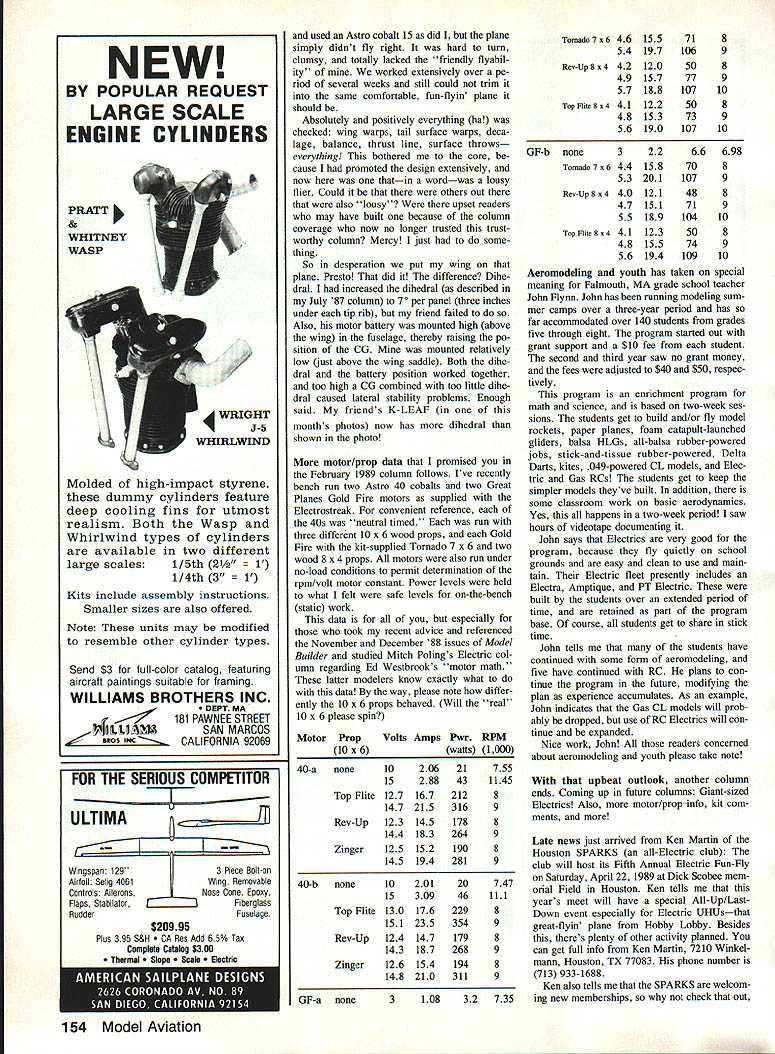
Motor test results (Prop = 10 x 6 unless noted). Volts (V), Amps (A), Power (W), RPM (1,000s)
- 40‑a
- none (no prop): 10.0 V, 2.06 A, 21 W, 7.55
- Top Flite: 12.7 V, 16.7 A, 212 W, 8.10
- Rev‑Up: 12.3 V, 14.5 A, 178 W, 8.07
- Zinger: 14.5 V, 18.3 A, 264 W, 9.00
- 40‑b
- none (no prop): 10.0 V, 2.01 A, 20 W, 7.47
- Top Flite: 13.5 V, 16.9 A, 226 W, 8.29
- Rev‑Up: 12.4 V, 17.4 A, 219 W, 8.19
- Zinger: 14.8 V, 21.0 A, 311 W, 9.11
- GF‑a (Gold Fire)
- none (no prop): 10.0 V, 1.08 A, 10.8 W, 7.35
- (Other GF prop runs were with Tornado 7 x 6 and two wood 8 x 4 props—data to be included in a future column.)
Please note how differently the 10 x 6 props behaved—will the "real" 10 x 6 please spin?
---
Aeromodeling and youth: John Flynn's program
Falmouth, MA grade‑school teacher John Flynn has run modeling summer camps for three years, accommodating over 140 students in grades five through eight. The program:
- Two‑week sessions
- Started with a $10 fee; later years ran $40 and $50 due to lack of grants
- Activities include building/flying model rockets, paper planes, foam catapult gliders, balsa CL/RC, rubber‑powered models, Delta Darts, kits, gas, control line, and balsa projects
- Small charge for parts; some local donations help
- Electric models are favored: quiet, clean, easy to use and maintain
- The Electric fleet includes an Electra, Amptique, and PT Electric built by students and retained by the program
Many students continued in aeromodeling. RC electrics are especially likely to continue and expand in the program; gas CL models may be dropped. Nice work, John—an important model‑youth effort.
---
Coming up / Late news
Coming in future columns: giant‑sized electrics, more motor/prop info, kit comments, and more.
Late news from Ken Martin of the Houston SPARKS (an all‑Electric club): the club held its fifth annual Electric Fun‑Fly on Saturday, April 22, 1989, at Dick Scobee Memorial Field in Houston. This year's event featured a special All‑U/Last‑Down event for Electric UHs. For full info contact:
Ken Martin 7210 Winkle Houston, TX 77083 Phone: (713) 933‑1688
The SPARKS welcome new memberships. Why not check it out?
Transcribed from original scans by AI. Minor OCR errors may remain.

