
Radio Control: Electrics
Bob Kopski 25 West End Dr. Lansdale, PA 19446
Third Annual Electric Fun-Fly (Livingston County RC Club)
FIRST THING this month is an announcement of the Third Annual Electric Fun-Fly of the Livingston County RC Club of Howell, MI on May 21, 1989. CD Keith Clark tells me that the meet will feature several fun events including:
- Most Beautiful
- Best Scale Appearance
- Best Aerobatic
- Most Unusual to Fly
But the main event will be an All-Up/Last-Down event — "because I enjoyed it so much at KRC," says Keith! Besides all this, there'll be door prizes, and no doubt, scheduled good weather (I hope!). You can get additional info from Keith at 2140 E. Highland Rd., Howell, MI 48843; telephone (517) 546-2462.
I'd like to comment here that Keith had a spectacular Dallaire at the '88 KRC meet. That plane had more sticks in it than I could believe and was beautifully finished in red, white, and blue. I never did get the details (motor/battery/etc.), but it was one of the most impressive models seen at the meet.
The Ampeater
The Ampeater is an all-balsa biplane design of mine that was pictured in the February 1988 column. That was a test photo to see how readers would react. I did this because the good editor had earlier agreed on a construction article, but I wanted to see what level of interest there might be before I got into it. The answer: NONE! Zero. Nada. Zip. I got NO reader reaction!
Then, in the January 1989 column's report of the '88 KRC Electric Fly I included a photo of two Ampeaters held by Insomia Griggs. I was so impressed that builder Bill Griggs had measured with a yardstick the year prior and produced his own that I simply had to take a picture of Insomia!
Well, reader reaction to this photo has not been the same — to say the least! I've received many letters requesting info and plans for the Ampeater, including cash "incentives"! Sadly, I have no plans. This is the only plane I've ever built by just drawing the plans on the wood. But with the current reader reaction I just may have to dust off my own yardstick. No promises here, but we'll see what happens later.
Plans and resources
Speaking of plans brings me to the following item. Those of you with an interest in OT, Nostalgia designs, early warplanes, modern ducted-fan designs, quarter-scale stuff, and goodness knows what else should check out the plans available from Bill Effinger of W. E. Technical Services. Not only are plans available, but Bill has pattern sets and parts lists for many. Many of these plans are well suited to electric conversion and may be just what you're looking for.
For example, I just got a set of plans for the Powerhouse 56 — a Berkeley free-flight gas kit from the Fifties and a very memorable part of my early modeling years that I'd love to electrify. Anyway, you can get a brochure from Bill by sending a single buck to W. E. Technical Services, P.O. Box 76884-A, Atlanta, GA 30323. Tell 'em Bob sent ya!
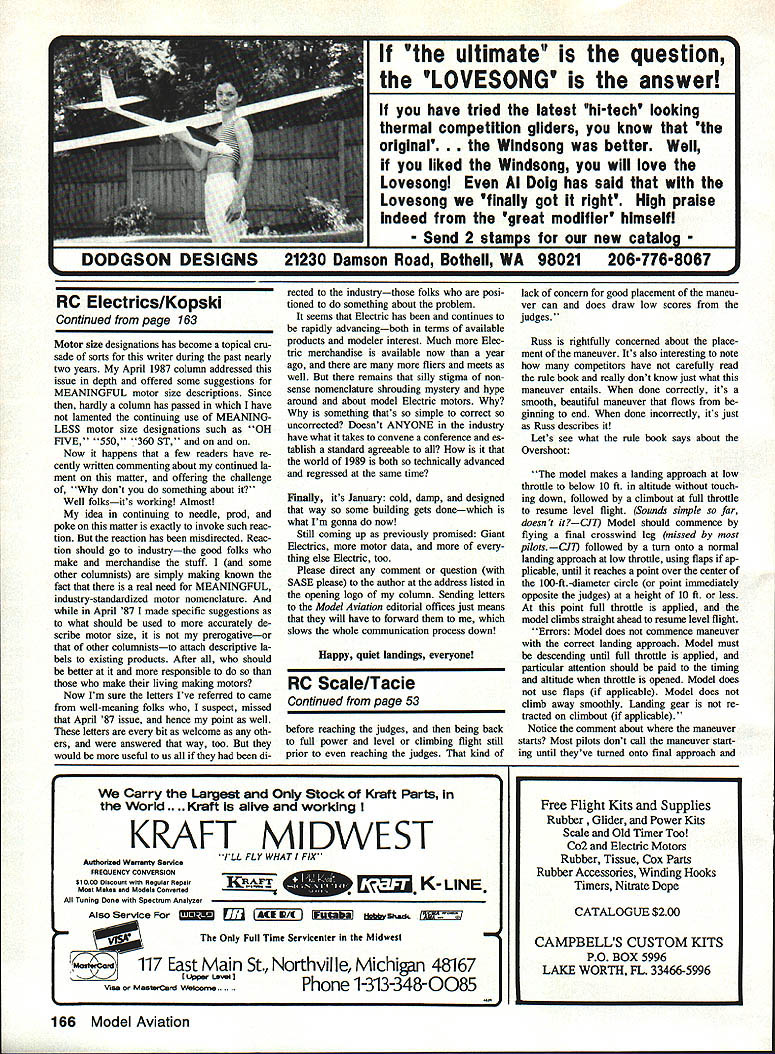
A new gearbox design has been announced by Leisure. This design replaces the earlier product and features a larger output (prop) shaft and heavier bearings. Those of you with the earlier version may want to check out this new design for increased durability and greater resistance to damage from prop-to-ground contact. You can write Leisure at 22971 Triton Way, Unit "B", Laguna Hills, CA 92653.
Tool testimonial — jigsaw
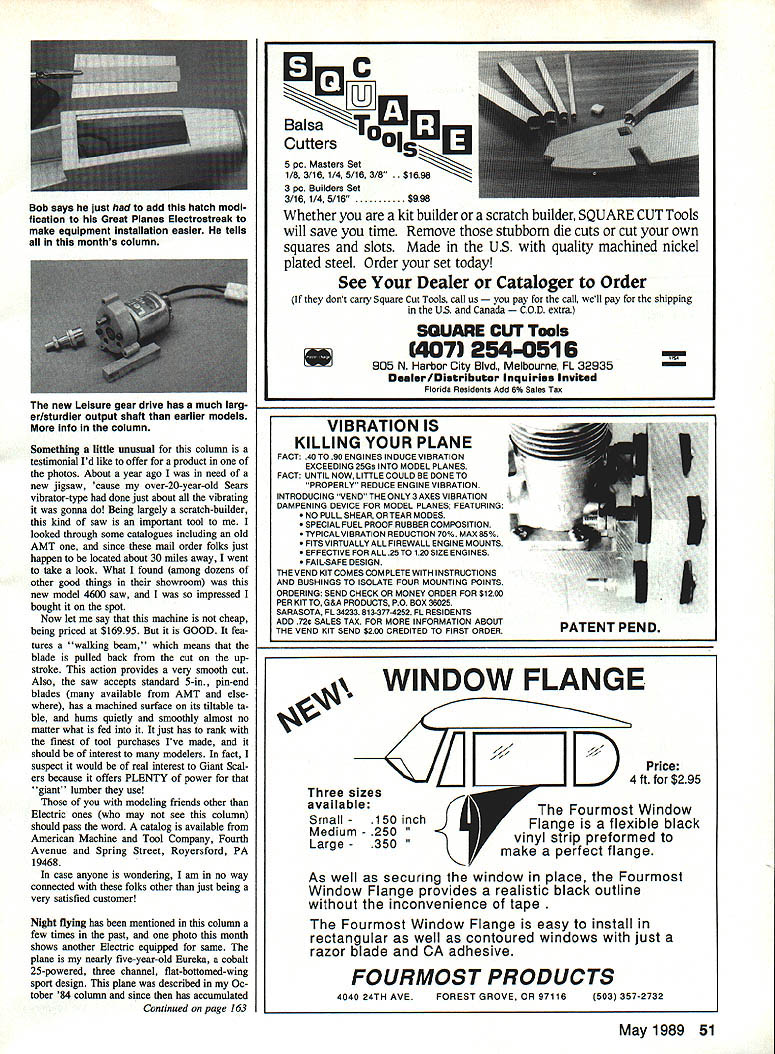
Something a little unusual for this column is a testimonial I'd like to offer for a product in one of the photos. About a year ago I was in need of a new jigsaw, 'cause my over-20-year-old Sears vibrator-type had done just about all the vibrating it was gonna do! Being largely a scratch-builder, this kind of saw is an important tool to me. I looked through some catalogues including an old AMT one, and since these mail order folks just happen to be located about 30 miles away, I went to take a look. What I found (among dozens of other good things in their showroom) was this new model 4600 saw, and I was so impressed I bought it on the spot.
Now let me say that this machine is not cheap, being priced at $169.95. But it is GOOD. It features a "walking beam," which means that the blade is pulled back from the cut on the up-stroke. This action provides a very smooth cut. Also, the saw accepts standard 5-in., pin-end blades (many available from AMT and elsewhere), has a machined surface on its tiltable table, and hums quietly and smoothly almost no matter what is fed into it. It just has to rank with the finest tool purchases I've made, and it should be of interest to many modelers. In fact, I suspect it would be of real interest to Giant Scalers because it offers PLENTY of power for that "giant" lumber they use!
Those of you with modeling friends other than Electrics ones (who may not see this column) should pass the word. A catalog is available from American Machine and Tool Company, Fourth Avenue and Spring Street, Royersford, PA 19468.
In case anyone is wondering, I am in no way connected with these folks other than just being a very satisfied customer!
Night flying and "Illumions"
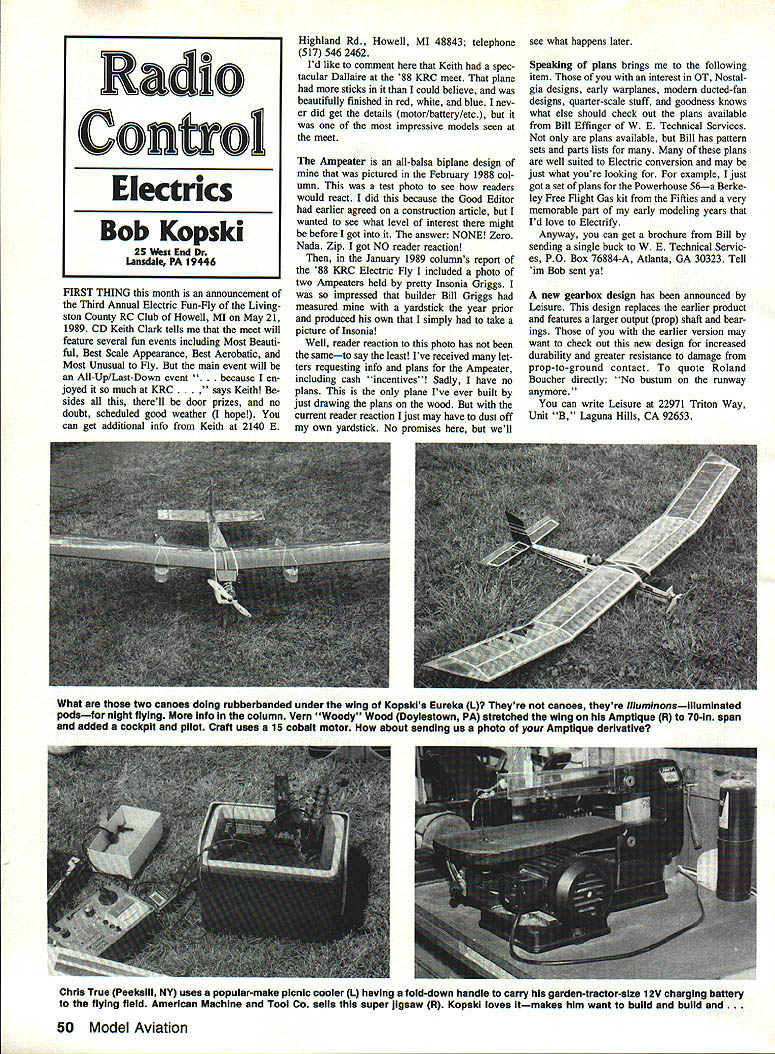
Night flying has been mentioned in this column a few times in the past, and one photo this month shows another electric-equipped one that does it. The plane is my nearly five-year-old Eureka, a cobalt .25-powered, three-channel, flat-bottomed sport design. This plane was described in my October '84 column and since then has accumulated hundreds of flights with the same motor and same 12-cell flight battery pack!
This past summer saw rekindled interest on my part in night flying, and one manifestation of that are the wing pods that have been added to the original Eureka. These removable pods are wooden and are rubber-banded in place, and in fact have been used on my Astro Challenger as well. I call these pods Illumions.
These Illumions are each 2.5-oz. balsa structures about 17 in. long and contain:
- Two 250-mAh cells
- A switch
- A charge jack
- Two lens assemblies for two tiny flashlights (one pointing forward, one aft)
Connections are soldered to the ordinary, replaceable flashlight bulbs. The front of each Illumion is covered in transparent yellow MonoKote; the rear in red transparent. In addition, several 18-in.-long, 1/2-in.-wide strips of chrome MonoKote are taped to the rear of each Illumion.
And what do I get for all this? Nighttime brilliance and dazzling fun! The multicolored Illumions permit full realization of model attitude and flightpath in total darkness. The spotlight/floodlight lens assemblies permit dead-on, head-on landing approaches from the horizon. The trailing chrome streamers provide a brilliant, fiery "afterburner" appearance as the model flies away from the flight line. In short, it's sheer dazzlement for all.
For those of you who may be interested, I strongly recommend this type of flying for docile models and skilled pilots who are thoroughly familiar with the daylight flight characteristics and control limits. Otherwise—go for it! It's a whole new, fun-filled modeling variant—best done with quiet, clean electric power, of course!
Electrostreak hatch modification
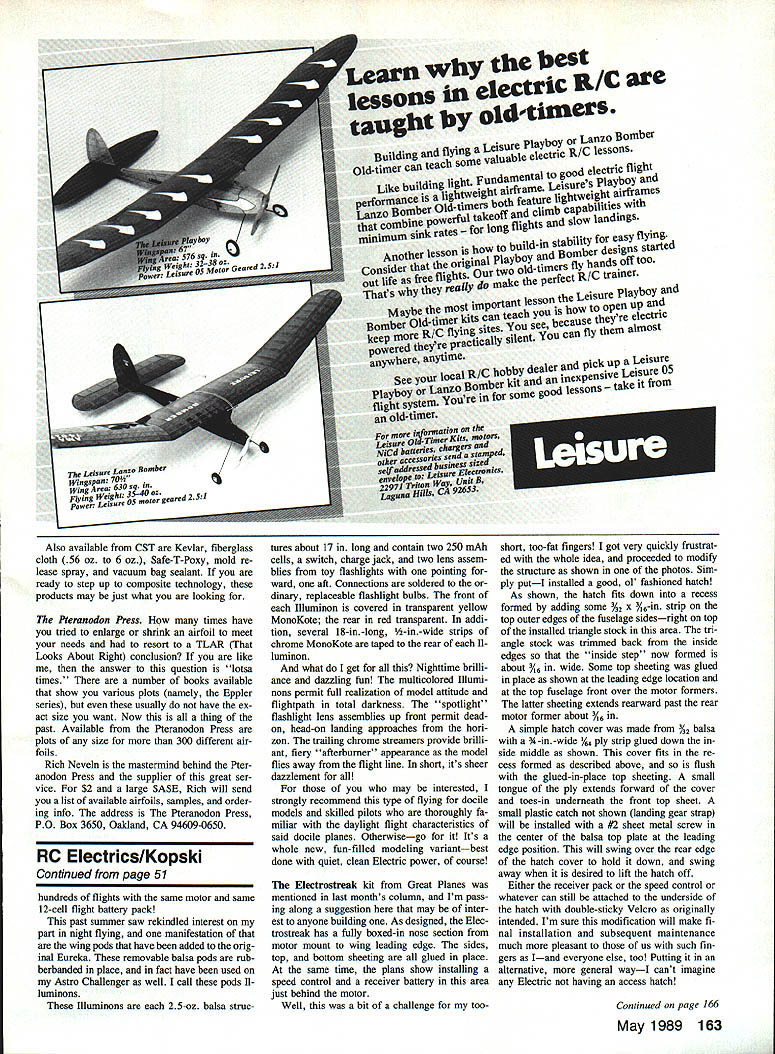
The Electrostreak kit from Great Planes was mentioned in last month's column, and I'm passing along a suggestion here that may be of interest to anyone building one. As designed, the Electrostreak has a fully boxed-in nose section from the firewall to the wing leading edge. The side, bottom and top formers are all glued in place. At the same time, the plans show installing a speed control and a receiver battery in this area just behind the motor.
Well, this was a bit of a challenge for my too-short, too-fat fingers! I got very quickly frustrated with the whole idea, and proceeded to modify the structure as shown in one of the photos. Simply put—I installed a good, old-fashioned hatch!
As shown, the hatch fits down into a recess formed by adding some 3/32 x 3/16-in. strip on top outer edges of the fuselage sides—right on top of the installed triangle stock in this area. The inside stock was trimmed back from the inside edges so that the "inside step" now formed is about 3/16 in. wide. Some top sheeting was glued in place at the leading-edge location at the top fuselage front over the motor former. The latter sheeting extends rearward past the rear motor former about 3/16 in.
A simple hatch cover was made from 3/32 balsa with a 3/8-in.-wide, 1/8-in. ply strip glued down the inside to strengthen it. Ply covers fit over the recess formed as described above and so are flush with the glued-in-place top sheeting. A small tongue of ply then extends rearward from the cover edge at the step area and fits into a slot cut in the hatch rear edge where a cord or small rubber band (landing-gear strap) can be installed to secure the hatch. A #2 sheet-metal screw in the edge of the hatch will hold it down and allow the hatch to be swung off to the side when it is desired to lift it. Either the receiver pack can go in the rearward area under the hatch or the switch can be attached to the hatch with double-sticky Velcro as originally intended.
If this modification makes final installation and subsequent maintenance much more pleasant for those of us who fly electrics—and everyone else, too—then it's well worth the effort. Putting it in an alternative, more general way—I can't imagine any electric model not having an access hatch!
RC Electrics / Kopski
Motor size designations
Motor size designations have become a topical crusade of sorts for this writer during the past nearly two years. My April 1987 column addressed this issue in depth and offered some suggestions for MEANINGFUL motor size descriptions. Since then, hardly a column has passed in which I have not lamented the continuing use of MEANINGLESS motor size designations such as "OH FIVE," "550," "360 ST," and on and on.
Now it happens that a few readers have recently written commenting about my continual lament on this matter, and offering the challenge of, "Why don't you do something about it?"
Well folks—it's working! Almost!
My idea in continuing to needle, prod, and poke on this matter is exactly to invoke such reaction. But the reaction has been misdirected. Reaction should go to the industry—the good folks who make and merchandise the stuff. I (and some other columnists) are simply making known the fact that there is a real need for MEANINGFUL, industry-standardized motor nomenclature. And while in April '87 I made specific suggestions as to what should be used to more accurately describe motor size, it is not my prerogative—or that of other columnists—to attach descriptive labels to existing products. After all, who should be better at it and more responsible to do so than those who make their living making motors?
Now I'm sure the letters I've referred to came from well-meaning folks who, I suspect, missed that April '87 issue, and hence my point was well made. These letters are every bit as welcome as any others, and were answered that way, too. But they would be more useful to us all if they had been directed to the industry—those folks who are positioned to do something about the problem.
It seems that Electric has been and continues to be rapidly advancing—both in terms of available products and modeler interest. Much more Electric merchandise is available now than a year ago, and there are many more fliers and meets as well. But where remains that silly stigma of nonsense nomenclature shrouding mystery and hype around and about model Electric motors. Why? Why is something that's so simple to correct so uncorrected? Doesn't ANYONE in the industry have what it takes to convene a conference and establish a standard agreeable to all? How is it that the world of 1989 is both so technically advanced and regressed at the same time?
Finally, it's January: cold, damp, and designed that way so some building gets done—which is what I'm gonna do now!
Still coming up as previously promised: Giant Electrics, more motor data, and more of everything else Electric, too.
Please direct any comment or question (with SASE please) to the author at the address listed on the opening page of my column. Sending letters to the Model Aviation editorial offices just means that they will have to forward them to me, which slows the whole communication process down!
Happy, quiet landings, everyone!
Transcribed from original scans by AI. Minor OCR errors may remain.

