
Radio Control: Electrics
Bob Kopski
25 West End Dr. Lansdale, PA 19446
GIANT ELECTRICS
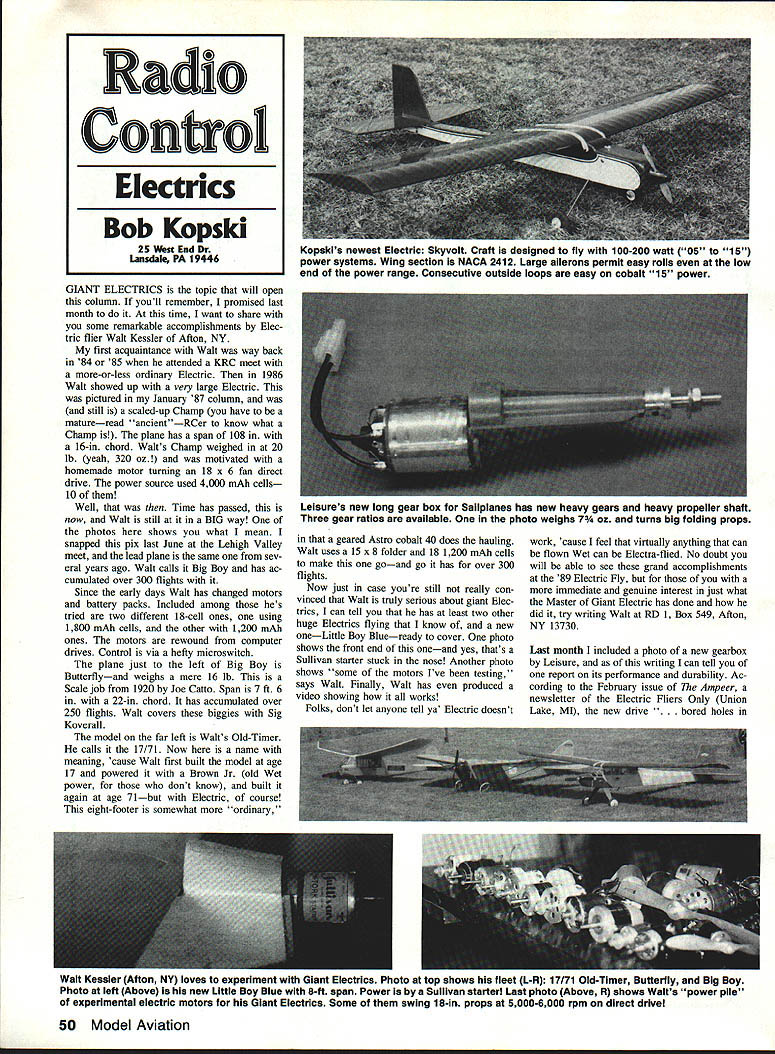
My first acquaintance with Walt Kessler (Afton, NY) goes back to 1984–85 when he attended a KRC meet with a fairly ordinary electric. In 1986 he arrived with a very large electric — a scaled-up Champ pictured in my January 1987 column. Walt still flies that ship, which he calls Big Boy.
Walt Kessler — notable models
- Big Boy
- Scaled-up Champ: 108 in. span, 16 in. chord.
- Weight: about 20 lb (320 oz).
- Original power: homemade motor driving an 18 x 6 fan direct drive; pack of ten 4,000 mAh cells.
- Later changes: different motors and battery packs (including two different 18‑cell packs using 1,800 mAh and 1,200 mAh cells); motors rewound from computer drives; controlled via a hefty microswitch.
- Flights: over 300.
- Butterfly
- Scale job from 1920 (Joe Catto).
- Span 7 ft. 6 in. (90 in.), chord 22 in.
- Weight: about 16 lb.
- Covering: Sig Koverall.
- Flights: over 250.
- Old‑Timer (“17/71”)
- Originally built at age 17 and powered by a Brown Jr.; rebuilt and electric-powered at age 71.
- Eight‑footer; geared Astro Cobalt 40.
- Prop: 15 x 8 folding.
- Batteries: 18 × 1,200 mAh cells.
- Flights: over 300.
- Little Boy Blue
- New plane, ready to fly; one photo shows the front end with a Sullivan starter mounted in the nose.
Walt also showed me photos of several motors he's been testing and has produced a video demonstrating his work. If you want to learn more or correspond, write Walt at: R.D. 1, Box 549, Afton, NY 13730.
Note: I firmly believe virtually anything that has been flown "wet" can be flown electric. Expect to see many of these accomplishments at the 1989 Electric Fly.
LEISURE GEARBOXES AND PRODUCTS
Last month I pictured a new gearbox by Leisure. Since then I've had reports on its performance and durability. Leisure also produces an extended‑length gear drive intended for sailplane installations; it features a new heavy output shaft and heavy gears and is available in at least three gear ratios (in addition to the standard unit).
Leisure is responsible for some favorite Electrics, including the Amptique and the Leisure Playboy (seen in AMA's film "Diamonds in the Sky"). For current catalog information, write Leisure (see the Leisure ad in this issue).
AMPTIQUE AND A WET‑POWER ANECDOTE
Over the past year I've pictured several unusual Amptique derivatives — creative modifications by spirited modelers. In an amusing twist, reader Howell Gwin Jr. (Beaumont, TX), a longtime glow‑fuel flier trying an Amptique as his first electric, ultimately "wet‑powered" his Amptique. He calls the result his O'Stique. Modeling is fun — and it doesn't really matter how you get it up.
If anyone sends me a photo of a rubber‑powered Amptique, I'll be delighted.
CONNECTORS
- CS Flight Systems (Middleboro, MA) now offers small, gold‑plated tubular pin‑and‑socket connectors with a solder cup that accepts up to 15‑gauge wire. They are insulated with heat‑shrink tubing (supplied) and sell for about $3 a pair. CS also publishes a discount catalog of electric goodies; I suggest investing the couple of bucks for a catalog — you'll likely recoup the cost on your first order.
- Sermos connector line has added another color: gray. In addition to red and black, Sermos offers orange, green, white, blue, yellow, and now gray (these less common colors are available directly from Sermos). John Sermos tells me the contacts are specially made for him and are extra heavily silver‑plated, resulting in very low loss and extremely high mating durability. I use them in all my installations.
ELECTROSTREAK MODIFICATIONS
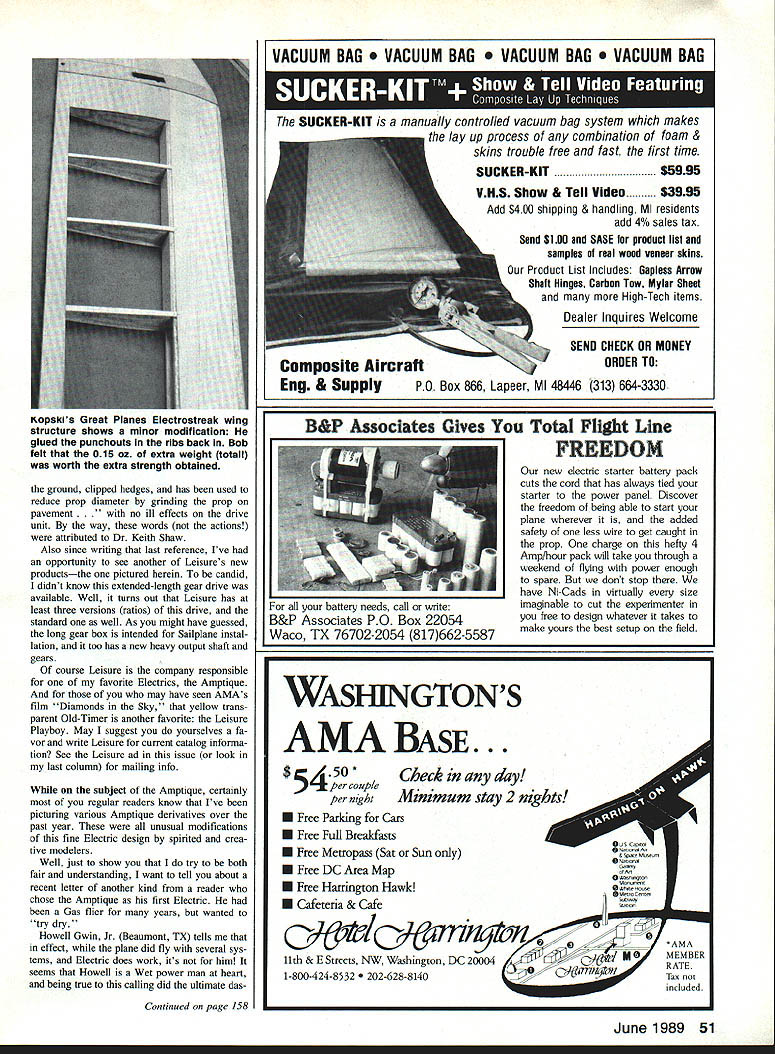
Last month I described a useful installation change to the Great Planes Electrostreak. This month I show another assembly modification: solid wing ribs.
Great Planes is weight conscious; the die‑cut ribs have punch‑out lightening holes, which are commonly left out. I glued the punch‑outs back in to form solid ribs. The total weight of the removed pieces was about 0.15 oz (150 thousandths), so I felt the added strength justified the small weight increase. After zapping the pieces back in I built the wing.
This illustrates the builder's tradeoff: light where it's right, strength where it's needed. I left the Electrostreak fuselage hardware (leadouts and shear‑column type parts) trimmed where appropriate, but reinforced the ribs where I felt it mattered.
ASTRO MODEL 112 CONSTANT‑CURRENT CHARGER
Astro's Model 112 constant‑current charger is now available, replacing the earlier Model 102 DC/DC Super Charger. Price (Astro October 1988 price list): $119.95.
Key specs and features:
- Intended to be powered from a 12‑volt auto battery.
- Capable of charging up to 28 cells.
- Output current: smoothly adjustable up to 5 amps.
- Front panel meters and recommended charge currents/times for cells from 500 to 4,000 mAh.
- Instructions include motor break‑in procedures.
- Equipped with a 15‑minute windup time switch and jacks for a voltmeter to monitor pack voltage.
"Constant‑current" means the charge current you set at the start remains essentially steady throughout the charge — a major improvement over the earlier constant‑voltage unit that required periodic adjustment to hold current steady. Many readers reported much improved Model 102 regulation after following the modifications published in the September/October 1987 issues. I'll be testing the Model 112 on the bench and at the field and will follow up with inside‑out photos and performance curves in a later issue.
NEW ELECTRIC COLUMN AND MY LATEST MODEL
- Another electric column is coming to RC Report, coauthored by Dr. John Mountjoy and Charlie Spear, both familiar names and regulars at the KRC meet.
- My latest electric (unnamed) is a 50‑in. model with a NACA 2412 section and is a "full house" installation. It is about the same size as many newer trainers (Mirage, Aero‑electric, PT, etc.) but is not intended to be a trainer.
Design and power:
- Intended for 100–200 watt power systems (Cobalt 05/15, similar systems).
- Battery compartment accepts corresponding packs (six or seven cell systems typical).
- Early flights: two systems trialed in poor weather — a Cobalt 15 with twelve 900 mAh cells, and a Great Planes Gold Fire on seven 1,200 mAh cells — both flew very nicely. More details to follow.
SENDING MAIL AND PHOTOS
Please send mail and photos directly to me (address at the top of this column). Sending material to the magazine editorial offices only slows things down because someone must forward it to me here in Lansdale.
EVENTS
The Boeing Racks RC Fliers of Kent, WA, announce the Seventh Annual Electric Fly‑In, scheduled for June 24–25, 1989 at the Boeing Kent Space Center Field. Activities and prizes include Most Aerobatic, Best Scale, Longest Flight, Class A Sailplane (AMA Event No. 509), and Best Multimotor.
Contact for more information: Bernard Cawley 29388 48th Ave. S. Auburn, WA 98001 Phone: (206) 839‑9157
Happy springtime (or anytime). Electric landings!
Transcribed from original scans by AI. Minor OCR errors may remain.

