
Radio Control: Electrics
Bob Kopski
25 West End Dr. Lansdale, PA 19446
Last issue opened with some meet announcements including one for the Second Annual Electrifest hosted by the Slo Fliers of the Morro Bay, CA area. At the time I had very little info to pass along, but now I have more details.
This meet is a serious contest (as compared with the fun-fly format) and includes these events:
- 7-cell Sailplane
- 7-cell Old-Timer
- Unlimited Sailplane
- Unlimited Old-Timer
- Pylon
- Pattern
- Sport Scale
The first four events above will be flown in four rounds beginning at 9:00 a.m. on Saturday. Based on the literature I received, there will be significant prizes to be won and the possibility of a dinner/social on Saturday. Pre-registration is $10 until August 1; $15 thereafter. Please contact CD Cal Drake, Box 1557, Morro Bay, CA 93442 for more info. Tell ’im Bob sent ya!
This sure makes it sound like that weekend is well covered at each end of the country with great meets, since the 10th Annual KRC Electric Fly is on the same weekend in Pennsylvania. Good luck and happy landings to everyone attending both activities.
The Gulf States Electric Fly-In is scheduled for Saturday, September 30 and Sunday, October 1. It is sponsored by the Tammany Aero Club. The event is for anything electric and features:
- a Scale event (AMA rules)
- demonstration flights
- workshops
- swap shops
- concession stand
- awards and prizes for several fun categories
- a free Cajun cookout for all contestants and their families
The flying site is the Tammany Aero Club Field, Goodbee, LA. For more information contact Boyd O'Brien, P.O. Box 7153, Metairie, LA 70010; telephone 1-504/835-5212. You can also contact Ben Mathews, 101 Mulberry Dr., Metairie, LA 70005; telephone 1-504/833-5589.
Tentative plans are underway for a two-day electric meet in Cape Cod. Dates will be October 28–29. Sounds like a good time for orange-and-black planes! This early word is from Charlie Sylvia of CS Flight Systems. I’ll let you all know if this materializes and what the details are—so keep readin’ this column!
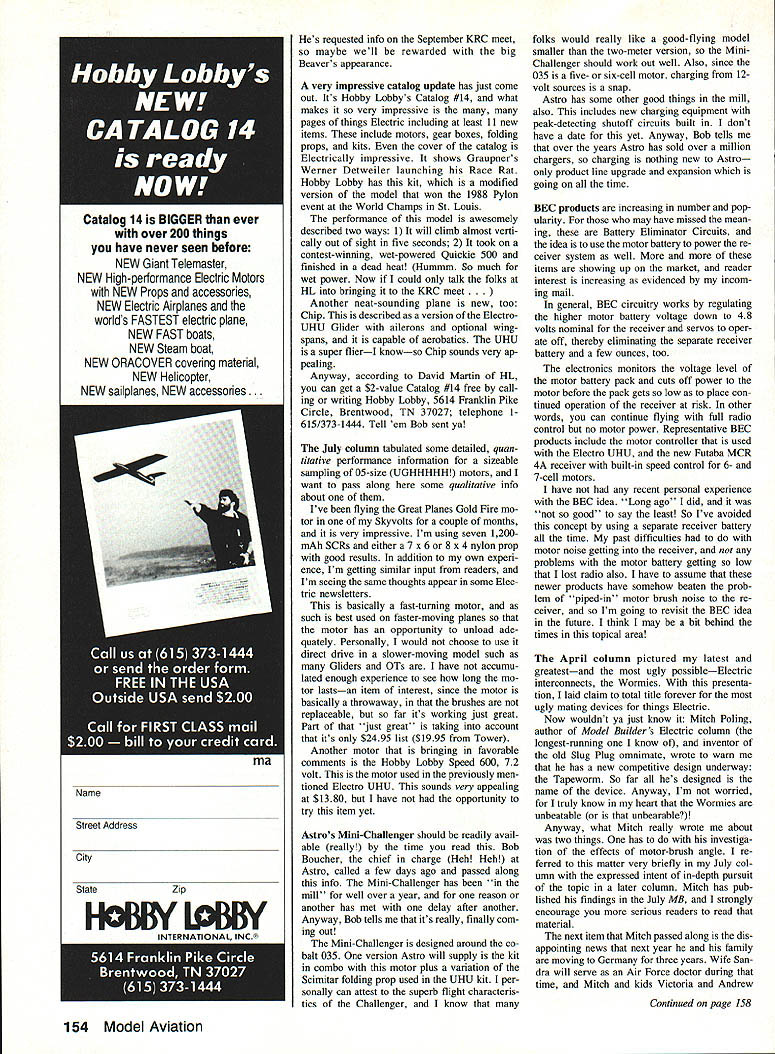
The ElectroStreak by Great Planes was mentioned in my May and June columns this year, and the May column brought in a response from Tom Stryker, the designer of the model. Tom wrote to say some kind things about the ElectroStreak. He likes the additional access hatches on the plane: a bottom forward hatch between F2 and F3 allows access to the motor and speed control; a rear hatch aft of F4 allows access to the servos.
Tom himself has two kit-built Streaks. The hatches shown are located on the bottom of the model and are made of 1/16" ply. The stock model is set up for landing gear also, but Tom doesn’t use it all the time. Tom feels that the bottom hatches are preferred because it’s easier to more fully streamline the top deck behind the motor that’s built solid. What can I say? The ElectroStreak is better off with hatches—according to both Tom and me.
Tom went on to discuss the possibility of a large Southeastern Electric meet next year in Florida. A possible location would be RC World, which has extensive facilities. Tom explained the intent to make the meet national in scope. Right now it is in the very early planning stages; but as details firm up I’ll pass along everything I know in this column. Best wishes to Tom et al. in the planning.
Another ElectroStreak photo this month has some interesting info to go along with it. This one was built by Kurt Klingebiel of Silver Spring, MD. Kurt built his without a rudder to save some weight. Beyond that, he is experimenting with different seven-cell packs which include 1200 mAh SCRs and SR 1800s. The SR 1800s, at about the same weight, fly full bore five minutes. The SR 1250 gives about three minutes full out—about the same time given SCRs.
With the first two packs the all-up weight is about 36 oz. This drops to about 31 oz. with the SR 1250 pack. Kurt says that this latter pack and lighter weight allows his Streak to “zip along,” and that the SR battery’s performance is impressive.
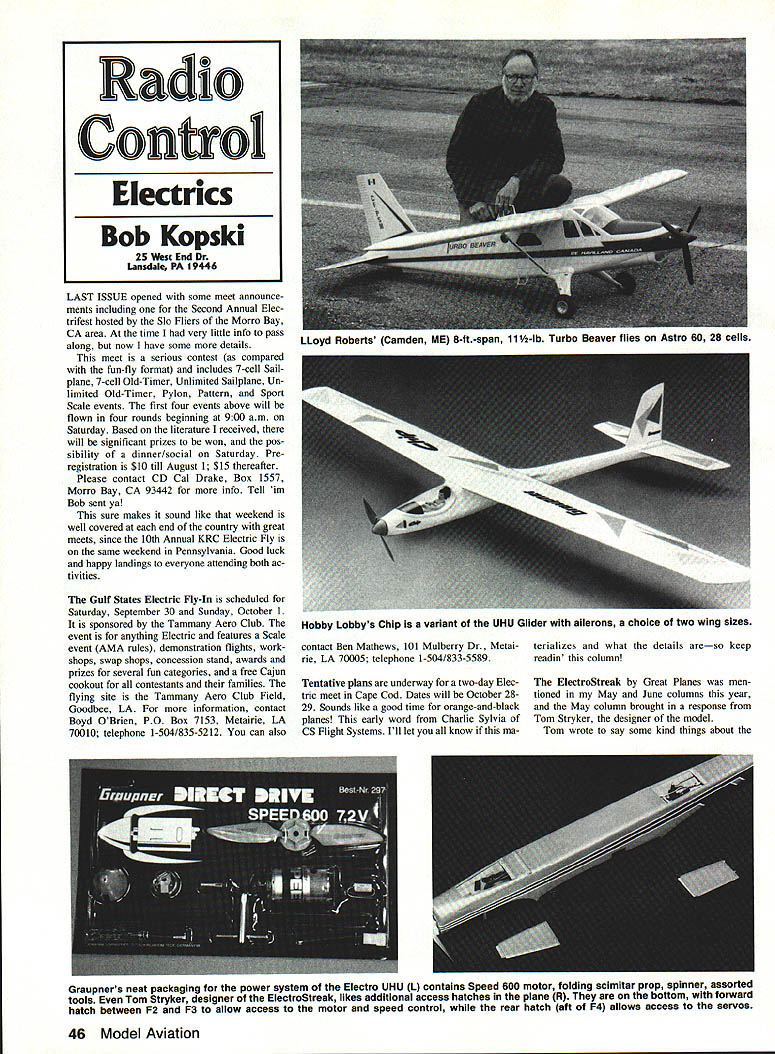
Giant electrics was the opening topic of the June column, and this month prodded Lloyd Roberts (Camden, ME) to send a photo of his very impressive 8-ft.-span Turbo Beaver. This 11-1/2-lb. model is motorized with an Astro 60 on 28 cells, and Lloyd says that the first flights are very promising. In his opinion, “Giant Scale Electric is neat.” He’s requested info on the September KRC meet, so maybe we’ll be rewarded with the big Beaver’s appearance.
A very impressive catalog update has just come out: Hobby Lobby’s Catalog #14. What makes it so impressive is the many pages of electric items including at least 11 new products—motors, gear boxes, folding props, and kits. Even the cover of the catalog is electrically impressive. It shows Graupner’s Werner Detweiler launching his Race Rat. Hobby Lobby has this kit, a modified version of the model that won the 1988 Pylon event at the World Champs in St. Louis.
The performance of this model is awesomely described two ways:
- It will climb almost vertically out of sight in five seconds.
- It took on a contest-winning, vet-powered Quickie 500 and finished in a dead heat!
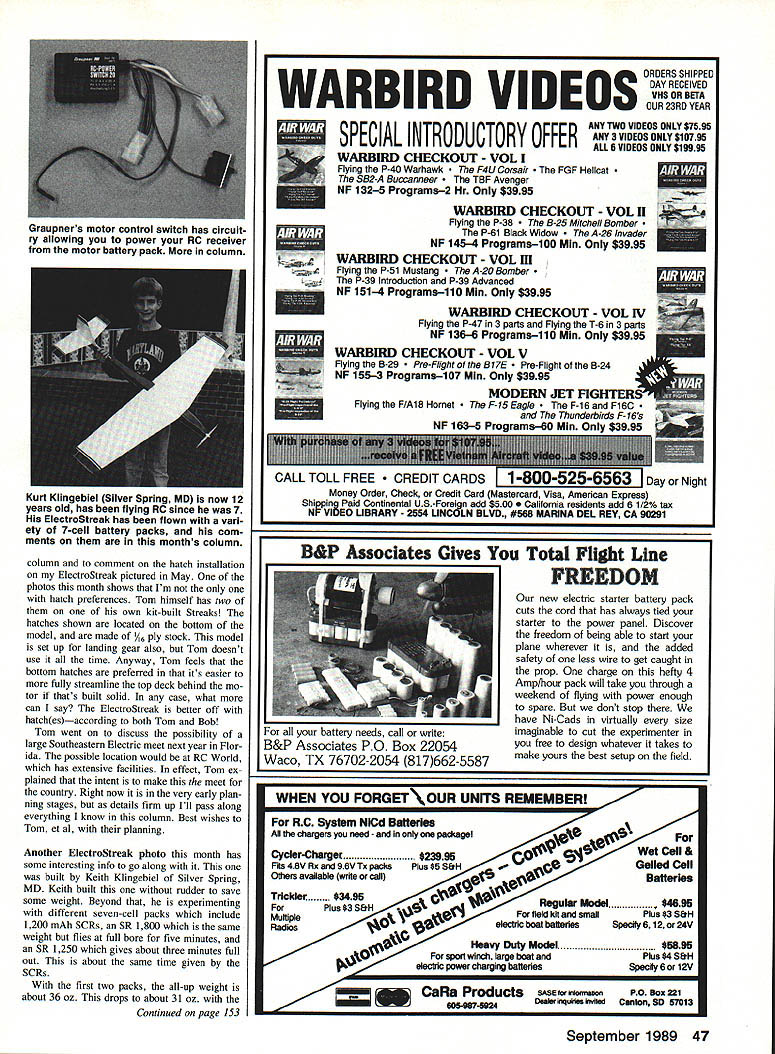
Another neat-sounding plane is new, too: Chip. This is described as a version of the Electro-UHU glider with ailerons and optional wing spans, and it is capable of aerobatics. The UHU is a super flier—I know—so Chip sounds very appealing.
According to David Martin of Hobby Lobby, you can get a $2-value Catalog #14 free by calling or writing Hobby Lobby, 5614 Franklin Pike Circle, Brentwood, TN 37027; telephone 615/373-1444. Tell ’em Bob sent ya!
The July column tabulated some detailed, quantitative performance information for a sizeable sampling of 05-size (UGHHHHH!!) motors, and I want to pass along some qualitative info about one of them.
I’ve been flying the Great Planes Gold Fire motor in one of my Skyvolts for a couple of months, and it is very impressive. I’m using seven 1,200-mAh SCRs and either a 7 x 6 or 8 x 4 nylon prop with good results. In addition to my own experience, I’m getting similar input from readers, and I’m seeing the same thoughts appear in some electric newsletters.
This is basically a fast-turning motor, and as such is best used on faster-moving planes so the motor has an opportunity to unload adequately. Personally, I would not choose to use it direct drive in a slower-moving model such as many gliders and OTs are. I have not accumulated enough experience to see how long the motor lasts—an item of interest, since the motor is basically a throwaway in that the brushes are not replaceable—but so far it’s working just great. Part of that “just great” is taking into account that it’s only $24.95 list ($19.95 from Tower).
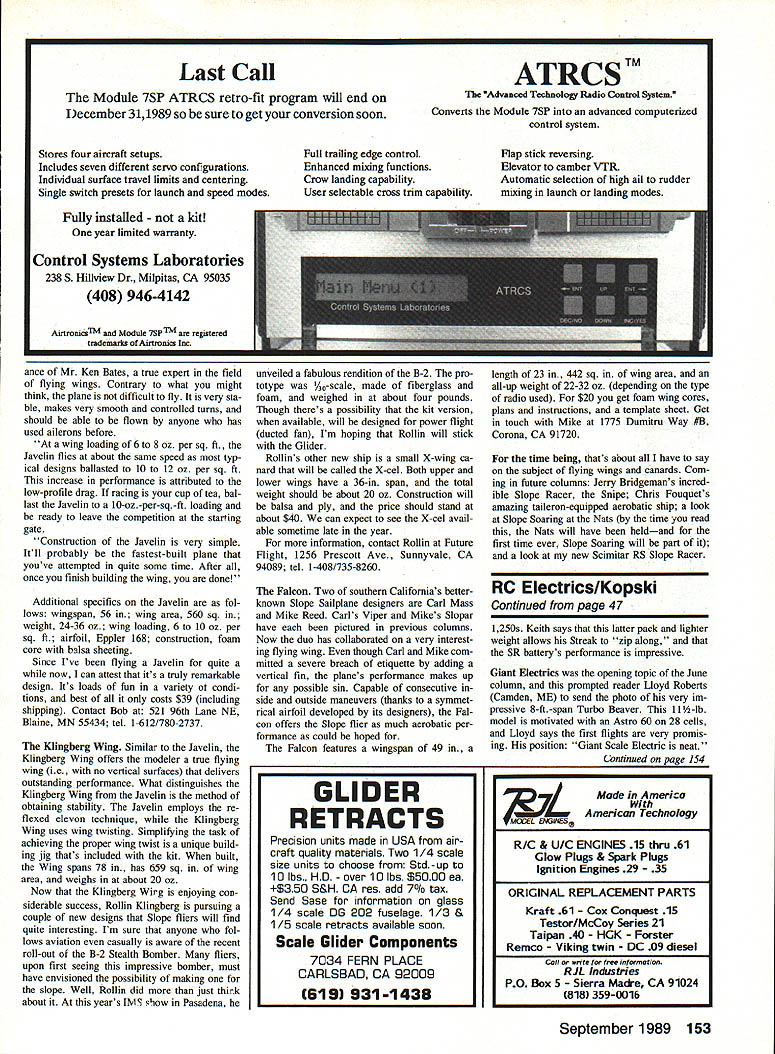
Another motor that is bringing favorable comments is the Hobby Lobby Speed 600, 7.2 volt. This is the motor used in the previously mentioned Electro UHU. This sounds very appealing at $13.80, but I have not had the opportunity to try this item yet.
Astro’s Mini-Challenger should be readily available (really!) by the time you read this. Bob Boucher, the chief in charge (Heh! Heh!) at Astro, called a few days ago and passed along this info. The Mini-Challenger has been “in the mill” for well over a year and met with one delay after another. Anyway, Bob tells me that it’s really, finally coming out!
The Mini-Challenger is designed around the .035. One version Astro will supply is the kit in combo with this motor plus a variation of the Scimitar folding prop used in the UHU kit. I personally can attest to the superb flight characteristics of the Challenger, and I know many folks would really like a good-flying model smaller than the two-meter version, so the Mini-Challenger should work out well. Also, since the .035 is a five- or six-cell motor, charging from 12-volt sources is a snap.
Astro has other good things in the mill, including new charging equipment with peak-detecting shutoff circuits built in. I don’t have a date for this yet. Over the years Astro has sold over a million chargers, so charging is nothing new to Astro—only product line upgrade and expansion which is going on all the time.
BEC products are increasing in number and popularity. For those who may have missed the meaning, these are Battery Eliminator Circuits, and the idea is to use the motor battery to power the receiver systems as well. More and more of these items are showing up on the market, and reader interest is increasing as evidenced by my incoming mail.
In general, BEC circuitry works by regulating the higher motor battery voltage down to 4.8 volts nominal for the receiver and servos to operate off, thereby eliminating the separate receiver battery and saving a few ounces. The electronics monitor the voltage level of the motor battery pack and cut off power to the motor before the pack gets so low as to place continued operation of the receiver at risk. In other words, you can continue flying with full radio gear control but no motor power. Representative BEC products include the Electro-UHU and the new Futaba MRC 4A receiver with built-in speed control for 6- and 7-cell motors.
I have not had recent personal experience with the BEC idea. “Long ago” I did, and it was “not so good,” so I’ve avoided this concept by using a separate receiver battery all the time. My past difficulties had to do with poor noise getting into the receiver, and not many problems with the motor battery getting low so that the receiver would die. I assume these newer products have somehow beaten the problems of “piped-in” motor brush noise to the receiver, so I’m going to revisit the BEC idea in the future. I think I may be a bit behind the times in this topical area!
The April column pictured my latest—and the most ugly possible—electric interconnectors, the Wormies. With this presentation I did claim to tailor forever for the use of ugly mating devices for things electric.
Now wouldn’t you just know it: Mitch Poling, editor of Model Builder’s Electric column (the longest-running one I know of) and inventor of the old Splug Plug connector, wrote to warn me that he has a new connector design underway: the Tapeworm. So far all he’s designed is the name for the device. Anyway, I’m not worried, for I truly know in my heart that the Wormies are unbeatable!?
Mitch actually wrote to me about two things. One has to do with his investigations of the effects of motor-brush noise. I referred to this matter very briefly in my July column with the expressed intent of pursuing the topic in depth in a later column. Mitch has published his findings in the July Model Builder, and I strongly encourage more serious readers to read that material.
The next item Mitch passed along is the disappointing news that next year he and his family are moving to Germany for the Air Force during that time, and Mitch and kids Victoria and Andrew are tagging along. (Sorry to see you leave this soil, folks.) The good news is that his Model Builder Electric column will continue and will take on some European flavor, ’cause they will be living in Wiesbaden, which Mitch describes as being near the heart of electro-flying in Europe.
I feel deeply indebted to Mitch, since his early electric writings (about 18 years ago) were one key factor in my getting seriously interested in electrics. My first successful electric flight was in the February/March timeframe of 1972—quite some time past Mitch’s. My interest and pursuit eventually led to my association with MA, the “All About Electrics” series in 1983/84, this column, and some feature articles along the way. Indeed, this very issue marks the beginning of my sixth writing year.
Thank you, Mitch. I wish you all well.
Please forward any comment or question (with SASE, please) to the author. My name and address appear at the column heading.
Late news: The Winston-Salem Radio Control Club, Inc. (of North Carolina) has announced its third annual Electric fly-in scheduled for August 19–20, 1989. The event includes an All-Up/Last-Down with cash prizes, plus prizes for Most Acrobatic and Beauty. Contact CD Charles Spear, 288 Holly Lane, Mocksville, NC 27028.
More late news: CS Flight Systems (see their ad) has new Sanyo 1800 SCRs in stock at $6.50 each. These sound like winners to me: they weigh 60 grams (1200s weigh 51 grams) and have a height of 49 mm (1200s are 51 mm), which is a lot more juice in a can that is only a little bit bigger. Tell ’em Bob sent ya!
Quiet, safe, and happy electric landings, everyone!
Transcribed from original scans by AI. Minor OCR errors may remain.

