
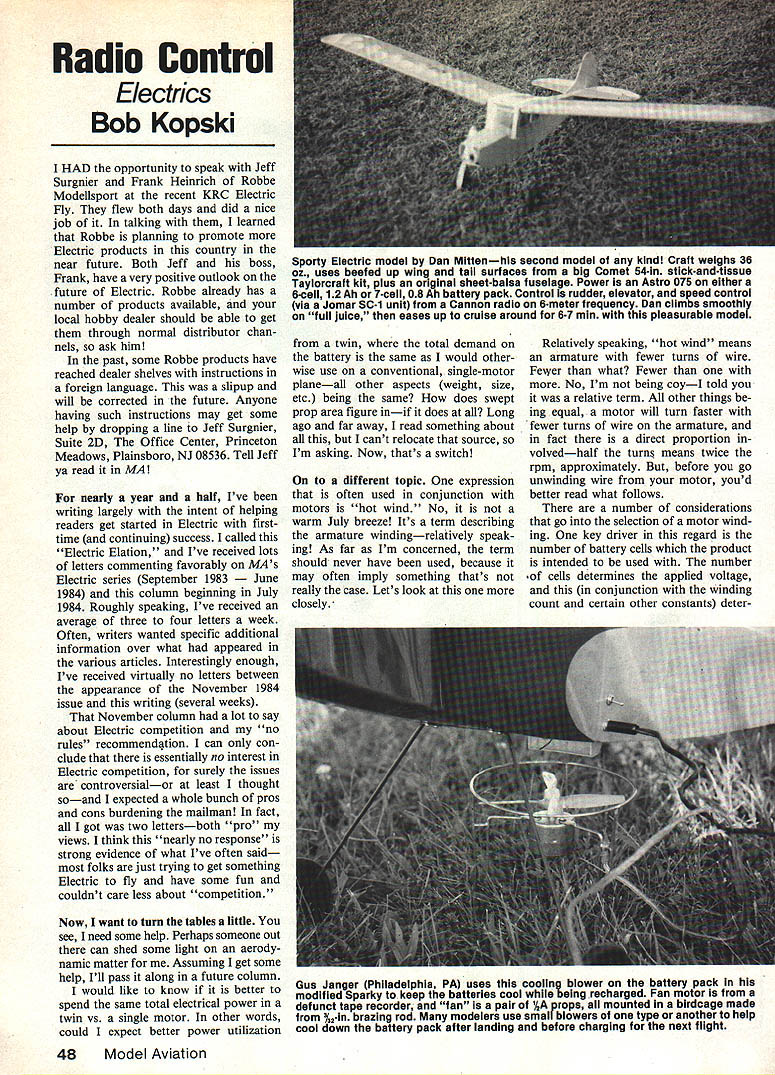
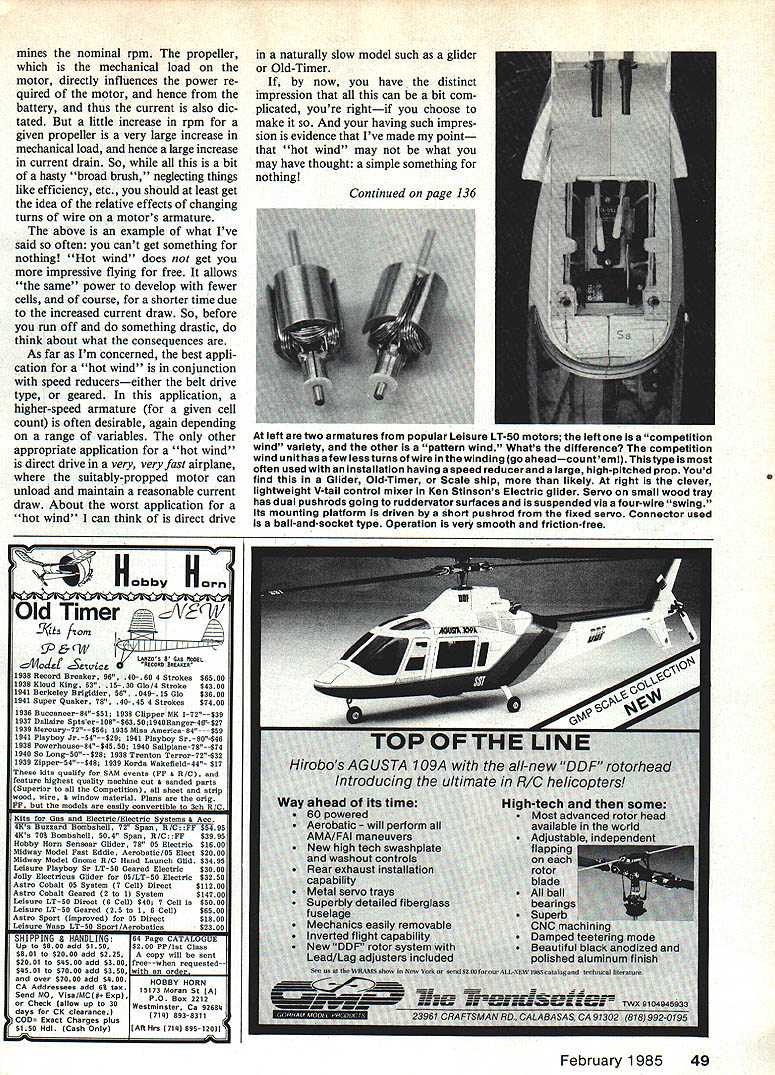
Radio Control: Electrics
Bob Kopski
Robbe Modelsport and Electric products
I had the opportunity to speak with Jeff Surgnier and Frank Heinrich of Robbe Modelsport at the recent KRC Electric Fly. They flew both days and did a nice job of it. In talking with them, I learned that Robbe is planning to promote more electric products in this country in the near future. Both Jeff and his boss, Frank, have a very positive outlook on the future of electric flight. Robbe already has a number of products available, and your local hobby dealer should be able to get them through normal distributor channels—so ask him!
In the past, some Robbe products reached dealer shelves with instructions in a foreign language. This was a slipup and will be corrected in the future. Anyone having such instructions may get some help by dropping a line to Jeff Surgnier, Suite 2D, The Office Center, Princeton Meadows, Plainsboro, NJ 08536. Tell Jeff you read it in MA!
Reader response and background
For nearly a year and a half I’ve been writing largely to help readers get started in electric flight with first-time (and continuing) success. I called this series "Electric Elation," and I’ve received lots of letters commenting favorably on MA’s electric series (September 1983 — June 1984) and this column beginning in July 1984. Roughly speaking, I’ve received an average of three to four letters a week. Often, writers wanted specific additional information beyond what had appeared in various articles.
Interestingly, I received virtually no letters between the appearance of the November 1984 issue and this writing (several weeks). That November column had a lot to say about electric competition and my "no rules" recommendation. I can only conclude that there is essentially no interest in electric competition; surely the issues are controversial—or at least I thought so—and I expected a whole bunch of pros and cons burdening the mailman. In fact, all I got was two letters—both "pro" my views. I think this near lack of response is strong evidence of what I’ve often said—most folks are just trying to get something electric to fly and have some fun and couldn’t care less about "competition."
A question for readers: twin vs. single motor power utilization
Now I want to turn the tables a little. I need some help. Perhaps someone out there can shed light on an aerodynamic matter for me. Assuming I get some help, I’ll pass it along in a future column.
My question: is it better to spend the same total electrical power in a twin as in a single motor? In other words, could I expect better power utilization from a twin, where the total demand on the battery is the same as I would otherwise use on a conventional single-motor plane—all other aspects (weight, size, etc.) being the same? How does swept propeller area figure in—if it does at all? Long ago and far away I read something about this, but I can’t relocate the source. I’m asking. Now, that’s a switch!
Motor winding: what "hot wind" really means
One expression often used in conjunction with motors is "hot wind." No, it is not a warm July breeze—it's a term describing the armature winding, relatively speaking. As far as I’m concerned, the term should never have been used, because it may often imply something that’s not really the case. Let’s look at this more closely.
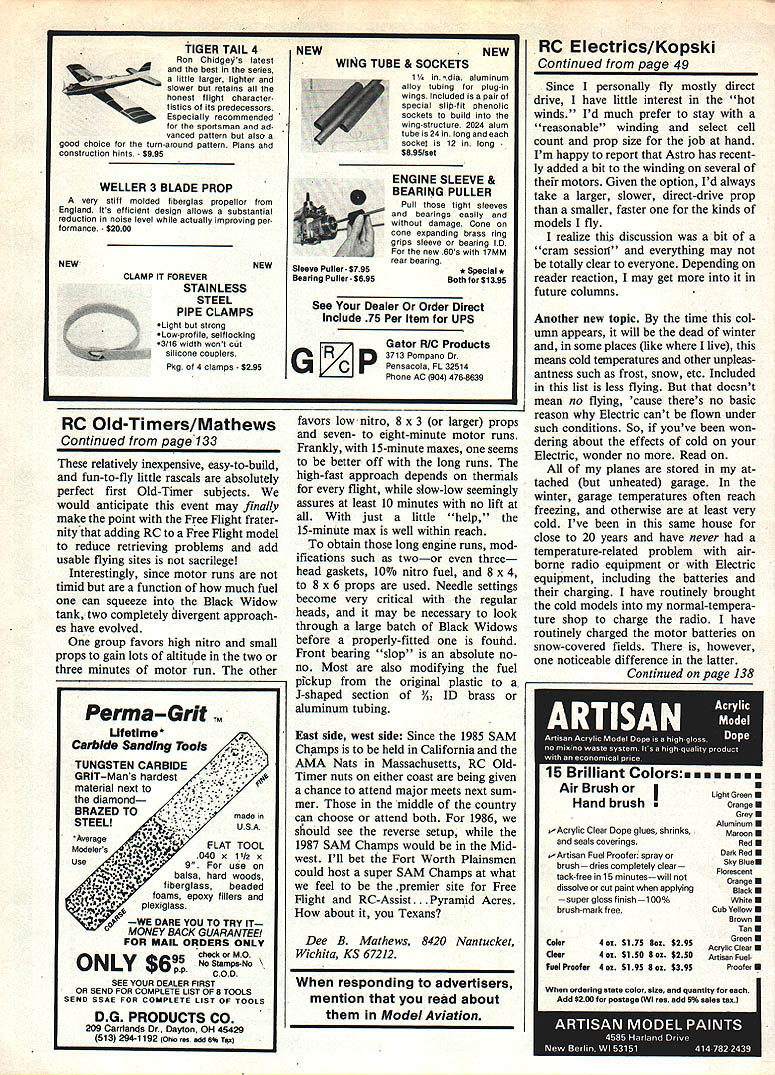
Relatively speaking, "hot wind" means an armature with fewer turns of wire. Fewer than what? Fewer than an armature with more turns. I told you it was a relative term. All other things being equal, a motor will turn faster with fewer turns of wire on the armature, and in fact there is a direct proportion involved—half the turns means approximately twice the rpm. But before you go unwinding wire from your motor, read what follows.
There are a number of considerations that go into the selection of a motor winding. One key driver is the number of battery cells the product is intended to be used with. The number of cells determines the applied voltage, and this, in conjunction with the winding count and certain other constants, determines the motor’s performance characteristics.
The propeller mechanical load on the motor directly influences the power required of the motor, hence the battery and the current drawn. A small increase in rpm with a given propeller can cause a very large increase in mechanical load, and hence a large increase in current drain. So it’s hasty to make broad-brush statements while neglecting things like efficiency.
The above is an example of what I’ve said so often: you can’t get something for nothing! "Hot wind" does not get you more impressive flying for free. It allows the "same" power to develop with fewer cells, and of course for a shorter time due to the increased current draw. So, before you run off and do something drastic, think about the consequences.
Important considerations when selecting a winding:
- Number of battery cells (applied voltage)
- Winding count
- Propeller load and propeller rpm
- Motor and system efficiency
- Intended application (direct drive vs. geared/reduced drive)
Appropriate and inappropriate applications for "hot wind":
- Best application: in conjunction with speed reducers—either belt drive or geared—where a higher-speed armature (for a given cell count) is often desirable.
- Other appropriate application: direct drive in a very, very fast airplane, where the suitably propped motor can unload and maintain a reasonable current draw.
- Worst application: direct drive in a naturally slow model such as a glider or Old-Timer.
If by now you have the distinct impression that all this can be complicated, you’re right—if you choose to make it so. Your having that impression is evidence I’ve made my point—that "hot wind" may not be what you thought: a simple something-for-nothing!
Since I personally fly mostly direct drive, I have little interest in the "hot wind." I’d much prefer to stay with a reasonable winding and select cell count and prop size for the job at hand. I’m happy to report that Astro has recently added a bit to the winding on several of their motors. Given the option, I’d always take a larger, slower, direct-drive prop than a smaller, faster one for the kinds of models I fly.
I realize this discussion was a bit of a cram session and everything may not be totally clear to everyone. Depending on reader reaction, I may get more into it in future columns.
Cold-weather flying
By the time this column appears it will be the dead of winter and, in some places (like where I live), this means cold temperatures and other unpleasantness such as frost and snow. Included in this list is less flying. But that doesn’t mean no flying—there’s no basic reason why electric can’t be flown under such conditions. So, if you’ve been wondering about the effects of cold on your electric gear, wonder no more.
All of my planes are stored in my attached (but unheated) garage. In winter garage temperatures often reach the freezing mark and otherwise are at least very cold. I’ve been in this same house for close to 20 years and have never had a temperature-related problem with airborne radio equipment or with electric equipment, including the batteries and their charging. I have routinely brought the cold models into my normally-tempered shop to charge the radio. I have routinely charged the motor batteries on snow-covered fields. There is, however, one noticeable difference in the latter.
It is common experience, even in normal temperatures, for the day’s first flight to be not as good as those thereafter: the first charge of the day doesn’t seem "as good" as those that follow. While I never viewed this phenomenon as temperature-related, I often referred to it as a "warm-up." However, the situation changes for the cold-storage conditions described above. The first charge really is a "warm-up," as may be the second and even the third. There is no question about it: that first very cold flight is likely to be quite a bit more sluggish than the second, and possibly the third. Thereafter, while your fingers may be freezing, the motor battery behavior seems perfectly normal because I think the batteries are warm (not hot) from use and have "forgotten" the cold week in the garage! More than once I have experienced a significant power increase in flight as the batteries warmed up, and this at a time when I’d expect some drop in power due to normal charge depletion.
By the way, winter air around here is the best air of the year for flying. It may be uncomfortable, but cold, dry, dense air sure makes a plane fly great. Models seem light and buoyant and are likely to have significantly longer motor runs because it seems the plane "weighs less" and less power is expended keeping the plane up; more power is available to make the plane go. And, as you may have guessed, this condition has a dual—or opposite. The worst flying air is the thin, humid, hot air of summer. All models, electric or not, are affected by both extremes.
Another incidental note: while the planes are stored in my garage, my flight box is kept inside at normal temperatures. It contains a lead/acid, tractor-size battery for "fuel," and I prefer to keep that at more familiar temperatures. I guess it’s the memories of those hard car starts on cold mornings!
Encouraging local Electric fly-ins
While many readers are loners in their immediate areas, some areas are enjoying small groups of fliers, even if just two or three persons. I’d like to encourage these scattered groups to consider hosting an Electric fly-in this upcoming year. This column will help by announcing their intentions.
Don’t worry about making a big deal of it. Forget "events." Forget prizes. Forget anything that sounds like work, except of course for sending information to incoming inquiries. Just make it a "come fly with us" day or weekend. All you have to do is share yourselves, your electric interests, and your field. No doubt there are several loners or small groups within easy traveling distance just dying to find someone else to share their interests with. Think it over, and send me the information. Remember, it takes a few months to get into print, so get moving now!
Happy landings.
Bob Kopski 25 West End Dr. Lansdale, PA 19446
Transcribed from original scans by AI. Minor OCR errors may remain.

