
Radio Control: Electrics
Bob Kopski 25 West End Dr. Lansdale, PA 19446
THIS MONTH'S TOPICS:
- Electric Connection Service (two offerings)
- Electric products info (RJM, Astro, Leisure, Hobby Lobby, Concept Models)
- Errata in January '90 MA (Skyvolt landing gear / iron-on cloth; KRC meet)
- Skyvolt questions/answers (nature of Skyvolt design)
- Comment column technical content includes more "high rate/frame rate" info
- An unusual motor development (this one has NO magnets)
Electric Connection Service (ECS)
HEAR THIS: The Electric Connection Service has some information for folks in the greater Pittsburgh, PA area.
There is an active and growing electric club in the area called WESS — the Westmoreland Electric Soaring Society. I’ve met a number of these folks at the annual KRC meet, and they fly a wide variety of electrics (the club name may mislead you into thinking it’s glider-only). WESS publishes an excellent monthly newsletter named Watts Current.
For more information contact:
- Neil Rossi, Vice President, WESS
3947 Murry Highlands Circle, Murrysville, PA 15668 Tel: 1-412-327-8741
WESS includes RJM’s Bob Markle among its members. Aside from acting as WESS President, Bob Markle (RJM) manufactures a fine line of electric accessories.
Also: David Lindsey is looking to communicate with modelers interested in converting glow-powered designs to cleaner, quieter electric power, particularly "40"-sized designs. Contact:
- David Lindsey
4440 E. 117th Ave., Thornton, CO 80233 Tel: 1-303-450-0779
Reminder: The ECS is for individuals and clubs wanting to find other electric fliers in their area. Send your information in writing if you want to be listed.
Electric Products & Industry News
RJM
- Introducing a gearbox for 25 / 40 / 60 Cobalts (yes, for "60"). Price: $75. The design follows RJM’s earlier boxes for the 05 / 15.
- A new Fly/No-Fly tester — a simple plug-in box with LED indicators to show if you have enough radio battery left to fly safely.
RJM contact: Unit #3 Sandy Hill Run RD #6, Irwin, PA 15642 (Bob Markle).
Astro
- Astro will soon add a new speed control (Part No. 205). Early word is it will be an optically coupled, high-rate configuration for best power-system efficiency and will include a brake function.
- The braking is planned to be implemented with a bank of P‑type MOSFETs wired to use energy otherwise dissipated during braking to charge the battery (this will only extend flight by a few seconds, not indefinitely). Expect early units soon.
Midwest Products
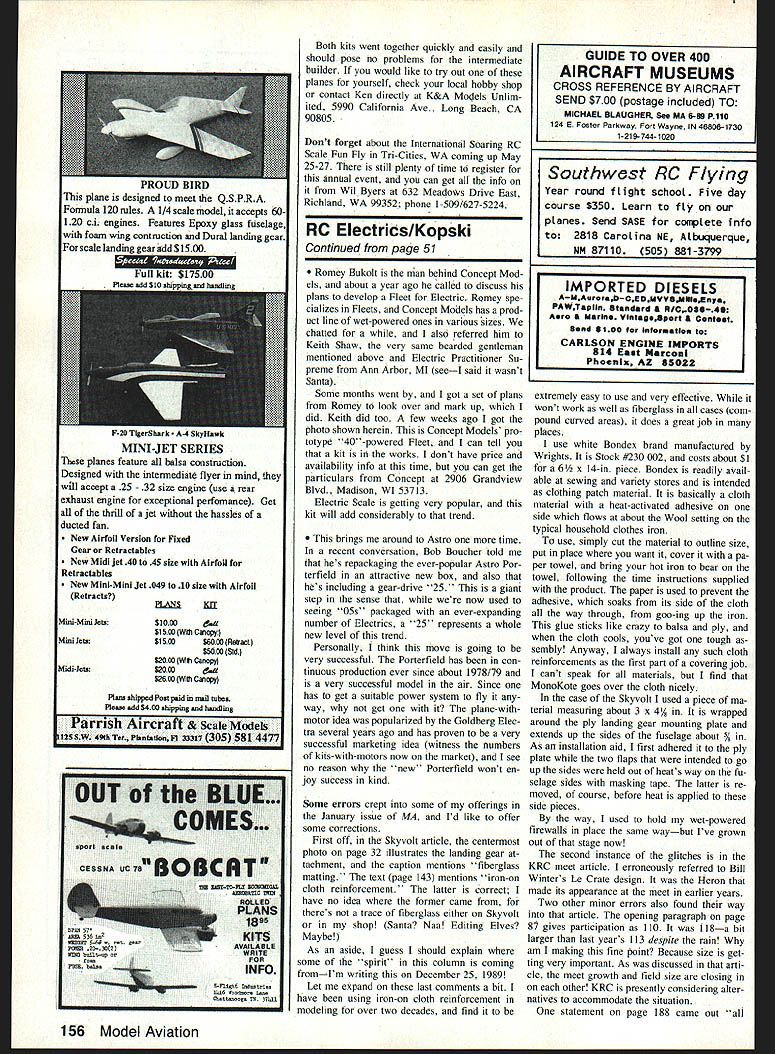
- Introduced the Electric Hots — the quietest member of its Hots line. Tom Stryker’s design originally appeared as a construction article in the Aug. ’89 issue of Model Aviation. Kit comes complete with an HP 100 motor. Price: $114.95.
Leisure
- Word has it Leisure has improved its gearbox output gears. The latest output gear design is thicker and dark gray in color. Leisure now prints the gear ratio on the gear, rather than indicating ratio by color. These are reported to be the best Leisure gears yet.
Elden-Ken / Stone Electronics
- Elden-Ken Electronics will become Stone Electronics starting the new year. New address:
1175 W. 17th Ave., #201, Lakewood, CO 80215 Tel: 1-303-234-0522
- They offer a line of five different speed controls, available as kits or assembled/tested versions. Prices range from $32 to $55.95.
Hobby Lobby
- Hobby Lobby introduced several new products after making a favorable impression at the ’89 KRC Electric Fly. New items include planes, gear drives, motors, folding props, prop adapters, and cones.
- Catalog #15 (free) contains full details and a full-color photo of Dave Martin holding the first-place plaque and plane (ASW-22BE) from the 1989 KRC Electric Fly.
Hobby Lobby contact: 5614 Franklin Pike Circle, Brentwood, TN 37027 Tel: 1-615-373-1444
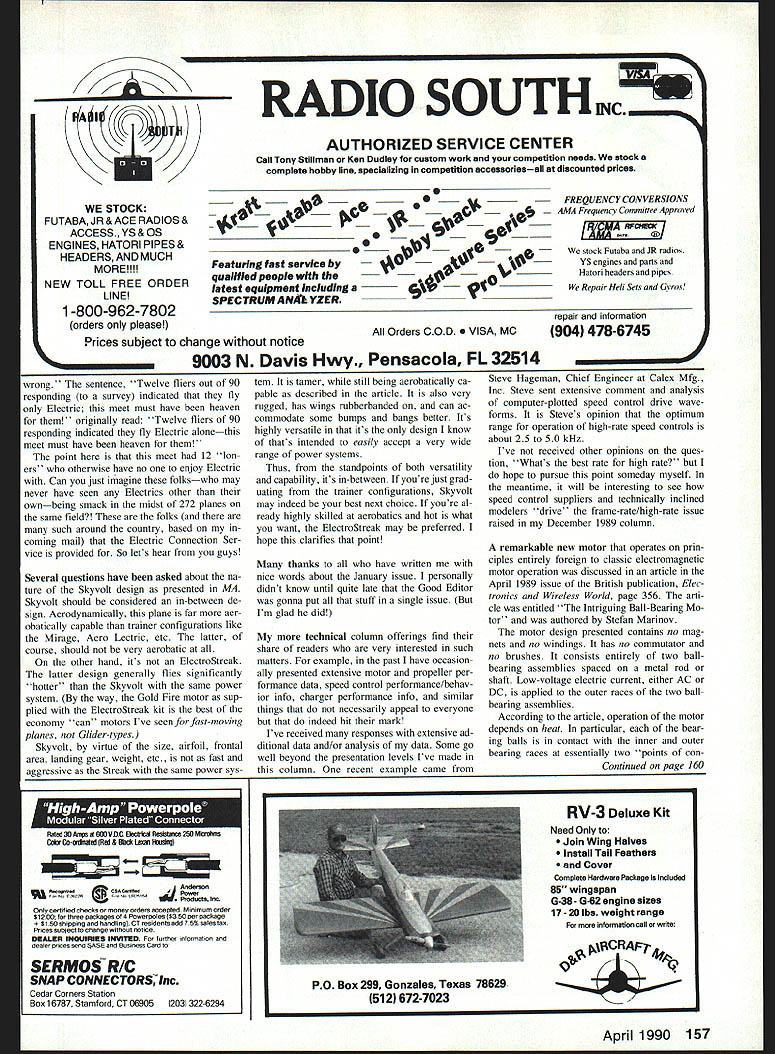
- Note: Hobby Lobby’s ET200 Electric Sailplane kit comes completely built and covered. Wingspan 78", power system with folding prop similar to the successful UHU.
Concept Models
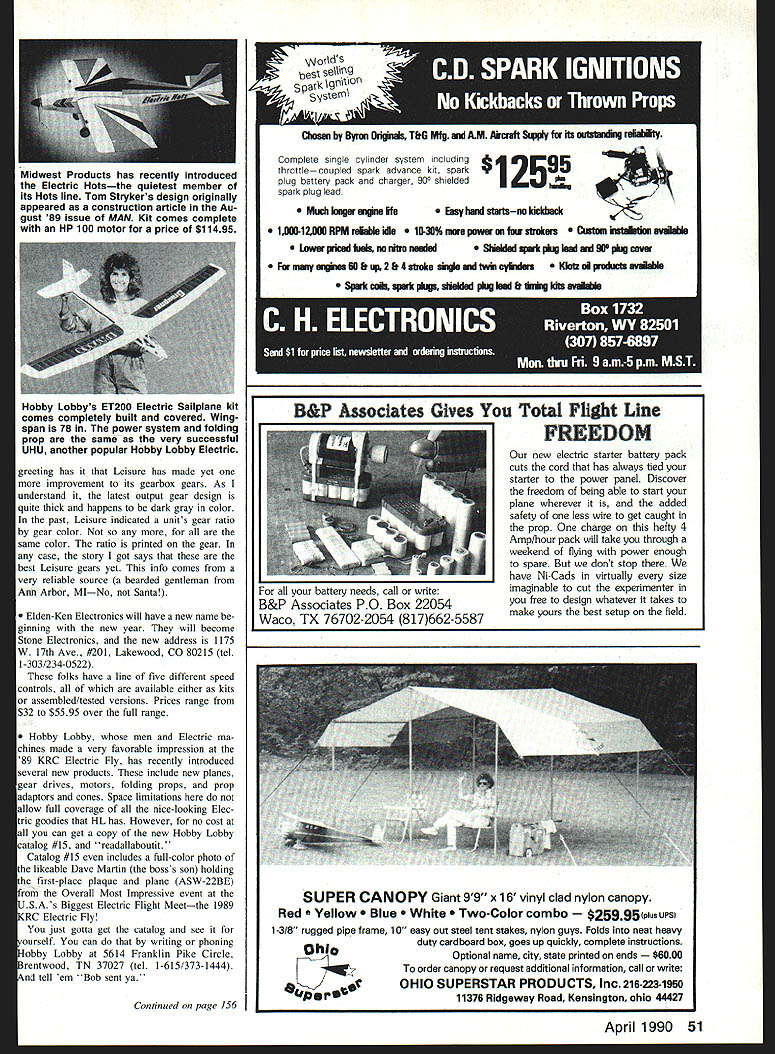
- Romey Bukolt of Concept Models is developing a Fleet kit for electric power. Concept Models has produced many wet-powered Fleets; a kit for a "40"-powered Fleet prototype is in the works. Contact:
Concept Models, 2906 Grandview Blvd., Madison, WI 53713
Astro Porterfield
- Astro is repackaging the popular Porterfield in a new box and including a gear-drive "25" motor with it. The Porterfield has been continuously produced since about 1978/79; packaging it with a motor follows the successful kit-with-motor marketing trend.
Errata & Corrections (January '90 MA)
- Skyvolt landing gear / reinforcement: In the Skyvolt article, a photo caption incorrectly mentioned "fiberglass matting." The text correctly stated "iron-on cloth reinforcement." The correct material used is iron-on cloth reinforcement, not fiberglass.
Additional notes on iron-on cloth reinforcement:
- I’ve used iron-on cloth reinforcement for over two years; it’s easy and effective for many applications (not ideal for contoured areas where fiberglass may be better).
- A recommended product is the Bondo cloth patch material (Stock #23002) used in the automotive trade; it costs about $1.20 for a 6-oz. tube and gives a fine finish when sanded.
- Usage: cut to size, place on the structure, cover with a paper towel, press with a hot iron on the cloth side for several seconds to activate the adhesive. After bonding, apply Bondo filler and sand to shape.
- KRC meet article corrections:
- Bill Winter’s Le Crate design was mistakenly referred to as the Heron. The correct identification is Le Crate.
- Participation number: The opening paragraph on page 87 gave participation as 10; the correct figure is 18 (larger than last year’s 13 despite the rain).
- A sentence in the article was misprinted. The intended meaning: "Twelve fliers out of 90 responding (to a survey) indicated that they fly only electric; this must have been heaven for them!" These are "loners" who otherwise have no local electric flying companions—precisely the people ECS aims to help.
KRC is considering field alternatives as meet growth and field size are closing in on each other.
Skyvolt — Questions & Answers
Several readers asked about the Skyvolt’s nature. Consider Skyvolt an in-between design:
- Aerodynamically, Skyvolt is more aerobatic than typical cabin trainers (Mirage, Aerotech, Ace Electric), which are not very aerobatic.
- It is not as "hot" or aggressive as an ElectroStreak with the same power system. The ElectroStreak generally flies significantly faster.
- Skyvolt’s size, airfoil, frontal area, landing gear, and weight make it aerobatically capable while being tamer and more rugged. Wings are rubberbanded on; it can take bumps and bangs better than many designs.
- Skyvolt accepts a very wide range of power systems — versatile and capable. It’s a good next step if you’re graduating from trainers. If you want high-performance aerobatics and already have advanced skills, the ElectroStreak may be preferred.
Note: The Gold Fire motor supplied with the ElectroStreak is one of the best economy "can" motors I've seen for fast-moving planes (not glider types).
Technical Column Notes — High-Rate / Frame-Rate
My technical columns draw readers interested in motor and prop performance, speed control behavior, charger performance, etc. I’ve received many responses with additional data and analysis.
Notably, Steve Hageman, Chief Engineer at Calex Mfg., Inc., sent extensive comment and analysis of computer-simulated speed control drive waveforms. He believes the optimum operating range for high-rate speed controls is about 2.5 to 5.0 kHz. I haven’t seen many other opinions on the best high-rate frequency yet; this is an area I hope to pursue further.
An Unusual Motor Development
A remarkable motor that operates on principles foreign to classic electromagnetic motors was described in the April 1989 issue of Electronics and Wireless World (page 356) by Stefan Marinov: "The Intriguing Ball‑Bearing Motor."
Description:
- The motor contains no magnets, no windings, no commutator, and no brushes.
- It consists of two ball-bearing assemblies spaced on a metal shaft. Low-voltage electric current (AC or DC) is applied to the outer races of the bearings.
- Operation appears to depend on heat. Each bearing ball contacts the inner and outer races at essentially two points. High current density at these contact points generates heat, causing a thermionic-emission–type effect and deformation of the balls at the hot points (the balls "get longer" between hot contact points).
- The heated, distorted contact areas create a tendency for the balls to roll away from the hot contacts; new contact points carry current, heat, distort, and roll in a continuous sequence, producing torque.
- The motor is slow and low torque. It is not self-starting but will continue to turn in the given direction if given a twist. Measurable rotation was reported at very small currents and low voltages.
Practical relevance to model electrics: none known at present — yet. It’s an intriguing concept and worth noting for future unconventional experiments.
Closing
Happy, quiet, springtime (heck — anytime!) electric landings, everyone!
Editor's Note
(From the RCM editor): A word of skepticism is offered regarding the ball-bearing motor article — consider the dates and sources. But if this or similar advanced technology becomes practical for modeling, you read it here first in Model Aviation.
When responding to advertisers, mention that you read about them in Model Aviation.
Transcribed from original scans by AI. Minor OCR errors may remain.

