
Radio Control: Electrics
Bob Kopski 25 West End Dr. Lansdale, PA 19446
This month's topics
- The Electric Connection Service
- A connector problem for the industry—and you, plus a patent
- Two electric meets
- The EAA
- Planes, motors, batteries, and props—some reminders
- Missing mail
- Some personal notes
The Electric Connection Service (ECS)
The Electric Connection Service is a big "half-success" so far. As you have seen in recent columns, an increasing number of readers have requested listings. It may become fully successful, but we won't know that for a while.
Being fully successful will mean that the majority of those seeking to connect actually do so. To date I've had only one bit of feedback concerning the inaugural ECS listing in the January 1990 column. Jim Jansen, 6525–43rd Ave., Kenosha, WI 53142, tells me he's heard from no one and wonders if he's possibly the only electric flier in Wisconsin. I don't believe that's the case—so let's connect with Jim, OK?
I'd very much like to hear from others who have been listed here as time goes along. The ECS is only useful if most of those seeking Electric connections find some. Please let me know.
This month's Electric fliers who want to connect
- Thomas Bassett, 259 Indian Rd., Wayne, NJ 07470 (tel. 1-201/839-5830). He has had some "wet" power experience but later found Electric. He can't find someone or a club with an Electric interest and wants to connect.
- Cal Drake, P.O. Box 1557, Morro Bay, CA 93442. Has other Electric modelers nearby but wants to expand the group.
- Art Garzon, 222 Circle Dr., Quarryville, PA 17566. One of the first three participants in the first KRC Electric Fly (1980). Art has moved and wants to establish new Electric connections. Tell Art Bob sent you.
- Walter Rady, P.O. Box 282, Newport, NH 03773. Very much likes electric sailplanes; finds thermaling a lot of fun.
- Jerry Smart, R.F.D. 3, Box 300, Warsaw, MO 65355. Lives in the boonies with lots of room to fly but no one to fly Electric with.
- David Walker, 1223 McNeilly Ave. #2, Pittsburgh, PA 15216 (tel. 1-412/563-6109). Recently flew Electra and is now hooked on Electrics; wants to share Electric elation.
- Bill White, 1312 SW 11th, Oklahoma City, OK 73108. Two others are flying Electric and want to find interested folks—sounds like a club in the making.
- Jim Wilson, 9442 N. 35th Pl., Phoenix, AZ 85028 (tel. 1-602/953-9180 [work]). Interested in smaller Electrics, OT Gas, and rubber replicas.
OK, everyone else: it's up to the modelers above who have done so much. Now it's your turn to act. Go get connected.
A connector problem — miswiring speed controls
Bob Boucher (pronounced boo-shay) of Astro Flight recently told me Astro and some other speed-control suppliers are having a real problem: modelers are miswiring speed controls and blowing the devices. Miswiring can very easily occur when unpolarized, "unisex" connectors are used.
In particular, the popular Sermos brand connectors are unpolarized — every connector fits every other connector. Since power wiring has two leads (positive and negative), it's possible to connect these connectors together backwards relative to the mating polarity. If a battery is mistakenly connected to the speed-control output, or the control is otherwise fed backwards, the device can be destroyed — often by instantly frying all the MOSFETs in the control. That can be expensive damage.
An increasing number of modelers, who may not realize how they damaged a control, return controls for warranty service. Suppliers are not obligated to honor warranty repairs in such cases, but often don't want to refuse and anger customers. I foresee suppliers being forced to limit warranty coverage or to charge a nominal fee when repairs are made to speed controls that have been misconnected.
I've done this myself with Sermos connectors and "smoked" a speed control. I paid for the repair and published a photo in the December 1989 Model Aviation showing how to stack Sermos connectors so you can't plug the wrong ones together. I encourage you to consider stacking connectors that way in your installations. Another approach is to use Sermos in different colors — they are available in many colors direct from Sermos.
Reflecting on field use (especially at the KRC Electric Fly with nearly 300 planes), Sermos is by far the most popular connector system. A single polarity-mating mistake with Sermos (or any connector that allows incorrect mating) can cause severe damage.
Suggestions:
- Industry should consider saying no to unjustified warranty work for miswired controls, or at least offer repairs at reduced price or on a case-by-case basis.
- Speed-control manufacturers and accessory suppliers should provide connectors or methods that prevent mating mistakes with their products.
By the way, in the same conversation Bob told me he invented speed controls for Electrics some time ago and holds the patent. Astro did a great deal for Electric in the early 1970s. Both Bob and Roland Boucher were with Astro then; Roland now heads Leisure Electronics. I suspect if it weren't for the Boucher brothers, Electric in America wouldn't be what it is today. Thanks, guys!
Upcoming electric meets
- Burlington County RC Club (NJ) — second annual Electric meet on July 14, 1990. A fun family event with goodies. Contact CD Bob Affleck, 123 Harrington Circle, Willingboro, NJ 08046.
- Tomcats' Electric RC Carnival — first annual, Saturday, June 16, 1990, in the San Jose, CA area. Contact Bob Ortman, 631 Sobrota Way, Campbell, CA 95008 (tel. 1-408/379-?) or CD Brian Nelson at 1-408/629-2827.
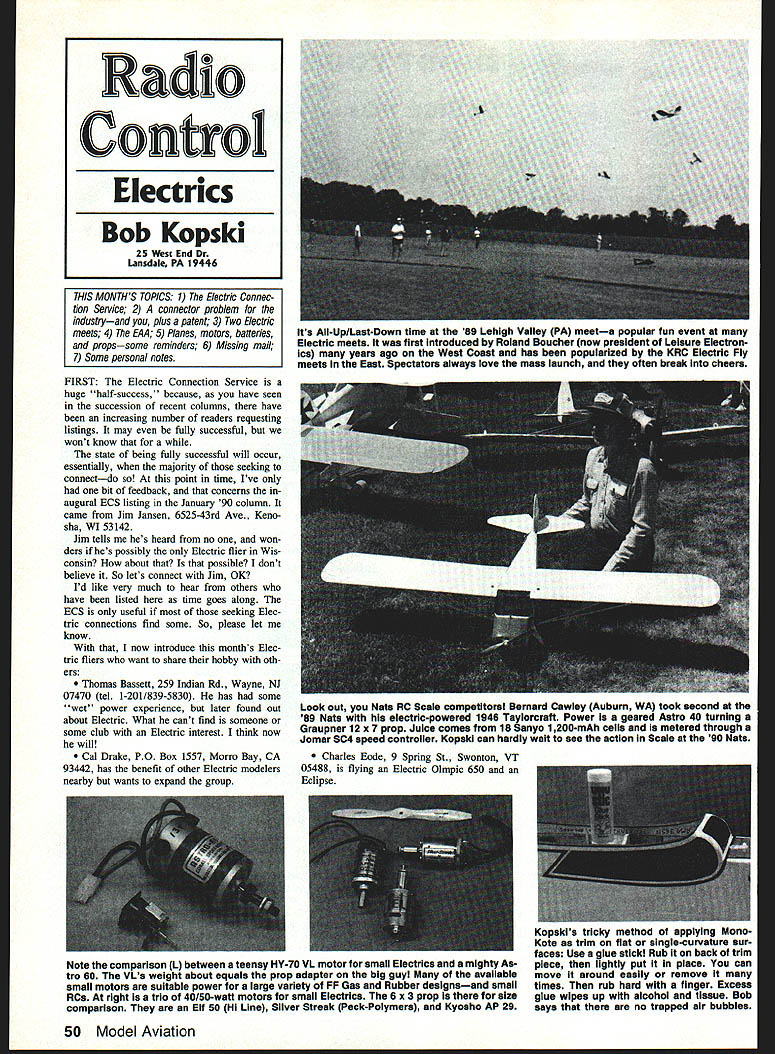
A reminder: last year Electric had a "first-ever" at the AMA Nats. Bernard Cawley of Auburn, WA took second in Sport Scale with an electric-powered 1946 Taylorcraft. Electric is an up-and-coming area of modeldom to watch — and to watch out for if you're a "wet" competitor!
The EAA (Electric Aeromodelling Association)
Do the letters EAA look familiar? There are two EAAs: the Experimental Aircraft Association (full-scale) and our AMA Special Interest Group, the Electric Aeromodelling Association. A SIG (Special Interest Group) promotes Electric flight through competition and by advancing the state of the art in motors and accessories. We invite you to contribute technical articles and discussions of new E-power techniques.
This information is from the EAA newsletter, The Silent Fly Sheet. The newsletter has become more regular recently, thanks to Acting Editor and EAA President Robert Stiff. Recent issues have included solid technical contributions (for example, from Keith Shawa).
You can join the EAA for $10 annually. Membership gets you the newsletter and helps support Electric by adding your voice to the SIG. A SIG should democratically represent its membership to the AMA and influence AMA Electric rules — something the EAA has done in the past.
Planes, motors, batteries, props — some reminders
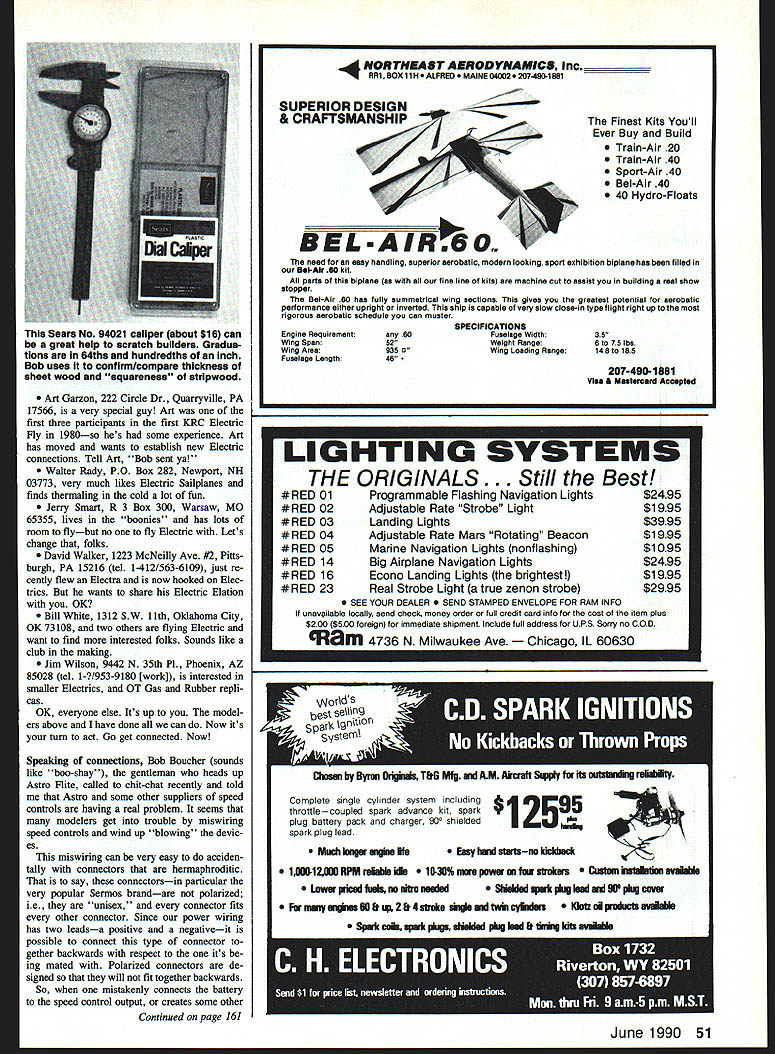
I corresponded with Don Snell of Hi Line Ltd. Hi Line manufactures a line of small motors for mini Electrics, including the Mini 16, the MIP 30, and the ELF 50 — roughly 6, 30, and 50 watts respectively. Other small power systems come from VL and Peck. There are many products on the market for small, light Electrics for both RC and free flight.
Don mentions that some folks experience disappointing performance with small systems. Often this comes down to not following basic guidelines. Here’s a mini-review for first-time and continuing success with E-power:
- Build light. Keep weight down but not at the expense of necessary strength. "Strength where needed, and light weight everywhere." Fractional ounces count, especially in models weighing only 6–16 oz total.
- Use good quality batteries and handle them properly. Small systems often use 100–500 mAh cells; using leftovers from other applications can lead to poor performance.
- Don't overprop. Bigger props don't always make things better.
In short: follow the instructions.
This is my year to get seriously into mini-Electrics. I have some of the products mentioned and a yearning to return to some childhood designs — Baby Phoenix, a W.A. Zeek, a PAA-Master, and more.
Missing mail
I've become aware that some incoming mail went astray around the winter holidays. These were reader letters to me (and to my daughters — see the January 1990 cover). If you wrote around that time and haven't received a reply, please write again. I apologize for the inconvenience.
Some personal notes
This time of year (end of February/beginning of March) marks anniversaries for me. Eighteen years ago I had my first successful electric flight — a shoulder-high, sorta radio-controlled circle immediately followed by power-on!
Seven years ago I agonized over whether to write an Electric series for Model Aviation. A handful of people encouraged me — my wife Wilma, friend Herb, Carl Wheeler, John Grigg, John Worth, and others. I was unsure and inexperienced, tempted to say no. Looking back, I'm very fortunate I said yes. I hope I made the right choice for you.
I receive hundreds of letters annually: friendly, thankful, questioning, informative, challenging, promoting this column, suggesting topics, from kids and seniors. Thank you all for being part of this Electric endeavor.
Please remember: I'm a modeler like you — human, sometimes mistaken, sometimes not to everyone's liking. You have my word I'll always do my best for Electric — whether you're a consumer, supplier, or casual observer. Comments and critique are welcome. I will attempt to answer all questions accompanied by an SASE. Please send to the author at the address above.
By the time you read this it should be springtime — happy Electric flying for everyone!
HAPPY!
Transcribed from original scans by AI. Minor OCR errors may remain.

